
Shadow Work Guides: Insights and Methods for Meaningful Inner Work
Guides → Shadow Work Guides
Shadow Work is the process of getting to know everything about yourself that’s currently outside your awareness. This intensive inner work can be a bit chaotic and disorienting at first, but it eases as you continue to integrate your “darker half.”
This category includes my best in-depth guides on Jungian psychology and general inner work.
In This Category
Shadow Work for Beginners
Shadow work is the process of getting to know the parts you left behind. Before shadow work, who you think you are—your ego or self-identity—is divorced from many aspects of your self. These disowned parts might include repressed emotions, fears, instincts, unrecognized desires, desirable and undesirable character traits, and much more.
When you engage in shadow work, it’s often because you sense that your self-perception is inauthentic. Or, you keep noticing yourself falling into the same old patterns. Regardless, the journey inward is calling, and it often begins with an exploration of your shadow.
If you’re new to shadow work, start here:
A Beginner’s Guide to Shadow Work: How to Integrate Your Dark Side
This comprehensive guide reveals how confronting and integrating the shadow dissolves projection and unlocks authenticity, including five practical methods for engaging the unconscious.
Jungian Psychology in a Nutshell
Psychiatrist Carl Jung is the modern father of shadow work. Jungian psychology, also known as analytical psychology, is the study of the psyche—the totality of the mind, soul, and unconscious processes that shape human behavior.
The process of inner work is just that: getting to know what we don’t know (our unconscious) and bringing it into harmony with our conscious awareness.
Jung provided a rich language and framework for understanding and exploring the psyche. These guides provide you with his essential insights.
The Individuation Process: A Beginner’s Guide to Jungian Psychology and the Path to Wholeness
If you want a solid summary of Jung’s framework, this guide is the place to start. Jung’s central concept—individuation—is the process of uniting conscious and unconscious aspects of the psyche. It explores the foundational concepts of Jungian psychology to help you understand how this inner transformation leads to authenticity and alignment with the Self.
What Is Depth Psychology? Jung’s Approach to the Unconscious
Another clear introduction to Jung’s analytical psychology, but in a more general sense. Explore how Jung’s framework of the ego, shadow, and collective unconscious integrates myth, dreams, and symbols to foster personal growth and individuation. This guide highlights 10 important concepts in analytical psychology.
The Psychology of Archetypes: Jung’s Map of the Mind
Archetypes are the universal psychological patterns that shape myths, stories, religions, and identity. These universal images are central to understanding Jungian psychology and one’s shadow. This guide explains how the psychology of archetypes reveals the forces of the collective unconscious, helping us understand the hidden motivations behind our thoughts, feelings, and behaviors.
Anima and Animus: Jung’s Path to Inner Union and Wholeness
In Jung’s lexicon, the anima and animus are inner archetypes—the feminine soul within a man and the masculine spirit within a woman. Following shadow work, the next stage of Jung’s individuation process is the integration of one’s anima or animus. But they also play an important role in shadow work. This guide illustrates how these powerful psychic forces shape attraction, creativity, communication, and inner balance—and why integrating them deepens emotional and spiritual maturity.
Jung and Alchemy: A Comprehensive Guide to the Alchemical Magnum Opus
Especially in Jung’s later work, he drew many parallels between ancient alchemy and his analytical approach to the psyche. To him, alchemy was a powerful metaphor for psychological transformation and individuation. This guide decodes the alchemical process—the Magnum Opus or Great Work—as an inner journey toward wholeness. Regardless of whether you use Jungian methodology in your shadow work, this guide provides practical insights into the process of inner work.
How to Do Inner Work
Inner Work is a broadly used term, nearly synonymous with shadow work. Regardless of what you call it, the process is the same: a portion of your conscious attention, which is mostly focused externally on the outside world (relationship, work, family, etc.), is redirected inward.
The subjective realm of thoughts, feelings, impulses, instincts, and imagination is examined to help you better understand yourself. These guides provide methods and frameworks for navigating the deep waters of the unconscious.
How to Do Inner Work: 10 Proven Methods That Go Deep
Inner work bridges the conscious and the unconscious mind. Rooted in Jungian depth psychology and Eastern philosophy, this guide outlines practical steps for shadow integration and emotional healing that lead toward individuation. Methods like self-analysis, spontaneous journaling, and active imagination are featured.
Active Imagination: A Practical Guide to Working with Archetypes
One of the most practical methods of doing inner work is the creative technique pioneered by Jung, called active imagination. It’s a powerful way to bridge our waking consciousness and the hidden psyche. There are many modern forms of active imagination, including Internal Family Systems, Voice Dialogue, and Psychosynthesis. This practice guide explores all of them and provides step-by-step instructions to get started.
How to Release Repressed Emotions for Deep Healing
One of the most pressing challenges of shadow work is that deeply repressed emotions are difficult to access. They were pushed out of consciousness for a reason. Many of these repressed emotions relate to childhood trauma. We can’t get to know our shadow without bringing this psychic content to consciousness. To do so, we must unlock the stored and stagnant energy in the body. This guide highlights proven methods for doing so, including Trauma Release Exercises, EMDR, and psychedelic therapy.
Emotional Awareness: How to Transform Feelings Into Conscious Energy
Greater emotional awareness is necessary for inner work. Without it, unconscious material remains out of view, and shadow work stalls. This guide helps you learn to recognize, feel, and transmute negative emotions using somatic awareness and conscious presence. It’s an excellent companion guide to the one above on repressed emotions.
How to Center Yourself: 12 Powerful Methods to Reduce Stress and Increase Focus
The main reason we tend to resist shadow work in general is that we’re often “out of the Center.” The Center is a Taoist and Chan Buddhist principle that describes an innate quality of consciousness used to stabilize the mind and attention. This guide explores various interpretations of the Center, as well as practical methods you can use right away. Building awareness of the Center or actively approaching it is essential for effective shadow work.
Self‑Deception: How the Mind Tricks Itself
Self-deception is the rule, not the exception. It’s also the reason why shadow work often stalls. So what is the nature of self-deception? Why do we deceive ourselves? How do we do it? And how can we overcome it? This guide examines the psychological mechanisms of self‑deception that keep us blind to our own motives and fears. It shows how honest self‑observation uncovers hidden patterns and restores authenticity.
Mapping Your Psyche with Archetypes
Archetypes are universal patterns within our collective psyche, which Jung called the collective unconscious. These primordial images influence virtually all human behavior.
A vital aspect of shadow work involves getting to know the various archetypes operating within our psyche—usually without our conscious awareness.
While Jung called them archetypes, modern systems like Internal Family Systems (IFS) refer to them as parts. Neo-Jungian systems call them subpersonalities. But the names we use aren’t what’s important. Instead, to navigate our psyche, we need to understand that our ego-mind is a multiplicity—a collection of subpersonalities—not a singularity.
Once we realize this critical insight, navigating our internal terrain takes on a new depth. These guides shed light on how specific archetypal forces shape the mind’s operating system, both when it’s functioning smoothly and when it malfunctions.
The Ultimate List of Archetypes (350+ Examples)
If you’re new to archetypes, you can explore this master list of archetypal expressions drawn from mythology, literature, and psychology. It’s an easy guide to scan quickly.
King Warrior Magician Lover: Four Foundational Masculine Archetypes
Neo-Jungian Robert Moore and mythologist Douglas Gillette provide a potent and practical model of the psyche in their classic King Warrior Magician Lover. Anyone doing shadow work will greatly benefit from this model, as it highlights the spectrum of shadow archetypes and their influence on our behavior. This guide provides a detailed summary of their findings.
Feminine Archetypes: The Complete Guide to the Female Psyche
This guide explores the feminine psyche using various frameworks, including classic Jungian figures and Jean Shinoda Bolen’s seven female archetypes modeled after the Greek goddesses.
Classic Jungian Archetypes: A Guide to Jung’s Timeless Psychic Patterns
Jung featured a select number of archetypal patterns in his work. This guide reviews 15 central archetypes he covered most often. This guide helps dispel the common misunderstanding that arises when people ask, “What’s my archetype?” Or, “What are Jung’s 12 archetypes?”
Joseph Campbell’s Monomyth: The Hero’s Journey Stages
Joseph Campbell’s classic Hero’s Journey framework is actually a well-designed map of inner transformation. Anyone involved in shadow work will appreciate Campbell’s monomyth structure and will see their own inner journey within it. This guide clearly maps the Hero’s Journey to psychological development.
Archetypal Deep Dives for Inner Work
Archetypes, parts, or subpersonalities play an important role in shadow work by helping us bring unconscious patterns into conscious awareness.
The guides above provide a complete framework for understanding these energetic forces and how they together create a full picture of the psyche.
The guides below provide a deep dive into a select few universal archetypes that influence human behavior.
Jung often referenced the Eternal Child in his work. It’s an exceptionally pervasive archetypal pattern in modern society, sometimes referred to as the Peter Pan Syndrome. This guide provides a deep dive into this archetype, including its causes, its pervasiveness today, and how to transcend it.
While the Hero is probably the most well-known archetypal pattern, it’s also the most misunderstood. This guide examines the hero archetype as a means of understanding the psychology of courage.
The Magician archetype represents our cognition. While this powerful image helps us create and transform the world, its shadow is a master manipulator and Trickster. Understanding how the magician can influence use, both constructively and with its shadow, is beneficial for inner work.
Jung often referred to the Sage archetype as the Wise Old Man/Woman in the psyche who provides vital insights and inner truths. However, this powerful archetype also carries a shadow with many expressions. This guide explores the Sage (the Shaman and the Guru), as well as four common shadow archetypes that can influence us.
Once energy vampirism is framed via archetypal psychology, you’ll never perceive it the same again. This guide explores the nature of energy vampires and emotional vampires who express themselves through us. Shadow work asks us to bring this unconscious power exchange into consciousness and reclaim our psychic sovereignty.
This guide provides a psychologically nuanced approach that reframes laziness as an archetypal energy to be integrated rather than fought. It illustrates how to transmute inertia into creative flow by working with archetypal forces instead of resisting them.
Navigating Toward Wholeness
While the unconscious terrain can be perceived as dark and murky, it’s also filled with illuminating insights, strengths, and gifts.
The goal of shadow work is not to wallow in darkness and self-pity, but to bring the disowned parts back into the fold, moving us toward wholeness.
Wholeness or completeness is the ultimate goal of inner work, in which we’re no longer at odds with ourselves because internal psychic tensions are resolved. Now, we can be “okay” with ourselves.
These guides provide further insights that support this movement toward wholeness.
How to Access the Higher Self: An Integrated Approach
Stabilizing one’s consciousness in the Higher Self, or Self, represents the goal of inner work. In Jung’s individuation process, the Self is the third and final archetype of development. It represents the organizing principle within the psyche. This guide provides a comprehensive look at the Self through the lens of depth psychology and Eastern philosophy. It illustrates what blocks it, how to recognize its presence, and how to access it within your daily life.
Jungian Synchronicity: Decoding the Psychology of Meaningful Coincidences
As you progress in getting to know your shadow, bringing unconscious material to consciousness, you start to experience frequent, meaningful coincidences. Jung termed these events “synchronicity.” This guide explores the metaphysical and quantum explanations for synchronicities. It shows how recognizing meaningful coincidences fosters a sense of purpose and reveals the hidden order that links our psyches to the cosmos.
Masculine and Feminine Energy Explained: Healing and Integrating the Opposites
The psyche is built on opposing forces. That’s why it’s challenging to integrate and bring into harmony. Before starting shadow work, we tend to be “one-sided”—we favor one polarity while denying the opposing force within us. This denial is what builds the shadow. This guide provides a deep dive into the differences between masculine and feminine energy, as well as how to bring them into balance. It’s a complementary treatise to the Jungian guide on the anima and animus.
Restlessness and the Search for Stillness
Why do we sometimes experience restlessness? Why, as a people, are we addicted to mental overstimulation? This guide provides a deep psychological explanation of restlessness and offers energetic, emotional, and behavioral strategies for transmuting it.
Essential Jungian Reading List
If you’re a big reader and want to explore Jungian psychology more deeply, go here:
Essential Jungian Psychology Reading Guide
Regardless of where you are in your inner work, Jung and the Jungians provide a range of insights for exploring the psyche. In this guide, I provide a curated list of the most influential Jungian psychology books, based on my experience.
Explore Other Domains
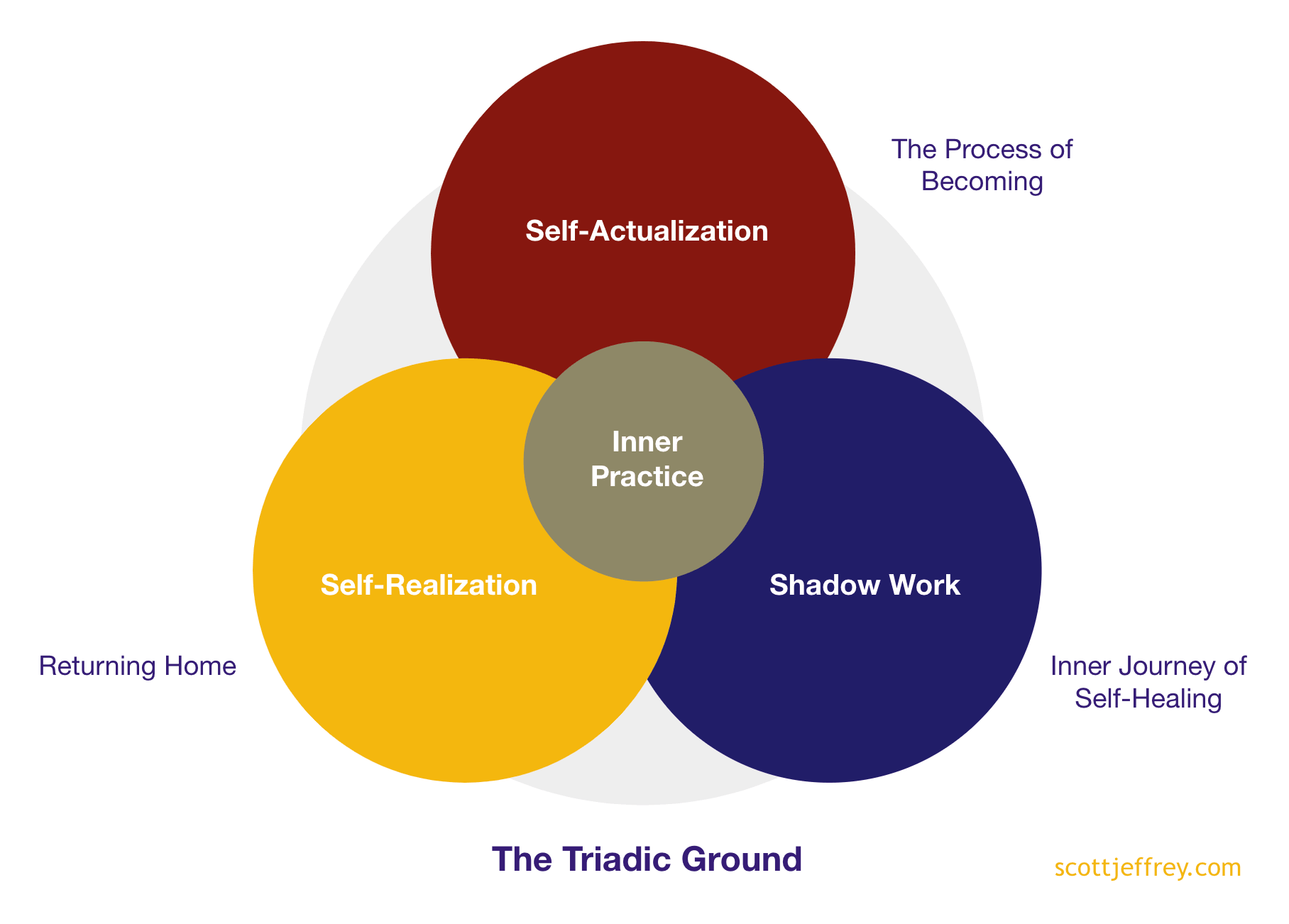
The Triadic Ground covers self-actualization, shadow work, spiritual awakening, and inner practice.
Discover other guides and methods along your path:
Self-Actualization Guides: Realizing Your Innate Potential
Inner Practice Guides: Establishing a Strong Foundation for Inner Growth