
In every field, from design to neuroscience, true creativity emerges through order—not chaos. Yet most people mistake inspiration for an accident of genius.
In reality, research by Graham Wallas and modern psychologists such as Mihaly Csikszentmihalyi shows that creativity follows a reproducible rhythm tied to both conscious focus and unconscious integration.
This guide explores the creative process through four archetypal phases—the Student, Wanderer, Light, and Scientist—each mirroring how ideas evolve from disciplined study to transcendent insight to tested reality.
You’ll learn how to engage these archetypes, remove resistance, and bring forth original, usable work.
Let’s dive in …
What is Creativity?
Creativity is deliberate transformation—an interaction between inner uniqueness and outer circumstance that produces something both original and useful.
Psychologist and creativity researcher Mihaly Csikszentmihalyi notes that the term “creativity” originally meant:1Mihaly Csikszentmihalyi, Creativity: The Psychology of Discovery and Invention, 25.
To bring into existence something genuinely new that is valued enough to be added to the culture.
Creativity isn’t merely self‑expression—it’s the act of bringing into existence something genuinely new and culturally valuable.
psychologist Carl Rogers adds another layer:2Carl Rogers, On Becoming a Person, 350.
The emergence in action of a novel relational product, growing out of the uniqueness of the individual on the one hand, and the materials, events, people, or circumstances of his life on the other.
Decades of research by Abraham Maslow and Howard Gardner affirm that creative development parallels self‑actualization and requires curiosity, openness, and persistence.
In cognitive psychology, creativity is increasingly recognized as a learnable system of mental stages rather than a rare gift.
The Four Stages of the Creative Process
Creativity unfolds in sequence. Each stage calls upon a different form of cognition and self‑relation, from disciplined learning to effortless surrender.
In his 1926 classic, The Art of Thought, English political scientist and psychologist Graham Wallas summarized the creative process in four stages:
Stage 1: Preparation
The mind prepares for the creative solution, which requires study and thinking intently on the subject—whether it be a musical composition, a new invention, a mathematical formula, or a business dilemma.
Stage 2: Incubation
A germination period follows. The person steps away from the problem and engages in an activity such as daydreaming, walking, reflecting, or meditating.
Stage 3: Illumination
Often, as a flash, a brilliant idea shoots through the mind, frequently during a mundane task or while one is engaged in something else.
Stage 4: Verification
The idea is tested to determine its validity. The composition is scored; the mathematical formula is proven.
Variations to these Stages
Although variations of this creative process were developed over the last century, Wallas’ four-stage framework remains.
Sometimes, you’ll see “5 stages of the creative process.”
Generally, this just means one of two things: They either added a fifth stage, usually called “Elaboration.” Or, they add an “Evaluation stage” as Stage 4 and bump Verification to Stage 5.
But ultimately, everyone is referring to the same basic model.

The Four Archetypes Behind Each Stage
While this four-stage model of the creative process is straightforward, it doesn’t clearly explain how we can apply it to our lives.
How can we use this framework to create our best work?
In 2001, I began an intensive 5-year research project to better understand the creative impulse. I closely examined dozens of what the world calls “creative geniuses.” This study led me to depth psychology and the examination of consciousness itself.
I found that these geniuses aligned with specific archetypes that mirror the stages of the creative process.
The Archetypes of Creativity
Psychiatrist Carl Jung observed that the psyche consists mainly of symbols and images.
Many of these images are collective in nature. That is, they are found all over the earth in our myths, dreams, fairy tales, and legends.
Jung called these universal images archetypes. Archetypes are set patterns of behavior for our interaction with the world.
Each stage of the creative process follows a set pattern of behavior. Each stage evokes specific types of images and emotions.
Here are the four archetypes of the creative process:
- The Student (Preparation): gathering knowledge, researching, and sharpening skills.
- The Wanderer (Incubation): releasing control, allowing unconscious synthesis.
- The Light (Illumination): experiencing the sudden revelation or insight.
- The Scientist (Verification): testing, refining, and manifesting the idea.
These stages interface with what neuroscientists term default‑mode and executive‑control networks, alternating between structure and spontaneity.3Beaty, R. E., Benedek, M., Kaufman, S. B., & Silvia, P. J. (2015). Default and executive network coupling supports creative idea production. Scientific Reports, 5, Article 10964. https://doi.org/10.1038/srep10964
In essence, the rhythm between focus and letting go is what gives rise to innovation.
| Stage | Archetype | Function |
|---|---|---|
| Preparation | The Student | Study, discipline, and curiosity |
| Incubation | The Wanderer | Surrender and unconscious integration |
| Illumination | The Light | Sudden insight and inspiration |
| Verification | The Scientist | Testing, refinement, and communication |
You’ll see these same patterns echoed in mythic narratives and in modern performance‑psychology research on flow states and self‑leadership.
Creativity is NOT About Personality
These four archetypes do not represent “people” or “personalities,” but rather the styles, qualities, or characteristics of people who produce creative work.
Jung highlighted in Modern Man in Search of the Soul the impersonal nature of creativity:
The secret of artistic creation and of the effectiveness of art is to be found in a return to the state of participation mystique—to that level of experience at which it is man who lives, and not the individual, and at which the weal or woe of the single human being does not count, by only human existence. This is why every great work of art is objective and impersonal, but nonetheless profoundly moves us each and all. And this is also why the personal life of the poet cannot be held essential to his art—but at most a help or a hindrance to his creative task.
This impersonal nature of creativity will become self-evident as we proceed below.
This distinction is important because many people falsely believe that only some people can be creative—that there are “creative types” and the rest of us. Extensive creativity research debunks this notion.
The Student Archetype: Stage 1 (Preparation)
Every creative journey begins with an apprenticeship. The Student archetype represents curiosity, humility, and focused dedication—the disciplined accumulation of knowledge before inspiration strikes.
The qualities of the Student include open-mindedness, child-like wonder, curiosity, dedication, drive, a capacity for intense focus, and a genuine love for learning.
The Student is a Beginner
The Student perceives the world at large from what Zen Buddhists call the Beginner’s Mind.
In The Dancing Wu Li Masters, author Gary Zukav explains that this is a characteristic of a master in any field:
“Whatever he does, he does with the enthusiasm of doing it for the first time. This is the source of his unlimited energy. Every lesson that he teaches (or learns) is a first lesson. Every dance that he dances, he dances for the first time. It is always new, personal, and alive.”
That is, the Student is open and ready to learn without preconceived notions and beliefs about what he is studying.
As physicist David Bohm observes in On Creativity:
“One prerequisite for originality is clearly that a person shall not be inclined to impose his preconceptions on the fact as he sees them. Rather, he must be able to learn something new, even if this means that the ideas and notions that are comfortable or dear to him may be overturned.”
The Student seeks wisdom and counsel from various sources of knowledge. He loves knowledge for knowledge’s sake. The Student makes new connections, perceives new patterns, and sees old things in fresh ways.
Because of his openness and humility, he avoids what psychologists call “functional fixedness”—looking at a problem from a familiar viewpoint.
The Student is Curious and Loves Learning
A trademark quality of the Student is curiosity.
Just like the tiger curiously sniffs, prods, and licks a newly-discovered object, the Student explores his subject of interest using all available intellectual, intuitive, feeling, and sensing faculties.
The Student dedicates himself to learning and improving his craft. This uncommon level of dedication and enthusiasm is also a hallmark quality of those we label as “genius.”
The true Student can be an expert in his field or a master at his craft; however, he still possesses the willingness to grow, a gratitude for his gifts, and a profound sense of humility about his ignorance.
From this position, the Student continues to learn, evolve, and discover new creative insights.
The Student Lives in Wonder
Albert Einstein noted the enchantment experienced by the Student:4Stephen Mitchell (Ed.), The Enlightened Mind, 1993.
“The most beautiful and profound emotion we can experience is the sensation of the mystical. It is the source of all true science. He to whom this emotion is a stranger, who can no longer wonder and stand rapt in awe, is as good as dead.”
Wonder at reality drives the Student onward. In Letters to a Young Poet, Rainer Maria Rilke instructs on how to remain a Student:
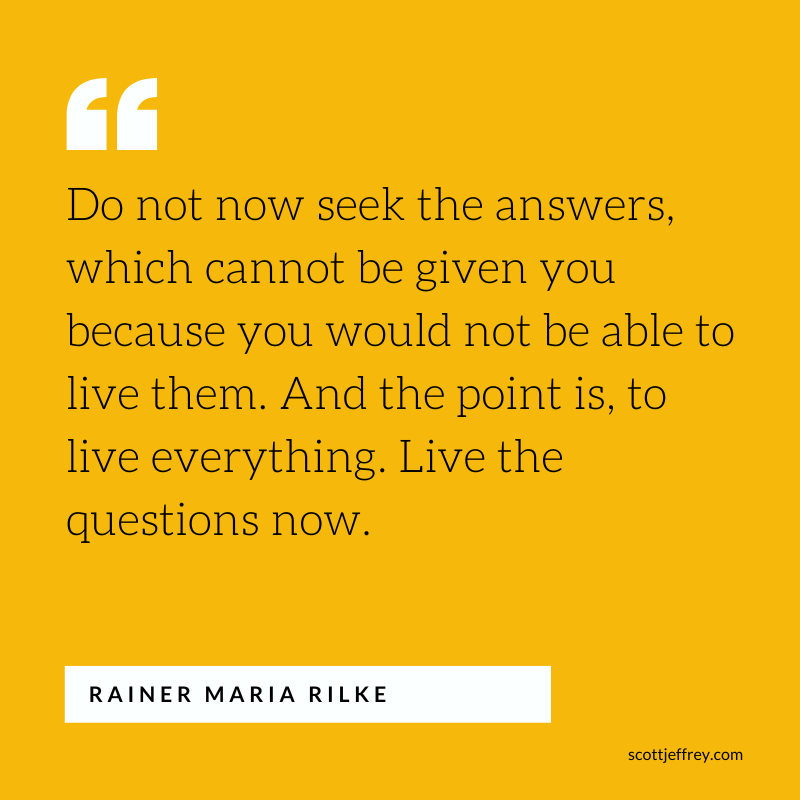
“Do not now seek the answers, which cannot be given you because you would not be able to live them. And the point is, to live everything. Live the questions now. Perhaps you will then gradually, without noticing it, live along some distant day into the answer.”
Rilke’s quote captures the essence of stage 1 of the creative process.
The Student Works Tirelessly
The capacity for intense focus is another attribute of the Student. The Student works tirelessly on a problem or to acquire a new skill.
The Student is tenacious in his pursuit of “living the questions.” Those who have prepared their minds are in a position to discover breakthrough ideas.
In Harvard psychologist Howard Gardner’s research (2011) on creative geniuses, he found that at least ten years of steady work at a discipline or craft were required for mastery.
Psychologist and creativity researcher Howard Gruber’s research (2005) concurs:5Howard E. Gruber (Ed), Creativity, Psychology and the History of Science (Boston Studies in the Philosophy and History of Science, 245), 2005.
“Perhaps the single most reliable finding in our studies is that creative work takes a long time. With all due apologies to thunderbolts, creative work is not a matter of milliseconds, minutes, or even hours—but of months, years, and decades.”
This single insight can transform your understanding of the creative process. It explains why most people think creativity is restricted to a select few.
The Student Prepares the Way
Preparation often includes an experience of utter frustration. The Student pushes their mind and abilities to the limit, exhausting every conceivable avenue of discovery.
When the mind reaches an impasse, the next stage of the creative process awaits…

The Wanderer Archetype: Stage 2 (Incubation)
After the Student prepares through hard work and dedication, knowledge must take root.
The sought-after, illuminated idea or connection must germinate. This germination occurs by way of the Wanderer archetype.
In neuroscience, this corresponds to activation of the default‑mode network, which integrates disparate memories and insights while the analytical mind rests.
Wanderer is open, patient, allowing, noncontrolling, flexible, appreciative, and unattached to beliefs, rules, or conventions.
The process of incubation cannot be forced. It occurs naturally, and it takes time for higher consciousness to resolve the problem.
The Wanderer archetype evokes images of the lone, aimless traveler, carefree and relaxed in the moment. The Wanderer moves with the wind, remaining unattached to ideologies, concepts, rigid theories, and dogma.
As the proverb instructs, “Bend like the willow; don’t break like the oak.”
The Wanderer Surrenders to the Moment
While the Student is direct in acquiring knowledge and skills, the Wanderer allows and surrenders to the moment.
Although the Wanderer may appear detached from life or responsibility, he has an innate appreciation and love for the beauty around him and for life itself.
Poet Rudyard Kipling understood the need to lay the conscious mind aside and embrace the Wanderer:6Rudyard Kipling, “Working Tools,” in The Creative Process: Reflections on the Invention in the Arts and Sciences, ed. Brewster Ghiselin (University of California Press, 1985), 162.
“When your Daemon is in charge, do not try to think consciously. Drift, wait, and obey.”
The Wanderer Lives Simply and Waits Patiently
A person aligned with the field of discovery tends to live simply, given that his basic needs have already been met. As such, he is carefree and present.
Wolfgang Amadeus Mozart reflects on his creative process:7Vernon, P. E. (Ed.). (1970). Creativity: Selected readings. Penguin Books.
“When I am, as it were, completely myself, entirely alone, and of good cheer—say, traveling in a carriage, or walking after a good meal, or during the night when I cannot sleep; it is on such occasions that my ideas flow best and most abundantly. Whence and how they come, I know not; nor can I force them.”
The Wanderer Yields
Acceptance of the creative process is paramount, as novelist Henry Miller notes:8Henry Miller, “Reflections on Writing,” in The Creative Process: Reflections on the Invention in the Arts and Sciences, ed. Brewster Ghiselin (University of California Press, 1985), 178.
“Every man has his own destiny: the only imperative is to follow it, to accept it, no matter where it leads him.”
The ego, however, often gets in the way. Our culture constantly challenges us to always do something—to continuously take action.
In our “doer” culture, we are not comfortable with the notion of allowing an idea to germinate. (In Taoism, this is called Wu Wei—the principle of nonaction, nondoing, or nongoverning.)
In fact, modern society doesn’t welcome the Wanderer. Especially in the business world, the primary values are on deadlines, speed, and constant activity.
Somehow, individuals are expected to generate awe-inspiring ideas and creative results while sitting at their desks or in back-to-back meetings all day.
Perhaps the only place where we still welcome the Wanderer is in the arts, where a poet or painter is allowed to wait for his muse while roaming the woods or sitting in cafés, staring into nothingness.
If the Student doesn’t surrender to the Wanderer, however, creative insight is unable to manifest. The creative process stops.
The Wanderer Triggers Flow States
Requiring a profound level of letting go, the creative act is preceded by an effortless state, void of any resistance.
Psychologist Mihaly Csikszentmihalyi termed this state “flow”. Maslow called it a peak experience.
Fully absorbed in what we’re doing, we achieve a Zen-like one-pointedness of mind. The mind becomes silent, or at least it recedes into the backdrop of conscious awareness.
In this state of flow, events unfold effortlessly, whether one is writing a poem, washing dishes, peeling a potato, or pruning the garden.
The “actor” behind actions and the “thinker” behind the thoughts dissolve. In these moments, we glimpse what the sages teach: everything is happening on its own.
The Wanderer Enters a Trance
The “eureka moment” of the creative process often occurs after a period of reverie or trance.
Walking peacefully after a meal, driving aimlessly on a country road, or taking a shower, we allow the creative impulse to shine upon the mind.
In his later years, psychiatrist Carl Jung would sit by the lake at his private Bollingen stone castle for weeks at a time, playing in the water, sand, and rocks until he felt inspired to write.
The composer Johannes Brahms describes the Wanderer’s Way:9Abell, A. M. (1994). Talks with great composers. Philosophical Library.
“I have to be in a semi-trance condition to get such results—a condition when the conscious mind is in temporary abeyance, and the subconscious is in control.”
Brahms’ observation is common to many musical composers.
The Wanderer Accesses Altered States of Consciousness
Creativity researcher John Curtis Gowan (1975) notes three ubiquitous phases of incubation:
Phase 1: The prelude ritual;
Phase 2: The altered state of consciousness or creative spell, during which the creative idea is born, starting with vibrations, then mental images, then the flow of ideas which are finally clothed in form; and
Phase 3: The postlude in which positive emotions about the experience suffuse the participant.
Playwright Neil Simon acknowledged this altered state of consciousness by saying:10Andreasen, N. (2005). The Creating Brain: The Neuroscience of Genius. Dana Press.
“I slip into a state that is apart from reality. My mind wanders—even when I talk.”
Neuroscience demonstrates the importance of downtime and doing nothing in the creative process.11Smith, K. (2012). Neuroscience: Idle minds. Nature, 489(7416), 356–358. https://doi.org/10.1038/489356a
When you wander, the brain isn’t idle. Instead, it’s completing the unconscious tasks of processing and integrating conscious experience.
This happens naturally when you sleep … and when you wander.
The Wanderer Remains Open, Empty, and Ready
We identify the questions in the preparation phase of the creative process. In the incubation phase, the mind remains open to receive the answers.
Pablo Picasso divulges the secret to his art:12Picasso, P. (1985). Conversation with Picasso (C. Zervos, Interviewer; B. Ghiselin, Trans.). In B. Ghiselin (Ed.), The creative process: Reflections on the invention in the arts and sciences (pp. 48–53). University of California Press.
“The painter passes through states of fullness and of emptying. That is the whole secret of art. I take a walk in the forest of Fontainebleau. There I get an indigestion of greenness. I must empty this sensation into a picture. Green dominates in it. The painter paints as if in urgent need to discharge himself of his sensations and his visions.”
“Emptiness” personifies the archetype of the creative process’s second stage.
In pushing the mind to its limits, the Student’s mind becomes full. Now, the Wanderer must let go of everything he thinks he knows and come to a state of emptiness.
Neuroscientist Nancy Andreasen (2005) explains that the brain “disorganizes,” which removes fragmentation momentarily to allow the creative impulse to arise.
If the mind does not eventually surrender the question, the “space” is not available for the answer to present itself.
![Peter Ilyich Tchaikovsky quote on creative process: "Generally speaking, the germ of a future composition comes suddenly and unexpectedly ... It takes root with extraordinary force and rapidity, shoots up through the earth, puts forth branches and leaves, and finally blossoms. I cannot define the creative process in any way but [by] this simile."](https://scottjeffrey.com/wp-content/uploads/2009/05/Tchaikovsky-creativity.png)
The Light Archetype: Stage 3 (Illumination)
The Light is the archetype of illumination. The experience of the Light is often likened to mystical experiences.
In The Varieties of Religious Experience, psychologist William James had this to say about mystical experiences:
“Although so similar to states of feeling, mystical states seem to those who experience them to be also states of knowledge. They are states of insight into depths of truth unplumbed by the discursive intellect. They are illuminations, revelations, full of significance and importance, all inarticulate though they remain; and as a rule they carry with them a curious sense of authority for aftertime.”
The Light has many names from many traditions: God, Divinity, Inner Teacher, Brahman, the Higher Self, the Kingdom Within, Intuition, Daemon, Inner Self, Inspiration, Revelation, Creation, Spiritual Vision, Universal Consciousness, and the Muse. The list goes on.
The Light is Our True Nature
The etymology of intuition is “knowing from within.” The root of inspire means “inner breath.”
What is this inner knower—this breath from within?
Sages, relying not on external observation but on an inner, subjective realization, tell us that consciousness itself is the inner knower and the light within.
Nondual sage Nisargadatta Maharaj explains in I Am That:
“Realize that your true nature is that of pure light only, and both the perceived and the perceiver come and go together.”
Carl Jung called the Light the “primordial vision” and saw it as an impersonal quality, separate from the personality of the artist:13Jung, C. G. (1933). Modern man in search of a soul (W. S. Dell & C. F. Baynes, Trans.). Kegan Paul, Trench, Trubner and Co.
“The poet’s work is an interpretation and illumination of the contents of consciousness … The primordial experience is the source of his creativeness; it cannot be fathomed, and therefore requires mythological imagery to give it form.”
The Light is a Higher Source
Throughout time, creative geniuses have intuited the impersonal nature of inspiration.
Meaning, they respond to their genius or creative work with humility, knowing they cannot take credit for what unfolds during the illumination phase of the creative process.
William Blake called God the “Poetic Genius.”14Blake, W. (1982). The complete poetry and prose of William Blake. Anchor Books. Giacomo Puccini said his greatest opera, Madame Butterfly, was “dictated to me by God.”15Abell, 1994.
Both Brahms and Beethoven appealed directly to the “Creator Himself.” Like Aristotle before him, Rudyard Kipling looked to his “Personal Daemon” for inspiration.
And, in recounting his experience with the creative process, Mozart said,16Vernon, 1971.
“What has been thus produced I do not easily forget, and this is perhaps the best gift I have my Divine Maker to thank for.”
The Light is Infinite Energy
Composer Richard Strauss had this to say about the source of his inspiration:17Abell, 1994.
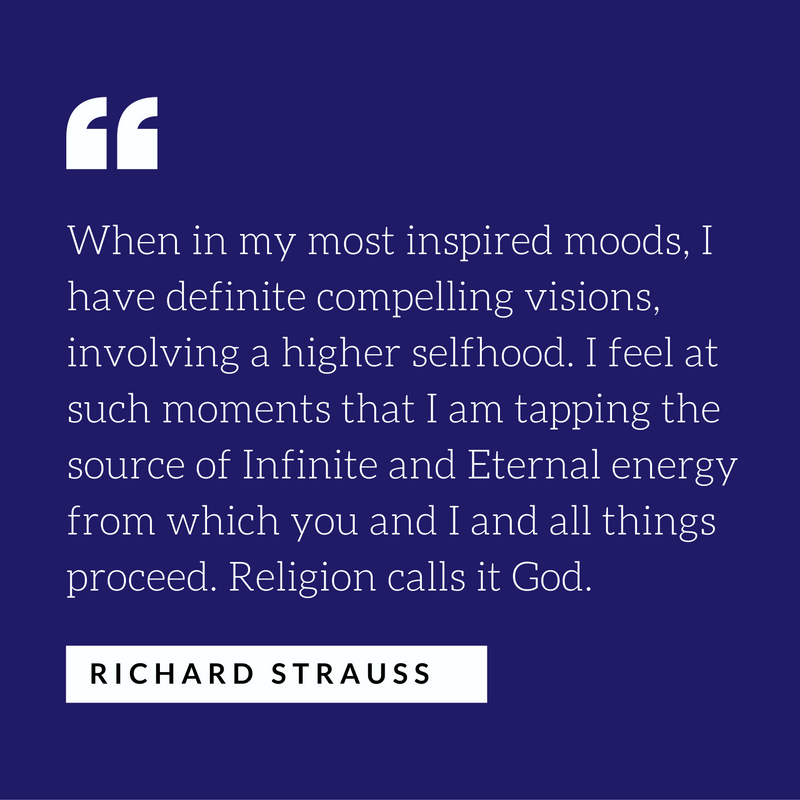
“Composing is a procedure that is not so readily explained. When the inspiration comes, it is something of so subtle, tenuous, will-o-the-wisp-like nature that it almost defies definition. When in my most inspired moods, I have definite compelling visions, involving a higher selfhood. I feel at such moments that I am tapping the source of Infinite and Eternal energy from which you and I and all things proceed. Religion calls it God.”
The words these creatives use to describe the Light vary greatly. However, they all point to a power beyond their egos—a subjective experience of a Higher Source—for their creative inspiration.
The source of this life is not personal or dualistic; instead, it’s impersonal and nondualistic.
The Light is Ineffable
The Light cannot be accurately described with words. The source of creative inspiration is not found in a concept, formula, theory, or process.
It is said to be ineffable, only realizable through an inner subjective realization—the realization of the nature of a higher source within us.
The Light Comes in a Flash
When unimpeded, inspiration can come to a person very suddenly. The genius often envisions the entire answer in a flash.
Mozart, for example, would experience an entire piece of music in his head, all at one time, not through a linear progression:18Ghiselin (Ed.), 1985.
“All this fires my soul, and provided I am not disturbed, my subject enlarges itself, becomes methodized and defined, and the whole, though it be long, stands almost complete and finished in my mind, so that I can survey it, like a fine picture or a beautiful statue, at a glance. Nor do I hear in my imagination the parts successively, but I hear them, as it were, all at once. What a delight this is I cannot tell!”
French poet and novelist Jean Cocteau describes a similar experience of illumination that occurred for the creation of The Knights of the Round Table:19Ibid.
“I was sick and tired of writing when one morning, after having slept poorly, I woke with a start and witnessed, as from a seat in a theatre, three acts which brought to life an epoch and characters about which I had no documentary information and which I regarded moreover as forbidding. Long afterward, I succeeded in writing the play and I divined the circumstances that must have served to incite me.”
The Light is a Revelation
Philosopher Friedrich Nietzsche explains illumination:20Ibid.
“The notion of revelation describes the condition quite simply; by which I mean that something profoundly convulsive and disturbing suddenly becomes visible and audible with indescribable definiteness and exactness. One hears—one does not seek; one takes—one does not ask who gives: a thought flashes out like lightning, inevitably without hesitation—I have never had any choice about it … Everything occurs quite without volition, as if in an eruption of freedom, independence, power, and divinity.”
For the Light to unfold, the individual surrenders to it—in stage 2 of the creative process.
The individual, at least momentarily, transcends the ego. This creates a sense of detachment from everything “out there.” Then, the “creative genius” simply becomes the channel for the Light.
Playwright Neil Simon accentuates the humility of the genius:21Andreasen, 2005.
“I don’t write consciously—it is as if the muse sits on my shoulder.”
The Scientist Archetype: Stage 4 (Verification)
Following the unfolding of illumination of the creative process, the Scientist takes over.
The role of the Scientist is to verify the discovery and to translate the revelation into something comprehensible to others.
The Scientist possesses what creativity researcher Edward de Bono (1999) calls “value sensitivity.” That is, he can see the value in the new creation. And he possesses the knowledge and experience to validate it (at least, initially).
In the verification stage, the mathematical formula is proven. The composition is performed. The image first presented to the mind is drawn onto the canvas. And the prose of a literary masterpiece is captured on paper.
The Scientist Refines the Work
The term “scientist ” is used rather loosely in the act of translating the intangible to the physical domain.
The moment of “creation” unfolds through illumination, preceded by preparation and incubation.
Now, the Scientist must confirm and communicate the revelation to complete the creative process.
In the verification phase, the illumined ideas become crystallized.
The Scientist is Challenged to Translate the Light
Translating the revelation into a cohesive, comprehensible form can be painstaking.
Many notable creatives, such as Friedrich Nietzsche, Jackson Pollock, and Vincent van Gogh, went mad while trying to verify their inner inspirations.
Van Gogh attempted to describe the process of translating the intangible into the tangible 22: Ghiselin (Ed.), 1985.
“How it happens that I can express something of that kind? Because the thing has already taken form in my mind before I start on it. The first attempts are absolutely unbearable. I say this because I want you to know that if you see something worthwhile in what I am doing, it is not by accident but because of real intention and purpose.”
Van Gogh found the verification stage of the creative process “absolutely unbearable,” as many other creative geniuses can attest.
The Scientist Verifies the Creative Illumination
Other times, the Scientist’s verification is effortless.
After working several hours every evening for 15 days on an equation, mathematician Henri Poincaré did something different. He drank coffee and couldn’t sleep:23Ibid.
“Ideas rose in crowds; I felt them collide until pairs interlocked, so to speak, making stable combinations. By the next morning I had established the existence of a class of Fuchsian functions, those which come from the hypergeometric series; I had only to write out the results, which took but a few hours.”
Chemist Dmitri Mendeleev, the creator of the Periodic Table of Elements, reported falling asleep while he struggled through exhaustion to categorize the elements by atomic weight:24Ibid.
“I saw in a dream a table where all the elements fell into place as required. Awakening, I immediately wrote it down on a piece of paper. Only in one place did a correction later seem necessary.”
Whether through ease or great effort, the Scientist must complete the creative process where the final work is produced.
Harnessing the Cycle
Every creator contains these four archetypes simultaneously. The art lies in knowing which one to invite, and when.
- Call forth the Student to learn.
- Allow the Wanderer to rest and integrate.
- Welcome the Light to reveal.
- Engage the Scientist to refine and deliver.
By honoring this sequence, you align with what depth psychology and cognitive science now agree upon: creative success emerges from balancing discipline and surrender.
For practical methods to trigger these transcendent states, explore this guide to peak experiences.
Applying the Creative Process in Daily Life
Creativity flourishes through rhythm, not randomness. Repetition, not revelation.
Now, let’s run through methods and practices that can help us align with archetypes of the creative process.
Preparation: How to Embrace the Student
The purpose of the Student—stage 1 of the creative process—is to learn, discover, and explore.
- Start with a beginner’s mind. Let go of everything you think you know and look at the world with the eyes of a curious child.
- Adopt a growth mindset where you fundamentally believe you can learn anything.
- Explore topics that truly interest you. Our brains learn approximately ten times faster when we’re interested in a topic.
- Develop habits that support continuous learning, such as reading 20 pages a day and taking notes on what you learn.
- Commit to reading more books. Although blogs and articles have their place, books promote deeper learning.
- Ask more questions. Brainstorm ten questions about your topic of interest, and then go explore to discover the answers.
The Student helps you learn technical abilities, skills, or knowledge.
Incubation: How to Align with the Wanderer
The purpose of the Wanderer—stage 2 of the creative process—is to remove all barriers and resistance. Here, we need to momentarily empty the mind so the Light can shine through.
- Learn to meditate to quiet your mind. Research shows meditation supports creativity.25Haase, J., Hanel, P. H. P., & Gronau, N. (2025). Creativity enhancement methods for adults: A meta-analysis. Psychology of Aesthetics, Creativity, and the Arts, 19(4), 708–736. https://doi.org/10.1037/aca0000557
- Gaze out at a landscape or stare up at the clouds.
- Tune your breath to your natural state.
- Go for a walk in nature. Listen to the rain.
- Tap a nap.
- Ground yourself to the Earth.
- Dance, play, laugh—do anything that puts you in a more carefree mood.
- Let go of wanting to know the answer.
- Stop striving. Stop trying. Enter the state of Wu Wei. Just be.
The Wanderer helps you get out of your way.
Illumination: How to Access the Light
The purpose of the Light—stage 3 of the creative process—is to allow the inspiration to shine into your conscious mind.
- Pray to a higher source within yourself—connect with your Higher Self.
- Call forth your inner guide.
- Enter an altered state of consciousness (however you can).
- Trust. Have faith. Stay open.
The Light connects you to the fundamental source of creativity: consciousness itself.
Verification: How to Evoke the Scientist
The purpose of the Scientist—stage 4 of the creative process—is to verify the truth behind your creative inspiration.
- Stay committed and devoted to your areas of interest.
- Know there is always more to learn and discover.
- Manage your internal energy so you have the stamina to improve your work.
- Ask questions like, “What’s great about this idea? How can I use this? How can I build on this?” to cultivate value sensitivity.
The Scientist helps you confirm and refine the creative work that came through you.
Honoring Our Innate Creativeness
I hope you found this tour of the creative process enlightening and instructive.
My studies into creativity and creative genius highlight that this process is truly available to all of us.
We unconsciously block the creative process when we fail to align with the appropriate creative archetypes at the right times.
For example, many of us struggle for various reasons to align with the Student. Distracted and full of self-doubt, we fail to launch ourselves into a discovery process of constant learning.
To remedy this, find something you’re interested in and dive in. Find ways of installing good habits that promote learning.
But many of us are already constant learners. (Anyone willing to wade through this massive guide qualifies.) For this group, the misstep often comes in identifying exclusively with the Student archetype.
When doing so, we may forget to let go, to drift, to wander. We don’t create a space for incubation. And so illumination never comes.
The remedy for this is simple: Allow yourself to just be. Be lazy for a little while. Gaze at the sky. Smile gently at yourself. Lighten up.
Trust in the creative process. It has worked for many who have come before us. It works for us, too.
Recommended Reading
Letters to a Young Poet by Rainer Maria Rilke
If You Want to Write by Brenda Ueland
The Creating Brain: The Neuroscience of Genius by Nancy Andreasen
On Creativity by David Bohm
Creating Minds by Howard Gardner
The Creative Process by Brewster Ghiselin
This guide is based on insights from my book, Creativity Revealed: Discovering the Source of Inspiration.
Read Next
How to Use Your Imagination for Creativity, Flow, and Insight
Restlessness and the Unconscious: Finding Stillness in a Distracted World
14 Powerful Self-Discovery Activities for Your Personal Journey
Leadership Symbols: How Great Leaders Use Powerful Imagery to Influence Others
References
- Abell, A. M. (1994). Talks with great composers. Philosophical Library.
- Andreasen, N. (2005). The Creating Brain: The Neuroscience of Genius. Dana Press.
- Blake, W. (1982). The complete poetry and prose of William Blake (D. V. Erdman, Ed.; Rev. ed.). Anchor Books. (Original work published 1965).
- Beaty, R. E., Benedek, M., Kaufman, S. B., & Silvia, P. J. (2015). Default and executive network coupling supports creative idea production. Scientific Reports, 5, Article 10964. https://doi.org/10.1038/srep10964
- Csikszentmihalyi, M. (1990). Flow: The Psychology of Optimal Experience. Harper Perennial.
- de Bono, E. (1999). Six thinking hats (Rev. and updated ed.). Little, Brown and Company.
- Dietrich, A. (2004). The cognitive neuroscience of creativity. Psychonomic Bulletin & Review, 11(6), 1011–1026. https://doi.org/10.3758/bf03196731
- Gardner, H. (2011). Creating minds: An anatomy of creativity seen through the lives of Freud, Einstein, Picasso, Stravinsky, Eliot, Graham, and Gandhi. Basic Books. (Original work published 1993).
- Ghiselin, B. (Ed.). (1985). The creative process: Reflections on the invention in the arts and sciences. University of California Press.
- Gowan, J. C. (1975). Trance, art, and creativity. Creative Education Foundation
- Gruber, H. E., & Bödeker, K. (Eds.). (2005). Creativity, psychology, and the history of science. Springer. https://doi.org/10.1007/1-4020-3509-8
- Haase, J., Hanel, P. H. P., & Gronau, N. (2025). Creativity enhancement methods for adults: A meta-analysis. Psychology of Aesthetics, Creativity, and the Arts, 19(4), 708–736. https://doi.org/10.1037/aca0000557
- James, W. (1985). The varieties of religious experience. Harvard University Press. (Original work published 1902).
- Jung, C. G. (1959). The Archetypes and the Collective Unconscious. Princeton University Press.
- Jung, C. G. (1933). Modern man in search of a soul (W. S. Dell & C. F. Baynes, Trans.). Kegan Paul, Trench, Trubner and Co.
- Kounios, J., & Beeman, M. (2014). The cognitive neuroscience of insight. Annual Review of Psychology, 65, 71–93. https://doi.org/10.1146/annurev-psych-010213-115154
- Maslow, A. (1968). Toward a Psychology of Being. Van Nostrand.
- Nisargadatta Maharaj. (1999). I am that: Talks with Sri Nisargadatta Maharaj (M. Frydman, Trans.; S. S. Dikshit, Ed.). Chetana Publications. (Original work published 1973).
- Rogers, C. (1961). On Becoming a Person. Houghton Mifflin.
- Smith, K. (2012). Neuroscience: Idle minds. Nature, 489(7416), 356–358. https://doi.org/10.1038/489356a
- Vernon, P. E. (Ed.). (1970). Creativity: Selected readings. Penguin Books.
- Wallas, G. (1926). The Art of Thought. UK: Harcourt Brace.