
We spend decades mastering the outer world—career, money, image—yet few of us study the inner world shaping every decision.
Around midlife (sometimes much sooner), a quiet question rises: Who am I beneath all this?
You might not even be aware you’re asking yourself this question at first. It’s like an inner itch that slowly intensifies.
When I started doing inner work in my mid-30s, I had already clocked well over a decade in “personal development.” I thought I had “figured things out.”
Then, like coming out of a spell, I realized I was climbing a ladder that was taking me away from myself.
From that point on, life took on a completely different tone and direction.
The call to inner work marks the beginning of genuine psychological and spiritual maturity.
Rather than surface “self‑help,” inner work dives into Jungian depth—mapping dreams, symbols, and unconscious energies to reclaim the Self.
This guide distills ten proven methods—spanning Western analysis and Eastern contemplative science—into a practical roadmap you can verify through experience.
Let’s dive in …
What is Inner Work?
Derived from Jungian psychology, inner work means consciously engaging with the psyche—bringing unconscious material into awareness to restore balance between the ego and the Self.
It refers to practices for getting to know oneself, that is, one’s psyche. The psyche represents the totality of one’s being, including the body and the mind.
In the context of psychiatrist Carl Jung’s theories and practices, inner work entails bringing all of an individual’s psychic material (unconscious) into consciousness.
Unconscious material (unconscious mind) can include thoughts, feelings, attitudes, impulses, images, and behavioral patterns.
Ultimately, inner work harmonizes this unconscious material with one’s conscious mind. The goal of inner work is to bring the individual to wholeness.
Inner work is often confused with shadow work, but they’re not the same thing. Shadow work is the entry point—confronting the parts of yourself you’ve disowned or repressed.
Inner work is the larger terrain that includes shadow work plus everything that follows: integrating what you’ve uncovered, dialoguing with inner figures, and translating insight into lasting change. Shadow work opens the door; inner work is the entire house.
Is it Worth Doing Inner Work?
Inner work doesn’t come easily for many of us, and it can be a messy process.
Is it really worth turning inward to examine yourself?
At one level, this is a humorous question. It’s like asking:
“Is it worth getting to know myself or should I just remain mostly unconscious and allow my prior subconscious programming and conditioning to rule my life?”
The truth is, as silly as this may sound, there are parts of us that would answer,
“No, it’s not worth it! Don’t do it! Stay unconscious.“
The ego likes to keep its current self-identity intact. It tends to avoid change or growth.
As such, we often encounter significant resistance to getting to know ourselves and exploring our inner world.
Why Inner Work Matters
As you resolve these internal battles—harmonizing the opposites—you start to level out, and a sense of inner calm and okayness prevails.
You experience less anxiety and fewer emotional triggers. In fact, you become less emotional in general as you’re less reactive to situations in the outer world.
Knowing yourself brings a kind of inner stability that’s often referred to as “self-confidence.”
As you become more intimate with your inner workings, you’ll find that you’re less judgmental of other people. Through depth work, we learn that most of our judgments represent disowned parts of ourselves.
So, to summarize, the benefits of inner work include:
- Less emotional reactivity
- More balance and “okayness” (stability)
- Less internal conflict and tension
- Less judgmentalism
- More inner calm and stability
- Less anxiety and insecurity
There are many additional benefits that you will discover in this process as well. For example, many of your unsupportive behaviors, including addictions and impulse control issues, lessen once you address the unconscious triggers related to them.
Resolving Internal Tensions
A significant benefit of inner work is that it resolves many existing internal tensions, including conflicts, desires, and unruly negative emotions that continually plague us.
Some of these tensions you’re probably aware of, but many of them are currently outside your awareness.
That’s why this work can be messy. It can be challenging to bring unconscious tensions from past trauma to consciousness.
The ego represses many early childhood experiences and related feelings. However, when one engages in inner work, these experiences begin bubbling to the surface.
At times, you might feel unsure of how to deal with these experiences, especially the stored negative emotions that accompany them.
But as you endure these “trials and tribulations,” you eventually become more “balanced” within yourself.
In the absence of this inner balance, people tend to burn out quickly.
The Process of Self-Healing
Ultimately, inner work is the process of self-healing, restoring emotional and energetic balance.
As Jungian Robert A. Johnson explains in Inner Work (1986):
The purpose of learning to work with the unconscious is not just to resolve our conflicts or deal with our neuroses. We find there is a deep source of renewal, growth, strength, and wisdom. We connect with the source of our evolving character; we cooperate with the process whereby we bring the total self together; we learn to tap that rich lode of energy and intelligence that waits within.
Perhaps most importantly, after sufficient inner work, you build greater consciousness, and an internal “awakening” unfolds.
As Jung wrote: “But your visions will become clear only when you can look into your own heart. Who looks outside, dreams; who looks inside, awakes.”1C.G. Jung Letters, Vol. 1: 1906-1950..
Is Inner Work Right for You? A Self-Assessment
The unconscious doesn’t send you a calendar invite. It communicates through symptoms—patterns you can’t break, reactions you can’t explain, a quiet sense that something’s off even when everything looks fine on paper.
Check each statement that rings true. Be honest. No one’s grading this but you.
In the past year, I have:
- Reacted to a situation with an intensity that surprised me—and I still don’t fully understand why
- Watched myself repeat a relationship pattern I swore I’d never fall into again
- Felt a wave of emotion (rage, grief, shame) that seemed disproportionate to what triggered it
- Judged someone harshly, then caught a flicker of recognition that what I disliked in them exists in me too
- Sabotaged something good—a relationship, an opportunity, a stretch of progress—without a clear reason
- Felt empty or numb despite hitting goals that were supposed to make me happy
- Noticed my inner critic is louder and crueler than anything I’d ever say to another person
- Avoided being alone with my own thoughts by reaching for my phone, a drink, or anything to fill the silence
- Said “I’m fine” when I wasn’t, because explaining what’s actually going on felt impossible
- Suspected that the version of me other people see isn’t the whole picture—and I’m not sure what the whole picture even is
- Experienced chronic anxiety, tension, or restlessness that doesn’t trace back to any specific event
- Felt a quiet pull toward something deeper—a sense that there’s more to me than the role I play in daily life
What your score means
0-3: You’re in relatively calm waters. Inner work is still worth exploring as a preventative practice—the same way you don’t wait for a heart attack to start exercising—but there’s no fire to put out right now.
4-7: Your unconscious is knocking. You’re functional on the outside but accumulating tension underneath. Patterns are repeating. The cost of ignoring this isn’t catastrophic today, but it compounds. A consistent journaling practice and some basic meditation would go a long way.
8-12: Inner work isn’t a luxury at this point—it’s overdue. Unconscious material is actively shaping your decisions, relationships, and emotional life. You’re spending significant energy managing symptoms whose roots you haven’t yet touched. Start with the foundational practices on this page, and consider whether professional support would help you navigate what surfaces.
No score gives you a pass on being human. The question isn’t whether unconscious material is running the show. You do, we all do. Instead, it’s how much of your life you’re willing to let it steer without your input.

The Two Classic Jungian Methods
To Jung, around middle age, an individual was supposed to shift from focusing on the external world (career, family, etc.) to the inner dimensions of one’s being. He notes in The Development of Personality:2C.G. Jung. The Development of Personality, C.W. Vol 17, 1954.
There is no birth of consciousness without pain. The ways that lead to conscious realization are many, but they follow definite laws. In general, the change begins with the onset of the second half of life. The middle period of life is a time of enormous psychological importance.”
Jung provided two primary methods for examining one’s psyche:
We’ll explore both of these methods below.
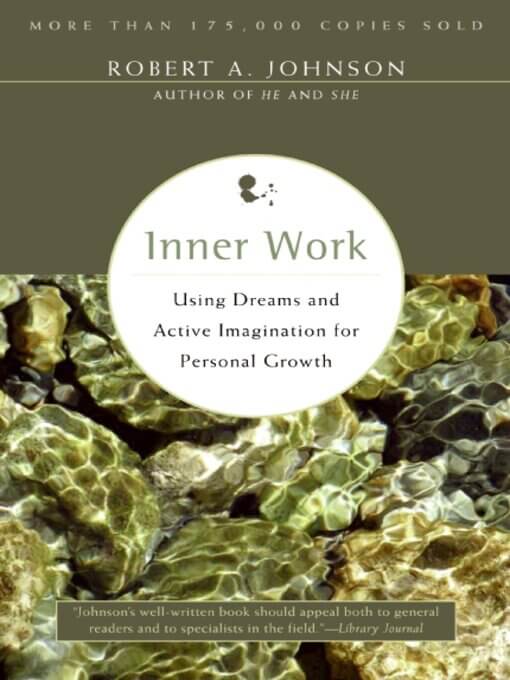
Read on Amazon →
(affiliate link)
In my opinion, Robert A. Johnson’s Inner Work: Using Dreams & Active Imagination for Personal Growth is the most accessible book on inner work.
Johnson is highly skilled at translating Jungian ideas and making them more accessible. Six of his books made my list of the best Jungian books.
1 – Dream Analysis: Decoding the Language of the Unconscious
Dream analysis (or “dream work”) was the central method of Jung’s analytic approach for revealing the psyche.
For Jung, dreams provided a way for us to bridge the gap between our conscious mind and our unconscious. He perceived dreams as a kind of love letter from the unconscious.
In Private Myths, analyst Anthony Stevens explains the function of dreaming from a Jungian perspective: 3Anthony Stevens, Private Myths, 1995.
Dreaming is a means by which the life of the individual is grafted on to the life of the species. It’s purpose is to promote adaption, growth, and consciousness.
In analysis, the patient (analysand) would recall a specific dream or series of dreams, and the analyst would then ask probing questions to delve deeper into the dream’s meaning.
As Johnson explains in Inner Work:
Every symbol in your dream has a special, individual connotation that belongs to you alone, just as the dream is ultimately yours alone.
Dreams, then, are a means of getting to know a deeper part of yourself.
How to Get Started With Dream Analysis
Johnson highlights four steps (similar to Jung and von Franz) for engaging in dream work:4Robert Johnson, Inner Work, 1986, 51.
- Making associations (with dream characters and symbols within the dream)
- Connecting dream images to inner dynamics (specific to the individual)
- Interpreting (the meaning of the dream)
- Doing rituals to make the dream concrete
The reason physical rituals are suggested is to help bring the ephemeral dream more into one’s physical reality. Jungians believe this helps bridge the gap between the unconscious and the conscious.
Dream analysis can be a demanding process. While some intuitive individuals may be able to do it independently, many likely do not (which is why analysts still exist).
Even if you aren’t going to engage in dream analysis as part of your inner work, simply learning to recall and write down your dreams (when they feel relevant) can be highly therapeutic.
Recording your dreams can pay dividends later in your inner work.

2 – Active Imagination: Dialoguing with the Hidden Self
Active imagination is the process of actively engaging with internal “characters” and figures from within one’s unconscious.
Jung used active imagination to augment his dream analysis.
For example, in the course of analyzing a dream, sometimes you hit a dead end, and neither the analyst nor the analysand knows where to go next.
This is when active imagination was often used.
Perhaps there was a shadowy figure in the dream. Jung might have the analysand call forth the figure and try to communicate with it.
Dreams occur to the dream ego, but there’s no conscious operator. In contrast, with active imagination, the ego becomes the conscious operator that interacts with the unconscious psychic content.
Active imagination, however, is different from passive fantasy or daydreaming, where the conscious ego tends to be “checked out.”
As the term implies, this process is active; the ego is actively engaged in the interaction.
How to Use Active Imagination
Johnson highlights four steps for active imagination based on Jung and von Franz:5Robert Johnson, Inner Work, 1986, 160.
- Invite the unconscious
- Dialogue and experience
- Add the ethical element of values
- Make it concrete with a physical ritual
While active imagination was an auxiliary process in early Jungian psychology, it’s arguably more common today than dream work.
In fact, a wide range of newer therapies have sprouted—all variations of Jung’s active imagination process. I highlight many of them in my two-part guide on the psychology of archetypes.
Additional Paths of Inner Work
While dream analysis and active imagination were the foundational methods in Jung’s work, they are not the only approaches for getting to know oneself.
Here are four other common approaches that can be used in conjunction with the above:
Let’s have a closer look …

3 – Reflective Journaling: Translating Insight into Language
Journaling can be a powerful process, especially at the early stages of one’s spiritual journey.
When I first began my inward turn, I journaled daily for years. I carried a pocket Moleskine journal with me virtually everywhere I went.
The basic process of recording your thoughts, feelings, and dreams helps cultivate greater self-reflection.6Blake T. K. (2005). Journaling; an active learning technique. International journal of nursing education scholarship, 2. https://doi.org/10.2202/1548-923x.1116
You don’t need any structure; just start journaling. While there are plenty of “journaling workbooks” on the market now, I don’t particularly like this approach. Workbook journals direct your mind in specific ways using prompts.
While staring at a blank page can be foreboding at times, use that blankness as a cue to access your unconscious.
That is, be patient and lean into the discomfort. This approach is more natural than using a prescribed journaling workbook. (Remember, the unconscious can be chaotic; embrace it.)
The active imagination technique discussed above works well with journaling. You essentially engage with characters in your unconscious and record the dialogue as it unfolds. I found there was far less resistance to active imagination when I used a journal in this manner.
4 – Somatic Reflection: Reading the Body’s Symbolic Messages
While some people prefer to use a journal, others may resist doing so. That’s okay. A journal isn’t essential.
What’s important is that you’re engaged in self-reflection. For example:
- Why did I just say that?
- Something feels off right now. What’s going on?
- I’m feeling overly anxious. Why?
- Do I really want this, or do I just think I do?
- I’m seeing a pattern here. Let’s take a closer look …
You can capture your thoughts in a journal or simply allow your mind to reflect.
Often, it’s helpful to walk or move your body to initiate self-reflection. As you tune in within, you’ll discover a range of psychosomatic cues. The body is constantly trying to speak to us.
As you build somatic awareness and a stronger mind-body connection, the process of inner work becomes more fluid.
Some people establish a ritual, like lighting a specific candle and sitting in a particular room to reflect.
Just find whatever works best for you.
Looking for a place to start? Somatic breathing helps enhance your awareness and quiet your mind.

5 – Creative Expression: Making the Unconscious Visible
Art and self-expression are powerful ways of conversing with one’s unconscious.
The unconscious is more closely associated with the right brain, as it communicates through images and symbols rather than words, logic, or reason (left brain). That’s why bringing the unconscious to consciousness can be so challenging.
Spontaneous self-expression circumvents left-brain logic, allowing a more direct connection with one’s unconscious.
Forms of self-expression may include drawing, painting, dancing, pottery, and writing short stories.
Jung found that virtually all of his patients began using various forms of self-expression at some point along their individuation process.
In fact, Jung was a skilled painter. He always had his active canvas in his office, visible only to him and his patients. Each canvas represented an aspect of his psyche at that time. Jung’s artwork and journal entries were published only recently in The Red Book (2009).
However, remember that you don’t need to be a “skilled artist” to use creative self-expression. (The skill part comes with practice.)
6 – Contemplative Prayer: Listening to the Inner Voice of the Divine
I noticed that some people consider prayer a form of self-reflection. This can be a dicey topic, but it’s worth addressing here.
First, most forms of prayer are not, in my opinion, related to inner work as you are conversing with an “other” outside of oneself. That is, most people pray to an external God rather than dialoguing with God within themselves.
To use prayer for inner discovery, bring whatever you consider God within yourself and ask it for spiritual guidance.
- What am I not seeing right now?
- What behaviors are still unconscious?
- How am I engaging in self-deception?
- What’s beneath my “positive intention” here?
- Where am I being dishonest with myself?
As the passage below from Jung will reveal, Eastern systems tend to equate the Self with God. If you’re going to dialogue with God, bring it to the Self.
Then, your “prayers” are related to personal discovery that supports one’s inward turn.

Eastern Methods for Inner Work
The Eastern traditions offer a myriad of techniques that are centuries old (many of which are thousands of years old).
The main difference between Eastern and Western methods lies in their emphasis.
Western techniques emphasize the ego and the personality.
In Western psychology, “getting to know yourself” means getting to know the totality of one’s personality—the person who is uniquely one.
Eastern philosophy, in contrast, emphasizes that the ego construct we call “personality” is ultimately an illusion.
Eastern approaches focus on getting to know one’s true Self, which transcends the personal ego, the body, the mind, and all of their dualities.
These approaches include:
These four methods build on each other: each one prepares you for the next, culminating in self-analysis—the art of bringing conscious awareness to your inner world as an ongoing, lived practice rather than a scheduled exercise.
Jung and Eastern Approaches to the Self
What’s interesting about Jungian depth psychology is that it, too, is ultimately trying to arrive at the Self.
Jung called it individuation, in which you first get to know your shadow, then your anima/animus, and finally arrive back home at the Self.
However, as Jung admitted in his foreword to The Spiritual Teachings of Ramana Maharshi, Eastern philosophy goes far beyond Western psychology.
Jung writes:7The Spiritual Teachings of Ramana Maharshi, 1972, ix.
The identification of the Self with God will strike the European as shocking. It is a specifically Oriental realization, as expressed in Sri Ramana’s utterance. Psychology cannot contribute anything further to it, except the remark that it lies far beyond its scope to propose such a thing … The Goal of Eastern practices is the same as Western mysticism: the focus is shifted from the “I” to the Self, from man to God.
Jung believed Westerners needed a different approach from Easterners, so he didn’t engage in their practices. However, since the 1980s, research in transpersonal psychology has highlighted the tremendous benefits of these so-called Eastern practices for everyone.
While the scope of Eastern methods goes beyond Western psychology, they can certainly assist us in getting to know ourselves through inner work.
For more on this topic, see Jung and Alchemy: The 4 Stages of the Magnum Opus.
7 – Meditative Presence: Training the Inner Observer
It can be argued that meditation is an essential prerequisite for inner work, at least for most individuals.
Why? Inner work requires us to examine unconscious aspects we generally don’t see.
Unconscious and subconscious material is often hidden and elusive, beyond or below our conscious awareness.
Meditation, at its core, is about stabilizing the mind. Greater stabilization makes the mind more still, enabling the Observer (also called the observing mind or Inner Observer) to take over.
From this neutral witness, it becomes infinitely easier to examine oneself. Self-reflection becomes a natural and often spontaneous process.
Formal meditation generally begins with a basic sitting practice, but eventually, you can cultivate the Inner Observer while walking, standing, or lying down.
If you’re new to meditation or want tips to improve your practice, see this meditation training guide.
8 – Breath Awareness: Regulating Mind Through Natural Rhythm
Our breathing is integrally tied to our thoughts. The more coarse and unnatural we breathe, the more unruly our minds.
To engage in inner work, learn how to “tune the breath” first.
In Eastern practices, tuning the breath is often done before meditation training. This practice is especially beneficial for those who struggle to calm down long enough to meditate.
The technique is simple: place your mind on the breath. That’s it!
Now, the challenge many Westerners have with this method is that we’ve been indoctrinated with various “breathing techniques.” For example, inhale for 5 seconds, hold for 5 seconds, and exhale for 5 seconds.
While some of these techniques have therapeutic value, they all have the same problem: they’re unnatural.
Anything unnatural leads to problems; it creates internal tension. The body already knows how to breathe correctly; it’s the mind that’s getting in the way.
In the Eastern arts, there are principles of proper breathing, sometimes called womb breathing, but you are NOT instructed to try to breathe this way.
Instead, you are instructed to simply rest the mind on the breath and to witness the process of breathing and the quality of your breath without judgment.
Under this neutral observation, the breath will naturally correct itself, becoming quiet, deep, steady, and slow.
When the parasympathetic nervous system switches back on, insights become more accessible.
Familiarize yourself with the principles of proper breathing here.

9 – Holding the Center: Returning to Stillness and Integrity
The Center is a concept deeply rooted in Taoist and Chan Buddhist philosophy.
In the ancient traditions, it isn’t located in a specific place within the body. Instead, it’s the fulcrum within oneself. It’s a place of “at-homeness” where one is neutral, calm, steady, and alert.
In everyday life, different characters or subpersonalities within the unconscious take the driver’s seat, and we experience their thoughts, feelings, and attitudes, generally without realizing it. The Jungians call these characters archetypes. The ancient Taoists call them ghosts, spirits, and sometimes, monsters.
When you abide in the Center, the ghosts and spirits are held at bay. That’s why the principle of the Center is so vital; it’s integral to genuine inner work.
When the ego is in command, we are susceptible to archetypal possession. However, by holding to the Center, the Spirit (Self) returns and the ego takes a back seat. The ego does not disappear; it is just no longer in command.
Jung wrote in his autobiography, Memory, Dreams, Reflections:
I began to understand that the goal of psychic development is the circumambulation of the self. Uniform development exists, at most, at the beginning; later, everything points toward the centre. This insight gave me stability, and gradually my inner peace returned.
The Center is like a gateway to the Self, to one’s Original Spirit.
10 – Self-Analysis: The Art of Stopping and Seeing
From this state of present-moment awareness, it becomes easier to direct your attention inward. That’s why contemplative practices were at the heart of these Eastern systems.
The light of consciousness is shone on one’s own mind:
- Why am I feeling this way?
- Where did this desire come from?
- What was the spark of this emotion?
- How does this energy move and dissipate?
In Chan Buddhism, this is called the process of stopping and seeing: stopping random thoughts and seeing one’s nature.
This stopping and seeing isn’t meant to be done once in a while, or in a journal at night, like you’re following some structured shadow prompts.
Instead, true self-analysis becomes an ongoing affair. You move slowly through the course of your day, stopping and seeing from the moment you awaken, through your day’s work, and as you go to sleep.
In this way, self-analysis becomes a lived method, something that transforms you slowly from the inside—each time you stop and see.
Stabilizing the Mind is the Foundation for Inner Work
I view these basic Eastern methods as foundational. In my experience, it’s prudent to develop a strong foundation using these methods, as they can greatly assist with inner work.
One of the biggest challenges with depth work, especially with integrating the shadow, is overcoming self-deception.
The more unruly one’s mind is, the more self-deception will become an issue. Conversely, with a steadier mind, greater curiosity, and self-honesty are present.
These Eastern methods may appear passive. You’re not trying to dialogue with archetypes, and you don’t invest energy in analyzing symbols or images.
In fact, in these types of Eastern practices, you are specifically instructed to avoid focusing your attention on images or your imagination, as this draws your energy into your mental landscape.
Yet, by further stabilizing the mind, you begin to “come to your senses” in the Center. With greater access to the Self, your inner guide takes over.
Done with the right intent, much of your inner world is revealed to you on its own.

Obstacles and Integration
The primary obstacle to inner work is the same as any dimension of self-mastery: internal resistance.
We already discussed how to overcome this resistance above: focus on Eastern methods, such as tuning the breath and accessing the neutral Observer, to help reduce it.
Just ensure that you’re not using meditation as a subtle form of spiritual bypass. This is a very common spiritual trap where we engage in various practices as a means of avoiding inner work.
When Progress Stalls: Hitting the Inner Wall
Sometimes, in the course of this work, you may feel like you hit a wall. You’ll experience a mental block or just feel like you’re lost or don’t know what to do next. Fear not! This is normal.
You may be hitting a plateau, or some archetype is taking over and blocking the inner discovery process. (The Innocent One archetype is a common culprit.)
There’s no need to get frustrated or try to force anything. Doing either of these things will likely only create more resistance.
Instead, just let everything be. Return to your daily practices, go for a walk, or do nothing for a while.
Sometimes, spontaneous writing in your journal can kickstart the process, too.
But keep paying attention to your attitudes, thoughts, feelings, and impulses. Watch. Listen.
- What voices are you ignoring?
- Who’s whispering to you so softly you can barely hear it?
- What are you denying or avoiding within you?
Keep this framework of self-analysis alive in you while you continually move toward the Center.
The Self-Expression Trap: A Warning About Sharing Insights Too Early
Other times, insights may flood in so quickly that it’s difficult to keep up.
The impulse here may be to share these insights with other people—friends, family, or even on social media.
I can’t stress this enough: do whatever you can to resist this impulse.
If you start sharing these insights (or your artwork related to inner work) with others, you will soon feel a sense of emptiness. You will likely reduce your drive for inner discovery as well. Why?
Because you’ve brought your conscious ego into the mix, the energy that was flowing inward has now become extroverted.
Jung understood this principle only too well. One of his patients was the curator of a major art museum in Zurich. She wanted to create a special exhibit for Jung’s work. He declined. Jung understood the purpose of his artwork and knew it would be an error to share it publicly.
Something to be mindful of.
Why Insight Alone Won’t Change You
When you initiate the inner work process, discovering insights about yourself can be riveting and revealing. You begin to see yourself with a lucidity unimaginable before you started.
However, insights alone will not change you. Yes, your consciousness will grow, but until these insights become a part of you, they will not change your dominant attitudes or behavior (your personality).
Your prior conditioning was installed many years ago, starting from birth. It’s unrealistic to think that you will transcend this condition, as if it can be overridden by a magical insight.
Mystic George Gurdjieff called this knowledge outpacing being. Insights provide the knowledge. But the internal power to act purposefully with this knowledge may not be available to you yet.
This again is why it’s so important to combine inner work with contemplative and energetic practices: the former provides organization and clarity while the latter provides the inner power and will to make daily changes.
Taken together, daily self-regulation becomes viable as you begin to constellate your attention around the Self.
Frequently Asked Questions About Inner Work
What is inner work in psychology?
Inner work is the practice of engaging consciously with your unconscious mind—bringing hidden thoughts, emotions, patterns, and impulses into awareness so you can integrate them rather than be ruled by them.
Derived from Jungian psychology, it aims for wholeness: restoring balance between the ego and the deeper Self.
What’s the difference between inner work and shadow work?
Shadow work is the entry point—the practice of confronting the parts of yourself you’ve disowned, repressed, or projected onto others.
Inner work is the larger terrain that includes shadow work plus everything that comes after: integrating what you’ve uncovered, dialoguing with inner figures, and translating insight into lasting change.
Think of shadow work as the door and inner work as the entire house.
We might say that shadow work is a necessary prerequisite. That is, you’re unlikely to make meaningful progress in inner work until you confront your shadow.
How do I start inner work as a beginner?
Start by stabilizing your mind. A basic meditation practice—even 10 minutes a day—cultivates the Inner Observer, the neutral awareness you need to examine yourself without getting swept away by what you find.
From there, begin recording your dreams and practicing reflective journaling. Don’t jump straight into shadow work before you’ve built some self-compassion.
How long does inner work take?
Inner work isn’t a course you complete—it’s a lifelong orientation. Some insights arrive quickly; lasting integration of deep patterns typically unfolds over years, not weeks. (And be very wary of anyone who says otherwise.)
The timeline depends on how entrenched your conditioning is and how consistently you practice. There’s no finish line, but the benefits compound.
Can I do inner work without a therapist?
Yes, many people begin inner work independently through journaling, dream recording, meditation, and active imagination.
However, if you’re dealing with significant trauma, severe depression, or find yourself destabilized by what surfaces, a skilled therapist—particularly one trained in depth psychology—is invaluable. Self-work and professional guidance aren’t mutually exclusive.
What are the signs I need inner work?
You keep repeating the same destructive patterns in relationships or your career.
You react emotionally to situations and don’t know why.
You’ve achieved external success but feel hollow. You’re harshly judgmental of others.
Your inner critic runs the show.
Any combination of these signals that unconscious material is driving your life from the shadows.
Is inner work the same as meditation?
No, but meditation is arguably a prerequisite. Meditation stabilizes the mind and cultivates the Inner Observer—the neutral awareness that allows you to examine unconscious content without getting hijacked by it.
Inner work then uses that stable awareness to actively engage with dreams, shadow material, inner figures, and emotional patterns. Meditation quiets the engine; inner work looks under the hood.
What’s the difference between inner work and self-help?
Self-help typically focuses on external strategies—habits, productivity systems, mindset shifts—that operate at the conscious level.
Inner work dives beneath the surface into the unconscious mind, where the patterns driving your behavior actually live.
Self-help asks, “What should I do differently?” Inner work asks, “Who am I beneath all this?”
It’s practical to try to consciously change your habits; however, oftentimes it’s not enough. Unconscious forces drive most of our behavior. Inner work directs your attention to the root problem.
Does inner work actually change your behavior?
Yes, but not through insight alone. Discovering a pattern is only half the equation—you then have to integrate that insight until it becomes part of your being, not just something you understand intellectually.
This is why contemplative and energetic practices matter: they build the internal capacity to act on what you’ve uncovered. Knowledge without the power to embody it is just mental furniture.
Is inner work painful?
It can be. You’re excavating material you spent years burying for good reason, and the ego resists being dismantled.
But the pain of doing inner work is the pain of healing—temporary and productive—whereas the pain of avoiding it is the slow, chronic ache of staying stuck.
Most people find the discomfort is far more manageable than they feared once they actually start.
Why do I resist doing inner work?
The ego likes to keep its current identity intact and tends to avoid change.
Your unconscious also contains material you’ve spent years repressing for good reason—facing it feels threatening.
This resistance is normal and expected, not a sign that something’s wrong with you. Working with resistance itself is part of the process.
How do I know if I’m making progress?
You’ll notice less emotional reactivity, fewer internal tensions, and a growing sense of inner stability that doesn’t depend on external circumstances.
You’ll catch yourself mid-pattern instead of after the fact. Judgment of others softens as you recognize that most judgments are disowned parts of yourself.
Progress in inner work looks less like a breakthrough and more like a gradual coming home to yourself.
Turning Inward Is the Real Adventure
In the early stages of this process, our inner world is largely unknown, and the ego innately fears it.
In the hero’s journey, the hero usually initially refuses the first call to adventure.
From this perspective, starting inner work IS the beginning of one’s true adventure.
While a multibillion-dollar self-help industry offers ways to “elevate ourselves” and “pursue happiness,” most of the techniques and methods it provides are, at best, surface-level.
To realize lasting contentment, or what I prefer to call “okayness,” we must turn inward instead. Only within the subjective inner domain can we arrive at true freedom.
If you’re ready to begin, explore shadow work next.
Safe journeys …
Join the Waitlist for Shadow Training
Are you interested in exploring your inner work more deeply? My flagship video course teaches you a wide range of effective methods, principles, and practices for getting to know and integrating your shadow. Enrollment opens once or twice each year.
Join the waiting list for Shadow Training here.
Further Reading
For additional titles related to Jung’s work, see the 21 Best Carl Jung Books and the Best Jungian Psychology Books.
(Disclaimer: affiliate links to Amazon below)
Inner Work by Robert A. Johnson → Read on Amazon
Dreams by C.G. Jung → Read on Amazon
Memories, Dreams, Reflections by C.G. Jung→ Read on Amazon
The Red Book by C.G. Jung → Read on Amazon
Dreams by Marie-Louise von Franz → Read on Amazon
Alchemical Active Imagination by Marie-Louise von Franz → Read on Amazon
The Way of the Dream: Conversations with Marie-Louise von Franz by Fraser Boa
[Viewable on Internet Archive and YouTube documentary]
Marie Louise von Franz’s The Way of the Dream is highly instructive for those interested in dream analysis. Unfortunately, it is now out of print. However, if you’re interested, you can watch the original documentary for free on the Internet Archive.
Read Next
Jungian Synchronicity: Decoding the Psychology of Meaningful Coincidences
Puer Aeternus Archetype: A Deep Decoding of the Peter Pan Syndrome
Anima and Animus: Jung’s Path to Inner Union and Wholeness
Classic Jungian Archetypes: A Complete Guide to the Psyche’s Timeless Patterns
What do you think?
Add your comments and thoughts below.
References
- Blake, T. K. (2005). Journaling: An active learning technique. International Journal of Nursing Education Scholarship, 2(1), Article 7. https://doi.org/10.2202/1548‑923x.1116
- Johnson, R. A. (1986). Inner work: Using dreams and active imagination for personal growth. Harper & Row.
- Jung, C. G. (1954). The development of personality (C. W. Vol. 17). Princeton University Press.
- Jung, C. G. (1961 / 1989). Memories, dreams, reflections (A. Jaffé, Ed.; R. & C. Winston, Trans.). Vintage Books.
- Jung, C. G. (1972). Foreword. In The spiritual teachings of Ramana Maharshi (pp. ix–x). Samuel Weiser.
- Jung, C. G. (1991). Dreams (R. Hull, Trans.). Princeton University Press.
- Stevens, A. (1995). Private myths: Dreams and dreaming. Harvard University Press.
- von Franz, M. L. (1979). Alchemical active imagination. Spring Publications.
- von Franz, M. L. (1985). Dreams. Shambhala.
- von Franz, M. L. (1987). The way of the dream: Conversations on Jungian dream interpretation. Shambhala.
- Lima‑Araujo, G. L. de, de Sousa Júnior, G. M., Mendes, T., Demarzo, M., Farb, N., Barros de Araujo, D., & Sousa, M. B. C. de. (2022). The impact of a brief mindfulness training on interoception: A randomized controlled trial. PLOS ONE, 17(9), e0273864. https://doi.org/10.1371/journal.pone.0273864
Hi Scott,
Can you please share your thoughts on the distinction between transformation, transcendence and transmutation in relation to inner work?
Is there specific applicability for each?
Thank you.
Hi Roopa,
Sure thing.
Transformation is more closely related to ego development and the structural changes that occur over time. Transformation applies to personal development.
Transcendence is more about moving beyond the ego-self. That is, shifting from the self to the Self, from the exclusive identification with the small “I” to a more expansive state of consciousness. Self-transcendence applies to spiritual development.
Transmutation is a term derived from alchemical literature. It’s also stage-related similar to transformation, but denotes more of an “unseen” process that can be less structural. Transmutation can apply to both personal and spiritual development.
Thank you very much, Scott. As someone who has been working on myself for sometime now, I use my everyday “happenings” as the material for understanding what is going on inside me. I’ve often wondered if what is broadly termed as inner work can be broken down into specific processes. I’ve heard the terms transformation, transcendence and transmutation used in relation to change and wondered if this very unscientific approach I use in some way feeds into one of the three I asked you about. Based on your response I would think that it might be the case helping me at a spiritual and/or psychological level. Thank you very much for your clarifications.
Another more technical term for what you described is called “phenomenological research.” Ultimately, inner work requires the examination of our subjective experience as we interact with the “objective” world.
Sounds good! Thank you!
Hi Scott, I have some follow-up questions from the earlier conversation, can you please share your thoughts on them.
With regard to subjective experience…
* From where/how is subjective experience generated?
* Do I create/co-create my own subjective experience using the content of my psyche?
* What in your understanding is the benefit of inner work at a personal and collective level?
Thank you very much. Your input in telling me about phenomenology was very useful.
“From where/how is subjective experience generated?”
This is a deep question, which I can not answer with an economy of words. Put simply, it’s generated from consciousness itself. Understanding the nature of this consciousness is the realm of the mystics.
“Do I create/co-create my own subjective experience using the content of my psyche?”
Philosophers would debate this type of question from their favored viewpoints. From the mystic’s perspective, impersonal consciousness is creating this experience of reality. Your psyche influences how you interpret it based on your “mundane conditioning”.
“What in your understanding is the benefit of inner work at a personal and collective level?”
I address numerous benefits in Part 2 of this guide:
https://scottjeffrey.com/shadow-work/
On the collective level, if enough people did inner work, the world wouldn’t be so absolutely insane; nor would it be run by psychopathic parasites.
Thank you for your explanations. These are topics relevant to our human existence that are of high ambiguity and your understanding is much appreciated.
The statement you mention “From the mystic’s perspective, impersonal consciousness is creating this experience of reality.” …does this not remove personal responsibility from the individual. If I were to engage that statement then it would leave me feeling that life is just happening to me and I have no part in its creation. Wouldn’t that introduce an element of disassociation with a person’s experience of their own subjective experience? It’s seems I’m caught in the philosophical debate. Since I do value the mystics view, I find the use of “impersonal” challenging.
As I said above, there’s no way to answer your question with an economy of words. A very long detailed response is necessary to give proper context (too much for a comment section of a post).
Nonduality (which is impersonal) must include duality (the ego-mind or body-mind organism). There’s an autonomous, independent “I” (the “I am” principle) that’s having this experience (believing it is separate).
But on a deeper level, this “I am” — the source of one’s subjectivity — is impersonal. As the sages all explain, the primary illusion (maya) is this “I am” — that is, at a higher level of realization, everything is happening spontaneously, and there’s no independent experiencer.
Here’s the challenge: what’s stated above can not be accurately apperceived by the mind because the mind is the source of duality.
Inner work is the process of moving toward wholeness. That is, healing the psyche that was wounded in childhood. But what’s being addressed here is beyond “inner work.” No Jungian insights that are relevant here.
You have clarified the use of the word impersonal as nonduality which is no longer challenging. The rest of your explanations are what I can resonate with. Thank you for your clarifications and explanations.
Hi Scott,
I’ve been contemplating the section on prayer as it is something that I feel meaningfully attached to in my own human identity.
What I also find myself doing is in a very active engagement within myself (inner dialogue) that I believe holds Divinity (not outside as popularized by many organized religions).
In previous discussions I have voiced a method I use in intimately connecting with my everyday experience to gain a depth of awareness into the nature of my experience that taps into ego-centricity, social conditioning and many other factors both personal and interpersonally.
What I have been struggling with is this very abstract word “God” which can from certain religious context appear very masculine.
I believe a primary purpose in engaging with inner work has been to deepen my understanding of myself as a “Woman (gender-wise) and my own Masculine principle (Animus in Jungian terms).”.
The Divine Expression that I can relate to within this framework would then lend itself to perceiving “God” having two Divine Emanations ( a Divine Masculine and a Divine Feminine), wherein the Divine Feminine can offer guidance to my Feminine self and the Divine Masculine can offer guidance to my own (masculine)/Animus within.
Wouldn’t this view offer a more direct experience with Divinity within oneself that can be applied to the objective world we live in?
Hi Roopa,
If this view that you described is helpful for you then perhaps there’s no reason to ask for external validation.
From my perspective, however, projecting masculinity or femininity onto divinity is an error in understanding. For example, you won’t see me refer to terms like “Divine Feminine” or “Divine Masculine” in my writing. The term “Divine Feminine,” in my experience, is almost always used in misguided ways.
I haven’t addressed Jung’s concept of anima/animus here yet, but I don’t entirely agree with his assertions. He thought he found confirmation of his theory in classical Taoism, but he was grossly mistaken.
If the term “God” doesn’t work for you, no need to use it — or find a replacement for it. I also shy away from the term because it has been twisted and distorted by so many interested parties.
However, I think if you project masculine/feminine onto the Self or Original Spirit, at some level, you’re anthropomorphizing the concept of “God.” Leave gender to the realm of form. In my opinion, it has no place outside of this realm.
I actually intuitively resonate with what you say in “if you project masculine/feminine onto the Self or Original Spirit, at some level, you’re anthropomorphizing the concept of “God.” Leave gender to the realm of form.”
It just feels right.
Thank you!
I hope you don’t mind another related and relevant question.
If we as human beings should become more divinely conscious, how can we relate to a divine existence based on our individual gender, without personification of “Divine attributes”. For example, if I am female and I want to live to embody a “feminine ideal or simply better feminine” that exercises the finer qualities of the feminine in human form, how would one do that without a relatable higher expression? Would it be flawed to follow that train of thought? Is there an alternative way from your experience?
Thank you for taking the time and effort to answer my questions.
I just wanted to clarify my earlier comment, Scott. I don’t feel I have made myself clear regarding what I mean by “Divine attributes”, which can be misleading if I am not specific. For practice purposes, I have found the work of Sri Aurobindo very useful especially around how he describes the “Divine Mother”. His personification is well-rounded in that it offers someone like me a framework of qualities that someone could embody in aspiration to connect with the Divine. His 4 manifestations of the Divine mother as “Maheshwari (Wisdom), MahaKali (Strength), MahaLakshmi (Harmony), MahaSaraswati (Perfection) offer a subset of qualities that any woman can aspire for, at least that is how I perceive it. Thank you again.
Roopa,
In this context, Sri Aurobindo is taking these four qualities or virtues — wisdom, strength, harmony, and perfection — and ascribing them to the “Divine Mother.” If that’s a helpful framework for you, I don’t see any problem with it.
From the perspective I was speaking from, I would ask, are wisdom, strength, harmony, and perfection not human qualities too? Are they otherwordly so we need to project some kind of higher power like divinity onto them? Are they not simply expressions within ourselves when our trauma and “mundane conditioning” are removed?
As a final point, I don’t know the context in which Aurobindo was using the term perfection, but striving for perfection can be very damaging to the psyche.
I do agree with you when you say they are human qualities, it’s very difficult to explain in words how they seem to present within me though without considering a spiritual context/perspective. I somehow seem to experience them in a strange manner though. It’s seem to developed and deepened over time.
I’ve also had an issue with the word perfection with MahaSaraswati. I guess my understanding is that her expression is one of completion without error (given she is associated with learning, knowledge and creativity). Thanks again, for your thoughtful responses.
This part talks about dream analyzes with symbols. I quote”How to Get Started With Dream Analysis
Johnson highlights four steps (similar to Jung and von Franz) for engaging in dream work:4
Making associations (with dream characters and symbols within the dream)”, did Jung compile a list of meanings for organic/man-made matter in his dream interpretations? Thank-you.
No, he did not.
I assume the characters in dreams are archetypes, and Jung knew them when he did his dream analysis. Where these known before Jungs dreaming in the red book? Symbols seem to be a different category, where did these come from, who made their meanings, were they conjured from people long ago and they listed them?
In Jungian dream interpretation, you don’t make the mistake of thinking that a particular image or symbol definitively means something. For example, a snake doesn’t mean “X.” There can be at least a dozen different interpretations of snake imagery and it depends on the individual’s dream as well as other factors.
Or as I like to say, sometimes a banana is just a banana!
When you say, “If you start sharing these insights”, in the part about warning on self-expression. Could there be an exception when you’re expressing something that needs work and you’re hoping for feedback or perhaps understand what you expressed at a later time? I assume the warning is about an accomplishment and is put out for your verification or give help to others.
This comment was about intuitive insights and creative self-expression that arise from within oneself. If you’re seeking external feedback or validation of these insights then you aren’t honoring the source of the insight. Instead, you’re projecting authority outside of yourself. As a general rule, patiently sitting with the insight will yield more meaningful results.
Can you tell me a distinction between Jung’s decision of not exhibiting his artwork, and he publicating his Red Book? I quote you.
“Jung understood this principle only too well. One of his patients was the curator of a major art museum in Zurich. She wanted to create a special exhibit for Jung’s work. He declined. Jung understood the purpose of his artwork and knew it would be an error to share it publically.” Thank-you.
Carl Jung passed away in 1961. “The Red Book” was published in 2009. Jung’s estate agreed to publish the Red Book, not Jung.
Jung didn’t even allow his partial autobiography (“Memories, Dreams, Reflections”) to be published until after he died.
Hey Scott, I really enjoy reading your work. I’m curious about practices like parts work by Richard Schwartz – and how this fits with inner work and if there are links to Jung in any way?
Hey Dea,
Richard Schwartz’s IFS is a more “modern” form of active imagination. I reference IFS here:
https://scottjeffrey.com/active-imagination/
(It’s a new guide that I haven’t sent out yet.)
According to Schwartz, the creation of Internal Family Systems was not influenced by Jung’s work. That said, the “parts” in IFS are akin to archetypes.
Regardless, IFS is a robust and structured system that individuals can use as a form of active imagination.
Greetings! Scott… And thank you for another wonderful guide. My question is on the denying innocent one archetype. How does one end up possessed by it, does it it start from childhood and how can one become better and better at spotting this archetype in action?
Greetings Given. Most of the shadow archetypes are learned behaviors from childhood. One way we become possessed by this shadow archetype is we were conditioned by “goodness” or “to be good” (“behaved”) during our upbringing. That is, we were manipulated into playing the Fool, often by one or both parents.
The Denying Innocent plays ignorant and naive. It doesn’t want to see how the world really is just as much as it doesn’t want to examine the dark side of the personality. When you feel clueless, confused, grandiose, or “good,” these are potential signs that the Innocent One is in the driver’s seat. When are unwilling to look at your “darker” impulses, thoughts, and sentiments, this too is a sign. Also, the more grounded you are, the easier it is to observe/spot this archetype taking over. (When the Innocent One is in charge, your feet are never “on the ground.”)
I’m sorry Given for writing in your post. I was inspired to write after reading your post and seeing Scott’s reply.
Can I know if I’m possessed by the innocent from other people’s reaction to me? For example, wanting me to feel guilt by calling me “goody goody”, and other people with vague words for example “YOU!” As though I did something wrong.
I have felt innocent in these situations, not knowing why they are discontented with me.
Observing the reactions of others is often a good indicator of the patterns you’re running — especially when you get the same type of behavioral responses from multiple people in different settings.
But I can’t speak to the vague illustrations you provided.
Another great guide! I’m currently reading The Wisdom of Enneagram that you have recommended. This guide helps me to figure out what the further works would be. Thanks again!
Thank you for the feedback, Niimka. The Wisdom of the Enneagram has many excellent insights.
Can’t thank you enough for sharing these powerful ideas about a typically overlooked process that frees us from hormonal and animalistic subconscious living.
Sure thing, Jay!
I don’t like the term ‘work’! This is a fun process, even joyful. It was important for my mature self to recognize that it had matured, that the ego I’ve worked to improve over the years can forgive all the stupid stuff my less mature ego screwed up, quickly shedding guilt and regret. Too bad Jung couldn’t wrap his head around the concept of Consciousness. Dipping into Consciousness really speeds up this whole process.
I can certainly be a “fun process” for some, but grueling and challenging for others. It depends on one’s temperament, drive, overall attitude, and prior conditioning.
This is a great guide to help you figure things out better. Knowing what works best for you is overall good.