
Most people think they understand what drives them—but over 90% of human behavior is governed by unconscious needs we rarely recognize.
From the rush to post on social media to the quiet craving for safety or love, these deeper forces trace back to a universal map of motivation: Maslow’s hierarchy of needs.
This in-depth guide offers a clear explanation of Maslow’s model and practical steps to move from deficiency toward authentic growth.
Let’s dive in…
The Hidden Drivers Behind Human Motivation
We want to believe we know the “why” behind our actions. If asked, we can provide reasons for every action, purchase, or statement we make.
Study after study, however, reveals a different truth: most of the time, we don’t know why we do what we do. That is, we’re unconscious of our real motivations.1See, for example, Daniel Kahneman’s Thinking Fast and Slow. Also: Bargh JA, Morsella E. The Unconscious Mind. Perspect Psychol Sci. 2008;3(1):73–79. doi:10.1111/j.1745-6916.2008.00064.x
Discovering our true motivations can be a sobering experience because doing so challenges the identity we often hold about ourselves.
Example: Why We Buy
For example, you may think you purchased a sweater because you liked the color or fit.
In reality, however, you likely bought the item because it reminded you of something: maybe someone you secretly envy (like a celebrity), or someone you subconsciously compete with wore a similar sweater.
We buy particular brands because they evoke a certain feeling in us. The source or trigger of these feelings is largely unknown to us (unconscious).
Denying Subconscious Motivations
Upon reading this, an internal voice may arise, “No. I’m not shallow or superficial like that.” (I have this voice, too.)
We often deny these primary motivations because they are inconsistent with how we perceive ourselves. This denial makes it difficult to observe what forces influence us “below the surface.”
Savvy marketers and advertisers, however, understand these hidden motivations and exploit them to get us to purchase their products.
Abraham Maslow’s 5 Basic Human Needs
You may already be familiar with Maslow’s basic human needs. He identified the needs as follows:
- Physiological needs: air, water, food, proper nutrition, homeostasis, and sex.
- Safety needs: shelter, clothes, routine, and familiarity.
- Belonging and love needs: affection and connection to family, friends, and colleagues.
- External Esteem needs: respect from others, recognition, and reputation/prestige.
- Internal Esteem needs: self-respect, high evaluation of oneself, achievement
Technically, Maslow outlined four basic needs (not 5) in his original treatise. However, the esteem need has both internal and external components, so it can be broken into two categories (yielding a total of 5 basic needs).
In Maslow’s model, self-actualization is not considered a “basic human need.” Instead, it represents a “growth need.”
Self-actualization needs include personal growth, skill-building, and the realization of one’s innate potential.
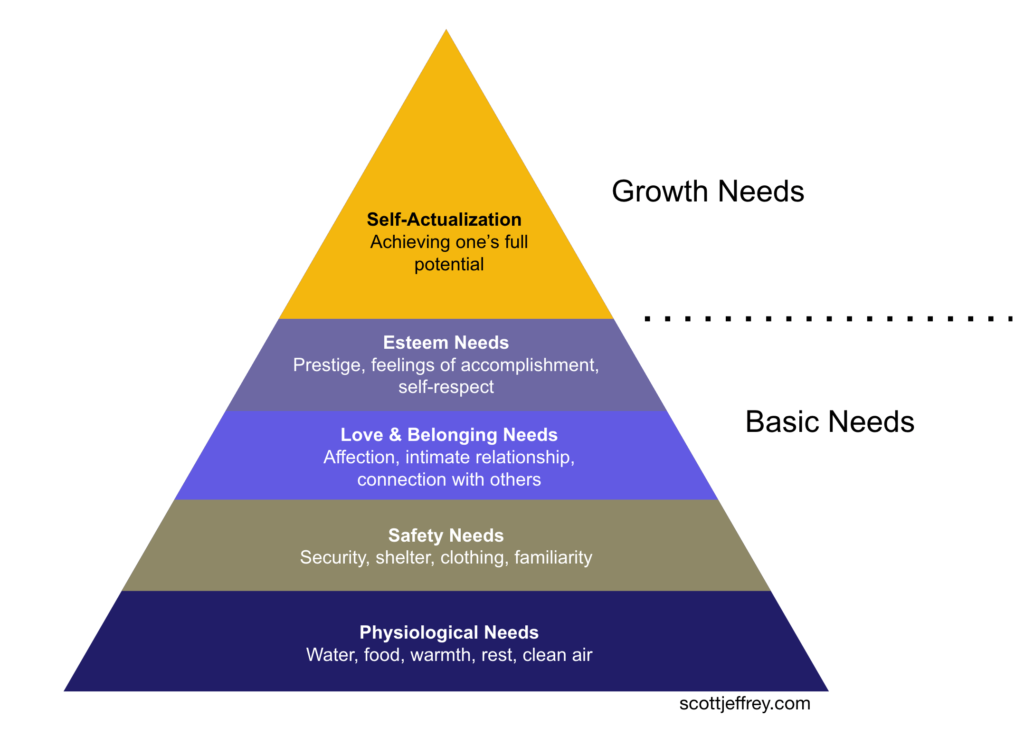 Abraham Maslow’s Basic Human Needs
Maslow’s Hierarchy of Needs
Most sources illustrate Maslow’s hierarchy of needs in a triangle, even though Maslow didn’t present it this way.
He did, however, express a hierarchy of basic human needs, moving from the lowest (physiological) to higher-level needs.
In A Theory of Human Motivation, Maslow explains:2Maslow, Motivation and Personality, 1954, 83.
At once other (and higher) needs emerge and these, rather than physiological hungers, dominate the organism. And when these in turn are satisfied, again new (and still higher) needs emerge, and so on. This is what we mean by saying that the basic human needs are organized into a hierarchy of relative prepotency.
Now, we’ll explore each of these basic human needs more closely. These needs can appear “academic” until we relate them to our daily experiences.

The 5 Basic Human Needs
All of the needs below self-actualization are basic human needs.
Maslow also called these basic human needs neurotic or deficient needs because if we’re focused on meeting them, we have anxiety.
We don’t feel like ourselves, and our lives aren’t fulfilling. We can’t operate from a calm, quiet center; we lack positive mental health.
Any unmet or ungratified basic human need causes problems and tensions that we seek to resolve.
1) Physiological Needs – Survival
Physiological needs are the requirements of all biological creatures. Without air, water, and food, biological organisms perish.
When we need food, we eat. If we don’t have food, we get anxious.
Physiological Needs Examples
When you have to pee during a flight, and there are six people in front of you waiting in line to use the lavatory, your physiological needs are threatened.
In some parts of the world, many individuals struggle to meet their basic physiological needs. It’s estimated that over a billion people lack access to sufficient food, basic nutrition, or clean water.
Physiological needs can also remain unmet, even among individuals in physically stable environments.
If, as a child, for example, meals were withheld as a form of punishment, a part of you (a child part) might always be seeking food (even when your body isn’t hungry). In this way, psychological trauma in childhood can threaten our basic human needs in adulthood.
2) Safety Needs – Stability
At its most fundamental level, to meet our safety needs, we need shelter from the elements, clothes to cover our bodies, and some semblance of the familiar.
Safety Needs Examples
If you don’t have enough money to pay for rent (or your mortgage and taxes), clothes (for protection, not fashion), and transportation (to get food and make money), your safety needs aren’t being met.
Once again, many people worldwide are unable to meet these basic human needs. Here, too, there are psychological ways the basic need for safety goes unmet.
If a part of you felt physically or psychologically unsafe as a child (which is sadly true for many of us), then that part is continually seeking security.
Even as an adult living in your own home, a fearful part of you can make you feel like something terrible is about to happen. For this reason, many adults leave their lights on at home after dark. It’s also why many people keep televisions, radios, or music running in the background at all times.
Also, when you’re in a period of transition, your basic security needs easily get triggered. Safety implies a certain degree of normalcy and control.
When your need for safety is threatened, you feel out of control. Naturally, you’ll want to get a grip on things.
Routines help us do that. But when you’re in the midst of a major life transition—for example, moving, out of work, or getting a divorce—you may feel unsafe.
3) Love and Belonging Needs – Connection
Belonging is a psychological need predominant during adolescence (often called the identity crisis in Erik Erikson’s model), and this need often remains unmet in adulthood.
Belonging is a feeling of connection with and approval from others. It starts with our immediate family, then branches out to friends, religious groups, and other social groups (like sports teams or clubs). This need to belong later extends into professional relationships and a significant other.
Love and Belonging Needs Examples
When you’re born into a genuinely loving and accepting family and grow up surrounded by mature, mentally healthy adults who can support, guide, and defend you when needed, a feeling of love and belonging can grow within you.
In adulthood, you become that guiding light for those around you and can bless others in need. You also no longer need to be around others to feel okay or complete.
But most of us—I dare say, virtually all—didn’t have such an experience in childhood (even though we sometimes delude ourselves into believing we did). Our parents may have done the best they could, but they were also psychologically immature, wounded, and unconscious of the majority of their behaviors, thoughts, feelings, and impulses.
As a consequence, most of us have a longing to belong that stems from a fear of being abandoned (which we subconsciously experienced as children).
This unmet need to belong drives us to identify with social groups, religious institutions, and other special-interest groups in adulthood. It also fuels many people’s impulse to spend time on social media.

4) Esteem Needs – Worth
Self-esteem, the last of Maslow’s neurotic needs, dominates most of our behaviors in public.
Our image-driven culture pushes us to be more concerned with what other people think than with how we feel about ourselves. We seek approval from others instead of self-acceptance.
Esteem Needs Examples
This unmet basic human need also stems from rejection and disapproval during childhood (whether explicit or subconscious).
For example, unmet external esteem needs influence most Facebook and Instagram use. Most social media users are posting things they are doing with a subconscious message of “Look at me. Look at how great I am.”
Each person continually compares, competes, and envies others. Numerous research studies link Facebook usage to increased depression and jealousy.3Walsh, D. (2022, September 14). Study: Social media use linked to decline in mental health. MIT Sloan Management Review. https://mitsloan.mit.edu/ideas-made-to-matter/study-social-media-use-linked-to-decline-mental-health These suppressed and repressed emotions get triggered because of an unrecognized basic human need for self-esteem.
If that wasn’t challenging enough, there’s another dimension to our esteem needs: internal esteem, or how we perceive ourselves. All of the judgment, criticism, and rejection we experience from our parents, teachers, and friends as children get internalized as the voice of an “inner parent.”
Some individuals have inner parents who are nurturing, accepting, and understanding, guiding their behavior not with shame and guilt but with self-compassion. These, however, are a small minority. Most of us have harsher inner parents who scold, berate, and judge us. We often call this voice our inner critic, judge, or saboteur.
5) Self‑Actualization – Fulfillment
Self‑actualization is often mistaken for achievement. In truth, it is integration. Maslow noted that the healthiest people seemed paradoxically humble: they sought truth more than fame, simplicity more than glamour. Their motivation was a devotion to wholeness.
As lower needs are met, our awareness can expand outward. Instead of asking, “What can I get?” we might ask, “What wants to emerge through me?” This shift from deficiency to growth transforms desire into creativity.
Sociologically, such individuals stabilize entire cultures—their equilibrium radiates coherence.
Maslow called their guiding principles Being‑values: truth, beauty, justice, aliveness, self‑sufficiency, and so on. When action expresses these values, life itself becomes art.
True self‑actualization isn’t a summit but a cycle: meeting needs, losing balance, rediscovering order at a higher octave. It’s the spiral of human evolution occurring within a single consciousness.
Assessing Your Current Need Fulfillment
How do you know if you have unmet basic human needs?
Here’s a simple test:
- If you can’t just sit down and “be”—if you feel like you need to constantly be “doing something” or consuming something (food, media, drugs, work, etc.)—your basic needs aren’t being internally gratified.
- Do you feel like you must be in a relationship at all times? Do you find yourself needy or clinging in your primary relationship? This neediness relates to a childhood wound.
- Are you investing at least a portion of your time in internal growth and development? If not, one or more of your basic human needs are unmet.
We all share the same needs. These needs are our birthright as human beings. But when something blocks or challenges these inalienable rights, we begin to exhibit strange behavior.
Driven by fear because we don’t feel accepted, loved, or respected, we often behave irrationally and impulsively to try to meet an unmet basic human need.
Generally speaking, the true motivation behind our irrational behavior exists outside of our awareness. That is, when something threatens our physiological, safety, social, or esteem needs, we don’t see why we’re behaving as we do.
How Unmet Basic Human Needs Rule Our Behavior
All of the neurotic needs we highlighted above hold us back. They keep us from actualizing our potential and being ourselves.
These unmet basic human needs force us into set patterns of behavior that reflect specific archetypes.
Belonging & Esteem Needs Examples
When we’re overly concerned with how people perceive us, we act in ways we think will earn their approval.
Different archetypes have different patterns of behavior. If, for example, you have unmet esteem needs, you’re going to seek status and approval from others. If someone in your environment is playing the “cool guy” (or cool girl) archetype, you might copy their behaviors and mannerisms to appear “cool” too.
Or, if someone behaves like an aristocrat (smug, arrogant, elitist, “high society”) and looks down on you, you’ll react in a specific way if you’re unconscious of this esteem need.
You might feel small compared to this person, so you’ll seek out someone else to dominate to feel better about yourself (in an attempt to boost your self-esteem).
Most of Our Behavior is Unconscious
Keep in mind that these archetypal patterns of behavior mostly operate outside of our conscious awareness—unless you’re doing extensive inner work.
We might think we are behaving one way, but in fact, we are presenting ourselves in an entirely different manner. We often rationalize our motives while our true motivation is hidden from us.
Research suggests that over 95% of our behavior is unconscious.4Young, Emma. (2018). “Lifting the lid on the unconscious,” NewScientist, July 25.
While this statistic may be shocking to the layperson, it’s a basic insight in depth psychology.
The unconscious, not the conscious, rules most of our lives—until we build consciousness.
This insight speaks to the importance of getting to know one’s shadow. The existence of these archetypes—driven by unmet basic human needs and childhood psychic wounds—is the cause of these unconscious behavioral patterns.
Why Basic Needs Often Plague Us in Adulthood
Psychologist David Richo (1991) explains in How To Be An Adult:
“We are born with inalienable emotional needs for love, safety, acceptance, freedom, attention, validation of our feelings, and physical holding. Healthy identity is based on the fulfillment of these needs … These needs are felt and remembered cellularly throughout our lives, though we may not always be intellectually aware of them. They were originally experienced in a survival context of dependency. We may still feel, as adults, that our very survival is based on finding someone to fulfill our basic needs.
“But early, primal needs can be fulfilled fully only in childhood (since only then were we fully dependent). In adulthood the needs can be fulfilled only flexibly or partially, since we are interdependent and our needs are no longer connected to survival.”
For most of us, our “inalienable emotional needs” were not met sufficiently in childhood. As adults, we are still trying to meet these basic human needs externally.
Resolving the Tensions of Unmet Needs
However, we can’t meet these basic human needs externally, or rather, we can, but only “flexibly or partially.”
Richo continues:
“Our problem is not that as children our needs were unmet, but that as adults they are still unmourned! The hurt, bereft, betrayed Child is still inside of us, wanting to cry for what he missed and wanting thereby to let go of the pain and the stressful present neediness he feels in relationships. In fact, neediness itself tells us nothing about how much we need from others; it tells us how much we need to grieve the irrevocably barren past and evoke our own inner sources of nurturance.”
So ultimately, it’s a Child part within us that’s driven by these basic human needs. Until we grieve and come to terms with the loss this child experienced, we cannot root ourselves in our Adult part and access our full potential.
Maslow’s Self-Actualization Need
What set Abraham Maslow apart from other psychologists is that he didn’t want to study neurotic people, which was the exclusive focus of his field at the time. (Arguably, the same is the case today.)
Instead, Maslow set out to understand positive mental health. This task required him to seek out individuals who weren’t struggling to meet their basic human needs.
Maslow looked for what he called self-actualizing people. Self-actualization is the need to become what one has the potential to be.
See this guide on self-actualization for the thirteen characteristics Maslow identified in self-actualizing individuals.
Because self-actualizing individuals focused on their internal growth rather than meeting their external needs, Maslow classified them as mentally healthy. However, he found it challenging to find enough of these individuals to study.
Since Maslow, developmental and transpersonal psychologists have also examined these same individuals. Generally speaking, they represent a very small percentage of the population.
What Motivates the Average Person
Basic human needs, such as food, water, sex, shelter, friends, family, and reputation, are external. We cannot meet them within ourselves. We seek to meet these needs through the environment and other people.
As Maslow writes in Religions, Values, and Peak-Experiences,
“Basic human needs can be fulfilled only by and through other human beings, i.e., society.”
So what happens once individuals fulfill their basic human needs? The individual’s attention makes a 180-degree turn: it shifts from what’s outside to what’s inside them.
Subconscious questions behind most human activity include:
- What will other people think of me?
- Will others like/approve of me?
- How do I compare myself to others?
Notice how these questions focus on the external world (i.e., basic human needs).
What Motivates Individuals with Positive Mental Health
In contrast, human beings with positive mental health—what Maslow called self-actualizing individuals—are guided by different internal questions:
- What am I really capable of?
- What’s my purpose here?
- How do I find meaning in my life?
- How can I actualize the best version of myself?
Notice how all of these questions relate to the individual. The question of capability or potential isn’t about someone else.
When individuals compare themselves to others, external esteem needs, rather than self-actualization, motivate their behavior.
From Deficiency to Growth Motivation
At first glance, this shift toward oneself appears selfish or egotistical. But it’s just the opposite.
When Driven By Basic Human Needs
Individuals necessarily act selfishly when basic human needs drive them.
Why? Because unmet basic needs stem from deficiency, from a feeling of lack, from a fear of not having or being enough.
These basic human needs stem from a pervasive sense of separation and tend to trigger the fight-or-flight response in our brains.
When this happens, we can’t assess situations from our more advanced prefrontal cortex because the primitive brain center (the limbic system) is in control.
When Motivated by Growth
Once individuals meet their basic needs, the anxiety that drives these needs falls away. Individuals can then relax into themselves.
The need to impress or get approval from others doesn’t influence their behavior (even though they’re aware that others judge them). They no longer seek a group or an idea to define their identity.
Dropping the need to compare themselves to others, they begin to individuate. They can now establish their unique path to self-mastery.
Psychologically mature adults no longer hold external rules of right and wrong. Instead, they have their own internal moral compass, personal values, and ethics, based on what Maslow called B-values, or being values.
Being values include truth, wholeness, justice, beauty, aliveness, richness, simplicity, effortlessness, and self-sufficiency.
Only such individuals can act genuinely selflessly. Otherwise, our actions are mere posturing, driven by unmet needs (usually external esteem or a desire to belong in “civilized societies”). This shift of attention from basic human needs to growth needs coincides with a shift in an individual’s consciousness.
 Alderfer’s ERG Theory
A Practical Approach to Basic and Growth Needs
The reality is that in daily life, most of us pursue these basic human needs simultaneously, to varying degrees. Instead of focusing on which need you’re attempting to meet, consider the overall direction of your life.
Instead of stacking the needs, one on top of the other, psychologist Clayton Alderfer illustrated them on a horizontal continuum.5Alderfer, Clayton P. (1969). “An empirical test of a new theory of human needs”. Organizational Behavior and Human Performance. 4 (2): 142–75. https://doi.org/10.1016/0030-5073(69)90004-X
If you’re investing an increasing effort in your growth, you probably feel more satisfied and fulfilled. This satisfaction will likely further fuel your growth efforts.
Research by psychologist Martin Seligman (2004) confirms this. Seligman, the founder of positive psychology, found that people experience greater gratification (lasting happiness) when they pursue growth by playing to their natural strengths.
If, however, your emphasis is turning to unmet relatedness and existence needs, your frustration is building. Frustration diminishes your motivation to grow.
Takeaway Lessons from Maslow’s Hierarchy of Needs
Here are four key takeaways based on Maslow’s theory of motivation:
- We are all more alike than we are different. We truly are part of a human family.
- Most of us are feeling more insecure, unloved, and unworthy than we admit to ourselves or others. These unmet basic human needs fuel our unconscious behavior.
- Authentic positive mental health, or mature psychological development, is reached when we resolve these hidden tensions within ourselves. Only then can we access our innate potential as mature adults.
- Focus on your overall life direction. Are you moving in the direction of growth (and feeling greater satisfaction)? Or are you regressing in an attempt to meet your basic human needs and feeling frustrated?
I know there’s a lot to digest in this guide. Reviewing the descriptions of Maslow’s needs above can help you become more conscious of how they operate in your daily life. This self-awareness is key to psychological development.
The Goal of Self-Actualization
If we strip away all of our unmet basic human needs and the drives of the archetypes they represent, we arrive at ourselves:
Authentic human beings with natural abilities and capacities that can be cultivated over time.
As Jungian author Robert Moore used to say in his lectures,
“Being an archetype is easy. Being a human takes work.”
In truth, a self-actualizing individual is more human.
Through psychological development, we strip away everything we are not and learn how to hold the psychic tensions within us.
Jung called this the process of individuation. We separate ourselves or individuate from the archetypes and behavioral patterns of our culture and society to discover what we are—our True Self.
It is in this sacred space that our true humanity lies. It represents an end to fear, unconscious behavior, and needless suffering that we are inflicting on ourselves and others each day.
Self-liberation, then, is the goal of psychological work, and it’s why “know thyself” was an essential dictum in Ancient Greece. It brings us to personal freedom or what the ancients called Moksha (self-liberation). It liberates us from our unconscious motivations and past habits. THIS is everyone’s birthright.
Where Do We Go From Here?
The process of self-actualization, individuation, and the realization of our potential is synonymous with the hero’s journey. It’s the developmental path from adolescence to full psychological adulthood, which takes heroic persistence, courage, and will.
On this journey, we learn to:
- Confront our fears
- Resolve our anger
- Experience our grief
- Accept our guilt and shame
- Uncover our true motivation
- Assert ourselves
- Integrate different parts of our psyche
- Get to know our shadow
- Pierce through our self-deception
- Locate authority within ourselves (recollect our projections)
To accomplish all of this, we must first cultivate self-awareness and self-leadership, become honest with ourselves, and learn to abide in our center. These practices allow us to reflect on our lives and better understand ourselves.
As this alchemical process unfolds, we walk forward on the path to our unique destiny.
Read Next
Four Stages of Learning Any Skill on Your Path to Self-Actualization
Peak Experiences & Flow: Maslow’s Formula for Human Potential
A Definitive Guide to Understanding Intrinsic Motivation
Jungian Synchronicity: Decoding the Psychology of Meaningful Coincidences
References
- Alderfer, Clayton P. (1969). “An empirical test of a new theory of human needs.” Organizational Behavior and Human Performance. 4 (2): 142–75. https://doi.org/10.1016/0030-5073(69)90004-X
- Bargh, J. A., & Morsella, E. (2008). The unconscious mind. Perspectives on Psychological Science, 3(1), 73–79. https://doi.org/10.1111/j.1745-6916.2008.00064.x
- Kahneman, D. (2011). Thinking, fast and slow. Farrar, Straus and Giroux.
- Maslow, A. H. (1954). Motivation and personality. Harper & Row.
- Richo, D. (1991). How to Be an Adult. Paulist Press
- Seligman, M. E. P. (2004). Authentic happiness: Using the new positive psychology to realize your potential for lasting fulfillment. Free Press.
- Walsh, D. (2022, September 14). Study: Social media use linked to decline in mental health. MIT Sloan Management Review. https://mitsloan.mit.edu/ideas-made-to-matter/study-social-media-use-linked-to-decline-mental-health
- Young, Emma. (2018). “Lifting the lid on the unconscious,” NewScientist, July 25.