
True leadership begins within. Before influencing others, one must learn to lead the complex network of drives, beliefs, and emotions inside the self.
Drawing on research from Daniel Goleman and the Internal Family Systems Institute, this guide unites Western developmental psychology with Eastern centering disciplines to present a complete framework for modern self‑leadership.
You’ll learn the ten core skills and eight stabilizing qualities that move you from reactivity to integration.
Let’s dive in …
What is Self-Leadership?
Psychologist Daniel Goleman points out in his bestseller Emotional Intelligence,1Daniel Goleman, Emotional Intelligence: Why It Can Matter More Than IQ, 1995.
“Exceptional leaders distinguish themselves because of superior self-leadership.”
So, what is self-leadership? While leadership focuses on how one influences others, self-leadership is about observing, understanding, and managing oneself.
Self‑leadership is the intentional practice of directing one’s thinking and behavior from an inner center of awareness and responsibility rather than from external control.
Self-leadership is closely linked to one’s levels of emotional and intrapersonal intelligence. It requires qualities like self-awareness, self-honesty, self-knowledge, self-regulation, self-motivation, and self-discipline.
By nurturing this inner faculty, we restore agency, integrity, and calm focus.
Self-Leadership Directs Authority Back Towards Oneself
Effective self-leadership is an aspect of mature adulthood. Research in developmental psychology shows that mature adulthood is strikingly rare.
According to various developmental models, fewer than 3% of people reach true psychological maturity, often referred to as integration.2Susanne Cook-Greuter. “Ego Development: A Full-Spectrum Theory Of Vertical Growth And Meaning Making.” (Yes, less than 3!)
Before reaching psychological maturity, we tend to project authority onto other people, groups, and institutions. We look outside of ourselves to determine our beliefs, values, moral codes of conduct, feelings, and behaviors.
As we move toward integration, our sense of authority gets directed inward. As a consequence, we become more responsible for our thoughts, actions, feelings, impulses, and behaviors.
As this process unfolds, we are less driven by external forces. For example, instead of being ruled by the need to belong (external motivation), we become more self-directed and autonomous (internal motivation).
10 Core Self‑Leadership Skills
Each of the following skills strengthens internal alignment between awareness, emotion, and behavior.
Together, they form the psychological architecture of maturity—the capacity to act from choice rather than impulse.
- Self‑Observation – The rudimentary discipline of noticing what arises in thought and behavior without instant reaction. Observation turns reactivity into data.
- Self‑Awareness – Recognizing inner moods, drives, and patterns. Research in Goleman’s emotional‑intelligence model shows that awareness is the keystone of all higher regulation.3Goleman, D. (2004, January). What makes a leader? Harvard Business Review. https://hbr.org/2004/01/what-makes-a-leader
- Self‑Regulation – Managing disruptive impulses through pause and reflection rather than suppression (see repressed emotions).
- Self‑Discipline – Commitment to consistent practice. Jim Collins’s research on Level 5 Leadership found this blend of humility and fierce resolve at the core of enduring achievement.4Collins, J. (2005, July–August). Level 5 leadership: The triumph of humility and fierce resolve. Harvard Business Review. https://hbr.org/2005/07/level-5-leadership-the-triumph-of-humility-and-fierce-resolve
- Internal Motivation – The shift from reward‑seeking to purpose‑driven effort. Deci & Ryan’s self‑determination theory demonstrates that autonomy and competence fuel sustainable growth.
- Focus and Concentration – Training attention restores the mind’s natural steadiness; scattered focus reflects inner fragmentation.
- Time Management – Prioritization guided by values rather than urgency; time reflects energy alignment.
- Emotional Resilience – The ability to recover equilibrium after hardship, integrating experience instead of resisting it.
- Self‑Reflection – Turning awareness inward to re‑evaluate motives, assumptions, and choices.
- Introspection – Deeper inquiry into the unconscious patterns that govern behavior; a crucial companion to shadow work.
Cultivating these ten capacities moves you from awareness to discipline, and finally to integration.
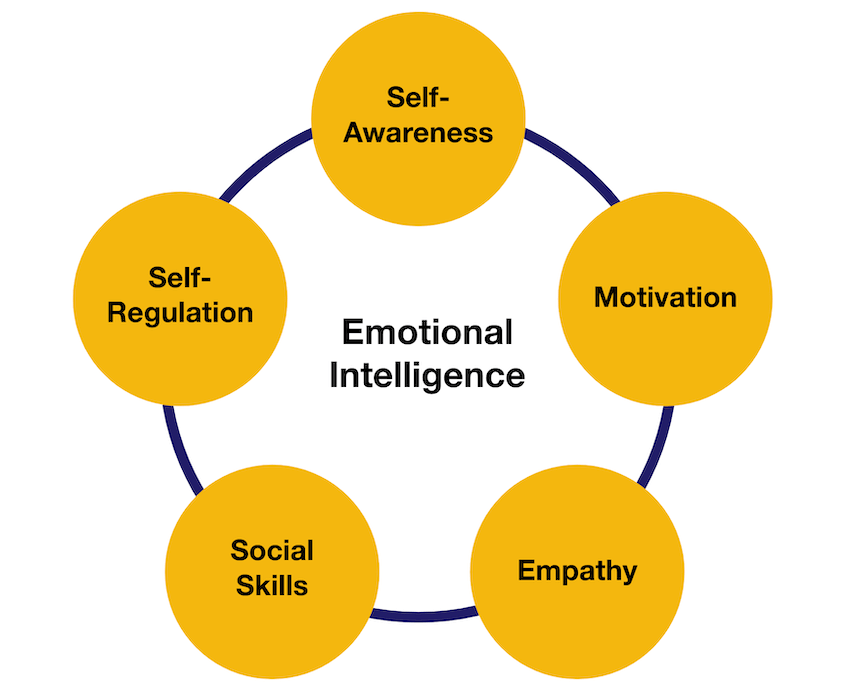
Five Pillars of Emotional Intelligence
Self-leadership is closely related to emotional intelligence. That is, they share many of the same qualities.
In his bestselling book and subsequent articles in Harvard Business Review, psychologist Daniel Goleman highlights five characteristics of emotional intelligence: self-awareness, self-regulation, motivation, empathy, and social skills.5Daniel Goleman, “What Makes a Leader?” Harvard Business Review, 2004.
Self-Awareness
Self-awareness is the foundation for both emotional intelligence and self-leadership.
All the other characteristics of emotional intelligence hinge on this one. Our capacity for self-awareness determines our potential for self-leadership.
Self-awareness is the recognition and understanding of our moods, emotions, thoughts, drives, impulses, and behaviors.
With self-awareness, you can recognize when a situation, thought, or person triggers a response in you. You can make a realistic assessment of your current emotional state and the drivers behind your behavior.
Seriousness or a rigid view of oneself blocks an accurate self-assessment. Goleman finds that those with greater self-awareness have a self-deprecating sense of humor. To see yourself clearly—including the often irrational reactions you have in situations—requires light-heartedness.
Self-awareness is a vital skill. We’ll discuss ways of developing this skill below.
Self-Regulation
Self-regulation is the ability to manage or redirect disruptive impulses and moods. It relates to the common phrase, “think before you act.”
Those who can regulate their emotions tend to have greater self-honesty, which makes them more trustworthy.
Self-regulation doesn’t mean suppressing or repressing our emotions. While we sometimes need to suppress our initial emotional response in a given situation, we must ultimately work with our emotional landscape so that our feelings don’t negatively influence our thoughts, attitudes, and behaviors.
Self-regulation means being flexible, open to change, and comfortable with ambiguity. Being okay with ambiguity is another defining characteristic of psychological maturity.
Internal Motivation
Motivation is the ability to work for reasons beyond money or status, and to pursue goals with internal energy and persistence.
Psychologist Abraham Maslow devoted a significant portion of his career to studying intrinsic motivation. He found that most people are primarily focused on meeting their basic human needs, such as physiological, safety, belonging, and self-esteem needs.
These basic needs are what Maslow referred to as deficiency needs.6Maslow, A. H. (1968). Toward a psychology of being (2nd ed.). Van Nostrand Reinhold. That is, when we don’t feel like these needs are met within ourselves, we become neurotic. All of these basic needs—for example, the desire for more material possessions and the pursuit of others’ approval—are driven by external motivations.
Self-actualizing people, in contrast, are internally motivated. Not only is this a sign of self-leadership, but it’s also a fundamental aspect of positive mental health.
According to Maslow, self-actualizing individuals demonstrate a commitment to realizing their full potential, encompassing a range of skills, capacities, and talents. In self-determination theory, this drive is called competence.7Deci, E. L., & Ryan, R. M. (1991). A Motivational Approach to Self: Integration in Personality. Nebraska Symposium on Motivation. Self-actualizing individuals often feel a sense of mission, calling, or destiny.
When our locus of control is within ourselves, it’s easier to stay level-headed, even in the face of major setbacks or failure.
Empathy
Empathy is the ability to accurately perceive others’ emotional reactions and respond with understanding.
This quality requires a close connection to one’s feelings. We can only understand others’ emotional reactions by knowing our own reactions and triggers. We all come hard-wired with the same emotions, but our triggers vary.
The more we’re able to stay present with and understand our emotional landscape, the larger our capacity for empathy for others.
Social Skill
Social skill is the ability to find common ground, build rapport, and manage relationships. With social skills, a person can influence and persuade others, lead them toward change, and foster high-performing teams.
With this pillar of emotional intelligence, we cross the bridge from self-leadership to leading others.
As in all other lines of intelligence, we can develop and grow our emotional intelligence and enhance our self-leadership skills.
What is the “Self” in Self-Leadership?
Psychologist Richard Schwartz is the founder of The Center for Self-Leadership (now called IFS Institute). While working with patients, Schwartz developed a concept of the “Self” that differs from mainstream psychology.
“Self,” in this context, doesn’t just mean our sense of self or ego. Instead, Schwartz refers to our true Self (capital “S”) as an organizing principle within us. This Self already possesses all the qualities we seek to develop or integrate to become a mature adult, including confidence, openness, and compassion.
IFS psychologist Jay Earley explains in Self-Therapy:8Jay Earley, Self-Therapy, 2012.
We all have a core part of us that is our true Self, our spiritual center. When our extreme parts are not activated and in the way, this is who we are. The Self is relaxed, open, and accepting of yourself and others. When you are in Self, you are grounded, centered, and non-reactive. You don’t get triggered by what people do. You remain calm and unruffled, even in difficult circumstances … When you are in Self, you come from a depth of compassion, enabling you to be loving and caring toward others as well as yourself and your parts. The Self is like the sun—it just shines.
Earley highlights the qualities of the Self discussed in both Western integrative therapies, like Jungian psychology, and Eastern spiritual traditions: relaxed, open, curious, compassionate, calm, centered, and grounded.
The ultimate goal of self-leadership is to navigate through our various parts, tendencies, and prior conditioning so our Self can shine forth.
The 8 C’s of Self-Leadership
Schwartz’s IFS Institute developed what they call the “8 C’s of Self-Leadership Wheel” to help assess your current level of centeredness with your Self.
Calmness
When you’re in the Center, there’s an internal calmness regardless of your external circumstances.
With this calmness, you’re able to manage challenging life situations in less automatic (preconditioned) and extreme ways.
Clarity
Clarity is another hallmark quality of being rooted in the Self. Clarity enables us to pierce through distortions (delusions) caused by extreme beliefs, emotions, and preconditioning, allowing us to perceive situations accurately.
It provides greater objectivity because we become aware of our personal biases without being influenced by them.
Curiosity
Layers upon layers of conditioned programming, beliefs, biases, and self-identities create a false image of ourselves (ego construct). We are none of these things. Curiosity helps us inquire into our true nature.
With curiosity, we can learn about ourselves and others without judgment. Here, criticalness gives way to a sense of wonder, a quality Maslow observed in self-actualizing individuals.
Compassion
Compassion enables us to appreciate others and ourselves without feeling the need to fix, change, or judge anything. It fosters a deeper understanding of ourselves and others.
In a state of compassion, we are more connected to our shared suffering—what Buddhists call Samsara. Self-compassion is a necessary ingredient for long-term, healthy development.
Many of us approach change with self-criticism, which prevents us from ever changing. When we have compassion for ourselves, we can learn and grow with understanding, kindness, and self-acceptance.
Confidence
Self-confidence empowers us to handle whatever life throws our way. Confidence comes after having worked through previous traumas, setbacks, and failures.
It’s not about being right or how others perceive you (projecting a false sense of confidence). With authentic confidence, you’re not afraid to make mistakes because you’re “comfortable within your skin.”
Courage
Courage enables us to take responsibility for our actions and make amends when we make mistakes. It gives us the strength to face external challenges and threats.
With courage, we can take action toward our goals that might seem too bold and overwhelming to others. Courage is a vital quality for doing inner work, facing our shadow, and embracing our hero’s journey to adulthood.
Creativity
In the Center, we have access to our innate creative potential. We can use our imagination to generate ideas and solve problems.
In the Self, we more easily experience peak flow states where we become fully absorbed in what we’re doing, accompanied by feelings of enjoyment, spontaneity, and inner freedom.
Connectedness
The quality of the Self is universal, so the more you’re rooted within the Self, the more connected you feel to others, whether it’s your partner, a project team, a community, or an organization.
In this connected state, you can relax your ego defenses and your need to control others. This sense of connectedness enables you to navigate life’s circumstances with greater ease and intuition.

The 8 C’s of Self-Leadership Wheel
How to Use the Self-Leadership Wheel
The Foundation for Self-Leadership provides a simple assessment tool called the Self-Leadership Wheel that you can use to evaluate how much “Self” you have available to you right now. You can download it here.
You go through each of the eight “Cs” above and rate yourself on a scale of 1 to 5, where 1 represents little or no access to the Self, while 5 is a high level of Self-presence.
6 Additional Qualities of Self-Leadership
Here are a few other attributes of self-leadership that aren’t represented in the 8 Cs:
Self-honesty
Self-honesty, also called integrity, is much easier to talk (and write) about than to practice. The mind has an unlimited ability for self-deception.
To peel away the layers that block the Self requires honesty. It takes integrity to observe our behaviors, underlying motivations, and true intentions without filters or judgment.
Accountability
Being responsible for our thoughts, emotions, behaviors, and actions is a hallmark quality of psychological maturity that arises from the Self. Without accountability, no growth can occur.
Self-discipline
Self-discipline helps us manage our mental and emotional state. Self-discipline isn’t just about managing impulse control; it’s the ability to follow through on important tasks and practices.
A strong personal will is also one of the two qualities researcher Jim Collins identified in outperforming leaders.9Collins, J. (2005, July–August). Level 5 leadership: The triumph of humility and fierce resolve. Harvard Business Review.
Humility
As our emotional intelligence develops, we become aware of the tensions, oppositions, and ambiguities within ourselves. Over time, observing these tensions breeds humility.
We don’t always know the answers. We aren’t always in control. We often make mistakes due to our ignorance and prior conditioning. Humility is the second quality Collins identified in his research on “Level 5 Leadership.”10Ibid.
Assertiveness
Assertiveness, here, doesn’t mean being ambitious or a “go-getter.” Assertiveness is found between aggressiveness and passivity. Subconsciously, we often behave either as bullies (aggressive) or weaklings (passive).
Neither of these behavioral patterns supports self-leadership. When we’re assertive, we stand up for ourselves without ego defensiveness or going to extremes. We can know what we want while still being mindful of others’ needs.
Inner Faith
With self-leadership, we place authority within ourselves, rather than delegating it to another person, concept, or institution.
This transition requires us to trust our Inner Guide and have faith that it will direct us in supportive ways.

Returning Home to the Self
While the concept of the Higher Self is relatively new to Western psychology, it has been a foundational principle in Eastern practices for millennia.
As such, for those genuinely interested in cultivating self-leadership, it’s instructive to take a “transpersonal” approach that combines Western and Eastern insights, practices, and methods.
Once you become more acquainted with the Self, for example, by using the Self-Leadership Wheel above, you’ll likely come to two stark realizations:
- You aren’t frequently connected to the Self, and
- The experience of the Self is fleeting.
That is, even if you become more centered in the Self, that experience doesn’t last very long. In the language of the Eastern traditions, this means we lack stabilization.
In lacking stabilization, we are out of the Center.
Self-Leadership Starts from the Center
The Center is a fundamental principle in Eastern philosophy, especially in Taoism. In the Complete Reality School of Taoism, they offer the analogy of the host and the guests.
The psyche represents your house. Lots of guests inhabit the house. In Schwartz’s IFS language, these guests are referred to as parts. Jung referred to them as archetypes.
These guests, parts, or archetypes are semi-autonomous subpersonalities within our psyche. Whenever any of these guests is in control, we are “out of the Center.”
The host is the Self. In Taoism, it’s also called the Original Spirit. The qualities of the Self highlighted in the traditions include calm, clarity, alertness, and neutrality. Neutrality is considered the guidepost of the Center.
The Self is neutral, so it doesn’t get triggered; it doesn’t judge. The Self is clear and empty, so it doesn’t expend energy on thoughts and feelings (as the guests do).
The Self is in the Center of the psyche. Buddhist mandalic artwork (such as the one featured above) symbolizes this principle.
The host’s role is to keep order in the house (psyche), but in most cases, the house has been overrun by unruly guests.
To cultivate self-leadership, we must return to the Center, bringing the host back in to establish order, thereby freeing us from the chaotic influences of the guests (parts).
How to Strengthen Self-Leadership Skills
How do you begin stabilizing in the Center?
First, it’s essential to understand why we often lose our connection to the Self—why most of us tend to live “out of Center.”
The primary reason is also why most of us lack emotional awareness: trauma.
As Dr. Bessel Van Der Kolk explains in his bestseller The Body Keeps the Score, childhood trauma is stored in the body. For this reason, it’s important to address repressed emotions from past trauma.
In the Eastern arts, this trauma is referred to as stagnation and energetic blockage. Once this energetic blockage occurs, we lose connection to the Self.
With this understanding, we can take an integrated approach to cultivating self-leadership.
An Integrated Approach to Self-Leadership
An integrated approach to self-leadership must address multiple dimensions or lines of development within one’s practices.
For example, using mental techniques alone without addressing the physical body will yield limited results over time.
Instead, we want to address our body, mind, emotions, and spirit—the totality of our psyche—to build a stronger bridge to the Self.
Since this website is heavily focused on self-leadership, I’ll direct you to other guides that address different dimensions of self-leadership training in the remainder of this guide.
I’ve grouped a series of related guides into two modules:
- Body-Mind Practices
- Depth Practices
Let’s start with body-mind practices …
Module 1: Body-Mind Practices
The first key is to bring our awareness into our bodies. The more connected we are to our body, the more natural self-leadership becomes.
All of these various methods will help improve mental clarity, energy, emotional resilience, focus, and calmness.
How to release repressed emotions
As discussed above, understanding the nature of repressed emotions and learning to address them is crucial for genuine self-leadership.
If you follow the principles for proper breathing without using any force, it brings you closer to the Self.
You can test out 15 different techniques to help you become more centered.
This guide provides many powerful techniques for grounding yourself in your body and on the Earth.
How to stand using Zhan Zhuang
This is a more advanced method of body-mind integration. It’s highly effective and provides lasting benefits.
How to train your mind via meditation
This in-depth meditation manual offers a range of “secrets” to enhance your mind-training efforts.
How to build emotional awareness
This guide covers similar content to this one, but with an emphasis on managing one’s emotional landscape.
Module 2: Depth Practices
Getting rooted and centered in our bodies sets the foundation for the second part of cultivating self-leadership.
Here, we engage in a dialogue with the various aspects of our psyche. The purpose of these methods is to bring the unconscious material in our psyche into consciousness. Or, as Jung often put it, to build more consciousness.
How to get to know and integrate your shadow
The shadow is all the parts of ourselves that we cut off from our awareness during our development. The primary reason people fail to develop self-leadership skills is that they remain unconscious of their shadow.
The Psychology of Archetypes: 3 Vital Roles
This is part 1 of a two-part series. This guide offers a more comprehensive understanding of archetypes and their influence on human behavior.
This is part 2 of a series on using active imagination to dialogue with the archetypes or subpersonalities in one’s psyche. It also highlights three other methods for inner dialogue, including IFS’s model for working with “parts.”
Recap: The Path of Self-Leadership
Self-leadership requires a combination of qualities such as self-awareness, self-regulation, and intrinsic motivation.
Similar to emotional intelligence, self-leadership requires us to observe and regulate our thoughts, emotions, impulses, moods, and behaviors.
The primary key to self-leadership is developing self-awareness. Self-awareness allows you to monitor your internal terrain. With it, you become aware of when you’re connected to the Self and when you’re not. Self-monitoring provides internal feedback that enables you to adjust and make corrections as necessary.
Self-leadership is challenging because our psyche contains a host of characters, known as parts or archetypes. Instead of just a singular mind, think of it as having “multiple minds.”
The Self is a quality of consciousness at the center of our psyche—an organizing principle that can bring harmony to the many divergent parts within us.
The more we move toward the Center, the more natural self-leadership becomes.
Self-leadership skills are cultivated through various practices and methods. Taking an integrated approach that combines Western psychology with Eastern practices yields lasting results.
The practices and resources in this guide can help you cultivate self-leadership and move closer to your Self.
Books on Self-Leadership
(Disclaimer: Affiliate links to Amazon below.)
Self-Therapy: A Step-By-Step Guide to Creating Wholeness and Healing Your Inner Child Using IFS by Jay Earley
We have voices, parts, or subpersonalities within our psyche. When we deny this fact, these parts rule us. When we accept this, we can learn to understand and harmonize the characters within us. Self-Therapy is based on a modern integrative approach called Internal Family Systems (IFS). It guides you step by step through the process of working with your parts.
Search Inside Yourself: The Unexpected Path to Achieving Success, Happiness (and World Peace)
by Chade-Meng Tan
Chade-Meng Tan was one of the first engineers at Google. Years later, he helped launch the Search Inside Yourself Institute, a leadership program within Google. The program is a synthesis of the work of psychologists Jon Kabat-Zinn and Daniel Goleman, neuroscientist Richard Davidson, and others. At its core, Search Inside Yourself is a mind-training program in emotional intelligence, a critical factor in outperforming leadership. Not only is this book an accessible and practical introduction to emotional intelligence, with clear practices and methods, but it’s also an excellent summary of dozens of other great personal development books, all rolled into one.
Emotional Intelligence: Why It Can Matter More Than IQ
by Daniel Goleman
The reason Goleman’s book remains relevant over 20 years after becoming a bestseller is that, despite repeated assertions that there are different kinds of intelligence, most people still equate “intelligence” with IQ. However, decades of research, particularly in the business sector, have shown that it’s emotional intelligence, rather than cognitive intelligence, that defines high performance and lasting success in both business and life.
Read Next
Emotional Awareness: Transforming Negative Emotion into Positive Energy
A Practical Guide to Jung’s Active Imagination
How to Release Repressed Emotions (4 Proven Methods)
How to Ground Yourself: 20+ Effective Techniques
References
- Collins, J. (2005, July–August). Level 5 leadership: The triumph of humility and fierce resolve. Harvard Business Review. https://hbr.org/2005/07/level-5-leadership-the-triumph-of-humility-and-fierce-resolve
- Cook‑Greuter, S. (2005). Ego Development: A Full‑Spectrum Theory of Vertical Growth and Meaning Making. Semantic Scholar
- Deci, E. L., & Ryan, R. M. (1980). Self-determination Theory: When Mind Mediates Behavior on JSTOR. The Journal of Mind and Behavior, 33. https://doi.org/43852807
- Deci, E. L., & Ryan, R. M. (1991). A motivational approach to self: Integration in personality. In R. A. Dienstbier (Ed.), Nebraska Symposium on Motivation, 1990: Perspectives on motivation (pp. 237–288). University of Nebraska Press.
- Goleman, D. (1995). Emotional Intelligence: Why It Can Matter More Than IQ. Bantam Books.
- Goleman, D. (2004, January). What makes a leader? Harvard Business Review. https://hbr.org/2004/01/what-makes-a-leader
- Maslow, A. H. (1968). Toward a psychology of being (2nd ed.). Van Nostrand Reinhold.
- Schwartz, R. C. (2015). Internal Family Systems Therapy. Guilford Press.
- Van der Kolk, B. A. (2014). The Body Keeps the Score: Brain, Mind, and Body in the Healing of Trauma. Viking.