
In any hero’s journey, there are multiple obstacles along the way. Trials and tribulations are standard operating procedures.
After all, how is the hero supposed to grow and learn its limitations without experiencing challenges and setbacks?
The spiritual journey is no different. A multitude of roadblocks, trapdoors, tricksters, and demons present themselves along the way.
Everyone will navigate around and through these obstacles differently. And not everyone will complete their quest.
Bringing these common blocks to consciousness helps us notice when we’re getting ensnared, so we can stay on the straight and narrow path.
This in-depth guide explores the most common spiritual traps that haunt the greater majority. They represent archetypal forces designed to stall our progress and growth.
Let’s dive in …
What Are Spiritual Traps?
Spiritual traps are anything that constrains one’s psychological development and spiritual growth.
Most of these traps prey on egoic or mental tendencies, such as the drive for safety or the need to feel special.
Many spiritual blocks relate to our collective high level of ignorance and naivete.
When divorced from discernment, knowledge, and critical thinking, the spiritual path can become treacherous.
Charlatans and misguided individuals abound. Individuals on a spiritual journey often maintain a high degree of openness. And this openness, coupled with naivete, leaves individuals susceptible to manipulation, distortions of reality, and other common traps.
Pseudo-Spirituality: The Dangers of Fake Spiritual Growth
Before covering the common obstacles to spiritual growth, we need to address a pervasive problem observed in virtually all “spiritual circles,” including traditional religion, secular spirituality, academia, and the new age.
It’s called pseudo-spirituality or fake spirituality, and it’s a wildly popular ego game.
With pseudo-spirituality, the ego uses the concepts of spirituality and growth as a tool to elevate itself.
How Pseudo-Spirituality Manifests as an Ego Defense
When this game unfolds, the individual might “act spiritual.” That is, they present themselves as “being spiritual” to elevate themselves.
While this spiritual facade is designed to maintain a certain perceived image (how other people perceive the individual), it’s also often an internal game.
Depth psychology illuminates how much of our behavior is unconscious. We can perceive ourselves (self-identity) one way while being entirely different.
For example, we might perceive ourselves as kind, considerate, and caring, while remaining psychologically divorced from our judgmentalism, envy, and spitefulness.
In Jungian terms, this is called being divorced from one’s shadow. And, it’s probably the single most common trap in the spiritual journey.
Divorcing ourselves from all of our “non-spiritual” qualities, we may find it easy to take the “moral high ground” and secretly look down on others. This is standard operating procedure in virtually every cult on the planet.
The Root Cause: Lack of Psychological Maturity
With pseudo-spirituality, the same underlying problem always exists: the individual is not engaged in any genuine psychological development or daily practices.
Instead of mining their darkness, they are reaching for the light. Instead of taking out their trash, they are dumping it in their neighbor’s backyard.
Making matters worse, many individuals mimic the practice.
For example, they’ll sit on a cushion for 30 minutes a day and post images on social media about their meditation practice. Or, they’ll let anyone who will listen to them know that they are a devout [put your religious or spiritual affiliation of choice here].
Common Ego Defense Mechanisms in Spiritual Circles
As such, individuals on the spiritual path often engage in all the classic ego defense mechanisms, including:
- Psychological Projection: Projecting one’s own qualities onto others.
- Denial / Avoidance: Denying that one even has certain attributes or qualities.
- Rationalization: Justifying one’s behavior to avoid confronting uncomfortable truths.
- Repression / Suppression: Pushing down or completely cutting off various tendencies, impulses, and feelings.
Each of these ego defenses represents a clear spiritual block.
Generally, when an individual consistently engages in these ego defenses, it’s a clear sign of a lack of self-awareness, emotional intelligence, and self-regulation.
Without cultivating these vital qualities, how can we hope to successfully navigate our spiritual journey?
Conceptual Knowledge vs. Genuine Internal Work
When individuals engage in these common ego defenses, we tend to see a lot of posturing (very common among church-goers, new-agers, and intellectuals alike). Posturing is another way of “acting spiritual.”
This lack of psychological development explains why we’ve heard about so many scandals in the Church involving pastors, priests, monks, and gurus alike. It’s why sex cults can form within circles of high-minded intellectuals (academic-types) and devout spiritualists.
Can sexual deviance and physical abuse coexist in an individual with psychological and spiritual maturity?
Clearly, it can not. But when an individual consumes external spiritual information without doing real inner work and genuine spiritual practice, the conditions are set for mischief and upheaval.
Conceptual spiritual knowledge gets mistaken for actual psychological and spiritual growth. And bad things happen because there’s no one in the driver’s seat to observe and regulate what’s going on.
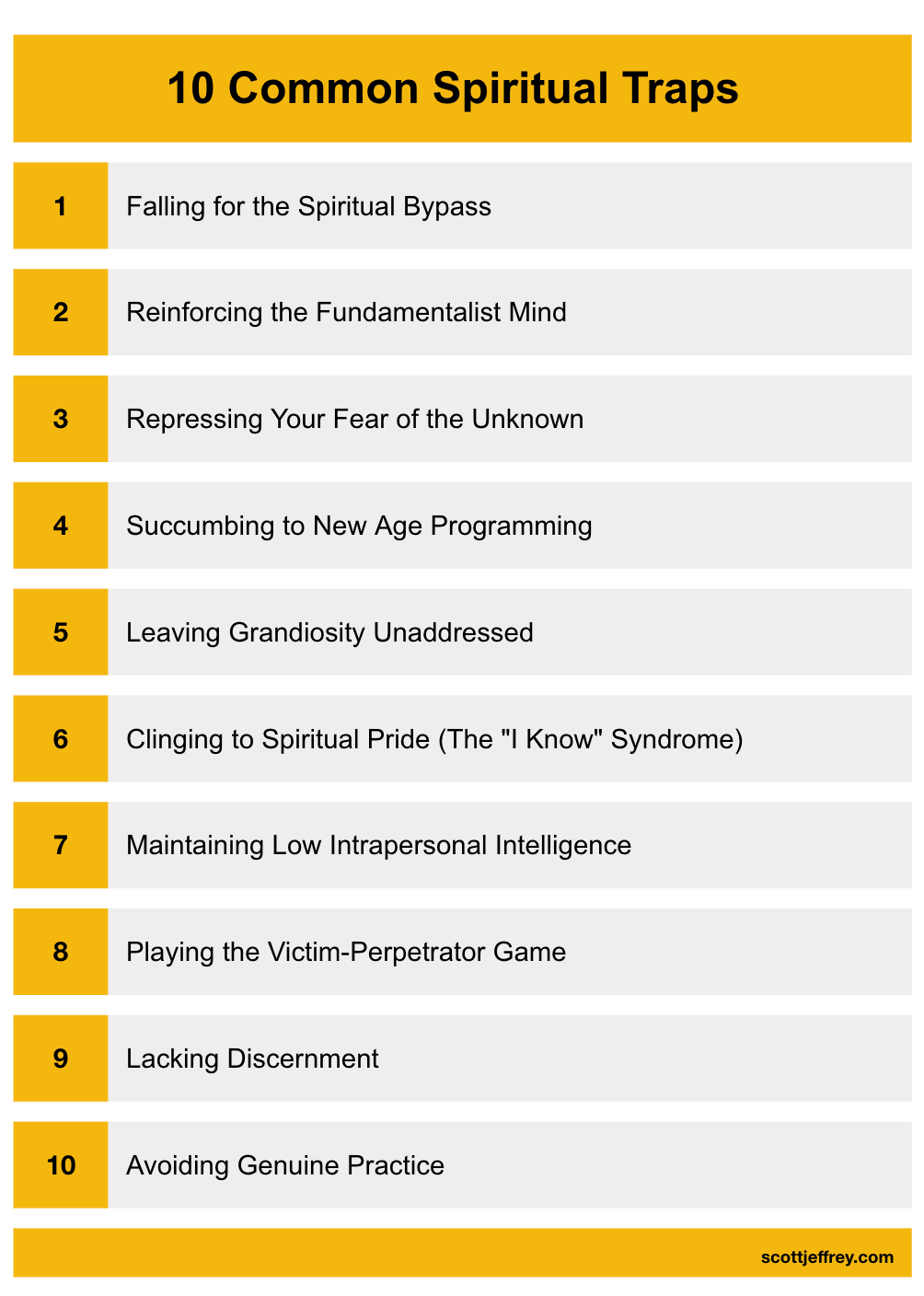
Ten Common Spiritual Traps
In truth, the spiritual journey can be treacherous. Like any true adventure, it isn’t safe, and success is not guaranteed.
Personally, I have fallen into virtually all of these spiritual traps at various points along my journey. A few of these pitfalls ensnared me for many years.
Some individuals fall into various spiritual traps and never get out. They can ensnare us for a lifetime if we aren’t prudent.
While not all of these spiritual blocks and traps will be relevant to your particular journey, it behooves us to be mindful of all of them.
Potential spiritual traps and blocks include:
- Falling for the Spiritual Bypass
- Reinforcing the Fundamentalist Mind
- Repressing Your Fear of the Unknown
- Succumbing to New Age Programming
- Leaving Grandiosity Unaddressed
- Clinging to Spiritual Pride (The “I Know” Syndrome)
- Maintaining Low Intrapersonal Intelligence
- Playing the Victim-Perpetrator Game
- Lacking Discernment
- Avoiding Genuine Practice
Let’s examine each spiritual trap in more detail.
1 – What is the Spiritual Bypass?
Let’s start with one of the biggest culprits hindering one’s spiritual journey. This spiritual block can stop the quest in its tracks. It is the essence of pseudo-spirituality.
Some people refer to it as the “spiritual bypass” or “spiritual materialism.”
Spiritual bypassing is a psychological defense mechanism where an individual uses spiritual practices to avoid confronting underlying emotional wounds, unresolved trauma, and the realities of their shadow self.
As psychologist Robert Augustus Masters (2010) established, spiritual bypassing occurs when we use spiritual concepts to avoid the necessary, often messy, work of psychological healing.
Virtually all of the discomfort unfolds during the parts of spiritual growth we may try to bypass, including:
- Getting to know the shadow;
- Wrestling with inner demons;
- Confronting our closely held but false views of ourselves and others;
- Becoming conscious of our unresolved trauma and arriving at acceptance;
- Understanding the source of our emotional triggers and learning to regulate them.
Virtually every emotional trigger we have, everything that sets us off as adults, was installed long ago.
Even physically addressing the pain and numbness stored within the body (energetically) can cause significant discomfort. But with spiritual bypass, we attempt to gloss over this necessary process and instead engage in emotional avoidance.
With this pervasive spiritual block, individuals might sit in meditation, envision “beings of light”, and chant “OM” secretly to avoid getting messy and doing the real internal work necessary for self-healing.

2 – Fundamentalism: The Trap of Rigid Belief Systems
Another common spiritual block comes in the form of fundamentalism and absolutism.
When individuals adopt an absolutist stance, they think in terms of dogmas and rules. Everything in life is perceived in black-and-white terms.
Fundamentalism and dogma can rule one’s life, creating mental rigidity within the individual’s psyche and reinforcing one’s dark side.
Absolutism often goes hand in hand with groupthink and cultism. Individuals rooted in fundamentalism are highly susceptible to joining cults, whether they be religious, new age, intellectual, sexual, or some other ideology.
This type of mental rigidity is observable in individuals with and without an organized religion. As psychologist Stephen Larsen explains in The Fundamentalist Mind: How Polarized Thinking Imperils Us All (2007), fundamentalism is wired into a part of the brain.
This trap stems from the drive for certainty and the inability to accept ambiguity (not knowing “the truth”). Individuals plagued with fundamentalist ideology haven’t come to terms with their insecurities.
If we don’t observe, challenge, and overcome absolutist thinking and the false sense of comfort it provides, it will continue to dominate our consciousness and stall spiritual growth.
3 – Repressing Your Fear of the Unknown
Behind fundamentalism is a hidden fear of the unknown. Having someone tell us the truth can bring comfort by eliminating uncertainty.
Uncertainty and doubt create mental discomfort. Our minds seek to resolve, suppress, or repress this discomfort.
Absolutism or fundamentalism is one way this “resolution” manifests. This rigid thinking keeps us from reflecting on questions like:
- What if my beliefs aren’t true?
- What if the cosmology I grew up with is wrong?
- What if specific individuals created my beliefs as a system of control?
- What if academia and other industries are funded by specific groups with a nefarious agenda?
- What if …
Another underlying fear relates to feelings of meaninglessness and existential despair. To avoid such overwhelming feelings, we may cling to the known (that is, our cherished, pre-programmed beliefs).
The key to overcoming this spiritual block is to acknowledge one’s fear of the unknown rather than pretend it’s not there. Then, begin to lean into the discomfort and see where it takes you.

4 – The Dangers of New Age Spirituality
Individuals on a spiritual journey are often curious and open-minded. This curiosity, however, can get you into trouble, trapping you in unending, troublesome rabbit holes.
The “Love and Light” Game
New-age ideologies are rampant in the modern age. Many individuals began departing from traditional, organized religions only to find themselves in various “new age” religions instead.
Channeling is a common practice within the new age, something the ancient traditions specifically warned against. With channeling, various “entities” (spirits, ghosts, demons) can enter your etheric body during this process (without you knowing it).
Those who embrace the new age often use language like:
- “Love and light”
- “Ascension”
- “Invocation”
- “Light workers”
That is, similar to many of those in traditional religions, these new agers become ungrounded, divorced from the dark side of their psyche.
As such, they are likely to:
- Remain unconscious of their behavior,
- Avoid genuine shadow work, and
- Stall their psychological development.
Once one is indoctrinated into new-age ideologies, spiritual discernment usually goes out the window.
Behind the New Age Agenda
It’s worth noting that the roots of the new age movement are found in the works of Alice Bailey, Helena Blavatsky, and the Theosophical Society. Bailey established the Lucifer Trust in 1922, before renaming it the Lucis Trust (as it’s called now).1Cumbey, C. (1983). The hidden dangers of the rainbow: The New Age movement and our coming age of anxiety. Huntington House.
If you research all the sponsors of Lucis Trust, you may better understand why caution is advised for this devious spiritual trap. (The new age movement is also directly tied to the transhumanist agenda, where “ascension” is also their primary goal.)
In addition to being ungrounded, new agers often seek novel altered states of consciousness, entranced by the endless phantasmagoria of the etheric and astral domains. The astral realm, too, is cautioned about within ancient traditions, and for good reason.

5 – Spiritual Grandiosity: Recognizing Ego Inflation
Grandiosity, arrogance, and ego inflation are other common spiritual traps.
Grandiosity is the feeling of being “better than” others. Grandiosity is a form of elitism as well as cultism.
For instance, when we identify with a particular group and believe it is “special” and superior to others (because we’ve been told so), this naturally fosters grandiosity. The ancient Greeks referred to it as hubris, outrageous arrogance.
This dynamic is sometimes referred to as the “Chosen One” syndrome, and it often occurs in religious organizations and cults. It also leads to the Savior Complex, where you think it’s your job to save other people.
This grandiosity is arguably even more rampant in academia, where atheists and “secular spiritualists” falsely believe they have the moral high ground and the “models” to prove it.
The bipolar nature of the psyche makes it easy to swing from highs to lows—from ego inflation (better than) to ego deflation (less than). Both are distortions.
Finding and holding to one’s center puts this ego game to rest.
6 – Spiritual Pride: The “I Know” Syndrome
Pride is another expression of grandiosity.
Pride signifies a lack of humility, leading to the “I know” syndrome. “I already know that …” (even when you don’t).
Pride and the “I know” syndrome:
- Inflates the ego,
- Stalls spiritual development, and
- Removes the drive for genuine spiritual practices.
After all, if you already “know,” why practice, why inquire, why carefully observe, and why self-analyze?
Why even endure the spiritual journey at all if you “already know”?
The “I know” syndrome is common among religious practitioners, academics, and many other groups.
In the context of spirituality, individuals who are well-read in spiritual topics or who read scripture their entire lives may develop deep “spiritual pride” in their external knowledge.
This pride becomes another challenging demon to conquer, for it most often causes a strong spiritual block.
The mind deals with concepts and mental maps. In contrast, the Self, one’s Original Spirit, is the source of all inner knowing.
Remember that true Self-knowledge is internal and not derived from any books or external concepts.
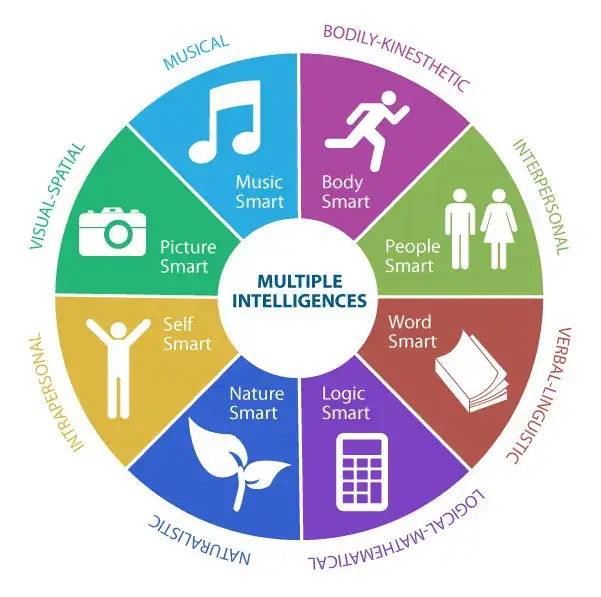 Howard Gardner’s Multiple Intelligences Theory
7 – Low Self-Awareness: The Root of Spiritual Stagnation
Intrapersonal intelligence is a fancy way of saying “knowing yourself.”
The biggest challenge with having low emotional and intrapersonal intelligence is that we lack a strong internal radar and feedback system.
With emotional and intrapersonal intelligence, we have:
- Self-awareness: Sufficient internal awareness to neutrally assess our thoughts, attitudes, impulses, reactions, judgments, and behaviors.
- Self-regulation: The ability to examine and regulate our emotions and feelings.
- Self-leadership: A strong internal observer who can evaluate and make course corrections as needed.
In the absence of these qualities, how can we successfully navigate one’s spiritual path?
Research shows that people who struggle to understand their own feelings are much more likely to have issues with stress and conflict.
A study in the European Journal of Investigation in Health, Psychology and Education shows that having high emotional intelligence helps you manage your feelings better and makes you more resilient when dealing with challenging life circumstances.2Garaigordobil M. (2020). Intrapersonal Emotional Intelligence during Adolescence: Sex Differences, Connection with other Variables, and Predictors. European journal of investigation in health, psychology and education, 10(3), 899–914. https://doi.org/10.3390/ejihpe10030064
True spiritual growth is impossible without a high level of self-awareness. When you lack intrapersonal intelligence, you lose your internal feedback system, making it nearly impossible to identify unconscious ego games or maladaptive behavior patterns.
As such, authentic spiritual growth requires us to engage in practices that help us build essential skills related to developing a strong internal observer.
8 – The Victim-Perpetrator Dynamic: Breaking the Ego Game
In this spiritual trap, the individual plays the Victim role while blaming an external person (or group) as the Perpetrator.
This victim-perpetrator ego game is age-old. It’s played at the individual, group, and national levels.
In the context of the spiritual journey, we often fall into the victim trap when we initiate the self-healing process.
And it’s understandable. In learning about our past, we naturally see others as the cause of our trauma and misfortune. The perceived cause might be a parent, a teacher, a friend, or a school bully.
The victim’s position is usually perceived first. It’s not that this perception is entirely inaccurate; it’s just not the whole story (from a bigger-picture perspective).
However, as long as we continue to play the victim-perpetrator game, we’re not ready to “let go”, arrive at acceptance, restore our internal power, and heal.
From the bigger picture, we see that a series of archetypes possesses each of us. And when various archetypal forces are in the driver’s seat, we are not in control of our behavior.
Instead, our prior conditioning and these archetypal energies rule us. Once this is all fully understood and digested, it’s difficult to engage in the victim-perpetrator game.
9 – The Lack of Discernment: Avoiding Ill-Advised Spiritual Paths
Discernment is “keen insight and good judgment.” It’s the ability to use critical thinking to separate authentic growth from marketing-driven spirituality.
Without this internal filter, spiritual seekers often fall for unverified claims and novelty-seeking behavior.
We can end up following various ill-advised “paths,” fields, and practices, driven by our ignorance, childlike naivete, and drive for novelty.
We might chase fleeting experiences (like altered states of consciousness) while neglecting the steady application of daily practice.
Be especially mindful of this trap if you have wandered into the new age camp. Discernment is often not exercised within this arena.
Some of us naturally possess higher degrees of discernment; others need to develop it through everyday learning (making mistakes) and continuous feedback.
Developing keen insight is the only way to avoid ending up in manipulative environments or unhealthy spiritual rabbit holes.
Along your inner journey, as you strip away everything you are not and move toward wholeness within yourself, spiritual discernment becomes more readily available.
Remember that true discernment is internally derived (from the Self).

10 – Avoiding Genuine Practice: The Difference Between States and Stages
This final spiritual trap affects individuals on devout religious, new age, and secular paths alike. Spiritual aspirants may avoid genuine practice for various reasons, including:
A) Not having a strong foundation in the importance of practice.
Without a strong foundation of how spiritual practices can transform us and help us develop, spiritual knowledge tends to remain exclusively conceptual (with no direct insights).
Often, the individual has a fixed mindset and is unaware of alternative options.
B) Focusing excessively on scripture and reading books.
When conceptual learning (book learning, sermons, and seminars) is not balanced with developmental practices, spiritual pride tends to grow rather than the individual.
That is, the authentic spiritual growth stagnates.
C) Proudly identifying oneself as “spiritual” or “religious.”
When an individual identifies themselves as spiritual or religious, they are maintaining an external identification. Identifying oneself as “spiritual” is nothing but a social mask—a standard ego game.
For example, if one proudly identifies themselves as spiritual or religious, they may find they are less motivated to engage in self-discovery or examine their shadow (unconscious).
What if they discover inner demons, desires, and attributes that are inconsistent with their spiritual identity? That’s a BIG risk!
Instead, they may simultaneously abort self-actualization and their authentic spiritual path without even knowing it.
D) Not understanding the vital difference between states and stages.
Spiritual practices exist that can produce positive results. However, many of these practices do not necessarily lead to internal development.
How is that possible?
As outlined in this guide to 200+ spiritual practices, some methods can trigger altered states of consciousness while others can lead to structural changes in one’s consciousness over time.
Generally, structured stages promote development, while altered states do not.3Wilber, K. (2000). Integral psychology: Consciousness, spirit, psychology, therapy. Shambhala Publications In many ways, our spiritual journey requires developmental progress.
Spiritual Traps FAQ
What is the most common spiritual trap?
The spiritual bypass is the most pervasive trap—using spiritual practices and concepts to avoid confronting unresolved emotional wounds, trauma, and shadow material. It’s essentially pseudo-spirituality dressed as growth.
How do I know if I’m spiritually bypassing?
Key signs include: using spiritual language to dismiss real emotions, feeling superior to “less evolved” people, avoiding conflict by claiming you’re “above it,” and prioritizing transcendent experiences over psychological healing.
What’s the difference between spiritual growth and pseudo-spirituality?
Genuine spiritual growth involves measurable psychological development, shadow integration, and increased self-awareness. Pseudo-spirituality is conceptual knowledge without inner work—looking spiritual without being transformed.
Why is shadow work important for spiritual development?
Without shadow integration, you remain divorced from your unconscious patterns. You can’t transcend what you refuse to acknowledge. Shadow work forces the inner honesty that makes genuine spiritual growth possible.
Can spiritual practices actually stall your growth?
Yes. When used as avoidance mechanisms rather than developmental tools, meditation, prayer, and other spiritual practices can reinforce the spiritual bypass and inflate spiritual pride rather than produce real transformation.
What is spiritual grandiosity?
Spiritual grandiosity is ego inflation masquerading as enlightenment—the belief that you’re spiritually superior, “chosen,” or more evolved than others. It’s a distortion that halts genuine development.
How do I develop spiritual discernment?
Discernment develops through: shadow work (inner honesty), critical thinking applied to spiritual claims, learning from mistakes, and cultivating the internal observer that distinguishes authentic insight from ego-driven fantasy.
Shadow Work: The Path to Inner Honesty and Grounding
While there may be many spiritual traps, the key to navigating them is the same: stay grounded and centered within yourself.
From a place of inner honesty, you become immune to most of these spiritual blockages.
This is why shadow integration is so absolutely integral to one’s spiritual path.
Shadow work breeds inner honesty and acceptance.
When I was engaged in the spiritual bypass, I didn’t want to acknowledge all the baggage I was dragging around.
When entranced by absolutist thinking, I wasn’t acknowledging how confused and fearful I was.
Divorced from my darker half, I couldn’t see my grandiosity and spiritual pride.
Shadow work forces you to come to terms with everything that’s left unaddressed from childhood.
Then, these various traps and the monsters they represent begin to fade in the background.
Safe journeys.
Read Next
Ready to move beyond these traps?
Start your journey with my Definitive Guide to Shadow Work and learn how to begin a structured daily practice.
See also:
What Is Spiritual Psychology? The Path to Integrating Ego and Spirit
A Wildly Practical Guide to Authentic Spiritual Awakening
Spiritual Healers & Their Shadow: A Complete, Real-World Guide
References
- Cumbey, C. (1983). The hidden dangers of the rainbow: The New Age movement and our coming age of anxiety. Huntington House.
- Garaigordobil M. (2020). Intrapersonal Emotional Intelligence during Adolescence: Sex Differences, Connection with other Variables, and Predictors. European journal of investigation in health, psychology and education, 10(3), 899–914. https://doi.org/10.3390/ejihpe10030064
- Larsen, S. (2007). The fundamentalist mind: How polarized thinking imperils us all. Wheaton, IL: Quest Books/The Theosophical Publishing House.
- Masters, R. A. (2010). Spiritual Bypassing: When Spirituality Disconnects Us from What Really Matters. North Atlantic Books
- Wilber, K. (2000). Integral psychology: Consciousness, spirit, psychology, therapy. Shambhala Publications.