
An unspoken underlying premise permeates both the field of psychology and the self-help industry: you’re somehow broken and need to be fixed.
This was one of Abraham Maslow’s great distinctions in the 1950s. While other psychologists fixated on mental illness, he turned the tables around and studied why some individuals access their higher potential.
This shift in framework is profound, and it’s an essential ingredient of spiritual psychology as well.
In this in-depth guide, we’ll explore what spiritual psychology is, how it differs from conventional psychology, and how you can use this holistic framework to heal and transcend the ego.
Let’s dive in …
Defining Spiritual Psychology: Beyond the Pathology-Focused Model
Spiritual psychology merges modern psychology with spiritual principles from the Wisdom traditions. It’s an interdisciplinary approach to the whole being, encompassing the body, the mind, and the spirit.
Researchers in the field emphasized that a truly transpersonal approach must transcend the ego without bypassing the essential work of psychological maturation.1Walsh, R., & Vaughan, F. (1993). On transpersonal definitions. The Journal of Transpersonal Psychology, 25(2), 199–207. https://www.atpweb.org/jtparchive/trps-25-93-02-199.pdf
Said another way, “You need to become somebody before you can become nobody.”
Spiritual psychology synthesizes the process of healthy ego development with transcendental frameworks and methods that support conscious awakening.
Distinguishing Spiritual Psychology from Conventional Clinical Paradigms
Most forms of psychology focus on mental illness.
That is, the field of psychology itself is a pathology-focused model. The underlying belief is that we (our egos) are sick and need to be made better. The field maintains an ever-increasing manual, the DSM-5-TR, that includes 298 disorders and nearly 70,000 diagnostic variations!
Consequently, modern psychology is fixated on the mind and everything that goes wrong with it. As such, it is focused on mental illness.
In contrast, spiritual psychology represents a more holistic and integrative understanding of the self that transcends and includes the mind.
Spiritual psychology is the study of the human experience through the lens of the total psyche (including Spirit).
The psyche represents the totality of one’s being, including body, mind, energy, soul, and spirit.
Authentic healing cannot take place when we only address the mind. Instead, we must examine and address the whole person.
| Dimension | Conventional Psychology | Spiritual Psychology |
|---|---|---|
| Ontology | Material reductionism; consciousness = brain activity | Consciousness is primary; matter is derivative |
| Scope | Mind (cognition, behavior) | Total psyche (body, mind, energy, soul, spirit) |
| Goal | Move from dysfunctional to functional | Integration → transcendence of ego |
| View of ego | Who you are | False self; a structure to mature then transcend |
| Pathology model | DSM-based; 298+ disorders | Trauma and shadow as developmental interruptions |
| Methods | Talk therapy, CBT, medication | Shadow work, meditation, somatic practices, archetypal mapping |
| Endgame | Symptom management, normal functioning | Individuation, Self-realization |
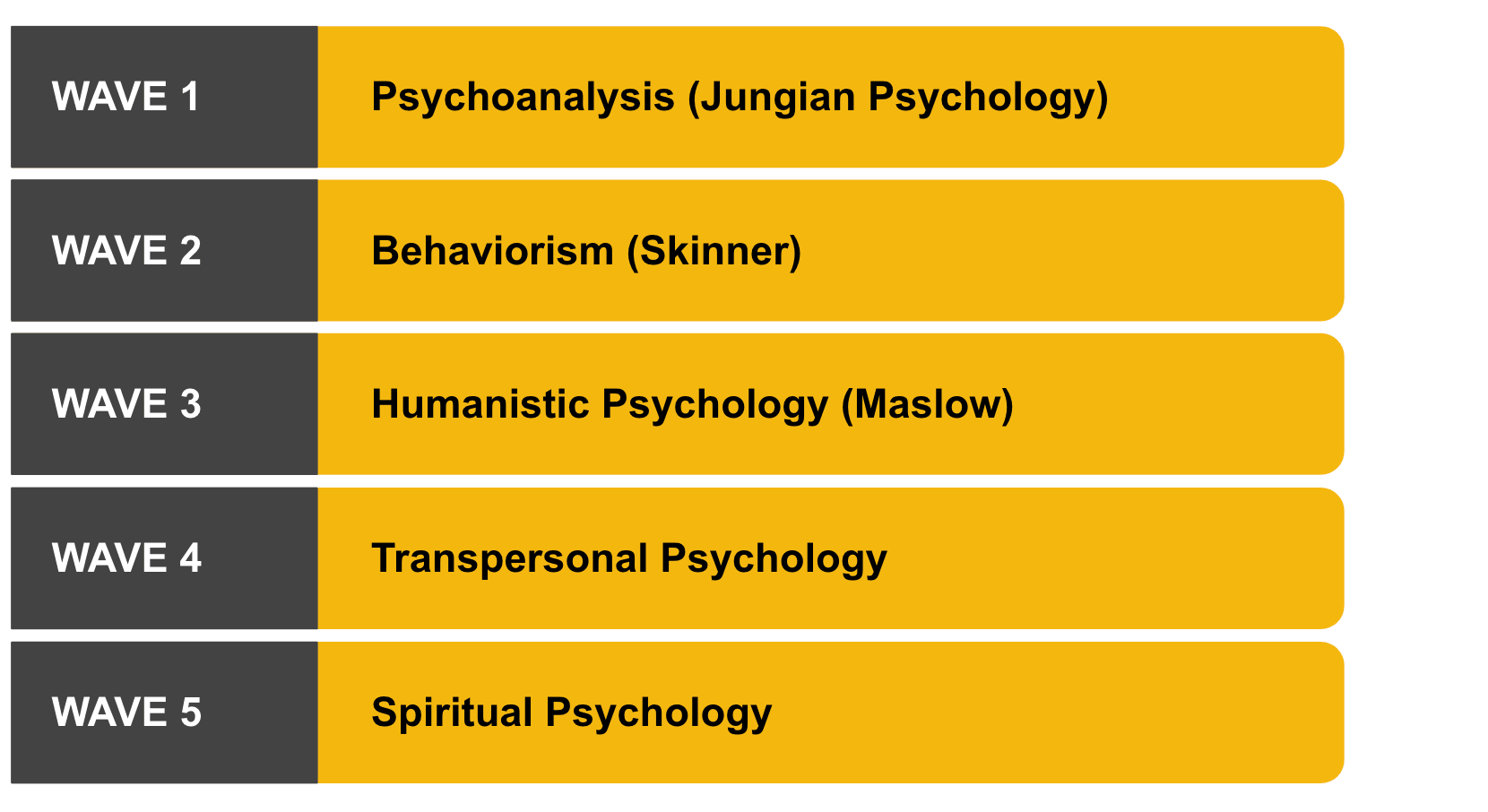 Five Waves of Psychology
The Roots of Spiritual Psychology: From Psychoanalysis to Transpersonal Development
Spiritual psychology finds its roots in several key waves of psychological theory, most notably:
Jung’s Foundational Ideas and the Individuation Process
Psychoanalysis was the first wave of psychology. However, psychoanalysis, led by Sigmund Freud, mainly focused on pathology and mental illness. (Freud set the tone for the entire field, which continues through today.)
Then, psychiatrist Carl Jung laid the groundwork by providing the first map of the human psyche. Jung delved deeply into the spiritual nature of humanity, a theme especially expressed in his later work.
Jung’s individuation process is a spiritual imperative for anyone genuinely looking for psychological sanity.
Humanistic Psychology: Maslow, Rogers, and the Self-Actualization Framework
Pioneered by psychologists like Abraham Maslow and Carl Rogers, humanistic psychology sought to understand human beings at their best.
That is, instead of focusing on mental illness, Maslow and Rogers asked, What does positive mental health really look like? What are humans actually capable of?
In Maslow’s case, this led to a deep study of self-actualization and the various ways humans access their highest creative potential.
The Transpersonal Revolution: Synthesizing Eastern Philosophy and Western Psych
Transpersonal psychology built momentum in the 1970s during the Human Potential Movement. Psychologists began synthesizing Western theories and practices with Eastern philosophies and methods.
Notable contributors include Stanislav Grof, famous for his work with LSD psychotherapy (1975) and holotropic breathing, and Roberto Assagioli’s Psychosynthesis, which was a modernization of Jung’s work.
While meditation was considered a cop out among traditional psychoanalysts, during the transpersonal revolution, it became an essential practice for psychological development.
Spiritual psychology is a synthesis of these earlier fields and, in many ways, is virtually indistinguishable from transpersonal psychology.
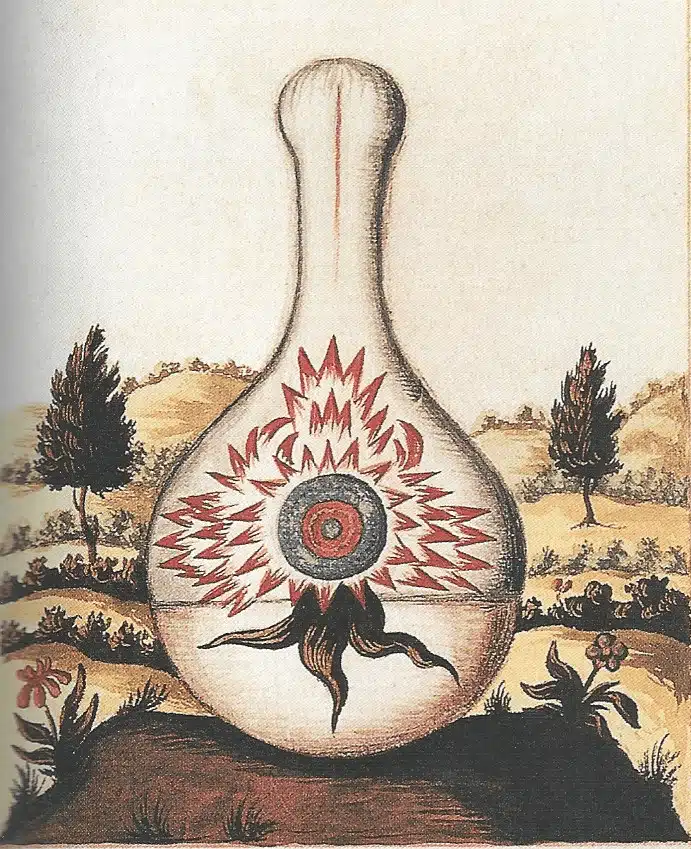
Core Frameworks: The Architecture of the Multidimensional Self
The following core concepts help further highlight how spiritual psychology differs from other mainstream approaches.
The Multidimensional Self: Moving Beyond Ego-Identity
Traditional psychology is focused on the ego, one’s sense of self, or self-identity.
Spiritual forms of psychology include this ego but also acknowledge a higher or greater aspect, known as the Higher Self, Transpersonal Self, or just Self (with a capital S).
While the basic ego represents a collection of programming and conditioning from childhood, the Higher Self is unconditioned, unharmed, and complete.
While general psychology views the ego as who you are, Eastern traditions view this ego as the false self.
From the Eastern, Jungian, and transpersonal viewpoint, the Self is closer to who we really are.
The importance of this distinction cannot be overstated. Yes, we can address various ego-related problems, but authentic healing comes from accessing the Self.
Materialism vs. Consciousness: Establishing a New Ontology
At its core, traditional psychology fails to understand and heal the individual in the same way that mainstream science has a limited understanding of the cosmos: the prevailing paradigm is materialism.
The fancy term is “material reductionism“—the belief that matter is the fundamental building block of everything.
However, material reductionism is at odds with the insights of great mystics and sages throughout time, as well as great scientific thinkers who are considered “fringe.”
For this cohort, spirit or consciousness comes first; matter comes second.
In materialistic sciences, including much of modern psychology, consciousness is relegated to brain activity (cognition), and spirit isn’t even part of the equation.
Spiritual psychology operates from a completely different ontology. Here, consciousness is primary; pure awareness is the foundational reality.
As nuclear physicist Amit Goswami breaks down in The Self-Aware Universe (1993), consciousness creates the material universe—not the other way around.
This vital insight is essential for genuine self-healing.
Preventing Spiritual Bypassing: The Trap of Premature Transcendence
Research in humanistic and developmental psychology shows that humans develop or evolve through specific stages.
Various models highlight these stages, including Jane Loveinger’s six stages of ego development and Erik Erikson’s eight psychosocial stages. All of these various models illustrate the basic path to a healthy, mature, integrated human ego.
Many individuals focused on spirituality, however, subconsciously seek to avoid this arduous path of psychological development. Instead, they wish to leapfrog directly to the end: enlightenment or Self-realization.
This innocent impulse leads to what’s called a spiritual bypass. Here, the individual essentially avoids self-discovery, past trauma, repressed emotions, and poor behaviors. Instead, they focus on reading and talking about spiritual ideas and concepts.
Spiritual bypassing is an attempt to avoid addressing the ego (small self) entirely, and it always leads to the same place: stagnation. The individual ends up cycling in the same place, year after year.
Spiritual psychology grounds the individual in everyday practices to help avoid this common spiritual trap.
Reframing the Human Experience: From “Being” to “Integrating”
Perhaps you’ve heard this phrase before:
We are not human beings having a spiritual experience; we are spiritual beings having a human experience.
I recall first hearing this quote from psychologist Wayne Dyer during a seminar in the mid 1990s. At the time, it struck a chord.
Today, this sounds cliché and “new agey” to me. Why? Because it fosters yet another artificial duality: human vs spiritual experience, as if these terms are mutually exclusive.
When this idea becomes part of our operating system, it often leads us to cut ourselves off from aspects of our own being. We become too detached.
Also, identifying oneself as a “spiritual being” can be deceptively elevating, which over time can lead to subtle expressions of grandiosity and ego inflation.
I suggest that it is more grounded to incorporate spirituality as part of the human experience rather than separate from it.
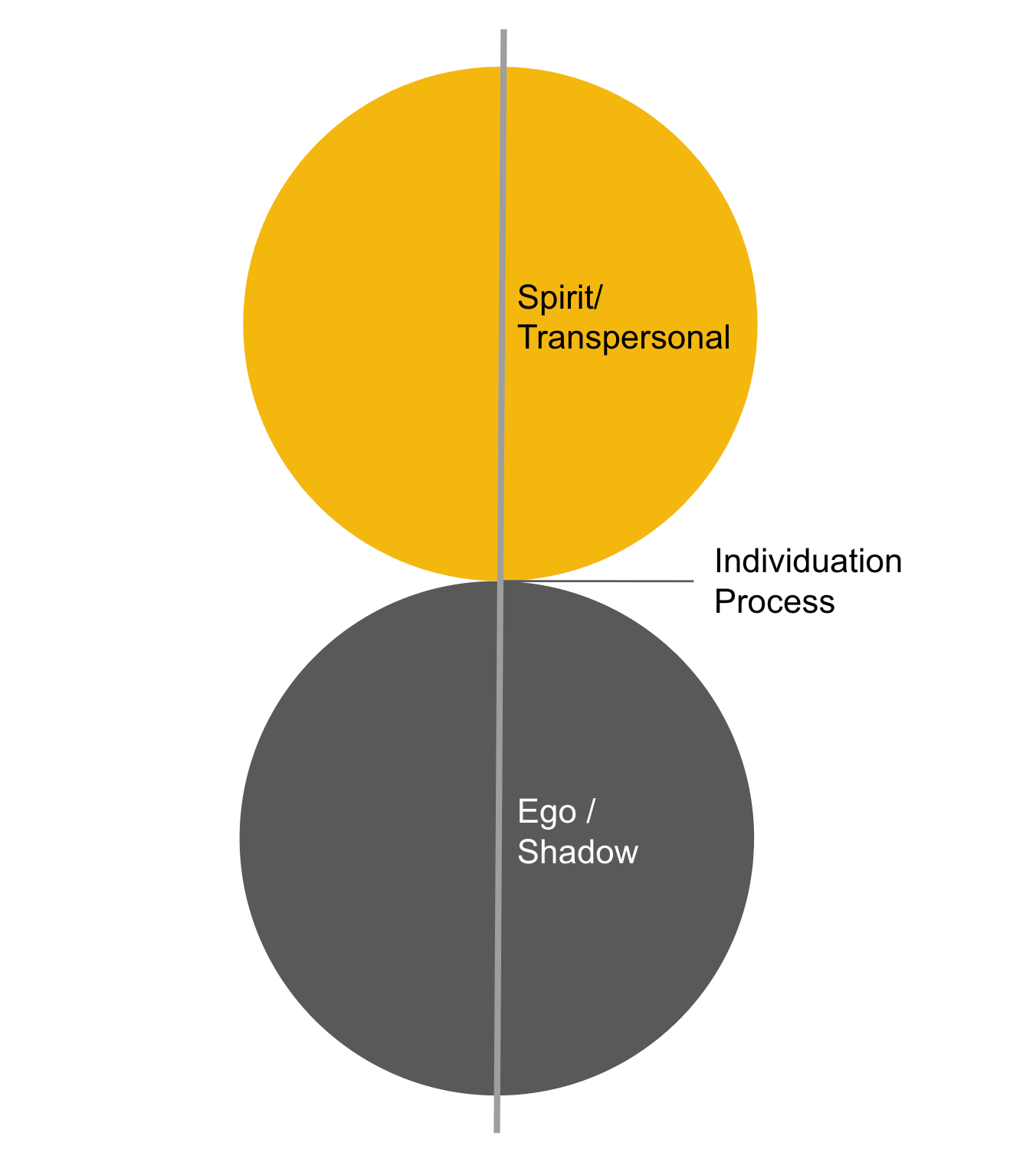 The Alchemical Axis
The Process: Making Psychological Healing a Spiritual Practice
Framing psychological healing as a spiritual practice highlights the practical nature of spiritual psychology as an overall holistic framework. This process begins with the shadow.
Shadow Integration: Making the Unconscious Conscious
Shadow work is the missing ingredient in most forms of modern psychology and spiritual disciplines alike.
Most of us have the tendency and preference to be perceived as “good.” In our efforts to “be the Light,” we tend to divorce ourselves from the darkness.
This process begins in early childhood and leads to the development of what Jung called the Shadow. The shadow represents everything we don’t know about ourselves—everything we are not currently conscious of.
Getting to know and integrating our shadow is the first step in Jung’s individuation process and an essential practice of spiritual psychology.
In truth, the “light” we’re seeking remains inaccessible until the darkness within us is made conscious and owned.
Or, as Jung put it,2Jung, C. G. (1968). The philosophical tree (R. F. C. Hull, Trans.). In H. Read, M. Fordham, & G. Adler (Eds.), The collected works of C. G. Jung: Vol. 13. Alchemical studies (pp. 251–349). Princeton University Press.
One does not become enlightened by imagining figures of light, but by making the darkness conscious.
Shadow work is the #1 antidote to the spiritual bypass.
Trauma Resolution: Addressing Repressed Emotions and Somatic Suffocation
The roots of most, if not all, of our self-inflicted suffering originate in childhood. While one’s level or severity of childhood trauma differs, none of us gets off scot-free.
Without trauma and repressed emotions, healthy development would be a natural and organic process. But sadly, this is virtually never the case.
As psychologist Bessel van der Kolk highlights in The Body Keeps the Score (2015), the trauma from our past is recorded and stored within our bodies—a well-documented insight in Taoist energetic practices for centuries.
This is why the spiritual bypass doesn’t produce positive results: this trauma must be brought to light and accepted first.
As psychoanalyst Donald Winnicott (1974) explained,
The catastrophe you fear will happen has already happened.
If I had heard this concept in my 20s, I probably would have balked at it. However, decades of inner work later, I can only marvel at this insight.
Thankfully, there are proven methods for addressing trauma and somatic tension, including EMDR, trauma release exercises, and bioenergetic analysis.
The Role of Suffering: Recontextualizing Pain as a Catalyst for Growth
Internal anguish isn’t something we easily embrace. It’s natural to try to avoid difficult feelings, unpleasant memories, and unflattering realizations.
However, by avoiding these discomforts, we tend to self-medicate (sedate) ourselves and therefore stall progress.
Seen more clearly, inner pain is a necessary precursor to positive change. Once embraced, suffering can be an initiatory force for growth.
It’s only when we suppress this pain that the anguish persists and lingers (seemingly indefinitely).
Once again, this is why the spiritual bypass is both alluring and harmful. It’s alluring because it justifies our resistance to facing the pain; it’s harmful because it forces stagnation and stalls further progress.
Spiritual psychology provides tools inspired by Eastern and Western methods to address our pain without being overwhelmed by it. We’ll discuss some of these methods below.
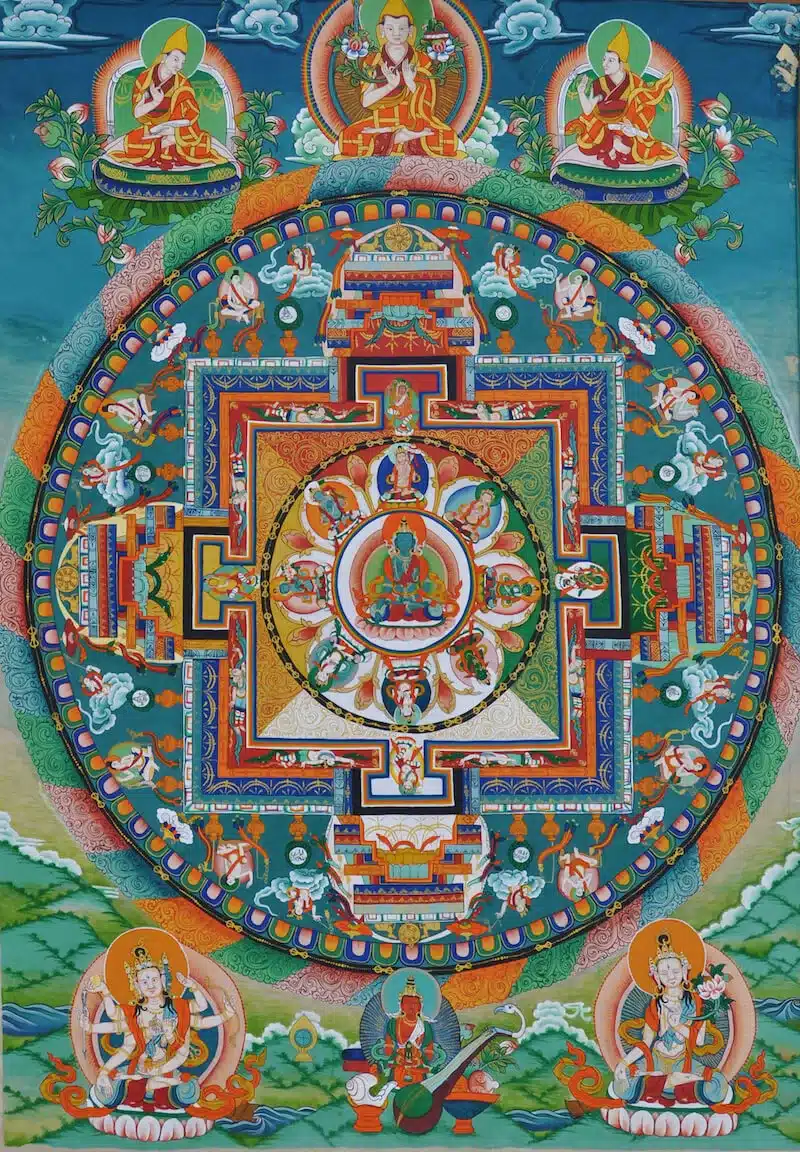
Integrative Practices for Conscious Evolution
As we’ve established, spiritual actualization requires psychological development.
The ego has many triggers, hang-ups, and blind spots. Consequently, it’s virtually impossible to see ourselves accurately from the ego’s rigid vantage point.
Rooted purely in one’s conditioned ego, we fail to see our past completely, make peace with it (acceptance), or move on.
But while the ego clings, the Transcendent Self lets go because IT knows we are not that.
To help navigate the minefield of inner work, spiritual psychology deploys integrative practices that support psycho-spiritual development and facilitate conscious evolution.
The Inner Observer: Accessing the Witness State
The traditions have various terms for the Self, including Inner Observer, Observing Mind, Observing Self, and Witness.
The Inner Observer is a neutral aspect of one’s Beingness. It’s nonattached, untriggered, unconditioned, and impersonal.
Accessing this Inner Observer is a central aspect of many meditative traditions. From this Observing Self, one can witness one’s thoughts and emotions without getting hooked by them.
Everyone has this Inner Observer; however, in most of us, the noise of the conditioned ego obscures it. As such, specific meditative training is used to ground ourselves in the ever-present witness.
From the Witness state, we can observe the ego and its problems without bypassing our pain and discomfort.
The Power of Neutrality: Centering the Self in Daily Life
The Center is another powerful principle in both Eastern systems and spiritual psychology. It, too, represents the organizing principle of the Self.
Oftentimes, one is instructed to locate and hold to the Center to realize the Self.
When we hold to the Center, we feel alive, alert, active, empty, and calm.
Neutrality is the defining characteristic of the Center.
The ego is anything but neutral. However, in a state of neutrality, we can see our past clearly and witness ourselves without judgment and emotional triggers. This state is the key to making rapid progress in our development.
Learning how to center yourself (and how to notice when you’re out of center) is an essential skill for transpersonal development.
Archetypal Mapping: Reflective Inquiry and the Psyche’s Multiplicity
While modern psychology views the ego as a singular entity (“the ego”), integrative psychologies—including Jungian, psychosynthesis, Internal Family Systems (IFS), and archetypal psychology—perceive the ego as a multiplicity.
That is, instead of the ego being a singular character, it’s viewed as a cast of characters, parts, or archetypes.
Archetypes are semi-autonomous subpersonalities within the psyche. Each archetypal pattern has its own thought patterns, behavioral tendencies, desires, memories, and proclivities.
Introducing this understanding of archetypes illustrates the complexity of the human psyche. It also helps explain so much of human behavior.
Inner dialogue—whether it’s using the Jungian method of active imagination, the IFS method, or another approach—brings these archetypal patterns into consciousness.
Reflective inquiry helps us communicate, navigate, and ultimately establish order between these various parts. It’s a powerful tool for building consciousness of one’s inner world.
While there may be a mainstream taboo against inner dialogue (“only crazy people talk to themselves”), it’s a powerful integrative tool for bringing balance to the psyche.

Living Method: Protecting Mental Sovereignty in a Distracted World
Ultimately, for spiritual psychology to be effective and nurturing, it must be integrated into one’s overall way of being.
Correct Practice: Distinguishing Living Methods from Isolated Rituals
Taoism makes an important distinction between a “living method” and a “dead method.”
For example, in the context of meditation, a dead method is when you sit on a cushion for 20 minutes before starting your day. This method is considered “dead” because the practice is isolated from the rest of your day (i.e., being).
In contrast, meditation becomes a “living method” when the practice stays with you even after you get off the cushion.
The sitting practice sets the foundation, but it’s what happens afterward that counts. Do you maintain that observing state as you eat, interact with others, and engage with your daily affairs? That’s a living method.
In fact, a “dead method,” which is practiced by virtually all spiritual bypassers, creates a new dichotomy or split within the psyche. I did this for many years when I first started meditating. You don’t even realize it’s happening. You create a “spiritual self” that’s divorced from your everyday conscious personality.
With a living practice, there’s no division. Once stabilized, the Observer becomes ever-present.
Navigating Modernity: Protecting Mental Sovereignty from Digital Entrainment
The reality is that much of modernity and the “conveniences” it provides is a double-edged sword, if not a seductive trap.
The noise of digital technology can be overwhelming. Social media encourages anxiety and depression.
Blue light devices drain our mental fortitude and disrupt our biological clock. EMF radiation emitted from our beloved technology disrupts our energetic fields. All of it is, by its nature and intended design, addictive.
Spiritual psychology can’t ignore the realities of modern life; it can only help contain and manage them.
Finding depth in one’s spiritual journey requires us to protect our mental sovereignty by establishing boundaries with technology, so we can stabilize within ourselves.
This is no easy feat. The mind is wired for constant stimulation and distraction, which keep us disconnected from the Self.
A simple strategy, such as avoiding technology for the first few hours each morning and for the first few hours before sleep, can be highly effective.
Establishing a morning routine focused on integrative practices can help you build a strong foundation for the day. Detaching from technology in the evening helps one’s body and mind relax, so you experience more restorative, deeper sleep.
Navigating the Inner Terrain: Key Questions
Q: How does spiritual psychology differ from traditional psychotherapy?
Traditional psychotherapy often operates within a pathology-focused model, aiming to move the patient from “dysfunctional” to “functional.”
Spiritual psychology addresses the whole person—body, mind, and spirit—and views the ego not as the final destination of health, but as a structure to be integrated and transcended through the Higher Self.
Q: Is spiritual psychology compatible with religious belief?
Spiritual psychology is not a religion. It is an ontological framework that recognizes consciousness as primary.
While it draws on the universal, experiential truths found in Eastern and Western mystical traditions, it does not require adherence to any specific dogma. It is concerned with direct experience of the Transpersonal, not faith in external doctrine.
Q: What is the biggest risk of blending spirituality with psychology?
As discussed above, the primary risk is spiritual bypassing—using spiritual concepts and practices to avoid confronting unresolved psychological trauma, repressed emotions, and shadow material.
A rigorous spiritual psychology practice always grounds transcendence in the gritty, necessary work of shadow integration and ego maturation first.
Q: Do I need a therapist to practice spiritual psychology?
While the internet provides frameworks for self-inquiry and reflective practice, working with a trained transpersonal or Jungian analyst can be invaluable for navigating deep-seated trauma and archetypal material that the ego cannot easily see on its own.
Ultimately, it’s a personal choice. Trust yourself to determine what’s best for you.
Conclusion: The Evolutionary Path of Becoming
There’s a vital reason we find stories, myths, and legends so engaging.
In them, we find the completed Hero’s Journey: the departure, the initiation, and the return home.
The Hero’s Journey Framework
That is, the journey has a specific sequence:
Departure: There’s a call to adventure. The hero reluctantly answers that call and is forced to leave the familiar world, entering the unknown.
That is, it must step outside the comforting confines of the conscious ego.
Initiation: Problems and drama unfold. The hero must overcome great challenges.
We plunge into the depths of our psyche, facing our fears, meeting our traumas and limitations head-on.
Return: The hero returns home, a changed person.
Through arduous inner work and contemplative practices, we become more integrated, transcendent, and whole.
Your Call to Adventure: The Practice of Becoming
But the real Hero’s Journey isn’t about arriving at a singular destination; instead, it’s a lifelong practice of becoming.
And in this context, the call to adventure isn’t external, but internal.
Are you ready to turn inward and begin your own process of self-inquiry?
Are you willing to plunge to the depths of your being to see what lurks in the shadows?
Can you make friends with yourself (including whatever you discover about yourself later on) and transcend the ego?
If so, the inward journey awaits.
Safe travels!
Read Next
The Ultimate Guide to Self-Transcendence (Maslow)
The 3 Stages of Spiritual Growth: From Self‑Discovery to Self‑Realization
The Individuation Process: A Beginner’s Guide to Jungian Psychology and the Path to Wholeness
Jung and Alchemy: A Comprehensive Guide to the Alchemical Magnum Opus
References
- Goswami, A. (1993). The self-aware universe: How consciousness creates the material world. Tarcher/Putnam.
- Grof, S. (1975). LSD psychotherapy: The healing potential of psychedelic medicine. Hunter House.
- Jung, C. G. (1968). The philosophical tree (R. F. C. Hull, Trans.). In H. Read, M. Fordham, & G. Adler (Eds.), The collected works of C. G. Jung: Vol. 13. Alchemical studies (pp. 251–349). Princeton University Press. (Original work published 1945)
- van der Kolk, B. A. (2015). The body keeps the score: Brain, mind, and body in the healing of trauma. Viking.
- Walsh, R., & Vaughan, F. (1993). On transpersonal definitions. The Journal of Transpersonal Psychology, 25(2), 199–207.
- Winnicott, D. W. (1974). Fear of breakdown. International Review of Psycho-Analysis, 1(1-2), 103–107.