
What if the same forces that shape myths also move within you?
Across history, people have told the same tales—the hero’s quest, the trickster’s deception, the mentor’s wisdom—because each expresses a recurring pattern in the human psyche.
Many people meet archetypes through stories—hero and villain, mentor and trickster—long before they realize these patterns live inside the mind itself.
Psychologist Carl Jung gave language to what storytellers have always known.
This guide distills more than 350 archetypes drawn from mythology, literature, and psychology. It reveals how these timeless energies operate in culture and in us.
Let’s dive in …
What is an Archetype?
An archetype is a recurring pattern of perception, emotion, and behavior that arises from the collective imagination of humanity. It is both a symbolic image and an instinctive template that shapes how we experience life.
Archetypes surface wherever human beings create meaning—through myth, art, writing, religion, and personal behavior. They are the invisible architecture of our imagination: the hero who faces chaos, the mother who nourishes, the trickster who disrupts.
Swiss psychiatrist Carl Jung described archetypes as “living systems of reactions and aptitudes”—forms the instincts assume in psychic life.1Jung, C. G. (1969). The structure and dynamics of the psyche (R. F. C. Hull, Trans.). H. Read et al. (Eds.), The collected works of C. G. Jung (Vol. 8, 2nd ed.). Princeton University Press He saw them not as learned ideas but as inherited potentialities that influence how we think, feel, and act.
Every culture gives its own names and symbols to these primordial images, yet the emotional signatures remain constant: courage, betrayal, nurture, transformation. Recognizing them helps us perceive the forces already moving within us.
Virtually every response we give to our environment is an expression of an archetype. All human behavior is guided by archetypal forces.
To understand archetypes is to translate behavior back into its original story—revealing that we are not isolated personalities but expressions of a shared human myth.
Types of Archetypes Across Story, Myth, and Mind
Archetypes appear in every domain where humans seek meaning. Across myth, story, and psychology, they reflect three overlapping dimensions:
- Mythic Archetypes: Universal forces embodied in gods, heroes, and cosmic dramas.
- Story Archetypes: Recognizable characters and narrative functions shaping fiction, film, and folklore.
- Psychological Archetypes: Inner patterns that direct emotion, thought, and behavior in daily life.
Regardless of context, each archetype expresses a symbolic energy moving between these worlds: the same Hero who slays monsters in myth is the one who faces fear within you.
Character Archetypes in Myth and Storytelling
Stories are the theater where archetypes play out most vividly. Every epic, film, or fairy tale arranges familiar roles that mirror psychological functions within us:
- The Hero – Acts on courage to overcome a challenge.
- The Mentor – Offers guidance born of experience.
- The Shadow – Embodies what the Hero must confront.
- The Trickster – Disrupts order to reveal hidden truth.
- The Lover – Seeks union and connection.
- The Caregiver – Protects and sustains life.
- The Ruler – Establishes structure and stability.
These same characters fill ancient myth, classic literature, and streaming dramas alike—proof that storytelling remains our oldest mirror for the psyche.
We have an unbroken lineage from Homer to Hollywood. The quintessential Hero’s Journey motif lives on.
Recognizing these characters sharpens perception of both narrative craft and the inner dramas they reflect.
Jump directly to the Master List of Archetypes
How to Create a List of Archetypes
The common belief about archetypes is that there are only a select few.
For example, a list of archetypes might have only 4, 6, or 12. Or, perhaps you’ll see a list of 52 or 80.
The reality is that there are thousands of archetypes. Each one possesses different behavioral patterns and subtleties.
However, a list of archetypes numbering in the thousands won’t be practical.
There’s no need to try to memorize any of these archetype lists. As Jung explains:2C.G. Jung, The Collected Works, Vol. 9, I, The Archetypes and the Collective Unconscious, 1969, Para 62.
It is no use at all to learn a list of archetypes by heart. Archetypes are complexes of experiences that come upon us like fate, and their effects are felt in our most personal life.
So first, we’ll run through a few archetype lists from popular models. Then, I’ll present a comprehensive list of archetypes for you to review.
Major Archetype Frameworks
Throughout history, psychologists, mythologists, and storytellers have mapped archetypes into structured models. Each offers a different lens on the same underlying forces: patterns that drive behavior, creativity, and transformation.
From Jung’s early psychological map to mythic systems like the Tarot, Zodiac, and Greek gods, these frameworks help us recognize universal energies wearing cultural costumes.
What changes is the language—hero, king, lover, fool—but the essence remains constant: the patterned intelligence of human nature seeking self‑understanding through story.
Use the following jumplinks to go directly to a particular framework:
- Jung’s Core Archetypes
- Masculine Archetypes (King | Warrior | Magician | Lover)
- Feminine Archetypes (Bolen’s Seven Goddess Patterns)
- Pearson’s 12 Personality Archetypes
- Enneagram Patterns as Archetypes
- Myss’s Spiritual Archetypes (80 Archetype Cards)
- Cultural & Symbolic Lineages (Tarot | Zodiac | Greek Gods)

Jungian Archetypes List
We start our journey with the man who popularized the concept of archetypes.
Perhaps more than anyone else, Carl Jung provided us with a map of the human psyche.
Through his analytical psychology, Jung classified many of the driving forces that dominate human behavior. (See my beginner’s guide to Jung’s individuation process.)
To Jung, archetypes weren’t just characters or subpersonalities. They also included motifs, symbols, and images. For example, birth, marriage, and death are symbolic archetypes in Jung’s canon.
The primary archetype examples Jung addresses throughout Archetypes and the Collective Unconscious (1959):
| The Self | The Mother |
| The Anima | The Child |
| The Animus | The Wise Old Man |
| The Shadow | The Hero |
| The Persona | The Trickster |
| The Father | The Maiden |
Jung referenced many other archetypes in his work, but the list above highlights the primary ones.
Get a closer look: see Jungian Archetypes: A Complete Guide to the Psyche’s Timeless Patterns.
List of 4 Masculine Archetypes
Another model for understanding archetypes comes from neo-Jungian Robert Moore. I reference Moore’s model frequently on this website because I find it incredibly practical and accurate.
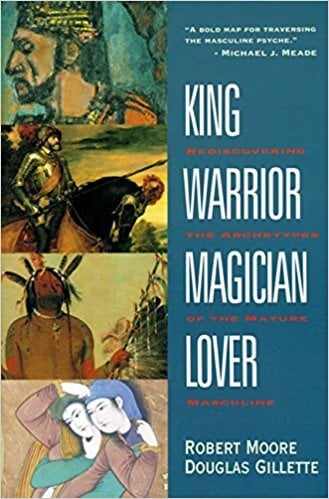
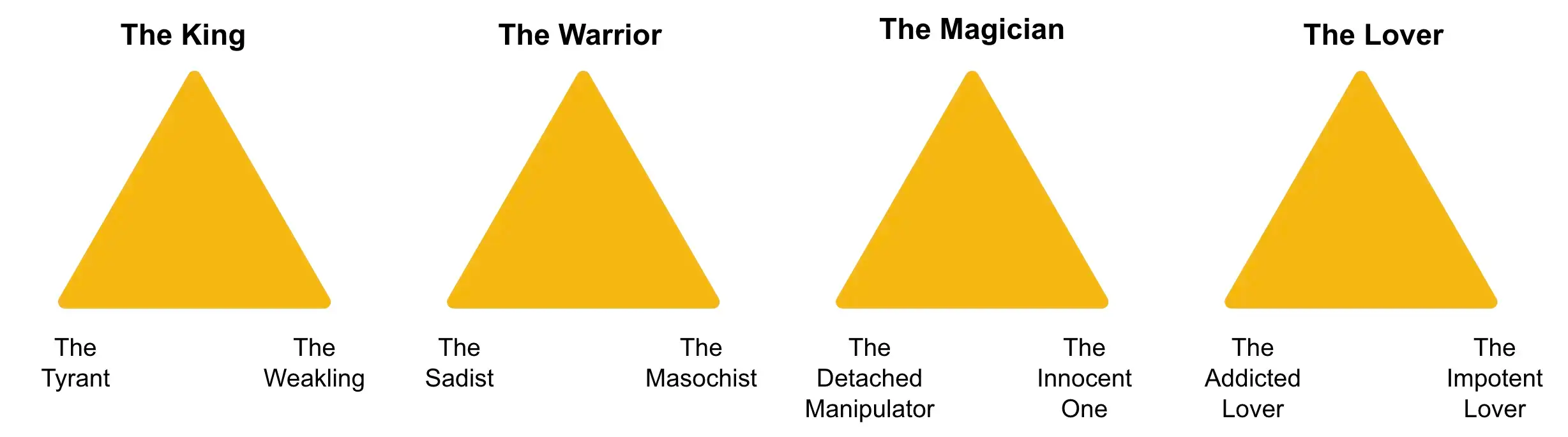
In King Warrior Magician Lover (1991), Moore and Gillette highlight the four primary archetypes in the masculine psyche, as well as the eight bipolar shadow archetypes that accompany them.
The four healthy masculine archetypes are:
- King
- Warrior
- Magician
- Lover
The eight shadow archetypes are:
| The Tyrant | The Weakling |
| The Sadist | The Masochist |
| The Detached Manipulator | The Denying “Innocent” One |
| The Addicted Lover | The Impotent Lover |
 Robert Moore’s Structure of the Psyche
The four healthy archetypes of boyhood are:
- The Divine Child
- The Hero
- The Precocious Child
- The Oedipal Child
The eight shadow archetypes of boyhood are:
| The High Chair Tyrant | The Weakling Prince |
| The Grandstander Bully | The Coward |
| The Know-it-all Trickster | The Dummy |
| The Momma’s Boy | The Dreamer |
While Moore’s archetypal research focused on the masculine archetypes, his model extends to the feminine psyche, where the Queen represents the King.3https://robertmoore-phd.com/index.cfm?fuseaction=page.display&page_id=32 He does suggest, however, that other variations in the feminine psyche probably aren’t addressed in his work.

Feminine Archetypes (Bolen’s Seven Goddess Patterns)
Psychiatrist Jean Shinoda Bolen identified seven feminine archetypes rooted in Greek mythology in Goddesses in Everywoman (1984).
Each symbolizes a different expression of feminine energy—nurture, authority, passion, innocence, independence, wisdom, and spiritual communion. These patterns operate in every psyche, not only in women, as ways of creating and relating to life.
These 7 female archetypes, based on her analysis of the Greek goddesses, are:
- The Mother
- The Queen
- The Lover
- The Maiden
- The Huntress
- The Wise Woman
- The Mystic
But again, this is just one example of feminine archetypes.
Clarissa Pinkola Estés featured the Wild Woman archetype in Women Who Run With Wolves (1992). Jungian Nancy Qualls-Corbett wrote a dedicated treatment on The Sacred Prostitute (1988). There are countless others.
Also, most of the archetypes listed in this guide can be masculine or feminine. For example, in the feminine psyche, the Lover, the Warrior, and the Magician exist, just as they do in the masculine psyche.

Pearson’s 12 Personality Archetypes
The “12 Archetypes” is a popular personality model from Margaret Mark and Carol Pearson’s Awakening the Heroes Within (1991). This 12-archetype model—the PMAI instrument—was later popularized in books like The Hero and the Outlaw (2001) by the same authors.
To clarify, while Pearson’s work is based on Jung’s insights, these 12 personality archetypes are not explicitly identified in Jung’s work.
The 12 personality archetypes in Pearson’s model are:
| The Innocent | The Lover |
| The Orphan | The Creator |
| The Hero | The Jester |
| The Caregiver | The Sage |
| The Explorer | The Magician |
| The Outlaw | The Ruler |
These 12 are also referred to as brand archetypes and are used by businesses in their marketing strategies.

Enneagram Patterns as Archetypes
Every personality system represents a collection of archetypes. In my opinion, the most robust personality model is the Enneagram. Within the Enneagram community, there are two versions of the model. While they are both similar, they use different names to characterize the archetypes.
One model developed by Don Riso and Russ Hudson outlines the nine personality types (or archetypes) of the Enneagram as follows:
Type 1: Reformer
Type 2: Helper
Type 3: Achiever
Type 4: Individualist
Type 5: Investigator
Type 6: Loyalist
Type 7: Enthusiast
Type 8: Challenger
Type 9: Peacemaker
The other model used by Enneagram Worldwide and highlighted by Helen Palmer in The Enneagram describes the personality archetypes as:
Type 1: The Perfectionist
Type 2: The Giver
Type 3: The Performer
Type 4: The Romantic
Type 5: The Observer
Type 6: The Loyal Skeptic
Type 7: The Epicure
Type 8: The Protector
Type 9: The Mediator
Riso and Hudson’s Enneagram model also includes nine variations or levels of each personality type. If we treat each level as an archetype, the Enneagram contains 81 archetypes. Plus, each type has “wings” and “variants,” which easily quadruples the number of potential archetypes.

Myss’s Spiritual Archetypes (80 Archetype Cards)
Author and medical intuitive Caroline Myss introduced an archetypal model that focuses on spiritual contracts and life purpose rather than on personality.
Her deck of eighty archetype cards ranges from the Healer and Visionary to the Victim and Saboteur—each portraying a light and shadow expression of the soul’s lessons.
Where Jung mapped the psyche and Moore outlined maturity, Myss explores the energies through which we orchestrate karma and service. Her system invites introspection on how our spiritual patterns play out in daily choices and relationships.
Myss’ archetypes list includes:
| Addict | Liberator |
| Advocate | Lover |
| Alchemist | Martyr |
| Angel | Mediator |
| Artist | Mentor |
| Athlete | Messiah |
| Avenger | Midas/Miser |
| Beggar | Monk |
| Bully | Mother |
| Child: Orphan | Mystic |
| Child: Wounded | Networker |
| Child: Magical | Nun |
| Child: Nature | Pioneer |
| Child: Eternal Boy/Girl | Poet |
| Child: Divine | Priest |
| Clown | Prince |
| Companion | Prostitute |
| Damsel | Queen |
| Destroyer | Rebel |
| Detective | Rescuer |
| Dilettante | Saboteur |
| Don Juan | Samaritan |
| Engineer | Scribe |
| Exorcist | Seeker |
| Father | Servant |
| Femme Fatale | Shape-shifter |
| Gambler | Slave |
| God | Storyteller |
| Goddess | Student |
| Guide | Teacher |
| Healer | Thief |
| Wounded Healer | Trickster |
| Hedonist | Vampire |
| Hero/Heroine | Victim |
| Judge | Virgin |
| King | Visionary |
| Knight | Warrior |
Cultural & Symbolic Lineages of Archetypes
Long before psychology gave archetypes a name, ancient cultures mapped them through story, ritual, and divination.
Systems like the Tarot, the Zodiac, and the Greek pantheon each mirrored the same forces Jung later described—only in mythic form.
These symbolic lineages remind us that archetypes aren’t theories but living patterns woven into human history.
They reveal how every era, using its own language of gods and symbols, sought to understand the universal designs shaping fate, character, and transformation.

Tarot Cards
The Major Arcana can be perceived as a sequential map of transformation. For example, The Fool and The World mark the psyche’s beginning and return.
Jung and the Jungians devote considerable attention to divination systems, such as Tarot, the I Ching, and astrology. (Read Jungian Synchronicity Explained.)
For Jung, these systems provide another means of access to the unconscious. All of the 78 Tarot cards and the 64 hexagrams of the I Ching represent archetypes. Jung had a particular fascination with Tarot, largely because it was considered “taboo.”
The Major Arcana tarot cards are:
| The Fool | The Magician |
| The High Priestess | The Empress |
| The Emperor | The Hierophant |
| The Lovers | The Chariot |
| Strength | The Hermit |
| Wheel of Fortune | Justice |
| The Hanged Man | Death |
| Temperance | The Devil |
| The Tower | The Star |
| The Moon | The Sun |
| Judgment | The World |
The Zodiac Signs
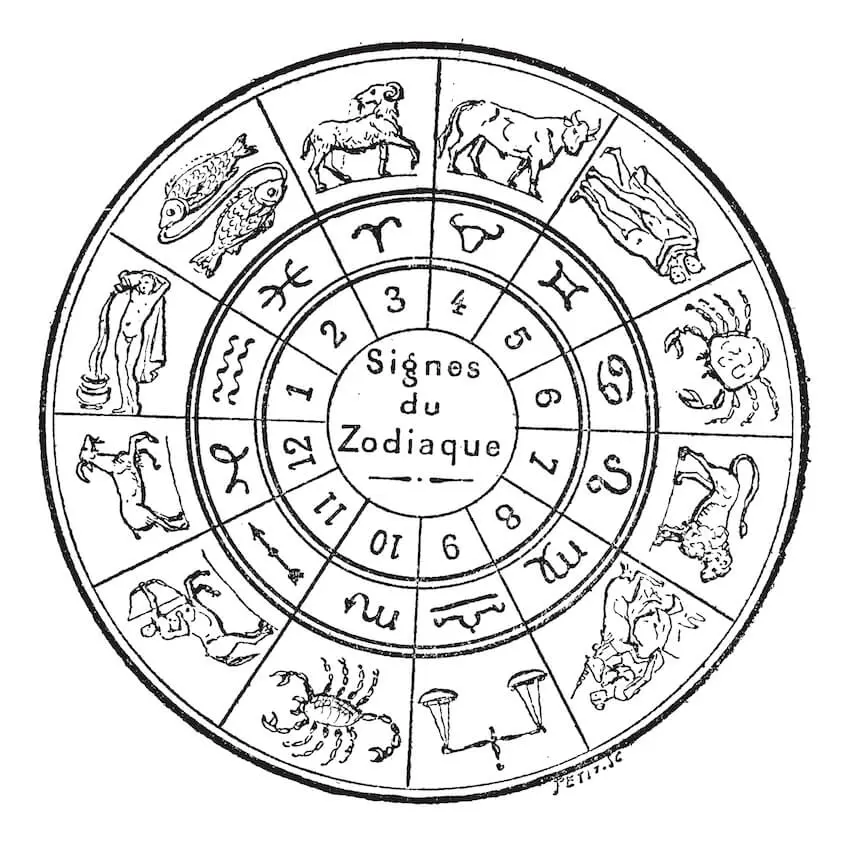
The Zodiac signs are twelve solar patterns reflecting cyclical human drives. It is arguably the oldest archetypal list in recorded myth.
| Aries | Libra |
| Taurus | Scorpio |
| Gemini | Sagittarius |
| Cancer | Capricorn |
| Leo | Aquarius |
| Virgo | Pisces |

The Greek Gods of Olympus
The Greek Gods of Olympus represent divine personifications of the psyche. Characters like Zeus, Artemis, Dionysus, and Athena reveal distinct psychic energies.
The list of Olympians includes:
| Zeus | Hermes |
| Hera | Dionysius |
| Poseidon | Hades |
| Demeter | Hypnos |
| Ares | Nike |
| Athena | Janus |
| Apollo | Nemesis |
| Artemis | Iris |
| Hephaestus | Hecate |
| Aphrodite | Tyche |
The Extended List: 350+ Archetype Examples
Finally, we arrive at the ultimate archetypes list.
Now that you have a better sense of different archetype examples from above, let’s take a look at a more complete list of archetypes:
A
| Accountant | Ambassador | Architect |
| Achiever | Analyst | Aries |
| Addict | Anarchist | Artisan |
| Addicted Lover | Anchorite | Artist |
| Adonis | Angel | Athlete |
| Adventurer | Anima/Animus | Attila |
| Advocate | Apprentice | Attorney |
| Alchemist | Aquarius | Author |
| Amateur | Arbitrator | Avenger |
B
| Beggar | Boss | Burglar |
| Black Widow | Builder | |
| Bon Vivant | Bully |
C
| Cancer | Chief | Courier |
| Capricorn | Child | Court Jester |
| Caregiver | Clown | Coward |
| Casanova | Communicator | Craftsperson |
| Celibate | Companion | Creator |
| Challenger | Con Artist | Crime Fighter |
| Champion | Consort | Critic |
| Charalatan | Consumer | Crone |
| Chariot | Copyist | |
| Chef | Counselor |
D
| Damsel | Detective | Divine Child |
| Dark Lord | Deviant Guru | Don Juan |
| Death | Devil | Double Agent |
| Defender | Devotee | Dreamer |
| Delusional Mystic | Devouring Mother | Drunk |
| Derelict | Dilettante | Dummy |
| Destroyer | Diplomat | |
| Detached Manipulator | Disciple |
E
| Earth Goddess | Entertainer | Evangelist |
| Earth Mother | Enthusiast | Everyman |
| Emperor | Environmentalist | Examiner |
| Empress | Epicure | Exorcist |
| Enchantress | Escort | Explorer |
| Engineer | Eternal Child |
F
| Fairy Godmother | Femme Fatale | Fool |
| False Prophet | Flirt | Friend |
| Father | Follower |
G
| Gambler | God | Great Mother |
| Gemini | Goddess | Guide |
| Gigolo | Godfather | Gunslinger |
| Giver | Gourmand | Guru |
| Glutton | Gourmet | |
| Go-Between | Grandstander Bully |
H
| Hanged Man | Hermit | High Priestess |
| Healer | Hero | Holyman |
| Hedonist | Heroine | Hunter |
| Helper | Hierophant | Huntress |
| Herald | High Chair Tyrant |
I
| Ice Queen | Individualist | Intellectual |
| Idiot | Innocent Child | Intuitive Healer |
| Impotent Lover | Innocent One | Inventor |
| Indentured Servant | Innovator | |
| Indigent | Instructor |
J
| Jester | Journalist | Judgment |
| Jnani | Judge | Justice |
K
| Killer | Knight | |
| King | Knower |
L
| Leader | Libra | Lover |
| Legislator | Lobbyist | Loyalist |
| Leo | Loner | |
| Liberator | Loser |
M
| Mad Scientist | Medicine Man | Miser |
| Mage | Medicine Woman | Momma’s Boy |
| Magical Child | Meditator | Monk |
| Magician | Mentor | Monster |
| Maiden | Mercenary | Moon |
| Martyr | Messenger | Mother |
| Masochist | Messiah | Mother Nature |
| Master | Midas | Muse |
| Matriarch | Minister | Mystic |
| Mediator | Minstrel |
N
| Narrator | Ninja | Novice |
| Nerd | Nomad | Nun |
| Networker | Nonconformist | Nurse |
O
| Observer | Oracle | Outcast |
| Oedipal Child | Orphan | Outlaw |
| Olympian | Orphan Child |
P
| Patriarch | Pioneer | Private Investigator |
| Peacemaker | Pirate | Profane Prostitute |
| Perfect Mother | Pisces | Progenitor |
| Perfectionist | Poet | Prophet |
| Performer | Preacher | Prostitute |
| Persona | Precocious Child | Protector |
| Peter Pan | Priest | Protester |
| Philosopher | Priestess | Provocateur |
| Pickpocket | Prince | Psychopath |
| Pilgrim | Princess | Puer Aeternus |
Q
| Queen |
R
| Rabbi | Renunciate | Robin Hood |
| Rebel | Rescuer | Romantic |
| Redeemer | Revolutionary | Ruler |
| Reformer | Right Arm |
S
| Saboteur | Seeker | Soldier |
| Sacred Prostitute | Seer | Soldier of Fortune |
| Sadist | Self | Sorcerer |
| Sage | Serial Killer | Spell-caster |
| Sagittarius | Serpent | Spiritual Master |
| Saint | Servant | Spiritual Teacher |
| Samaritan | Settler | Spoiler |
| Samurai | Sex Addict | Spy |
| Savior | Shadow | Star |
| Scapegoat | Shaman | Stepmother |
| Scavenger | Shape-shifter | Storyteller |
| Schemer | Sherlock Holmes | Strength |
| Scientist | Sidekick | Student |
| Scorpio | Siren | Succubus |
| Scribe | Skeptic | Sun |
| Sculptor | Slave | Swindler |
| Secretary | Sleuth | Sybarite |
| Seducer | Snoop | |
| Seductress | Sociopath |
T
| Taurus | Therapist | Trickster |
| Teacher | Thief | Tutor |
| Temperance | Tomboy | Tyrant |
| Temptress | Tower |
V
| Vagabond | Villain | Visionary |
| Vampire | Virgin | |
| Victim | Virgo |
W
| Wanderer | Wheel of Fortune | Working Mother |
| Warrior | Wise Old Man | World |
| Weakling | Wise Old Woman | Wounded Child |
| Weakling Prince | Witch | Wounded Healer |
| Weaver | Wizard | |
| Werewolf | Workaholic |
Z
| Zombie |
How Archetypes Shape Modern Life
Archetypes aren’t relics of myth—they run silently through marketing, media, technology, and everyday behavior.
When you scroll social feeds, buy a product, or vote for a leader, archetypal imagery guides the story you’re responding to.
Advertisers summon the Lover to promise connection, the Hero to sell transformation, the Rebel to brand disruption. Politics and entertainment use the same code: spectacle framed as a battle of saviors and shadows.
Inside the self, archetypes still choreograph our scripts. We build careers from the Warrior’s drive, search for meaning through the Seeker, and often burn out when the Martyr goes unchecked.
Recognizing these patterns helps break their unconscious hold.
Every headline, movement, and meme carries myth beneath the surface. To see through the archetypal lens is to glimpse the operating system of culture itself—revealing that the stories shaping society are also the stories shaping you.
To study archetypes in modern life is to realize that myths never ended—they simply changed costumes.
Archetypal Mapping: How to Recognize the Patterns Active in You
Archetypes aren’t roles to choose but energies that move through us.
Most people shift between several every day—the Warrior during conflict, the Lover in intimacy, the Sage while reflecting, the Trickster while avoiding truth. (Of course, simplifying here. The pantheon of archetypal characters within each psyche is far more nuanced than this.)
You can start noticing which voices take the stage in different moments. Observe your language, posture, and emotional tone.
- What part of you is speaking now?
- Who resists?
- Who seeks approval?
This type of archetypal mapping can play an essential role in one’s inner work.
The goal isn’t to label yourself but to see the inner cast more clearly. Once you notice a pattern, pause and breathe; awareness separates you from automatic identification.
Then you can decide whether that archetype serves the moment or is acting out an old script.
Over time, this attention reveals the psyche as a living ensemble—each part essential, but none is sovereign. Consciousness expands not by exile or dominance, but by learning to listen to every voice within.
Why the Idea of a ‘Dominant Archetype’ Can Be Misleading
Modern personality tests often invite you to find your “dominant archetype.”
While this idea is comforting, it’s also deceptive. The psyche isn’t ruled by one pattern—it’s a constellation of archetypal energies that activate under different conditions.
You may express the Warrior at work, the Lover at home, and the Sage when writing. The goal isn’t to crown a single ruler but to notice the interplay—the inner ecology—of these forces.
Awareness arises when we can observe which archetypal voice is present right now rather than identifying with it permanently.
Working With Archetypes for Personal Growth
Once you recognize archetypes around you, the next step is inside.
You can’t control these forces, but you can build a relationship with them.
Each pattern carries both light and shadow: the Caregiver heals or enables; the Warrior protects or dominates. Growth begins when you notice which aspect is active.
Start with observation—see which roles repeat in work, love, or conflict.
- Which ones energize you?
- Which drains you?
Write or sketch them; imagination translates archetypal energy into awareness. As Jung taught, awareness differentiates you from the pattern, giving conscience a foothold.
Working with archetypes isn’t about chasing perfection but about integrating the many characters within. Every time one becomes conscious, a fragment of the self returns to wholeness.
Read Next
As you can see, our psyche is filled with a pantheon of characters and archetypal energy vying for our attention.
It’s no wonder humans are such complex creatures.
Want to begin making sense of it all?
Start with these guides:
The Psychology of Archetypes: Jung’s Map of the Mind
The Individuation Process: A Beginner’s Guide to Jungian Psychology and the Path to Wholeness
Jungian Archetypes: The Complete Guide to Carl Jung’s Timeless Psychic Patterns
References
- Jung, C. G. (1969). The structure and dynamics of the psyche (R. F. C. Hull, Trans.). H. Read et al. (Eds.), The collected works of C. G. Jung (Vol. 8, 2nd ed.). Princeton University Press.
- Jung, C. G. (1969). The archetypes and the collective unconscious (R. F. C. Hull, Trans.). H. Read et al. (Eds.), The collected works of C. G. Jung (Vol. 9, Part 1, 2nd ed.). Princeton University Press. (Original work published 1959)
- Moore, R. & Gillette, D. (1991). King Warrior Magician Lover. HarperOne.
- Myss, C. (2003). Archetype Cards. Hay House.
- Pearson, Carol. (1991). Awakening the Heroes Within. HarperOne. Harper.
- Von Franz, M. L. (1980). Archetypal Dimensions of the Psyche. Shambhala.
This was so helpful. Great comprehensive list on this subject. Would you look at the astrological signs and planets as well?
Most definitely. Bella. The 12 Zodiac signs are arguably the original list of archetypes. Thanks for your comments.
e
e
e
e
Marvelous compilation of archetypes! Thankyou so very much!! Susan W.
You’re most welcome, Susan. Thank you.
e
e
e
e
e
This is such helpful work!! Brilliant! Thank you <3
– K.P. Freed
I appreciate the feedback, K.P.
e
Quote’ ” Archetypes are what Carl Jung called “primordial images” and the “fundamental units of the human mind.”
“Primordial images” Is a beautiful word, I may going be heavy here, saying anything that pops up in my mind, but after half a bottle of wine my inhibitions fade a bit. Losing my fears in a little room in front of the pc, not as if I walked out of the unit to face reality. My defenses and rigidly would raise and fears increase. After all I’m tapping a keyboard to someone half round the world with probaly a few uninterested readers of my post. What could go wrong.
Primordial images, I think may be inflicted upon humans, by how, what and whom I don’t know. Only it is an essential component for us to feel of “our own existence”. To give us something to work on to evolve. This brings me to think physicality is a minor point, so the unseen of what we don’t know is major to who we are. Thank-you.
I hope you havn’t found this post offensive. This gave me a chance to notice the unconciuos coming out. After reflecting, I’m seeing spontaneanty, free, calmness, undesirable and offensive.
I’m considering this to be an indication of character/personality, hidden behind the persona. I am also under the impression this is my anima. Why I think that is from the description used with the keyboard.
You or your readers would not find my statements as provocative as I do while writing it. Could you make some clarity for me. Thank-you.
I don’t know what specifically you’re looking for clarity. It sounds like you were just processing your thoughts, but for some reason, doing so in the public comment section of this page.
e
I have had half a bottle of wine, and when I do this I feel insightful. I do know the dangers of falling into alcoholism, but I feel secure in that I only do this once a week. I would like to know if there is a supplement or vitamin that will act the same way as alcohol does, preferable without the negative side-effects and forgetfulness.
In my defense, which brings me to a point that I have never previously considered it relevant in day to day living. But it does seem to be a common component of most people.
I’m babbling on with no concern to the people I’m talking to. I’m trying to find the point of why I’m writing this, but just keep laughing. Hope you don’t think I’m a troublemaker, but if you do; know that I probably deserve it.
Anyway, I enjoyed my laughter (if that was the point…). Could you tell me to stut-up and tell me to stop writing while I’m drunk? Thank-you.
Brett,
I’ve noticed that you’ve posted dozens of comments are various guides. Please be respectful of my time and that of the other readers.
If you have a genuine question related to a specific guide, be brief and concise with your question/comment.
Instead of posting comment like the one above, use a journal. It will be less narcissistic and potentially more beneficial for you.
Thank-you.
I like llamas.
That is all.
Hmph! ~~ I guess I do like you~ sparky~kun uwu
What about archetypes in opposing pairs, in relation to “ancient enemies?” For lack of an ancient reference, please think of the Coyote and the Roadrunner. For a real-life reference, think of the conflict in the Middle East – the tribes of the Israelites vs the tribes of Palestinians. They have been at each other for at least 5000 years, over a piece of sand. Think of the Russians and the Ukrainians – a little better, arable land, but still, there’s a whole world for each to inhabit. I wish I knew where to go with this thought, but it keeps coming back to me. One of the references I read said that both parties are opposite sides of the same coin. I would like to find a source that seeks and finds rapprochement between the sides. It seems that without one, the other could not exist (How could a coin have one side as a physical object). Does that mean that conflict is an eternal state in the human experience?
Archetypes do have opposites like (Appollo and Dionysus) as well as bipolar shadow opposites as neo-Jungian Robert Moore’s work illustrates. (See, for example, the Magician archetype: https://scottjeffrey.com/magician-archetype/)
However, having extensively studied the two conflicts you presented above, this is NOT the issue of opposing archetypal forces as you described. What you’ve described is the propaganda many of us have been indoctrinated with. That is, these conflicts are socially engineered. (Breaking down why this is the case would take too long here.) The cause of these so-called conflicts is singular: the detached manipulator working behind the scenes.
“It seems that without one, the other could not exist (How could a coin have one side as a physical object). Does that mean that conflict is an eternal state in the human experience?”
No. It means that conflict and tension are an eternal state of *archetypes* — NOT the human experience. The entire point of individuation is to strip away these archetypal forces and the tensions that arise from them. Only then, can individuals transcend conflict. Building consciousness is the pathway beyond conflict. Without this process, one remains possessed by archetypal forces. (“Easy to be an archetype; difficult to be a human.”)
I am probably your most cut and dry archetype and I have a story weather you believe it or not God spoke to me and gave me a specific set of rules guidelines among other things. My archetype is I understand the story I have is very valuable and this is all that I’m willing to say as sometimes I already feel like a Marked Man if you’ve ever had anybody that has ever said any of these things to you and one of their archetypes and you would like to know more we need to talk more personally Scott sincerely Jeffrey
At a young age for lack of better words I was hidden with my brother basically Roman Catholic convent school mixture middle of nowhere surrounded by 500 Amish families not Mennonite I got shot in this place the first time the the light touch me what you got time I refer to it as God’s grace Legions of angels are helping me transcend if that makes sense
It’s important to keep in mind that no one is an archetype. There is a pantheon of archetypal images within the collective psyche. Many more archetypal images exist that are not listed above.
But ultimately, a human is not an archetype. And when we identify with a particular archetypal pattern, it’s usually a sign that we’ve become “possessed” by it. As such, it’s important to center and ground yourself.
If you feel like you need to be guided by external forces, that’s a personal choice.
I never feel like I need to be guided I feel like I wish I had someone with as much knowledge about things like protecting the Innocence around me or having the power or having the ability to work hand in hand with the Holy Spirit possibly our Lord Almighty himself finding the names of these and sending them to their Eternal hole where they should stay have never even hardly maybe one time in my life I heard somebody in prayer or in talking about God ever joke around with him talk about it sense of humor go back and forth with him I’ve never seen anyone or heard anyone hardly ever and he he loves that just like everybody else does he have people are always so serious they always want something or they have to they’re asking a serious question you can ask a serious question and mix it up with and I said clean friendly joke while you’re praying while you’re talking about him with someone else he loves that people don’t know this I know this. Would you like to see these angels these Legions of angels he sends two or three times a week sometimes every night of the week depending on how much studying I’m doing in that depends on how much my brain can handle before I get too bad of a headache because information flows like a highway like you were saying the collective I know exactly what you’re saying if you would like though recently have been taking pictures just on a regular Samsung a 03 cheap camera from 50 ft away as their summer you will just have to see them but once you see them if you know the different types of angels the orders the ones that were the guardian if you know about them you will recognize them you you will see four orders divine Legion of angels in mid is the most Heavenly picture you can ever imagine like something William Shakespeare across somebody with paint beautifully but they would have to have seen this themselves to see it like the pictures that I have. Please forgive me I’m not asking you to guide me I’m asking Maybe for a safe person that I trust to go back and forth with no one I have came across I don’t I don’t even have to ask I they will mention something you know have you started your Awakening whatever the term they may use I will be able to tell instantly where they’re at with it or even if they did transcend into any thing that I have yet to speak with anybody that has any knowledge not even a third of the knowledge of the things I have been told by God himself he’s only spoke to me one time but he puts images and communicate with me through nature so so many with other times and ways I will tell you that his voice was the most beautiful thing that I’ve ever heard in my life and I don’t see how anybody I don’t think it’s possible to hear it without trying or just because of how beautiful his voice is not what he’s saying is I better stop there like I said I don’t want anybody around me to get hurt maybe where I’m at right now is where I need to be at this point I’m going to pray to him about you I think he’s already gave me an answer I think that’s why you are contacting me back I believe the way the angel said I threw a rock picture fish bowl and ripples that it caused was not expected by the heavenly father by the Angels but clearly they are happy with what transpired and they warned as always to watch what I say
Please use correct syntax and sentence structure if you want me to read and reply to your message. Also please be as concise as possible.
Thank you for this. This was incredibly helpful, I’ve been writing an essay arguing why Achilles is the hero Archetype of the Iliad, and this helped me a lot. Thank you for your incite and summary of Archetypes!!
Great to hear, Colby!
Extraordinary work and very well presented!!
Just a quick question- Do you know of any work or study that has been done on isolating our relationship with these archetypes.
The idea here is that our relationship with the archetype is an entity separate from the archetype itself. The relationship adheres us to the archetype in a specific way possibly even misusing an archetype for a purpose for which it was not designed.
If, for example, we have a relationship of dependence on an archetype is it clarified that our dependence is generating a state of consciousness in which we are believing in the archetype more than we believe in our-self.
This dependence allows the archetype to choose for us influencing our choices and making us followers of an identity code rather than creators of possibilities that are independent of archetypal influence.
Thanks for any reply you might have!!
Hi Larry,
I’m not entirely certain I understand what you’re asking.
The general idea is that when the Center (Self) is not stabilized, we are “possessed” by various archetypal forms. Without access to the Self, we either identify with a particular archetype as one’s personality or a blending of subpersonalities.
So, it wouldn’t be so much that we have a dependence on a particular archetype but rather that we mistakenly identify with a particular archetypal pattern.
That said, see Robert Moore’s neo-Jungian model for more context:
https://scottjeffrey.com/king-warrior-magician-lover-masculine-archetypes/
That is very helpful !!
Thanks for your response !!
I was thinking that the dependence aspect may surround the idea is that while mistakenly identifying with an archetype that is possessing me I may come to believe that the archetypal character does me better than I do me.
Which is to say that I believe in the archetype more than I believe in the self that is independent of the archetypal character.
In this way I may depend on the archetype to define me rather than doing my own self-discovery and self-worth work.
Ah, yes, I understand what you mean now. In fact, if you look at much of the new-age type material (especially online), you might assume that we’re supposed to do what you’re describing.
The misaligned concept of “What archetype am I?” is one such illustration.
I believe “Ego and Archetype” by Edward F. Edinger might be of interest to you.
But the main issue is that most of us do not access the Self. Instead, our self-identity is centered around the ego-mind, and this ego-mind comes with a “house of guests” (archetypes) based on our prior conditioning.
As the traditions explain, in holding to the neutral Center, the Self (host) returns and establishes order in the house (with all of its previously unruly guests).
This response was awesome !!
Much appreciated!!
Beautifully said!!
So me
can I ask you a question please?
can I ask you a question please?