
I was a spiritual bypasser for many years. It consumed much of my 20s and 30s.
The information shared in this guide could have saved me over a decade.
If you’re reading this, chances are you intuit there’s something off on your current inner path.
When you first learn about bypassing, it’s like an internal alarm bell rings. It might be subtle at first, but it can escalate to a full-scale siren call.
That’s when the inward turn truly begins.
In this in-depth guide, we’ll explore the spiritual bypass: the various ways it manifests, the psychological mechanisms that trigger it, how to self-detect if you’re bypassing, and finally, how to transcend this common spiritual trap.
Let’s dive in …
What is the Spiritual Bypass?
Spiritual bypassing is the common tendency of using spiritual concepts, teachings, and practices to avoid unresolved emotional tension, psychological trauma, and unfinished developmental work.
Transpersonal psychologist John Welwood coined the term in the 1980s.1Welwood, J. (1984). Principles of inner work: Psychological and spiritual. The Journal of Transpersonal Psychology, 16(1), 63–73. He was a member of a Buddhist community at the time and noticed this behavior among its members, including himself.
With a spiritual bypass, awakening, self-liberation, or enlightenment supersedes psychological development.
When we bypass, we subconsciously use spiritual concepts to attempt to sidestep the messy, chaotic, and uncomfortable work of development.
The seductive nature of the “higher path” lures us in, and spiritual practices like meditation function as a clever psychological defense mechanism.
The Psychology of Avoidance: Why We Bypass
Truthfully, it’s completely understandable why we bypass. I engaged in bypassing for many years. Some people may avoid this common trap, but the vast majority of us succumb to it—at least initially.
Think of it this way: Spirituality tends to elevate us. In contrast, authentic inner work can be dark, messy, chaotic, and painful.
From the ego’s perspective, which would you choose?
Is it any wonder why spiritual bypassing is so prevalent?
Consequently, our “pursuit of peace” is often a mask for deep-seated emotional avoidance.
Researchers in the counseling field have described this pattern plainly: spiritual bypass happens when someone uses their spiritual beliefs and practices to avoid dealing with unresolved psychological issues.2Cashwell, C. S., Bentley, D. P., & Yarborough, P. (2007). The only way out is through: The peril of spiritual bypass. Counseling and Values, 51(2), 139–148. https://doi.org/10.1002/j.2161-007X.2007.tb00071.x They call these issues “unfinished business.”
The problem isn’t with spirituality itself. The problem is skipping the other levels of healing that need to happen alongside it.
Homeostasis: Why the Ego Resists Self-Mastery
At its core, spiritual bypassing is a form of internal resistance. And, overcoming resistance is an essential part of realizing self-mastery.
The ego naturally seeks homeostasis. It’s comfortable within its known range; it clings to the familiar and fears the unknown.
Addressing personal trauma and psychological limitations pushes into the unfamiliar. Inner work challenges our homeostasis. As such, we tend to resist it.
The Mechanisms of Internal Resistance
Ultimately, with this biological drive toward homeostasis, the ego tends to resist psychological change.
This resistance tends to remain below the surface—subconscious or unconscious—manifesting in various ways, including:
- Self-medicating: consuming unhealthy foods, sugars, alcohol, drugs, shopping, etc.
- Distraction: engaging in endless entertainment, video games, social media, mobile phone obsession, or even professional work.
- Spiritual Bypassing: pursuing spirituality as a means to “transcend the ego.”
That is, spiritual bypassing is just yet another, more deceptively clever way of avoiding responsibility and psychological growth.
The Rise of Bypassing in the Digital Age
Toward the end of his life, famed mythologist Joseph Campbell reflected on what might happen to humanity in an age without living myths—when the old mythologies no longer stir the modern psyche.
What would fill that meaning void?
Decades later, our answer seems to be: choose-your-own-adventure spirituality. A blessing and a curse.
Arguably, spiritual bypassing is more rampant today than ever before, for a few reasons:
- Social media rewards the performance of enlightenment. Posting spiritual quotes and curated serenity takes zero inner work but generates real social currency.
- Teachings arrive without context or prerequisites. Someone can stumble onto nondual teachings on TikTok before they’ve done basic emotional regulation work. The information is available; the readiness often isn’t.
- The loneliness epidemic drives people toward an instant spiritual identity. When genuine community is scarce, adopting a spiritual persona offers a fast sense of belonging—no vulnerability required.
Simply put, a flood of spiritual teachings is more accessible today than at any point in human history—and with virtually no accountability.

Duality vs Nonduality (Bypassing Attempts to Avoid the Dual)
Mixing Levels: Bypassing in Spiritual Communities
Another reason bypassing occurs in spiritual communities and among individual aspirants relates to misunderstandings of specific spiritual teachings.
In particular, nondual teachings within Hinduism and the Doctrine of Anatta (No Self) in Buddhism both tend to foster this confusion.
In these teachings, the everyday world is considered Maya (illusion), and the ego-self is considered the root illusion.
Duality itself—every expression of form in this three-dimensional realm—is temporary and, therefore, not real.
Paramataman (Supreme Self), the Unmanifest Absolute, is the only ultimate truth.
Ironically, this ultimate truth is used as the ego’s powerful excuse to bypass psychological development.
(For a comprehensive primer on nonduality, see Duality and Nonduality Explained.)
The Transpersonal Trap: Transcend and Dissociate
A basic conceptual understanding of nondual awareness tends to foster dissociation. That is, we disconnect ourselves from the ego, but not in a constructive or psychologically healthy way.
We say, “I’m not this ego, so what is there to address?” It becomes a subtle excuse to avoid taking personal responsibility.
This dissociative problem was so common in spiritual circles in the 1980s that it became a key focus in transpersonal psychology.
Popular theorists such as Ken Wilber often wrote about the importance of “transcending and including” rather than “transcending and dissociating.”3Wilber, K. (1995). Sex, ecology, spirituality: The spirit of evolution. Shambhala Publications.
Becoming Somebody Before Becoming Nobody
Transpersonal research led to Jack Engler’s distinction that “You had to become somebody before you can become nobody.”4Wilber, K., Engler, J., & Brown, D. P. (1986). Transformations of consciousness: Conventional and contemplative perspectives on development. New Science Library/Shambhala Publications.
Nonduality and the Anatta doctrine lead you to become “nobody,” as their contemplative practices are designed to help you transcend the ego. That is, “nobody” is the spiritual goal.
However, the Western insight was that ego development comes first. Becoming “somebody” is the psychological reality.
So yes, from the standpoint of the “ultimate truth,” your trauma, repressed emotions, and behavioral conditioning might not be real in the absolute sense. But that doesn’t mean you can leapfrog over it.
As long as you believe you exist (as an independent entity), the inner work remains.
Why Gurus and Spiritual Teachers Bypass Too
The reality is that most spiritual teachers and gurus also engage in spiritual bypassing.
That’s why spiritual cults abound, why many gurus amass fortunes at the expense of their devotees, and why sexual promiscuity is common within cult circles.
Psychologically, it’s often the blind leading the blind. If a spiritual teacher is engaged in bypassing, their students likely will too.
I was a student of a Western spiritual teacher in my late 20s and early 30s. Being exposed to various nondual teachings was tantalizing. I had no context or understanding of “bypassing.”
Fortunately, I became this teacher’s authorized biographer. Through extensive multi-year research, I was exposed to many disheartening truths. This teacher had indeed bypassed (ironically enough, he was a psychoanalyst before becoming a spiritual teacher).
Consequently, his entire community, including me, was bypassing too! It’s understandable. There’s no prerequisite to be a spiritual teacher.
After you spend decades accumulating spiritual knowledge, you become a walking encyclopedia. Spiritual insights and aphorisms pour out of you with ease. You can respond intelligently and persuasively to most inquiries.
Yet, you can be “cognitively enlightened,” while still being psychologically stunted. As Ken Wilber (2006) explains, “Growth in the cognitive line is necessary but not sufficient for the growth in the other lines.”
That is, just because you have developed your mind by reading, intellectual pursuits, or contemplative practices, doesn’t mean you have grown psychologically. These are independent lines of development.

Signs, Symptoms, and Examples: Is Your Practice a Bypass?
In my view, it’s not a function of whether you’re bypassing; it’s to what extent.
Here are common signs, symptoms, and examples that you are likely spiritual bypassing. Each of them signifies that psycho-spiritual development has stalled.
1 – Toxic Positivity: Riding the “Good Vibe” High
Toxic positivity is especially common in New Age circles. Negative emotions like grief, anger, or fear are discouraged. Instead, there’s a compulsive need to “maintain positivity” and send out “good vibes,” or your frequency/calibration will drop.
Toxic positivity is the tendency to dissociate from one’s shadow, the disowned parts of oneself.
2 – Intellectualization: Collecting Spiritual Concepts
This is perhaps the most common trap in spiritual bypassing. It’s enticing to read spiritual texts and listen to various lectures and teachings, assuming that this newfound knowledge marks personal progress.
I fell into this trap for many years, consuming loads of spiritual material and even meditating daily while completely ignoring all genuine forms of inner work. In the process, I built a new “spiritual ego” that later had to be dismantled.
3 – Detachment: Dissociating from Emotional Pain
True non-attachment enables us to examine emotional tension and rediscover childhood memories without being overwhelmed or judgmental.
However, with the spiritual bypass, we don’t cultivate this healthy distance; instead, we detach or dissociate from our problems. This detachment leads to emotional numbing that can be mistaken for a “meditative state.”
We’ll address this bypassing symptom in more detail below.
4 – Grandiosity: Falling into Superiority Complexes
The specialized knowledge of the spiritual realm can be incredibly alluring and elevating. You feel you have knowledge others don’t, which triggers feelings of specialness. This specialness often leads to the Savior Complex, the “holier-than-thou” syndrome, or a perceived sense of enlightenment.
This form of grandiosity can be observed in virtually all cults and most spiritual communities. I experienced this ego inflation for years when I was a member of an ideological cult. It’s incredibly tantalizing, and when you’re under its spell, it can be difficult to break free.
Within a cult context, this superiority complex subsumes the entire group, who become the “special few”—the only ones who know “the Truth.”
5 – The Blame Game: Avoiding Personal Responsibility
Genuine psychological development requires us to experience grief for our past behavior (when we were less conscious). Experiencing this grief leads to acceptance and taking personal responsibility.
With the spiritual bypass, we avoid taking personal responsibility by blaming others. We might play the victim-perpetrator game where we’re the perpetual victim (blaming others), so we don’t see how we’re complicit and take responsibility.
Again, without experiencing grief and taking responsibility, psychological maturity is unattainable.
6 – The Manifestation Trap: Chasing Reality Creation Over Real Growth
This is another alluring trap within many New Age spiritual communities. The “law of attraction” belief system is perhaps the most popular culprit. This trap aligns well with the “good vibes” and “higher frequency” concepts of toxic positivity.
Besides the fact that the “law of attraction” is insincere (it doesn’t acknowledge inherent power structures, personal limitations based on circumstances, etc.), this fixation on “manifestation” is yet another ego tool for bypassing inner work.
7 – Psychedelic Escapism: Chasing Altered States to Avoid Reality
It’s not that psychedelics can’t have their place within spiritual development. In fact, many ancient cultures perceived various mind-altering substances as entheogens. Meaning these hallucinogens, like peyote and “magic” mushrooms, were used specifically in religious rites.
However, if you’ve been around these drug subcultures, including popular Ayahuasca communities, you can still observe rampant spiritual bypassing. The right “set and setting” is simply not enough.
I went through an intensive “drug phase” in my mid-30s. Accessing various altered and higher states of consciousness without effort is tantalizing. And while certain substances did help reveal aspects of my shadow to me rather rapidly, the integration didn’t start until after I passed this phase.
Ultimately, psychedelics are ungrounding; they can take you far away from one’s Center—the opposite direction of deep and constructive psychology and spiritual development.
True Non-Attachment vs. Spiritual Bypass: Where the Line Blurs
One way we subconsciously use bypassing as a form of psychological avoidance is by misunderstanding the Eastern concept of detachment.
The detachment trap: Because duality (this world and everything in it) is ultimately Maya (illusion), it’s best to separate yourself from the illusion (detach).
Most spiritual bypassers mistake this pseudo-detachment for genuine non-attachment.
Genuine non-attachment leads to full engagement with life, present-moment awareness (mindfulness), and alert responsiveness.
In contrast, bypassing leads to avoiding the full spectrum of human experience and numbing ourselves.
With non-attachment, we pay attention to our emotional flow, which leads to insight and the healthy release of emotional energy.
Bypassers repress their emotions, which leads to energy stagnation.
Non-attachment enables us to ground our awareness within the body, while still understanding that we’re not that.
Conversely, bypassers float around in abstraction and intellectualization. They cling to spiritual ideas that cannot be applied to daily life.
| True Non-Attachment | Spiritual Bypass |
|---|---|
| “I feel this fully and let it move through me.” | “I don’t need to feel this—I’m above it.” |
| Present, engaged, responsive | Detached, avoidant, numb |
| Emotion flows → insight → release | Emotion is bypassed → repression → stagnation |
| Grounded in the body | Floating in abstraction |
Reviewing the above table, can you tell whether you’re engaging in true non-attachment or a detached spiritual bypass?
The Anatomy of the Trap: Common Bypassing Beliefs & Behaviors
Now that we’ve covered common signs of spiritual bypassing, let’s explore the beliefs and behaviors that can lead to this trap.
1 – Shadow Projection
The shadow represents everything we disown or cut off from ourselves. However, what we disassociate from is still there; it’s just hiding outside of conscious awareness.
To avoid seeing our disowned qualities, we necessarily project these qualities onto others.
For example, bypassing individuals tend to maintain a “spiritual” persona. They perceive themselves as “spiritual,” and they try to make others see them this way too.
But let’s say the person is arrogant and/or ignorant. That is, they often behave arrogantly (or ignorantly) even if they don’t perceive themselves this way.
Consequently, they will project this arrogance or ignorance onto others to maintain their spiritual persona.
2 – Narcissistic Defenses
Many spiritual and new age communities use terms like “oneness” and “unity” as core spiritual principles. “From the Many, there is one.”
In the bypass, individuals use these spiritual concepts as excuses to avoid taking personal responsibility for their behavior.
That is, bypassers consistently engage in an ego defense mechanism called rationalization: “Hey man, we’re all one. Don’t take yourself so seriously.”
Clinging to concepts of oneness and identifying with the group’s ideology is standard bypassing behavior.
3 – Regressive Coping
Coping is a byproduct of toxic positivity. Here, we can justify and reframe any bad behavior and avoid life challenges.
After all, how can you uphold a positive attitude if you’re dealing with strong negative emotions and difficult problems? Won’t that “lower your frequency”? Here, avoiding “low vibrations” becomes an excuse for functional incompetence.
This regressive coping keeps the bypasser psychologically frozen, in perpetuity, for as long as they uphold these erroneous belief systems as “truth.”
4 – “Everything is an Illusion” Fallacy
We touched on this fallacy in our earlier discussion on nondual teachings (“Mixing Levels”) and the tendency to disassociate.
If all of duality, including the ego, is perceived as an illusion (Maya), then why engage in life at all?
- Why address our wounds?
- Why try to heal and become whole?
- Why do shadow work?
- Why seek growth and self-mastery?
- What’s the point? None of it is real.
This line of thinking enables the spiritual bypasser to dismiss systemic issues and avoid personal accountability.
The core misunderstanding is that nonduality contains duality.
5 – False Forgiveness
Since the bypasser avoids navigating their emotional responses (because negative = bad), they develop clever forms of self-deception.
For example, let’s say someone wrongs you by violating your privacy or gossiping behind your back.
Bypassers might quickly shrug it off: “It’s all good. No worries. We’re all One. I forgive you. Love and light. Namaste.”
In the process, we suppress healthy boundaries in the name of “love,” and consequently repress negative emotions like anger and rage.
6 – Spiritual Materialism
Spiritual Materialism occurs when we use spiritual concepts and practices to strengthen our personal ego.
Tibetan Buddhist meditation teacher Chögyam Trungpa Rinpoche coined the term in his classic, Cutting Through Spiritual Materialism (1973). (Ironically, this teacher turned out to be a spiritual bypasser himself!5Demetrakas, J. (Director). (2011). Crazy wisdom: The life & times of Chögyam Trungpa Rinpoche [Film]. Crazy Wisdom Productions)
Spiritual bypassing is the psychological mechanism of spiritual materialism. The attitude of spiritual materialism (uplifting the ego) results in spiritual bypassing (using spirituality to avoid psychological suffering).
I suspect that the primary unaddressed shadow quality that leads to bypassing is insecurity.
Unacknowledged feelings of insecurity lead many of us to inflate our egos (via spiritual materialism) so we can artificially uplift ourselves.
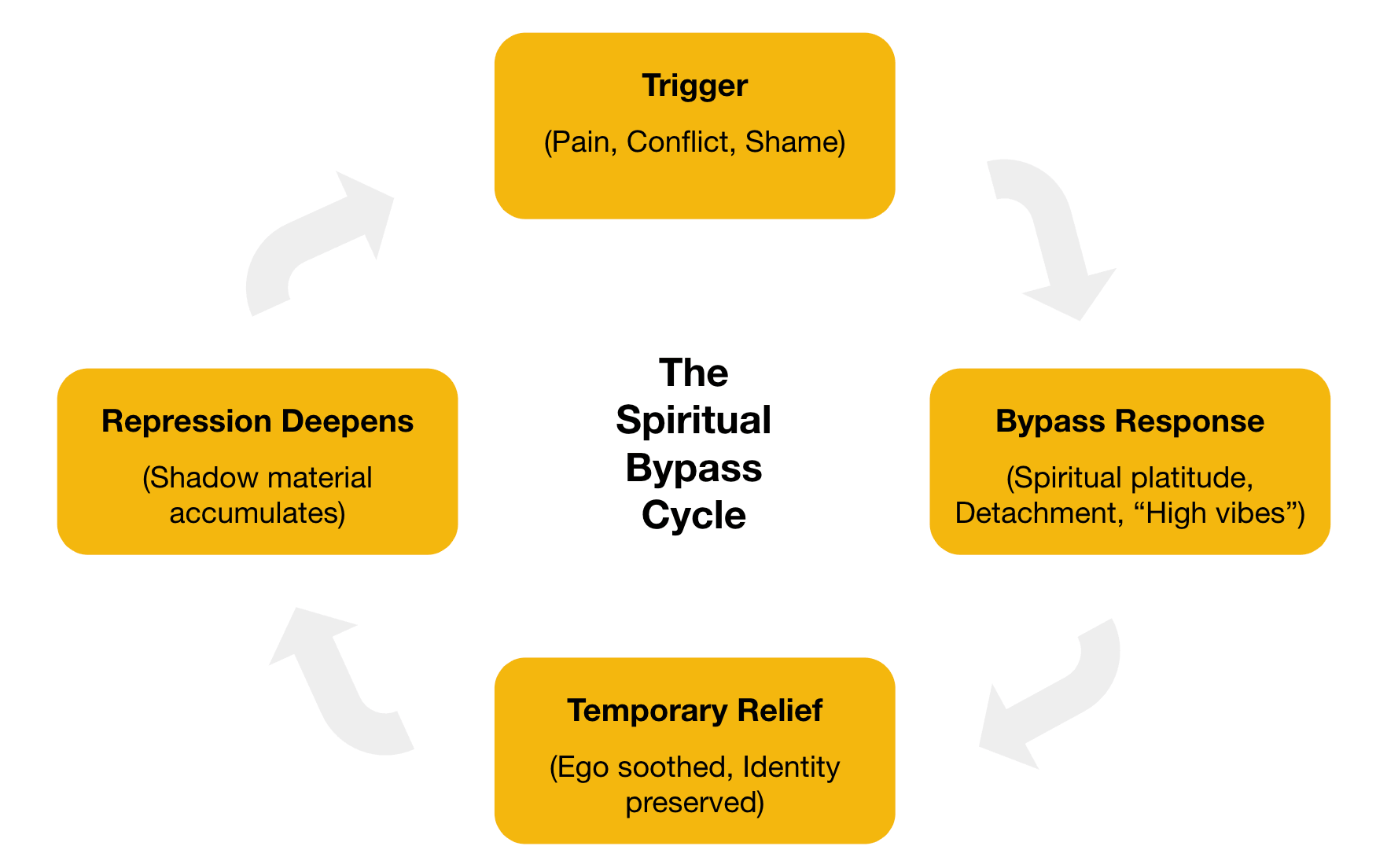 The Bypass Cycle
Bypass Cycle: The Harmful Loop That Stalls Growth
Now that we have a foundation in the various ego games involved in bypassing, let’s illustrate how this destructive process can keep us locked in a self-constructed psychological prison.
- The Trigger: The cycle starts with an initial trigger. The trigger might be a psychological pain, a conflict within someone else, or shame about your behavior.
- Bypass Response: While in healthy development, this trigger leads to initial inquiry and discovery, the bypass response is a spiritual platitude that reinforces one’s detachment from the problem or reframes it with a “higher vibration.”
- Temporary Relief: This response helps soothe the ego and maintain one’s current self-identity.
- Repression Deepens: Consequently, because the bypasser hasn’t engaged in self-analysis and confronted the problem, their repression deepens, and more shadow material accumulates.
This four-step cycle shows just how destructive bypassing can be. While it might seem innocent, each loop strengthens one’s shadow, increasing the psychological splits within the individual.
This helps explain why many individuals who succumb to cults and various ideological groups never grow up.
Jung called this the Puer Aeternus archetype; others refer to it as the Peter Pan syndrome.
Remember: what’s left incomplete, we’re doomed to repeat. As such, spiritual bypassing keeps us locked in repeating unsupportive patterns from childhood.
Self-Deception: The Subtle Art of Bypassing
One thing I’ve learned from years of self-observation: the mind’s capacity for self-deception appears infinite.
The shadow of the Magician archetype—the Detached Manipulator or Trickster—is a master deceiver.
You can think you’re avoiding the bypass trap when you’re just playing a more subtle version of it.
If you don’t watch yourself vigilantly, different variations of this trap can manifest.
Bypassing can begin mildly and escalate to greater severity. Or, it can start severe before backing into more mild, yet still unproductive, expressions:
| Mild Bypass | Moderate Bypass | Severe Bypass |
|---|---|---|
| Spiritual reframing to soften discomfort | Chronic intellectualization; “observer mode” as a lifestyle | Full emotional numbing; depersonalization |
| “This is just a lesson.” | “I’m just witnessing the emotion, not engaging it.” | “I don’t feel anything anymore—I’ve transcended.” |
| Still feels, but redirects quickly | Feels distantly, through a lens | Doesn’t feel at all |
These variations are important to be mindful of. They can help you detect this avoidance behavior on your own.
Path of Integration: Moving From Bypassing to Embodiment
Once I realized I had been heavily engaged in spiritual bypassing for many years, I went through a very dark period, often referred to as the “Dark Night of the Soul.”
Psychologically, this was an intensely ungrounded and chaotic period for me (right on the back of psychedelic mania).
Recovery from this period involved an intense focus on three essential integrative practices:
Let’s examine each of these vital practices.
Shadow work is the critical first step in Jung’s individuation process. So, let’s start there.
 Jung’s Map of the Psyche
1 – Shadow Work: Integrating Your Disowned Self
The single most potent antidote to spiritual bypassing is shadow work: getting to know the “darker side” of your personality.
Said another way, IF you fully know your shadow, you will not bypass. It’s that simple (in theory).
In fact, bypassing results because we have left our shadow unattended. In an effort to remain unconscious of attributes and qualities inconsistent with our conscious personality (how we perceive ourselves), we cling to “higher truths.”
Bypass is elevating, which leads to ego inflation. Shadow work, from an egoic viewpoint, can be demoralizing and cause ego deflation.
Because the ego wants to prop itself up instead of swim through the trash, it dives into spirituality as a bypass. (As I said, the mind’s capacity for self-deception appears infinite!)
Getting to know your shadow, when done honestly, is an entirely grounding process. The subconscious drive to elevate yourself through spirituality diminishes when both your feet are firmly planted on the ground.
After I realized that virtually everyone in the spiritual community I was part of was avoiding their shadows—including the teacher—I dove into shadow work as if my life depended on it.
If you would like to get started or are curious to learn more, see my definitive guide to shadow work.
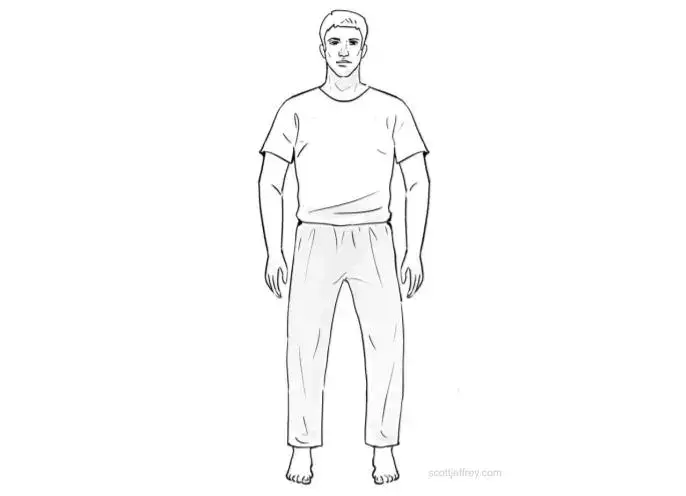 Zhan Zhuang’s Wuji Standing Posture
2 – Somatic Integration: Reconnecting Body and Mind
Besides being divorced from one’s shadow, the second fundamental reason we bypass is that we’re divorced from our body.
Meaning, for most of us, our minds are not integrated with the rest of our physical form.
Consequently, our thinking function is often segmented from our sensing and feeling functions. This dissociation means we are working with limited information from moment to moment.
Now, to clarify, you can be an athlete, someone who works out regularly, or even do yoga daily, and STILL be disconnected from your body. You can be physically fit, “look healthy,” and STILL lack body awareness.
Developing somatic awareness requires us to sink our attention into our bodies. It requires us to slow down and pay close attention inward.
For example, it’s incredibly challenging, if not impossible, to cultivate genuine somatic awareness while listening to music, watching a monitor, or talking to someone else.
When bypassing was a way of life for me, I had virtually no body awareness. I read up to four books per week, meditated for hours, and spent most of the time within the safe confines of my mind.
Even though I was physically active and took long hikes multiple times weekly, I remained mentally fixated.
For me, embracing qigong practices was an essential step to reforging the body-mind connection.
The practice that led to the most powerful changes is an ancient standing practice called Zhan Zhuang.

3 – Emotional Awareness: Learning to Feel Again
Many individuals engaged in spiritual bypassing are emotionally numb. This psychological numbness translates to body numbness, where we can’t feel much of our internal body, including our vital organs.
From a Taoist context, emotional stagnation leads to energetic blockage within the body. Not only does this cut us off from our genuine feelings, but it also leads to physical pain, chronic illness, and diseases over time.
A HUGE aspect of overcoming the bypass involves learning to relate to our emotions in more constructive and healthy ways.
However, this is challenging for many of us due to repressed trauma from childhood that caused the energetic stagnation in the first place.
For this reason, for many bypassers, the path forward is physical and energetic first. That is, it’s often helpful to engage in somatic bodywork and release some physical stagnation before trying to cultivate stronger emotional awareness.
We can’t regulate what we aren’t fully conscious of. So, cultivating emotional awareness precedes emotional regulation.
In building a healthy relationship with emotions, you begin to perceive them as expressions of energy and data, just like our thoughts.
Learning how to accept whatever we’re feeling without trying to change or resist it helps us integrate this data back into our overall experience.
For more on this topic, see this practical guide to developing emotional awareness.
Practical Application: A Framework for Authentic Practice
To utilize integrative practices and overcome the bypassing phenomenon, you may find it helpful to keep the following principles in mind.
Radical Honesty: Acknowledging Your Lower Nature
Since the bypassing trap is a form of self-deception, the essential remedy is radical honesty.
Without radical honesty, we can’t confront our shadows or observe the ego games we’re playing with ourselves.
Yes, we have a Higher Self. But we must also fully acknowledge that we have a “lower” self (ego), too. And this ego-self is usually the gateway to higher realizations, not detached from it.
We are largely products of our environment. We adopt many destructive behaviors and beliefs early on in life. We are often possessed by a series of archetypal forces that don’t have our best interests in mind.
Denial of these facts leads to bypassing. Genuine acceptance of these facts enables rigorous self-examination and self-inquiry.
Shifting Inward: From Avoidance to Ego Confrontation
The avoidance behavior of spiritual bypassing is the result of an external orientation:
- External spiritual concepts
- Books, seminars, workshops, and lectures
- Spiritual groups and gatherings
We might hold the idea of “All is one,” for example, but it’s still an external concept. If this idea were internalized, we probably wouldn’t say or even think it.
Moving beyond bypassing requires us to shift our orientation from the comfortable, external world of “higher truths” to the messy, chaotic internal domain of our psyches.
Shadow work, for instance, is a continual series of confrontations with one’s ego. We perceive ourselves one way, while our attitudes and behaviors conflict with our conscious identity.
The more we shift our orientation inward—to genuine self-examination—the energy we had subconsciously invested in bypassing gets redirected back to ourselves.
Dropping the Spiritual Identity: Finding Internal Ground
This is a tough one for many of us—especially for those within spiritual communities, religions, and cults.
When our core identity is centered around our “spiritual nature,” we invariably engage in self-deception and are susceptible to persistent bypassing.
Remember, bypassing occurs because we are subconsciously seeking an ego elevation. We want to raise ourselves and avoid pain. This impulse is what’s ungrounding. It’s what leads us to fixate on spiritual ideas at the expense of daily life and healthy development.
If, at your core, your self-identity is spiritual at the outset, it’s unlikely you will ever examine your shadow. You won’t be able to; the internal conflict will be too great.
Integrate the light and dark within you, rebuild your somatic awareness, and then see if a spiritual identity is still necessary or relevant to you.
Frequently Asked Questions About Spiritual Bypassing
Let’s run through some common questions about the spiritual bypass:
Is spiritual bypassing the same as spiritual materialism?
They are highly related terms. Bypassing is the psychological mechanism of spiritual materialism.
Spiritual materialism uplifts the ego, which can result in using spirituality to avoid psychological pain (i.e., the bypass).
Can you be spiritual without bypassing?
Yes, of course! Study your spiritual texts and engage in meditative practices. Just be sure to also:
- Self-reflect frequently
- Pay attention to your emotions and feelings
- Lean into uncomfortable feelings and realizations
- Continuously mine your shadow
- Address your psychological trauma
- Get to know the various subpersonalities or archetypes within your psyche
In truth, the Wisdom traditions in their purest expressions are composed of integrated systems of practice. For example, meditation was not divorced from self-analysis; the two went hand in hand.
Spirituality divorced from psychology leads to delusions and grandiosity. To avoid the bypass, engage in inner psychological work alongside your spiritual pursuits.
This in-depth guide on spiritual practices explores the topic in greater depth.
What’s the difference between spiritual bypassing and healthy detachment?
Spiritual bypassing leads to avoidance behavior, emotional numbing and repression, energetic stagnation, and abstract intellectualization (using spiritual ideas as platitudes not grounded in daily experience).
Genuine detachment (or more accurately, non-attachment) enables us to engage fully in life, function in present-moment awareness, and be mindfully responsive.
With non-attachment, we can be attentive to our emotional flow and learn from it. Instead of getting lost in abstractions, we cultivated a grounded presence within the body.
How do I know if my spiritual teacher is bypassing?
Look at their life, not their lectures. A teacher who speaks eloquently about non-attachment but has a trail of broken relationships, financial exploitation, or unaddressed scandals is bypassing.
One reliable signal is how they handle criticism—do they deflect it with spiritual language (“you’re just projecting,” “that’s your ego talking”), or can they sit with discomfort and take responsibility?
Also watch their inner circle: if everyone around them is psychologically stunted, emotionally immature, or financially dependent, the teacher is almost certainly bypassing—and modeling it for their students.
A genuine teacher doesn’t need you to stay small so they can stay elevated.
In the case of the spiritual teacher I followed years ago, I later discovered that he had manufactured his own book testimonials and left a wake of broken relationships.
In truth, spiritual bypassing is the standard in spiritual communities, not the exception. Almost every Western spiritual teacher I’ve examined was bypassing.
Is spiritual bypassing a mental health issue?
It’s not a clinical diagnosis, but it functions as a maladaptive coping mechanism—and the counseling field has studied it as such.
Research has linked spiritual bypassing to higher levels of depression, anxiety, and stress, as well as narcissistic traits.
When someone consistently uses spirituality to avoid psychological pain rather than process it, the underlying issues don’t disappear—they compound.
Over time, this avoidance can deepen emotional numbness, reinforce dysfunctional relationship patterns, and stall mature development. So while “spiritual bypassing” won’t appear in the DSM, the psychological consequences are real and measurable.
Conclusion: The Courage to Be Human
When you first discover that you’ve been engaged in transcendental escapism, it can feel overwhelming and discouraging.
I recall feeling like I was a fraud and that I had to start “all the way back at the beginning.”
However, the spiritual knowledge you have accumulated still holds value; it may still serve you well in the future.
You just might need to “back-track” and build a strong internal foundation first.
In the context of internal alchemy, you need to build a strong vessel so that the intense heat of the transmutation process doesn’t crack it.
This internal firing process takes tremendous attention, will, and courage to allow things to “cook.” It’s no wonder we have an impulse to bypass.
It takes great courage to endure this process, to challenge our self-identity, and navigate through our internal darkness.
But ultimately, this is the path back Home.
As we bring order and wholeness to the psyche, stabilizing in one’s Center, we don’t climb up to the Self.
Instead, a gentle, grounded presence guides us back to our Original Nature.
Read Next
A Complete Master List of Virtues from the Wisdom Traditions
Jungian Synchronicity: Decoding the Psychology of Meaningful Coincidences
A Wildly Practical Guide to Authentic Spiritual Awakening
What Is Spiritual Psychology? The Path to Integrating Ego and Spirit
References
- Cashwell, C. S., Bentley, D. P., & Yarborough, P. (2007). The Only Way Out Is Through: The Peril of Spiritual Bypass. Counseling and Values, 51(2), 139–148. https://doi.org/10.1002/j.2161-007X.2007.tb00071.x
- Demetrakas, J. (Director). (2011). Crazy wisdom: The life & times of Chögyam Trungpa Rinpoche [Film]. Crazy Wisdom Productions.
- Trungpa, C. (1973). Cutting through spiritual materialism. Shambhala Publications.
- Welwood, J. (1984). Principles of inner work: Psychological and spiritual. The Journal of Transpersonal Psychology, 16(1), 63–73.
- Wilber, K., Engler, J., & Brown, D. P. (1986). Transformations of consciousness: Conventional and contemplative perspectives on development. New Science Library/Shambhala Publications.
- Wilber, K. (1995). Sex, ecology, spirituality: The spirit of evolution. Shambhala Publications.
- Wilber, K. (2006). Integral spirituality: A startling new role for religion in the modern and postmodern world. Integral Books.