
Across myths, religions, and modern stories, a single figure keeps reappearing: the elder who illuminates the path, yet never walks it for us.
This is the Sage Archetype—the timeless image of the inner teacher, the one who sees beyond appearances and mirrors the truth waiting within.
Whether the Sage arrives as Yoda guiding Luke, or as a sudden revelation in your own journal, its message is the same: awakening requires understanding.
In this in-depth guide, we’ll uncover how this archetype activates wisdom, how its shadow distorts truth, and how you can embody its higher function in daily life.
Let’s dive in …
What is the Sage Archetype?
The Sage Archetype symbolizes the part of the psyche that perceives reality through insight rather than information—uniting the intellect with conscience.
The sage archetype is an expression of the deepest part of us.
As a character in stories and mythologies, the Sage plays the vital role of guidance in every hero’s journey.
This archetype often appears as a ritual elder who imparts knowledge and wisdom to a young hero just starting on his adventure.
Psychologically speaking, the sage archetype represents an intuitive knowing within us that transcends our conscious mind (the ego).
The Sage is associated with wisdom, knowledge, morality, and great power. It is the closest expression to what the traditions call Spirit, Self, or Atman—the God within us.
The Sage Archetype at a Glance
| Aspect | Description |
|---|---|
| Core drive | To perceive truth through insight and guide others toward awakening |
| Source of power | Intuitive knowing that transcends the ego—the still voice of the Self within |
| Highest expression | The mentor who illuminates the path but never walks it for the hero |
| Corrupted expression | The False Prophet who trades wisdom for wealth, status, or control |
| Archetypal masks | Wise Old Man/Woman, Shaman, Guru, Mystic, Oracle, Prophet, Earth Mother |
| Element | Light—illumination, clarity, the dispelling of ignorance |
| Cultural examples | Yoda, Gandalf, Dumbledore, Galadriel, Obi-Wan Kenobi |
| Modern equivalents | The therapist, the elder, the genuine spiritual teacher, the inner voice of conscience |
| Essential question | “What is true?” |
Two Core Functions: Awareness and Moral Development
The Sage is responsible for the cultivation of two vital elements:
- Cognitive consciousness (or Self-Awareness): the capacity to observe oneself clearly, to question, to reflect. This is relatively straightforward. It takes discipline and devotion, but it can be trained.
- Moral refinement (or Virtue Ethics): the hard-earned outcome of shadow work, individuation, and the hero’s journey itself. This is where most fail. It cannot be trained; it must be lived.
Both of these elements are essential for psychological development. Develop the first without the second, and the Sage slips into its shadow.
Develop both, and the Sage becomes what Jung called the Self—the innate spiritual center of the personality.
This tension between awareness and moral development is the axis on which the entire guide turns, and we’ll return to it when we examine why the Sage’s shadow dominates modern culture below.
How the Sage Archetype Functions in Our Lives
The Sage expresses itself in a multitude of ways:
- Intuitive insights
- Revelations
- Inspiration
- Spiritual guidance
It’s extraordinary to witness what happens when we pay attention and listen to the wordless messages from our inner guide.
The ego, or conscious mind, is rather limited in its perception of reality. It sees reality through the lens of its prior conditioning and programming.
The Self (sage archetype), in contrast, has no such restrictions and limitations. Unphased by all of this conditioning and chaos, it sees all and knows all.
The Sage in Myth and the Hero’s Journey
Mythologist Joseph Campbell observed a similar dynamic in his hero’s journey decoding.1Joseph Campbell, The Hero with a Thousand Faces.
Generally, early in the hero’s quest, at a critical moment, he receives “supernatural aid” from a mentor character—another variation of the Sage archetype.
This supernatural aid might be a magical talisman, a key, an amulet, a lost map, a book, divine wisdom, or essential training that the hero needs to continue his quest.
The Sage’s Role for the Hero (Psychologically)
The Sage doesn’t just provide magical talismans and supernatural aid to the hero.
The encounter with the Sage induces introspection and self-reflection on the ego.
From Jung: 2C.G. “The Phenomenology of the Spirit in Fairytales.” The Archetypes and the Collective Unconscious. 220.
Often the old man in fairytales asks questions like who? why? whence? and whither? for the purpose of inducing self-reflection and mobilizing the moral forces, and more often still he gives the necessary magical talisman, the unexpected and improbabe power to succeed, which is one of the pecularities of the unified personality in good and bad alike.
That is, the activation of the sage archetype leads one to examine oneself and one’s life situations, thereby building greater cognitive awareness (consciousness).
“Mobilizing the moral forces” is vital here, too. The Wise Old Man archetype encourages our moral refinement, which is essential for healthy development and self-healing.
In many wisdom traditions, this is called the cultivation of virtue.
Without refining our moral structure, we tend to slip into the shadows (see below).
Sage Examples: Yoda, Gandalf, Dumbledore, and Galadriel
In The Matrix, Morpheus explains what the Matrix is to Neo and then trains him to “free his mind.” (The Oracle appears to be a sage archetype, but we learn later in the trilogy that she’s actually a Trickster—a shadow archetype.)
In the original Star Wars trilogy, Luke Skywalker meets two sage archetypes along his journey. Obi-Wan plays a critical role in initiating his quest in Star Wars. In Return of the Jedi, the ancient sage Yoda trains him on the ways of the Force and what it really means to be a Jedi.
In The Lord of the Rings, Gandalf is the quintessential Sage archetype—a wise old man who imparts knowledge and provides supernatural aid to the fellowship when necessary.
In the Harry Potter series, whenever Harry Potter gets into trouble, Dumbledore is nearby to offer counsel or provide a “nudge” in the right direction.

Galadriel, also known as the Lady of Light and the Lady of the Golden Wood, is another sage in J.R.R. Tolkien’s The Lord of the Rings. This character represents the archetypes of the Earth Mother, Mother Nature, Goddess, and the feminine expression of the Self.
The Earth Mother is powerful, dark, wise, and intuitive, able to peer into the hearts of men and women. She is not separate from nature and the earth; she is part of them. In fact, she is one with the flow of all life.
The Sage Can Only Guide, Not Do
An important point is that the Sage archetype does not interfere with the hero’s journey.
The Sage cannot complete the quest for the hero; it can only provide aid.
That is, while the Sage may offer support when the hero gets stuck, the ultimate success or failure of the adventure is still on the hero’s shoulders.

The Sage Archetype Within the Psyche
Like all archetypes, the Sage can manifest in an individual’s psyche in unique ways.
For philosopher Friedrich Nietzsche, for example, the Sage appeared as the prophet Zarathustra.
In Jung’s case, the Sage manifested in his imagination as Philemon.3C.G. Jung, The Red Book. Philemon guided Jung on an imaginative journey that influenced all of his later work
Jung’s Wise Old Man and the Self
Psychiatrist Carl Jung commonly observed the Wise Old Man figure in his patients’ dreams and fairy tales. This archetypal motif became a central figure in Jungian psychology.
In fact, the final stage of Jung’s individuation process was the integration of this Wise Old Man archetype, which Jung also referred to as the Self.
For Jung, the Self was, in essence, the innate spiritual aspect of everyone’s personality.
Jung explains in The Archetypes and the Collective Unconscious:
The old man always appears when the hero is in a hopeless and desperate situation from which only profound reflection or a lucky idea—in other words, a spiritual function or an endopsychic automatism of some kind—can extricate him. But since, for internal and external reasons, the hero cannot accomplish this himself, the knowledge needed to compensate the deficiency comes in a sagacious and helpful old man.
That is, when the young hero faces a difficult challenge and can’t solve it on his own, a wise figure appears to offer aid.
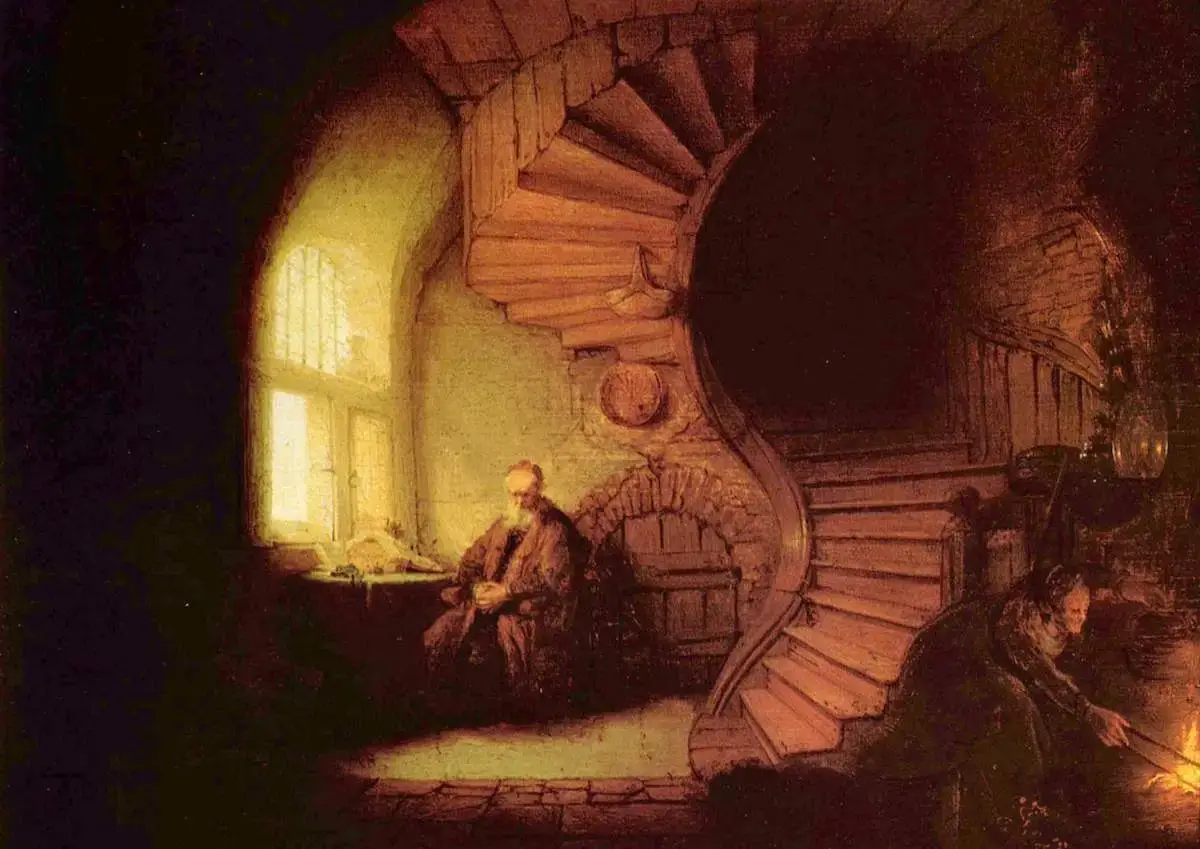
Sage Example: Philosopher in Meditation
The light of the sun pours through the window. Sitting in meditation, the Philosopher absorbs the light reflected on the floor.
He reflects on the light of consciousness, readying himself to ascend the spiral stairway to enlightenment. The Philosopher is an archetype, akin to the Sage or Wise Old Man.
Expressions of the Sage: Magician, Shaman, and Guru
A pantheon of archetypes is linked to the Sage, including:
Shaman
Holyman
Wise Old Man/Woman
Medicine Man/Woman
Knower
Magician
Mentor
Oracle
Mystic
Hermit
Great Mother
Mage
Seer
Prophet
Guru
Wizard
Sorcerer
Guide
Alchemist
Saint
Spiritual Teacher
Jnani
Now, let’s take a quick look at three variations of the Sage:
Each one shares common traits but with a slightly different emphasis.
The Sage vs. Magician: Intuitive vs. Learned Knowledge
Jung’s work featured the Wise Old Man archetype. Neo-Jungian Robert Moore, in contrast, focused on the magician archetype as the knower and creator of worlds.
The primary difference between these archetypes is mainly the emphasis on how they are expressed within the psyche.
As Moore and Gillette point out, the domain of the Magician covers all knowledge that takes special training to acquire. We use Magician energy, for instance, to establish our careers and develop real-world skills.
In contrast, the Sage’s knowledge is deeper and more primordial. It represents intuitive knowledge of reality and oneself, with a greater focus on truth and enlightenment.
Essentially, the Magician emphasizes acquired knowledge, which the ego develops over time, whereas the Sage’s knowledge cannot be acquired.
In fact, it’s just the opposite: to access the Sage’s wisdom, the ego must take a back seat, surrendering to a source greater than it.
The Shaman and the Natural World
The shaman archetype is another common expression of the Sage.
Also known as the Medicine Man/Woman, the Shaman’s knowledge is predominantly focused on Nature and the natural world.
Moore and Gillette explain:
The shaman in traditional societies was the healer, the one who restored life, who found lost souls, and who discovered the hidden causes of misfortune. He was the one who restored wholeness and fullness of being both individuals and communities.
The Shaman often uses various herbs, plants, and mushrooms to evoke mystical peak experiences in the initiate to commune with the Divine.
The Guru and Inner Transmission
The Guru, also known as a Holyman or Jnani, has a rich history in the East, especially in places like India.
The intuitive insights and spontaneous knowledge of the Self (and beyond) attract students and devotees from all over.
Many great Indian sages, such as Ramana Maharshi and Nisargadatta Maharaj, attracted an international audience, with tens of thousands of visitors from around the world.
The true Jnani transcends life and death and speaks from a position beyond space and time (known as “nondual“).
Their words and insights pierce the ego’s walls, helping to activate the Guru within the individual.
The real Guru also “transmits” their energy to the initiate, thereby supporting their own Self-realization.
The Sage’s Shadow: Knowledge Without Wisdom
The Sage is an incredibly powerful archetype. As such, it casts a profoundly large shadow.
In general, the shadow represents everything we don’t know about ourselves—everything we’re not conscious of.
When it comes to archetypes within the psyche, it’s important to understand their shadow attributes as well.
Shadow archetypes related to the Sage include:
Let’s examine each of these in more detail.
1 – The Detached Manipulator
Because the Sage is associated with cognition, self-deception is the theme of its shadow.
The Detached Manipulator is the archetype Robert Moore highlights in his model of the psyche. It represents the active shadow of the Magician archetype, also known as the Trickster.
This archetype withholds specific knowledge to hinder the progress of others.
Instead of sharing knowledge, he focuses on controlling and manipulating others.
The Manipulator has a cynical detachment from life and human values.
I go into more detail about this shadow character in the Magician guide.
2 – The Delusional Mystic
The Delusional Mystic has mistaken his own fantasies for Reality.
Instead of comparing his insights with a community of equals (“sangha”), he isolates himself from others.
He secretly believes he’s the sole proprietor of truth.
In his grandiosity, the basic insights he might have initially gained become increasingly distorted.
He eventually becomes completely divorced from reality.
If the Delusional Mystic attracts followers, the group instantly turns into a cult that can become destructive over time.
The goal of the Delusional Mystic is to keep its followers subservient to it without end.
3 – The Deviant Guru
The Deviant Guru expresses itself in so-called spiritual communities and cults around the world.
Many spiritual communities, in fact, eventually degrade into sex cults. For example, in the late 1970s and early 1980s, many A Course in Miracles study groups turned into orgies.
Many popular spiritual teachers like OSHO and Trungpa Rinpoche were known for having sex with many of their mostly female devotees.
This Deviant Guru touches on an aspect of the individual’s shadow that has never been examined.
While they consciously sought knowledge and spiritual insights to realize enlightenment, another aspect of them wanted this knowledge to influence, manipulate, and seduce the opposite sex.
In fact, from my observation, many new-age communities—including yoga teachers and practitioners—seem to be possessed by this Deviant energy.
The conscious justification for this energy is, “Well, sex and sexuality are spiritual.” This concept, however, is inconsistent with ancient traditions that warned against this false belief.
Yet, misunderstandings of the meaning of “twin cultivation” in Taoism and the popularity of texts like the Kama Sutra from ancient India continue to this day. (These misconceptions are expressions of the Deviant Guru energy.)

4 – The False Prophet
The False Prophet is also known as the False Teacher or Charlatan.
It too has a rich history, especially in India. Today, this archetype is prevalent in the West as well.
The Charlatan is a peddler of “knowledge” whose real aim is to accumulate money and physical possessions.
This archetype is driven by what I’ve called elsewhere, “the Business of Enlightenment.”4Jeffrey, S. (2013). Power vs. truth: Peering behind the teachings of David R. Hawkins. Creative Crayon Publishing.
The primary difference between the Detached Manipulator and the Charlatan is that the Charlatan knowingly deceives others.
Arguably, there are far more False Prophets in today’s world than authentic Sages. Perhaps it’s always been that way.
In the history of Taoism, for instance, there were periods when authentic teachers and texts emerged in the culture. Then, quasi-Taoist cults formed, and extraneous teachers became popular. Finally, over time, a genuine sage would emerge and once again clarify the Way (Dao).
The popularization of “sex techniques” for spiritual development (Deviant Guru) apparently arose from charlatans and marketers trying to profit in public markets. All the genuine Sages and classic texts warned against these practices.
For more on this topic, see Spiritual Healers & Their Shadow: A Complete, Real-World Guide
Why the Sage’s Shadow Dominates Modern Culture
As we said, the sage archetype’s two primary functions are the cultivation of cognitive consciousness and the refinement of morality.
Developing cognitive consciousness is relatively easy. It simply takes devotion, discipline, and will to cultivate one’s mind each day—learning, reading, paying attention, observing, and so on.
Moral refinement, however, is a different matter entirely. Moral refinement is the outcome of a successful Hero’s Journey; it’s the result of an often arduous individuation process.
Developing true moral character is hard-earned. Doing so requires completing internal alchemical processes, such as shadow work, in which the individual brings their unconscious into consciousness.
While gurus and spiritual teachers may be popular, getting to know one’s dark side is not. The truth is that very few gurus know their shadow.5Zweig, C., & Abrams, J. (1991). Meeting the shadow: The hidden power of the dark side of human nature. Jeremy P. Tarcher/Putnam.
Instead, these gurus believe they have “transcended” their body and mind, while in reality, they may just have disassociated from the self. As such, the absence of moral refinement in culture and society manifests the shadow of the sage archetype in abundance.
False Gurus and the Cults Among Us
With the prevalence of false gurus also comes the popularity of cultism. Spiritual cults abound—they are literally everywhere. Some have physical groups, others are virtual, and still others are purely ideological.
Cultism always results in spiritual bypass when the individual fails to examine themselves closely and address old psychological wounds.
Cults form because of a psychological symbiotic relationship between the False Guru and the confused student/devotee. The devotees project authority onto the charismatic cult leader. In many cases, this is a Father projection stemming from the devotee’s unaddressed childhood wounds.
The cult leader is driven by grandiosity and inflation, feeding on his followers’ projections.
Individuation, or becoming whole within oneself, is the goal of psychological development. In the absence of this sense of wholeness, there’s a constant feeling of emptiness, like “something is missing.”
Subconsciously, many people are attracted to cult leaders and cult groups because of this “missing something” feeling.
However, this internal tension can NOT be resolved externally. It can only be resolved by going inward.

How to Safeguard from the Sage’s Shadow
Intellectualism is a common trait in the modern world. It’s an expression of Magician energy.
Jung believed that the dominance and overemphasis on thinking and rationalism in society result from what he called a wounded feeling function.
The drive for knowledge for knowledge’s sake—or to use that knowledge to profit or manipulate others—has profound limitations.
As Taoist Zhuan Zhou writes:6Zhuang Zhou [Zhuan Zhou]. (~4th century B.C.E./1997). Zhuangzi (S.‑Y. Liang & W.‑C. Wu, Trans.). In S.‑Y. Liang & W.‑C. Wu (1997), Qigong empowerment (pp. 298–304). Way of the Dragon.
“The human life span is limited. Knowledge is unlimited. It is very dangerous to use a limited life span to seek limitless knowledge. It is even more dangerous when you know that it is dangerous, yet you still think that knowledge makes you smart.”
From neutral observation, it becomes abundantly clear that seeking limitless knowledge is a form of neurosis (mental illness) that plagues the modern world.
It is only in understanding these inherent limitations that we’re able to transcend them. In doing so, the emphasis can shift from external knowledge to intuitive insights.
Also, as with any archetype, the danger arises when we identify with it. Identifying with the Sage, for example, invariably leads to ego inflation (grandiosity)—a very common spiritual trap.
The safeguard against this grandiosity is humility combined with self-knowledge via inner work.
The integrated Sage, by contrast, expresses through intuitive insight, moral refinement, humility, and non-interference—qualities explored above.
Frequently Asked Questions About the Sage Archetype
What’s the difference between the Sage and the Magician archetype?
The Magician’s knowledge is acquired—built through training, study, and ego-driven mastery of real-world skills. The Sage’s knowledge cannot be acquired.
As we’ll see below, to access it, the ego must surrender to a source greater than itself.
The Magician asks, “How can I use this?” The Sage asks, “What is true?”
What are the core traits of a Sage personality?
The integrated Sage unites intuitive insight with conscience—perceiving truth directly rather than through accumulated information.
Key markers: cognitive self-awareness, moral refinement earned through shadow work, non-interference in others’ journeys, humility that quiets the ego, and the capacity to induce self-reflection through questioning rather than instruction.
How do I know if I’m dealing with a false guru or an authentic Sage?
Authentic Sages never cultivate dependency. They illuminate the path but refuse to walk it for you.
False teachers—whether the Deviant Guru, Delusional Mystic, or Charlatan—feed on projection, isolate followers from equals, and trade wisdom for wealth, sex, or control.
If the teacher needs your subservience, you’ve found a shadow.
Is the Sage archetype always an old man?
No. Jung’s senex (wise old man) is one expression, but the Sage also appears as the Earth Mother (Galadriel), the Jnani beyond space and time (Ramana Maharshi), the Philosopher in meditation, or a sudden revelation in your own journal.
The Sage is defined by insight, not age or gender.
What is the shadow side of the Sage archetype?
Knowledge without wisdom.
The Sage’s shadow emerges when cognitive development outruns moral refinement—producing the Detached Manipulator (knowledge as control), the Delusional Mystic (fantasy mistaken for reality), the Deviant Guru (spiritualized predation), and the False Prophet (wisdom sold for profit).
How can I access Sage energy in everyday life?
Start by stabilizing the Inner Observer—that neutral, calm awareness beneath the chatter.
Anchor the breath deep in the lower torso. Practice sitting meditation to quiet the mind.
Then, crucially, soften the ego’s need for control. Any trace of grandiosity blocks the Sage. Humility is the price of entry. See below for more context.
Accessing Sage Energy in Everyday Life
While accessing Magician energy is a more active process (involving the accumulation of external knowledge), connecting to Sage energy is more passive.
The Magician helps us create in the external world. The Sage guides us back home through our inner world.
Any form of ego inflation—grandiosity, hubris, thinking that you’re “better than” others—will block the inner Sage.
It takes great humility to safely access the sage archetype. In a sense, this occurs when the ego surrenders to the Higher Self.
Aligning with Divinity Within
There’s a reason that the Eastern traditions (as well as Jung) equated the Self with God.7Jung, C. G. (1972). The spiritual teachings of Ramana Maharshi (Foreword). Weiser Books.
While the quest for knowledge may lead many individuals away from an external concept of god, it need not cause one to reject the notion entirely.
Many intellectuals, for example, become atheists, which is ultimately an expression of grandiosity that tends to block intuitive insights.
In contrast, when you recognize the profound limitations of intellectual knowledge (as Zhuan Zhou highlighted above) and instead submit to the Self, an internal shift occurs.
Accessing Sage energy begins with a shift toward one’s subjective, inner world. Jung had his methods, like active imagination; the East used its own methods.
The key, according to many Eastern traditions, is to learn how to access one’s Inner Observer.
How to Access the Inner Observer
This is a topic we cover frequently on this website because it relates to depth psychology, self-development, and spiritual growth.
The Inner Observer or Observing Mind is neutral, calm, alert, and steady.
Eastern traditions offer many practices and methods to help individuals access this Inner Observer.
Internal training to stabilize this Inner Observer is considered foundational—a prerequisite for more advanced practices.
1 – Anchor the Breath
To start, you first learn to anchor your breath deep within your lower torso, its natural home. This somatic breathing helps settle the body’s energy, calm the nervous system, and quiet the mind.
2 – Stabilize the Mind
Next, sitting practices are used to stabilize the mind. Your attention is placed on the source of awareness itself—the Inner Observer.
3 – Consolidate Energy
Over time, the body’s energy consolidates (rather than scattering), and one’s consciousness becomes unified and stable.
Other practices, like Zhan Zhuang (standing), help integrate the body-mind so that one’s instincts work together with intuitive insights.
4 – Surrender the Ego and Listen Inward
One’s ability to access Sage energy is directly related to his/her ability to stabilize and govern the mind sufficiently—and to let go or soften the ego’s need for control. Then, listen inward.
In doing so, the Self (spirit) can take its rightful place in the Center of one’s being.
Read Next
The Hero Archetype: A Comprehensive Guide to the Psychology of Courage
Puer Aeternus Archetype: Understanding the Eternal Child
Anima and Animus: Jung’s Path to Inner Union and Wholeness
Jungian Archetypes: A Complete Guide to the Psyche’s Timeless Patterns
What Do You Think?
Share your thoughts and comments below:
References
- Campbell, J. (1949). The hero with a thousand faces. Princeton University Press.
- Jeffrey, S. (2013). Power vs. truth: Peering behind the teachings of David R. Hawkins. Creative Crayon Publishing.
- Jung, C. G. (1959). The archetypes and the collective unconscious (R. F. C. Hull, Trans.). Princeton University Press.
- Jung, C. G. (2009). The red book (Liber Novus) (S. Shamdasani, Ed.). W. W. Norton.
- Jung, C. G. (1972). The spiritual teachings of Ramana Maharshi (Foreword). Weiser Books.
- Liang, S.‑Y., & Wu, W.‑C. (1997). Qigong empowerment: A guide to medical, Taoist, Buddhist, and Wushu energy cultivation. Way of the Dragon.
- Moore, R., & Gillette, D. (1991). King, warrior, magician, lover: Rediscovering the archetypes of the mature masculine. HarperCollins.
- Zweig, C., & Abrams, J. (1991). Meeting the shadow: The hidden power of the dark side of human nature. Jeremy P. Tarcher/Putnam.
- Zhuang Zhou [Zhuan Zhou]. (~4th century B.C.E./1997). Zhuangzi (S.‑Y. Liang & W.‑C. Wu, Trans.). In S.‑Y. Liang & W.‑C. Wu (1997), Qigong empowerment (pp. 298–304). Way of the Dragon.
Absolutely fantastic material! Very complete. Thank you for this.
Thank you for the feedback, Anna!
As per usual, well-written, easy to comprehend and right on time! Thank you for this and your other shares with the world. we are in desperate need of them, and YOU! May you continue to prosper in all your endeavors. Many Blessings Now and Always.
Thank you, Shante.
Great read – thank you again. Susan
Great to hear it, Susan.
Clear, profound and therefore seemingly simple …yet we know it is not! Worth a daily read.
Thanks for the feedback, Carol.
Invaluable insight presented in plain language. The hallmark of authentic wisdom is humility and universal acquisition. The desire to complicate it and render it inaccessible is the flag of the Charlatan. Great Summary.
Yes, Tess. The desire to complicate things is often the mark of a Charlatan. But oftentimes people lack straightforward communication because they either aren’t clear within themselves or they haven’t developed the skills to communicate clearly. Thank you for the feedback.
Thank you for this thought provoking writing, Scott! It raised many questions in my head.
For instance, I have noticed that when I share my insights/deeper truth with people, it turns them away. I heard recently that if I get an insight, I should not hurry and share it with others, ’cause it is manipulating my inner sage. On the other hand, though, I believe that if some info comes to you, it is meant to serve others, as you’re the channel. And you have to pass it on. That’s a huge dilemma for me – whether to share bits of wisdom I get intuitively with others or not.
Not sharing, as I can see from your article, is very much about detached manipulator. Yet, I am mostly withholding not to hinder their progress, as you write, but rather not to stand out, not to irritate them with my insights and stay safe. What are your thoughts on it? When does it make sense to share knowledge and when not?
Hi Yuliya,
“Not sharing, as I can see from your article, is very much about detached manipulator.”
To clarify, this isn’t what I said above. The Detached Manipulator *withholds* information. This is different from “not sharing.”
To help address your tensions, it’s important to be mindful of the context. For example, I’m sharing knowledge on this website because that’s the role I’m playing as a writer/guide/coach/etc. But if I’m talking to someone I know, I’m not playing this role. So unless someone comes to me with a particular problem, I don’t offer insights or “share wisdom.” It would be inappropriate and sound like I’m pontificating, which is off-putting as you’ve observed in the response of others.
Regarding insights you receive, the Taoists addressed this directly, warning that you should not share your intuitive insights with others. (It’s a common mistake we all seem to make initially.) When you do, these insights will eventually stop flowing, stalling your development. So this may be worth reflecting on and paying close attention to the “impulse to share.”
Thank you, Scott, this makes a lot of sense.
So nice to read wonderful insights from you scott, on this confusing topic; thank you
Sure thing, Shruti.
Very interesting.. at first I was just searching for what type of archetype my character is. Definitely.
Yes. Many people seem to think that their character or personality relates to a particular archetype, however, this is not the case. We each have a “family of archetypes” within our psyche.
Hi Scott,
This sentence doesn’t sound quite right: Instead of comparing his insights with a community of equals (“sangha”), he isolates himself from others.
Does everyone have to be part of a community to compare their insights?
A well functioning group requires a high level of self-managing individuals to operate in a manner that you describe.
A mystic doesn’t necessarily have to be delusional if they don’t belong to a group/sangha.
At the most fundamental level if everyone is connected the person may still be present to their inner sage, without sharing their insights, in solitude.
Is this possible?
Thank you for an interesting decoding of the sage archetype.
Hi Ava,
Thank you for the thoughtful question. That statement you’re referring to doesn’t mean the sage needs to be part of a group — that a sage needs to join a community of any kind. (That kind of thing is more likely to be found within certain sects of Buddhism.) That said, there still is external verification of equals among the sages.
For example, Indian sages like Ramana Maharshi and Nisargadatta Maharaj weren’t in a group. However, they both acknowledged (recognized) each other’s level of knowledge and referred certain students to the other based on various factors. They had mutual respect and in that way had their own kind of “sangha.” We find the same kind of verification within the Taoist tradition as well.
“At the most fundamental level if everyone is connected the person may still be present to their inner sage, without sharing their insights, in solitude.”
Absolutely. That’s the true nature of the Sage archetype. It is an internal phenomenon.
Thank you, Scott.
“What is this life? A frenzy, an illusion,
A shadow, a delirium, a fiction.
The greatest good’s but little, and this life
Is but a dream, and dreams are only dreams.”
― Pedro Calderón de la Barca, La vida es sueño
In my life, there is a load of regrets which nothing can be done about;
Just change with the times with the least amount of resistance.
My curiosity has been piqued by my nde.
Sincerely
Lawrence
That’s a beautiful quote, Lawrence. It was clearly written by someone who pierced more deeply into the nature of this reality.
Hi Teacher
Please teacher I must know teacher I need to you having answer my queastions if please?
First teacher with Guru archetype. Is it wrong to realize oneself as Guru if supernatural dreams and signs from the clouds in sky tell you of your potential destiny?
Second teacher I must know teacher. With detached manipulator archetype is it shadow because they manipulator of man or because they detached of one manipulation of man inside oneself. Is Self inside man meaning man/Self can be detached and manipulationings of inner Self/man workings?
Thank you teacher I love you teacher for your very helpful and profund teachings and hopefully wish for your answers to come.
faithfully from your favourite student
Bahsalialiyangi
Hi Bahsalialiyangi,
“Is it wrong to realize oneself as Guru if supernatural dreams and signs from the clouds in sky tell you of your potential destiny?”
Identification with the guru archetype is always precarious because it can lead to ego inflation and delusion. Supernatural dreams and signs are available to all. They are more of an expression of the “Prophet” than the Guru. The Guru reveals the truth about reality. One’s “potential destiny” is still in the realm of the ego/personhood.
“With detached manipulator archetype is it shadow because they manipulator of man or because they detached of one manipulation of man inside oneself. Is Self inside man meaning man/Self can be detached and manipulationings of inner Self/man workings?”
I’m not clear on what you’re asking here because of the English translation. The detached manipulator is an aspect of the shadow because it’s generally outside of a person’s conscious awareness. The Self does not engage in manipulation. If the detached manipulator is in charge, the individual doesn’t have access to the Self.
When the student is ready the teacher appears…..thanks a lot.From Nairobi, Kenya.
Sure thing, Thomas.
Hi Scott,
I am not sure if you will be able to clarify this for me. I recently purchased a book titled “ Crones Don’t Whine: Concentrated Wisdom for Juicy Women (Devine Feminine and Goddesses in Older Women)”.
The word “Devine” spelt with an “e”, is it different from “Divine” spelt with an “i”?
If you know the difference can you please let me know. Thank you!
Hi Roopa,
I’m not familiar with the spelling of “divine” with an “e.” I don’t recall seeing a reference to this spelling in the literature.
For a split second, “devine” looked like “devil” to me …
Interestingly I thought exactly the same thing…every time I see that word it disturbs and bothers me. Appreciate your response.
I want to know the art you used. Some I recognized; others I didn’t. Have you named the artists and sources somewhere? Thank you for a stimulati g discussion!
The images have descriptions in gray beneath each of them.
I would love to download and print this article, it is fascinating. I can’t seem to find a way to do this.
The download option is available in two places: toward the beginning of the guide (above “22 Different Expressions of the Sage Archetype”) and above the last subheading. It says, “Download: Decoding the Sage Archetype (PDF)”
Interesting opinion piece. I often find it fascinating to learn from people who think differently. It is certainly a challenge to write about an abstract, heart-centered, inner philosophy, from a concrete, analytical, black-and-white thinking style. I appreciate the phrases in the article such as, “in my opinion”, and “to me…”, as opposed to “always” and “everyone”. It’s lovely to know there are sages who walk amongst us, as it is so easy to not recognize them. I am thankful for this article’s attempt at casting a light on this easily misunderstood character.
Thank you for the comments, Kir.
There are many expressions of the sage — and these archetypal forms can be expressed through any manner of people. The key thing is to differentiate between the sage as an archetype versus the sage as a person.
Great article. Do you think Jung himself may have suffered a bit under the deviant guru? He was reportedly quite a womanizer, even sleeping with his patients.
Tim, that’s an astute question/observation. And the answer is, most likely, yes, I believe so.
Jung’s first mistress, Sabina Spielrein, was a patient. (She appeared to have helped Jung arrive at many of his core concepts in his writing.) He also seemed to be surrounded by hordes of women on many occasions. (Most of the original “Jungians” appeared to be younger women.)