
OVERVIEW: This guide provides an in-depth review of the book King Warrior Magician Lover by Robert Moore and Douglas Gillette, which explores the four foundational masculine archetypes.
______________
Today’s guide explores four masculine archetypes in neo-Jungian theory: King, Warrior, Magician, and Lover.
This powerful model illuminates the path to mature masculinity and the everyday obstacles we all men (and women) face.
Let’s dive in …
What are Jungian Archetypes?
Archetypes are basic images or patterns within the human psyche.
They are like templates or blueprints for our behavior.
Carl Jung originally referred to these basic forms as primordial images before adopting the term archetypes.
To Jung, archetypes were the invisible fundamental units of the human mind that guided virtually all behavior.
In Jung’s work, he highlighted a series of fundamental archetypes that virtually everyone can relate to, including:
- The Mother
- The Father
- The Child
- The Persona
- The Shadow
- The Anima
- The Animus
- The Self
- The Hero
- The Maiden
- The Wise Old Man
- The Trickster
These can be considered “classic Jungian archetypes.”
Others in the Jungian community picked up the baton and continued to refine his ideas.
Two notable neo-Jungians are James Hillman and Robert Moore. (This guide focuses on Moore’s contributions to the field.)
If you’re new to archetypes, see this comprehensive primer: The Psychology of Archetypes.
Jung’s Map of the Psyche

Carl Jung’s Model of Psyche
Before we dive into Moore’s King Warrior Magician Lover model, it’s worth doing a super quick review of Jung’s roadmap of the psyche.
The ego is one’s conscious sense of self (or self-identity).
The shadow lies below the surface in what Jung called the collective unconscious.
The collective unconscious is a universal repository of images, patterns, and forms. It is the home of all the archetypes.
In the center of the psyche sits the Self. The self is the organizing principle within the psyche.
Robert Moore’s Model of the Psyche
 Moore’s Structure of the Self (Four Masculine Archetypes)
Robert Moore’s Neo-Jungian model isn’t in direct conflict with Jung’s. Instead, it’s simply more differentiated.
Moore’s model uses a pyramidal structure. The four sides represent four masculine archetypes that represent four fundamental aspects of our humanness.
These four masculine archetypes are the King, Warrior, Magician, and Lover.
The peak of the pyramid is what Moore refers to as the cohesive Self.
The individuation process leads one to integrate these four energies, ultimately arriving at the Self.

Moore’s Pyramidal Structure of the Four Masculine Archetypes
One of the most practical aspects of Moore’s model is how the shadow is represented.
In Jung’s work, the shadow is a singular figure—an archetype representing everything you don’t know about yourself.
In contrast, Moore highlights that each of the four foundational masculine archetypes has a shadow.
And it’s not just a singular shadow, as each archetype has a bipolar shadow. For example, the King archetype’s bipolar shadow is the Tyrant and the Weakling.
We’ll go into more detail about these bipolar shadows below.
Four Foundational Masculine Archetypes (Mature Masculinity)

Neo-Jungian Robert Moore and mythologist Douglas Gillette were well-known in the “men’s movement” in the 1990s.
The duo published a series of books, including King Warrior Magician Lover: Rediscovering the Archetypes of the Mature Masculine (1990), The King Within, The Warrior Within, The Magician Within, and The Lover Within.
Their presentation of the masculine psyche includes the archetypes of boy psychology and how things often go wrong in early development.
Then, the authors highlight the four major archetypes of the mature masculine psyche.
- The King Archetype
- The Warrior Archetype
- The Magician Archetype
- The Lover Archetype
The authors liken these four archetypes of mythology to the:
- Four winds of the Navajo people,
- Four faces of Hindu gods, and
- Four gospels of the early Christians.
Each of these four masculine archetypes represents a fundamental set of attributes of the masculine psyche. If just one of these archetypes is out of balance, the psyche can easily fall into chaos.
These four masculine archetypes center around the Self. In fact, Moore’s model attempts to illustrate the structure of the Self.
For Moore and Gillette, these four archetypes represent the four energies in the human soul.
Jung’s Four Functions vs Moore’s Four Masculine Archetypes

Jung’s Four Functions (Psychological Types)
Jung’s psychological types center around what he called the four functions:
- Thinking
- Feeling
- Intuition
- Sensation
For Jung, the transcendent function (the Self) was arrived at by developing one’s inferior function and balancing all four functions in the center.
In contrast, Jung’s mistress and teacher, Tony Wolff, believed there were four structural forms within the feminine psyche.1https://robertmoore-phd.com/index.cfm?fuseaction=page.display&page_id=31
Moore’s model follows this tradition, highlighting the four structural forms of the male psyche:
- The King Archetype
- The Warrior Archetype
- The Magician Archetype
- The Lover Archetype
Ultimately, the goal of both models is the same: to individuate and converge in the Center—to arrive at the Self.
The Masculine and Feminine Psyche
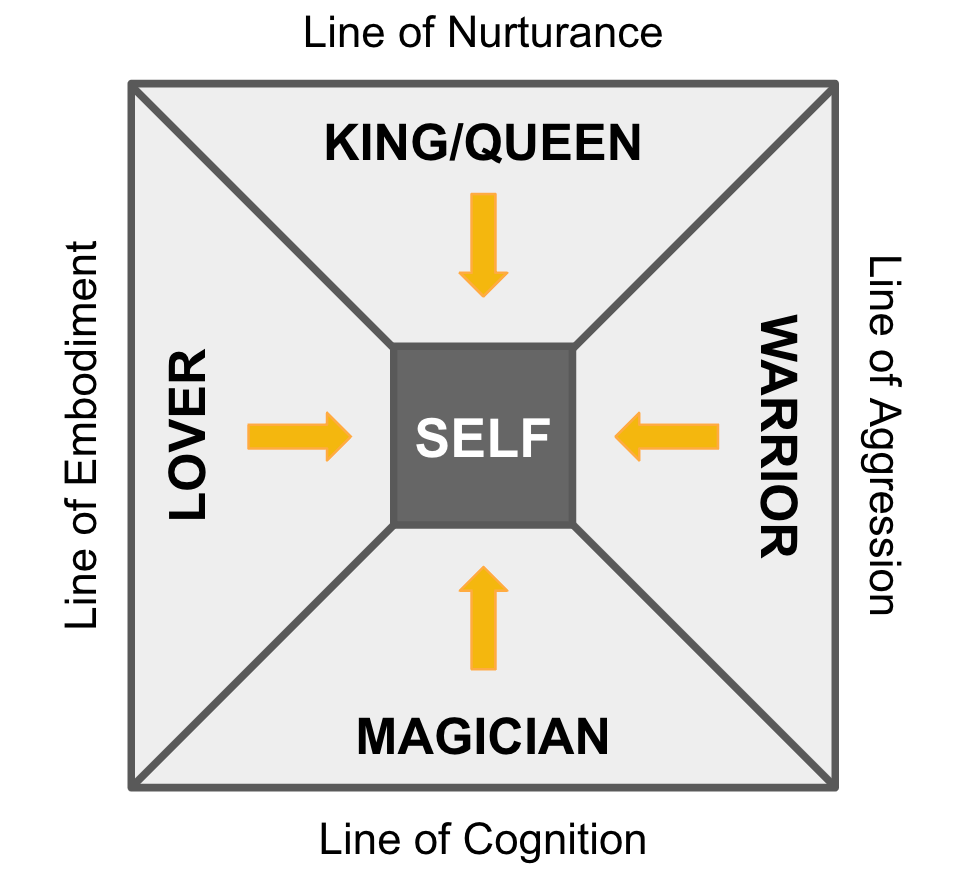
Moore’s Map of the Psyche: Feminine and Masculine Archetypes
While Moore and Gillette’s work focused on the masculine psyche, in his lectures, Moore explained that with a few modifications, this model extends to the feminine psyche, too.
For example, in the feminine psyche, the King archetype is replaced with the Queen as the organizing principle.
The Queen is just as essential as the King. They are both nurturing, organizing, and centering within the personality.2https://robertmoore-phd.com/index.cfm?fuseaction=page.display&page_id=32
Also, remember that within Jungian psychology, the masculine psyche has a feminine counterpart: the Anima.
Conversely, the feminine psyche has a masculine counterpart: the Animus.

Moore’s Archetypal Self as a Double-Quaternio
Both men and women have these four energies. And both genders must find a way to access these energies and bring them into balance. Ultimately, this is the goal of the individuation process.
However, Moore points out that men and women use different approaches to arrive at the Self. (The Self is ultimately nondual.)
For example, when boys in adolescence are flooded with Warrior energy, girls of the same age are flooded with Lover energy.3https://robertmoore-phd.com/index.cfm?fuseaction=page.display&page_id=34
As Jungians like to say, men and women “pass each other in the night” during midlife.
For an examination of feminine archetypes, see: A Beginner’s Guide to Female Archetypes.
Four Masculine Archetypes: King Warrior Magician Lover
Now, let’s briefly look at these four foundational masculine archetypes featured in Moore and Gillette’s book: King Warrior Magician Lover.
Remember that each masculine archetype has a set of common attributes, qualities, and expressions in its healthy form.
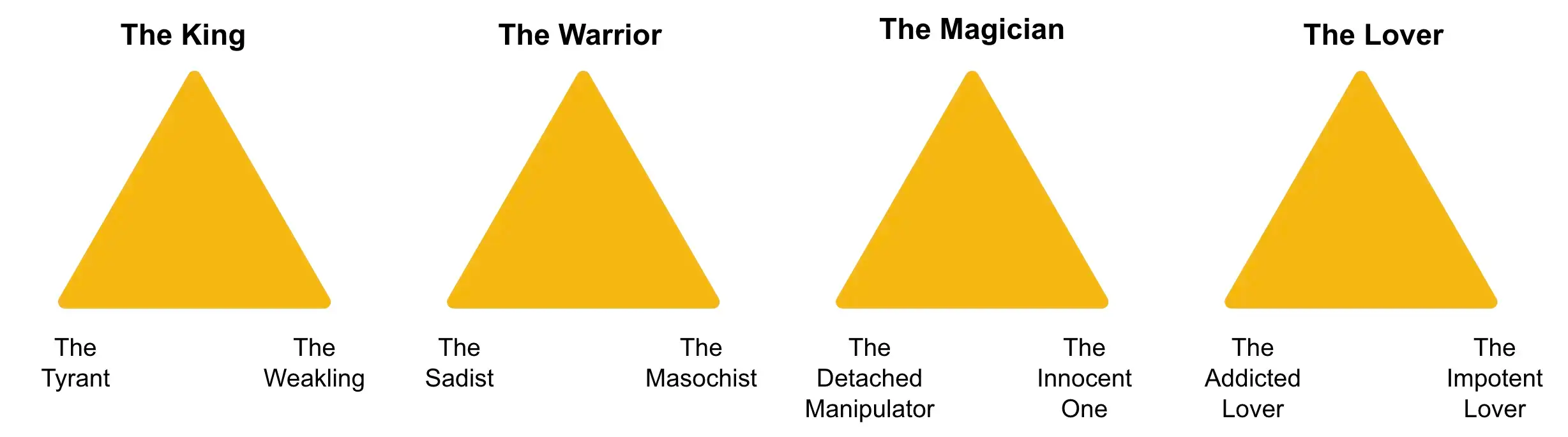
Immature and Mature Masculine Archetypes from King Warrior Magician Lover
Also, each masculine archetype has a bipolar shadow. The bipolar shadow represents what can go wrong in the course of development.
Each bipolar shadow has an active and a passive side. Both shadow sides illustrate common attributes, qualities, and expressions found in “unhealthy” development.
The reality is that we all express these destructive bipolar patterns at various stages and periods of our lives. It’s mainly a matter of degrees and emphasis.
Some of us are possessed and ruled by these shadow archetypes more frequently than others.
I often reference Moore and Gillette’s King Warrior Magician Lover on this website because it is incredibly revealing, instructive, and valuable for anyone engaging in shadow work.
The bipolar shadow archetypes apply equally to both the masculine AND the feminine.

Shah Namah, the Persian Epic of the Kings
The King | Masculine Archetype
The King archetype represents the line of nurturance. This quintessential masculine archetype signifies the primordial man, the “Image of God,” the Atman.
The King represents the ordering principle within the man’s psyche. For instance, a stable, grounded man is in contact with this archetypal king energy.
The Function of the King Archetype
The King provides order within a man’s life and to those around him, helping him stay internally consistent (instead of saying one thing and doing another).
Another vital function of the King archetype is to provide fertility and blessing.
When the King and Queen are present, the land is fertile, and the people are at peace and prosperous. In the absence of the King and Queen, the land becomes barren, famine comes, and the people suffer greatly.
This masculine archetype sits in the Center. From this Center, he maintains order, organization, and creative power. What’s outside the King’s domain represents chaos, the demonic, and the “nonworld.”
The King is arguably the most critical masculine archetype, as it establishes order and stability. However, this King energy is also the most challenging of the four to harness within a man’s psyche. Most often in one’s individuation process, the King comes online last.
Attributes of the King Archetype
Key characteristics of the King archetype include:
- Provides order, stability, and calm
- Generative: providing blessings to the younger generation so they can flourish
- Creatively partners with the Queen (feminine aspect of the psyche)
- Conduit to the Divine World; mediator between the mortal and the Divine
- Supports healing, wholeness, and integration
- Reasonable and rational
- Maintains integrity of being and purpose
- Stabilizes chaotic emotions and unruly behavior
- Possesses a deep knowingness and powerful inner authority
- Encourages creativity in others
- Lives by the Dharma; is one with the Tao (the Way)
- Creates the conditions for others (wife and kids) to prosper
The King resides in the Center.

Structure of the King Archetype
The Shadow King Archetypes
In many modern, dysfunctional families, the father is immature, weak, or absent. Under these conditions, there isn’t sufficient King energy, which leaves the family in chaos and disarray.
The bipolar shadow archetypes of the King are the Tyrant and the Weakling.
The King Archetypes’ Active Shadow: The Tyrant
The active side of the King’s shadow is the Tyrant.
The Tyrant hates, fears, and envies new life. In fact, he is threatened by new life.
Never residing in the Center, the Tyrant lacks calmness, generativeness, and creativity. As such, he tends to leave a wake of destruction.
As a purely self-interested narcissist, the Tyrant exploits and abuses others. The true Tyrant is ruthless, merciless, and without feeling.
He hates beauty, innocence, strength, talent, and life force because he lacks the internal structure of King energy.
Ultimately, he is terrified of his hidden weakness and lack of potency. Consequently, he projects that weakness onto others and seeks to dominate them.
With his grandiosity (ego inflation), he cannot easily receive criticism, often feeling weak and deflated.
The tyrannical father will go out of his way to undermine the joy, strength, energy, and abilities of his son or daughter.
On the world stage, the Tyrant is everywhere. It runs most governments and world organizations.
The King Archetype’s Passive Shadow: The Weakling
Behind the protected facade of the Tyrant is the Weakling, the passive side of the King’s shadow.
Also lacking centeredness, the Weakling is anxious, fearful, and insecure. He is prone to paranoia.
The Weakling exhibits oppressive behavior and constantly represses his grandiosity. (When he hits his limits, the repressed grandiosity bubbles to the surface or explodes into hostility.)
He may appear “nice” and “rational” in one instance, but later becomes a “different person” (when the repression gives way).

Achilles fighting against Memnon
The Warrior | Masculine Archetype
The Warrior archetype represents the line of aggression and the energetic aspect of one’s psyche.
The Warrior in his fullness is like a samurai living by his code—”a spiritual or psychological path through life”—a total way of being.4KWML, 79. This powerful masculine archetype pushes us to embrace life’s challenges and harness our life force energy.
In both men and women, the Warrior represents the capacity for aggression, but not in a destructive way.
Instead, this aggressive stance toward life rouses, energizes, and motivates us.5Ibid.
The Function of the Warrior Archetype
Warrior energy empowers us to stay motivated, cultivate focused discipline, establish boundaries, follow through, and serve a cause or mission.
Potent Warrior energy shifts us from defensiveness and holding back to tackling life’s problems, tasks, and responsibilities with confidence. This archetype is strategic and takes what the Buddhists call “right action.”
Men tend to access this Warrior energy earlier in life, while women pass through this line of aggression in mid-life (where men tend to become more passive).6David Gutmann, Reclaimed Powers: Men and Women in Later Life, 1994.
Attributes of the Warrior Archetype
Key characteristics of the Warrior archetype include:
- Energizing, motivating, and focused
- Takes an offensive (instead of a defensive) attitude toward life
- Responsible and disciplined
- Ready to leap into battle
- Moves us forward
- Takes “right action”
- Alert and awake (doesn’t sleepwalk through life)
- Knows what he wants and how to get it
- Possesses clarity of mind and razor-sharp evaluation (discernment)
- Strategic and tactical (doesn’t overthink)
- Adapts to difficult situations
- Knows his limitations and capabilities
- Engages in in-depth training to develop skills
- Makes every action count
- Has an unconquerable spirit
- Loyal to something bigger than himself; devoted to a cause, his god, his civilization, etc.
Like the Samurai, the Warrior has a sense of imminent death that propels him through life, leading to full engagement with an unconquerable spirit.

Structure of the Warrior Archetype
The Shadow Warrior Archetypes
The bipolar shadow archetypes of the Warrior are the Sadist and the Masochist.
The Warrior Archetype’s Active Shadow: The Sadist
The Sadist is the active pole of the Warrior’s shadow.
The Sadist is the “demon of cruelty,” which can manifest as cruelty with or without passion.
Darth Vader is the iconic Sadist expressed as a passionless killing machine.
Because his mind and feelings are not under control, the Sadist is prone to taking emotional swings at everyone. Violent emotionalism is a trademark of the Warrior’s shadow.
This destructive masculine archetype can enter us when we’re experiencing times of extreme fear or rage.
The Sadist loathes “the weak,” preying on the helpless and vulnerable. (That is, the Sadist attacks his own Masochist that he is repressing.)
Ritual humiliation is commonly found in cults around the world, expressing a trademark process for the Sadist.
The Sadist develops from adolescent insecurity of the Hero archetype that carries over into adulthood.
He lacks legitimate phallic power because he is still battling powerful feminine archetypes from childhood. (For more on this topic, see Jung’s Anima-Animus.)
In everyday life, the Sadist exhibits a compulsive personality, often prone to workaholism.
He constantly harasses, belittles, and attacks everyone and everything, leading to burnout.
The Warrior Archetype’s Passive Shadow: The Masochist
The Masochist is the passive pole of the Warrior’s shadow. You can’t have a Sadist without a Masochist to prey on.
The Masochist willingly takes the abuse. He is a cowardly pushover, like a whipped puppy.
Projecting the Warrior energy onto others, the Masochist feels powerless within himself.
He is unable to defend himself physically or psychologically. As a consequence, he is easily taken advantage of. (The Sadist-Masochist duo is a spillover from the Bully-Coward from boy psychology.)

Hermes Trismegistus, Floor inlay in the Cathedral of Siena, Russia
The Magician | Masculine Archetype
The Magician archetype is the energy of cognition, awareness, insight, thoughtfulness, and reflection.
With Magician energy, we move from information and knowledge to more profound wisdom for healing ourselves and others. The Magician is the builder of our world.
The Function of the Magician Archetype
The Magician possesses hidden knowledge acquired through specialized training. Its role is to contain and channel its power for the good of all. This means becoming generative as one matures in their development.7As depicted in Erik Erikson’s “Generativity vs Stagnation” in his psychosocial developmental model.
This powerful masculine archetype understands the hidden dynamics of the human psyche and can harness the power of introversion. As a consequence, it can manipulate others for good or evil.
He possesses a finely tuned “B.S. detector” and the ability to think through problems that are not obvious or perceptible to others.
The Magician governs the observing ego and insulates us from the overwhelming power of the other archetypes.
Jung often referred to this masculine archetype as the Wise Old Man or the Sage archetype. He is a seer and a prophet.
Attributes of the Magician Archetype
Key characteristics of the Magician archetype include:
- Highly knowledgeable; capacity for deep thinking
- Knower and master of technology
- Guides the process of transformation
- Initiates secret and hidden knowledge of various kinds
- Endures special training
- “Spends a large amount of time, energy, and money to be initiated into realms of secret power”8KWML, 98.
- Willing to undergo risky ordeals to acquire mastery
- Understands the links between the seen and the unseen, the world of humans and spirits
- Possesses an enormous amount of power; a master of containing and channeling this power
- Can cleverly deflate arrogance in others
- Has an excellent “B.S. detector”
- Sees through denial and exercises discernment
- Can uncover unconscious motives and self-deception
- Regulates life functions of the psyche as a whole9KWML, 107.
- Helps insulate us from the overwhelming power of the other archetypes
- Harnesses the energy of introversion
- Emotionally detached and stable (not easily swayed, pushed, or pulled)
The Magician is the Witness of the Experiencer, helping us govern the observing Ego and enabling us to delve into the depths of the psyche and the unseen worlds.

The Magician Archetype
The Shadow Magician Archetypes
The bipolar shadow archetypes of the Magician are the Detached Manipulator and the Denying “Innocent” One.
Magician’s Active Shadow: The Detached Manipulator
The Detached Manipulator is the active pole of the Magician’s shadow.
The Detached Manipulator is detached from human values, making him cruel and cynical. He manipulates others by withholding vital information.
This shadow image manipulates human perception and behavior for its own delusional agenda.
The Detached Manipulator tends to overthink instead of fully engaging in life. He is afraid to live, “caught in a web of pros and cons about his decisions and lost in a labyrinth of reflective meanderings.”10KWML, 114.
This “armchair adventurer” cannot participate in life or the lived experiences of others, leading him to feel isolated and lonely. He cuts himself off from living, relatedness with others, and his soul.
Detached Manipulators abound in modern society. We find them as professors in most graduate schools, advertisers on Madison Avenue, as well as many therapists, and all propagandists working for NGOs and other special interest groups.
Magician’s Passive Shadow: The Denying “Innocent” One
The Denying “Innocent” One is the passive pole of the Magician’s shadow.
The Innocent One wants the power and status of those utilizing their Magician energy, but doesn’t want the responsibilities that come with this archetypal energy.
He has no interest in sharing, teaching, or helping others. In fact, he’s hostile toward questions.
The Innocent One will learn just enough to derail those making a worthwhile effort.
He’s motivated by envy, resenting those who act, live, and want to share.
The Innocent One fears others will discover his lack of potency (life energy). Inwardly, he feels desolate and lifeless.

Lovers (Mithuna), India, 11th century
The Lover | Masculine Archetype
The Lover archetype represents the energy of play, embodiment, intimacy, joy, and affiliation.
This archetypal pattern is closely tied to our instincts, senses, and sensitivity to the physical world.
With the Lover archetype, one dances with life, experiencing vividness, aliveness, and passion. Without a healthy connection to Lover energy, one experiences life as flat, dull, and meaningless.
The Function of the Lover Archetype
From a classical Jungian sense, the Lover represents one’s sensing function, the aspect of the psyche that regulates sensory experiences.
Aligned with the Lover archetype, one can creatively adapt to life’s hardships.
The Lover is compassionate and able to empathize with the world around him while experiencing connectedness through his feelings.
For the Lover, all life is art, and everything evokes subtly nuanced feelings.11Ibid., 122.
Repressed emotions like grief, joy, and rage often block access to this potent archetypal energy.
Attributes of the Lover Archetype
Key characteristics of the Lover archetype include:
- Enables vividness, aliveness, passion, and a sense of personal meaning
- Provides energy and sensitivity to the external world
- Deeply sensual and sensitive
- Provides a sense of connectedness through feelings (not thoughts)
- Wants to touch and be touched; wants to be “touched” by everything
- Doesn’t recognize boundaries
- Can read people like a book
- Senses people’s shifting moods
- Deeply feels both the joy and the pain of others
Lover energy “intuits the ultimate Oneness of all that is and actively seeks to experience that Oneness in daily life.”12Ibid., 124.

The Lover Archetype
The Shadow Lover Archetype
The bipolar shadow archetypes of the Lover are the Addicted Lover and the Impotent Lover.
Lover Archetype’s Active Shadow: The Addicted Lover
The Addicted Lover is the active pole of the Lover’s shadow.
When this active shadow is in charge, the person experiences lostness—”lost in an ocean of the senses.”13Ibid., 132.
The Addicted Lover lives only for the pleasures of the moment. He is fully engaged in what Maya (the Buddhist term for illusion), addicted to all manner of sensuous things.
He creates a web of immobility. Unable to detach and gain distance from his feelings, he lacks perspective.
The Addicted Lover cannot ground himself. As such, he lacks self-regulation and becomes eternally restless.
The Addicted Lover is perpetually searching for something but doesn’t know what he’s looking for. Moore and Gillette write, “He has an insatiable hunger to experience some vague something that is just over the next hill.”14Ibid., 135.
Lacking the ego structure of the mature masculine, he’s still under the spell of the feminine unconscious from childhood.
The Addicted Lover is often synonymous with the Don Juan syndrome, where the man seeks an endless stream of women. This Don Juan syndrome is a carryover from the Mamma’s Boy archetype from childhood. (These topics are covered in this guide on the Puer Aeternus archetype.)
This shadow archetype seeks the ultimate continuous orgasm—the endless “high.” (This can lead, for example, to drug or pornography addiction.)
The man possessed by the Addicted Lover is enveloped by both his personal unconscious AND the collective unconscious.
The Addicted Lover opposes what it needs most: boundaries, distance, and detachment.
Lover Archetype’s Passive Shadow: The Impotent Lover
The Impotent Lover is the passive pole of the Lover’s shadow.
In the case of the Impotent Lover, life is experienced in a detached manner. He feels sterile, flat, and listless.
Under the Impotent Lover, the man lacks enthusiasm, aliveness, and vividness. He is perpetually bored, lacks an appetite for life, and speaks in a monotone fashion.
Those possessed by this shadow archetype become chronically depressed and dissociated.
While the Addicted Lover is constantly seeking the next orgasm, the Impotent Lover leads a man’s sex life to become stale and inactive.
The Bipolar Shadows of the King, Warrior, Magician, and Lover

The shadow archetypes of these masculine archetypes reveal volumes about humanity.
These archetypal energy patterns highlight what dominates the majority of human behavior.
These patterns are the source of much suffering and discontent for the individual and society.
In my opinion, any model that can help us navigate the tumultuous waters of human suffering is worthy of our attention.
Inflation, Deflation, and the Journey to the Center
The ego frequently toggles between inflation and deflation.
Ego inflation denotes grandiosity (feeling “greater than others”). Ego deflation signifies insecurity (feeling inferior to others).
The active shadow side of the King, Warrior, Magician, and Lover masculine archetypes represents ego inflation, while the passive side expresses ego deflation.
Said another way, grandiosity (feeling god-like and superior) signifies:
- The Tyrant
- The Sadist
- The Detached Manipulator
- The Addicted Lover
On the other end of the spectrum, the ego feels small, less than, and inferior to others.
Deflation is associated with the passive shadow archetypes:
- The Weakling
- The Masochist
- The Denying “Innocent” One
- The Impotent Lover
Ego deflation leads to depression, anxiety, envy, and hate.
The goal of psychological development is to “thread the needle.” That is, to walk the line of the Center between inflation and deflation, touching on the King, Warrior, Magician, and Lover energies without being possessed by them.
The Spirit or Self represents that point in the Center of one’s psyche. This Spirit or Higher Self brings organization to the psyche so that these shadow archetypes are kept at bay.
The Power of Understanding the Bipolar Shadow Archetypes
In my years of experience working with this material, I’ve found the insights of the bipolar shadow of the King, Warrior, Magician, and Lover most revealing. These insights are instrumental for anyone doing shadow work.
The first step is to become conscious of these destructive patterns by familiarizing yourself with them.
Second, you observe yourself and others more attentively to build greater consciousness.
You begin to catch these patterns playing out within you. When done from one’s Center, this type of inner observation helps reduce one’s influence.
Once you can observe these bipolar shadows, you can more completely understand what Jung meant by a “split” within the human psyche.
This understanding breeds self-compassion and humility. It can also greatly reduce our hypocrisy and judgments of others.
How to Access the Masculine Archetypes: King Warrior Magician Lover
Each of these masculine archetypes serves an important role:
The Warrior archetype provides the life force energy to be decisive, take action, and live full-on.
The Magician archetype helps us navigate through life while cultivating knowledge and skills.
The Lover archetype provides vividness and a sense of personal meaning to our daily experiences.
And the King keeps everything in order and in balance, blessing the next generation.
In King Warrior Magician Lover, Moore and Gillette don’t provide an overwhelming amount of instruction on how to access these masculine archetypes in healthy ways.
Their later books, such as The King Within and The Warrior Within, offer a bit more instruction, but still, not a whole lot.
One classic Jungian tool they suggest is active imagination. That is, having an inner dialogue with these four powerful masculine archetypes when needed.
Moore often pointed out that we humans are NOT archetypes. He frequently reminded us, “It’s easy to be an archetype; difficult to be a human.”
The point is that merging or identifying with these archetypal forces is dangerous and leads to psychological problems.
Instead, the goal is to access the energy associated with the King, Warrior, Magician, and Lover masculine archetypes.
If you keep to the Center, staying with what’s “natural,” this access can happen spontaneously.
Final Thoughts on Masculine Archetypes
King Warrior Magician Lover is a powerful and instructive model for better understanding the human psyche and the natural path of development, especially for the mature masculine.
Understanding the bipolar shadow of the King, Warrior, Magician, and Lover archetypes is a worthwhile exercise for anyone seeking self-awareness and a deeper understanding of the world around them.
But always remember that “the map is not the territory.” Models may attempt to represent reality; however, no model is an exact representation of reality.
Recommend Reading on Masculine Archetypes

King Warrior Magician Lover: Rediscovering the Archetypes of the Mature Masculine
by Robert Moore and Douglas Gillette
Read Next
A Complete Guide to Jungian Synchronicity
12 Brand Archetypes: How to Apply Archetypal Psychology to Marketing
Spiritual Healers & Their Shadow: A Complete, Real-World Guide
Spiral Dynamics Integral: How to Use Graves’ Values Model for Psychological Development