
Do you know that indescribable euphoric feeling when you’re at your best?
The volume of the world turns down.
Internal resistance falls away, and with it, your sense of self.
Fully absorbed in the present task, you access more of your innate potential without effort.
The psychological literature calls it a peak experience.
Unfortunately, this experience tends to be the exception, not the rule.
In this in-depth guide, you’ll discover:
- What a peak experience actually feels like—with 7 real examples you’ll recognize
- Maslow’s 16 defining traits of peak experiences (and why they matter)
- The hidden saboteur that blocks flow—and the simple performance formula that defeats it
- 4 body-based practices to access peak states more consistently, starting today
Already familiar with Maslow’s framework? Jump straight to the practices →
Let’s dive in …
What is a Peak Experience?
A peak experience is a temporary state of heightened perception and performance in which self‑focus dissolves and pure awareness directs action
Peak experience is a term humanistic psychologist Abraham Maslow used to describe a higher state of consciousness when humans perform at their best.
A common term for a peak experience is flow or a flow state.
Maslow believed that when having a peak experience, we are closest to our authentic selves—our true identities.
The concept of flow and peak experiences is a bridge between psychology and mysticism.
In a peak experience, we are no longer motivated by our basic human needs. That is, we are not motivated by the external world.
In his research, Maslow found that although anyone (including children) can have a peak experience, self-actualizing individuals have these heightened experiences more frequently.
That is, peak experiences are a sign of positive mental health and a part of our birthright.
Real Examples of Peak Experiences
Peak experiences aren’t confined to monks on mountaintops or athletes breaking world records. They show up in ordinary life—you’ve likely had one without knowing the name for it.
Here are seven recognizable examples across different domains:
1 – The Athlete’s “Runner’s High”
A marathoner hits mile 18, and suddenly the pain vanishes. Legs move without conscious command.
The distinction between self and movement collapses—she is the running. Time distorts. What felt like a grinding slog becomes effortless, euphoric, almost floating.
This isn’t just endorphins; it’s a textbook peak experience where challenge and skill perfectly balance, self-consciousness dissolves, and action becomes autotelic.
2 – The Musician Lost in Performance
A jazz pianist closes his eyes mid-solo. He’s no longer thinking about chord voicings or finger placement. The music plays through him.
When he opens his eyes, 12 minutes have passed. He couldn’t tell you what notes he played, only that he felt whole, integrated, completely alive.
3. The Writer in Flow at 2 AM
She sits down to draft one paragraph. Three hours vanish. The words arrive faster than she can type—no inner critic, no second-guessing, no staring at a blinking cursor.
Her sense of self recedes entirely. She’s merged with the work. When she finally looks up, she’s surprised by the clock.
This is the creative peak experience: absorption so complete the ego takes a back seat, and the work emerges effortlessly.
4. The Parent Holding Their Newborn
A father holds his daughter for the first time. The hospital room fades. Past and future collapse into a single, luminous present moment.
He feels simultaneously powerful and humbled, insignificant and essential. There’s no wanting, no striving—just a profound sense of completeness, awe, and unconditional love.
Maslow noted that childbirth and early bonding moments reliably trigger peak experiences even in people who’ve never had one before.
5. The Surfer Catching the Perfect Wave
She paddles into a wave, and suddenly everything synchronizes. No fear, no hesitation. She’s not riding the wave—she and the wave are one continuous event.
The self merges with the environment. Action and awareness unify. The moment feels eternal and instantaneous at once.
When she paddles back out, she’s grinning without knowing why. Surfers describe this state in almost mystical terms: high-risk, high-skill activities with immediate feedback are peak experience factories.
6. The Hiker Enveloped by Nature
A solo hiker reaches a ridge at sunrise. The valley below stretches endlessly. Without warning, his internal chatter stops.
He feels a sudden, overwhelming sense of belonging—not to a place, but to existence itself.
Maslow called this the “oceanic feeling”: the dissolution of ego boundaries, a sense of oneness with something larger. No drugs, no meditation training—just a human being, present and receptive, touched by awe.
7. The Scientist’s Sudden Insight
A researcher has been wrestling with a problem for weeks. She steps away to make tea—and the solution arrives fully formed, like a gift.
In that moment of clarity, she experiences what Maslow described as “B-cognition”: a flash of perception where everything fits together in a coherent, beautiful whole.
The insight itself is accompanied by a rush of joy, gratitude, and a feeling of being graced—the characteristic surprise and humility of the peak experience.
The 16 Qualities Explained: What Each Trait Feels Like
In Toward a Psychology of Being, Maslow highlights 16 qualities he observed in those who realize a peak experience:1Maslow, A. H. (1962). Toward a psychology of being. D. Van Nostrand Company. https://doi.org/10.1037/10793-000
- Integrated
- Oneness
- Powerful
- Effortlessness
- Self-determined
- Free of inhibitions
- Spontaneous
- Creative
- Uniqueness
- Present
- Merging of self and other
- Nonstriving
- Poetic expression
- Completeness
- Playfulness
- Surprise
These 16 qualities aren’t just a checklist—they’re the blueprint for what we’ll train in the actionable section below.
But listing them out doesn’t help us too much. Let’s explore each dimension in more detail. Since many of these attributes are interrelated and overlapping, I’ve grouped them by their natural overlap below.
Oneness and Integration
A person in a peak experience feels more unified and whole. That is, they feel less fragmented and dissociated. With fewer internal splits and tensions, they feel more autonomous and at peace within themselves.
Naturally, in this state, we feel more like our true selves. In Eastern traditions, this is often referred to as “Holding to the Center.”
Maslow writes,2Ibid, 117.
As he gets to be more purely and singly himself he is more able to fuse with the world, with what was formerly not-self.
In this state:
- The creator becomes one with his work being created.
- The appreciator of the music becomes the music.
- The astronomer merges with the stars “out there.”
So even though we feel more ourselves in a peak state, we simultaneously transcend ourselves—going beyond our selfhood to an egoless state.
Powerful and Self-Determined
In a peak experience, we often feel that we’re at the peak of our internal power. We can use our capacities at their best and fullest. This is a quintessential idea behind self-actualization: realizing our fullest potential.
It’s as if all of our highest capacities get activated during a peak experience. We become “fully functioning” with greater intelligence, perceptiveness, strength, and grace.
Self-determination is an important quality of mature adulthood. Psychiatrist Carl Jung considered it an essential component of individuation.
From Maslow:3Ibid, 118.
The person in peak experiences feels himself, more than at other times, to be the responsible, active, creating center of his activities and of his perceptions. He feels more like a prime mover, more self-determined.
In this state, you feel fully responsible—the CEO of your own life (“CEOsage”). The locus of control is fully within yourself.
Now, you are the master of your fate. You are decisive, strong, confident, and single-minded, ready to overcome opposition.

Freedom from Inhibition and the Inner Critic
In a peak experience, individuals are not ruled by feelings of lack and deficiency.
Mental blocks, fears, doubts, reservations, outside controls, the inner critic … they all simply fall away.
Basically, without internal splits and tensions—when we’re no longer at war within ourselves—all of these self-imposed limitations evaporate.
Spontaneity and Creativity
Maslow often described spontaneity as a key attribute of creativity and self-actualizing individuals.
Rigidness is a quality of neurosis (mental illness). Spontaneity and creativity are qualities of positive mental health.
In a peak experience, we’re more spontaneous, expressive, natural, and free-flowing. When we’re free of inhibitions, spontaneity arises naturally.
With greater spontaneity, we are naturally more creative. Studies on divergent thinking illustrate how young children (age 5) are virtually all geniuses (98%). Yet, after a decade of “education,” that number drops to 10 percent.
By adulthood, the number of individuals who score at the genius level is a paltry 2 percent.
The Taoists call this the result of “mundane conditioning.” It’s the conditioning of the external world that inhibits our natural potential (and makes us mentally ill). But in a peak experience, innate qualities like creativity shine through.
Uniqueness and Poetic Expression
Maslow used the terms “acme of uniqueness, individuality, or idiosyncrasy.”
In a peak experience, all of our roles and personas (social masks) drop away so we can access our “unique selves.”
Maslow notes that when we have a peak experience, our communication and expressions are often poetic and mythical. It’s as if we are expressing what’s deeply embedded within our psyches.
This attribute, once again, points to the importance of creativity in self-actualization.
Presence and Awareness in the Now
Maslow observes that in a peak state, individuals are “more here-now, most free of the past and of the future in various senses, most ‘all there’ in the experience.”
Those in the mindfulness movement will appreciate this description. Maslow describes the goal of mindfulness meditation: to be fully present in the here and now.
In this state, we can listen better to others without prior conditioning, including judgments, biases, emotional triggers, and projections.
This sense of present-moment awareness is the result of greater selflessness.

Merging of Self and Other – Letting Go
Here, there’s a “letting be of the self and of the other.”
That is, in a peak experience, one can respect and love oneself and respect and love another simultaneously.
Here, we grasp the non-self by “letting it be itself, by letting it go, by permitting it to live by its own laws rather than by mine.”
Nonstriving and Effortless Action
Another key characteristic of a flow state is effortlessness. When we’re in a peak experience, there’s no friction; only a naturalness and ease to whatever we are doing.
This quality relates to the Buddhist concept of the Middle Way, or what the Taoists call Wu Wei (nongoverning).
There are no doubts or hesitation—just “right action” emerging as a function of being natural.
As such, we enter a state of non-striving. Non-striving is another way of defining Wu Wei:
- Non-striving
- Non-action
- Non-governing
- Non-doing
In this higher state, we just are.
Our conscious minds can have trouble understanding this important concept because the ego is driven by doingness and action. The ego deploys will and effort with specific purposes.
But in the peak experience, all of this falls away. The ego/mind takes a back seat, which is what enables the qualities highlighted above to manifest.
With non-striving comes a complete absence of wants and desires. (This is the goal of many of the Eastern traditions.)
Playfulness and Surprise
Maslow said he had difficulty in describing this particular playfulness due to limits in the English language, but it came down to a cosmic, good-humored quality that transcends hostility of any kind. It’s a kind of exuberant delight.
During and after a peak experience, individuals report feeling lucky, fortunate, and graced.
Maslow notes that these peak experiences aren’t planned; they just happen.
We might get the feeling, “I don’t deserve this.” In this state, there’s a profound feeling of humility. With a peak experience often comes profound feelings of gratitude and joy.
This feeling of gratitude and joy can lead to an all-embracing love for humanity and/or existence itself.
Wholeness and Completeness
A sense of inner completeness defines the peak experience.
Maslow explains that the authentic person is “complete or final in some sense; he certainly experiences subjective finality, completion or perfection at times; and he certainly perceives it in the world.”
Jung referred to this attribute as wholeness. Arriving at psychic wholeness is the goal of Jungian alchemy—of bringing one’s unconscious into harmony with one’s consciousness.
But in a temporary peak experience, we can all get a glimpse of this state of wholeness.
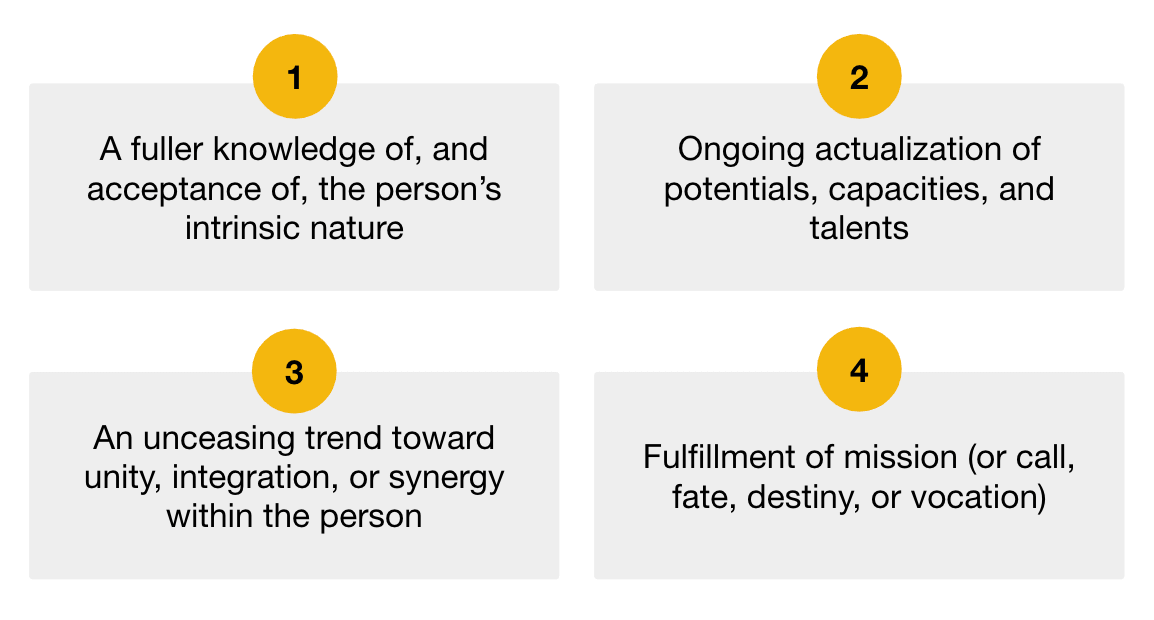 Maslow’s Definitions for Self-Actualization
Self‑Actualization and the Science of Flow
Maslow found that self-actualizing individuals have peak experiences with far greater frequency.
He defined self-actualization as the need to become what one has the potential to be.
This need for growth leads us to:
- An ongoing actualization of our capacities and talents,
- The fulfillment of our mission (calling)
- Self-knowledge and a full acceptance of nature,
- An unceasing trend toward integration.
So the more we invest in our own natural development, the more chances we have of having a peak experience.
Decades of comparative research confirm that peak experience, peak performance, and flow are overlapping expressions of the same optimal consciousness.
A landmark study by psychologist Gayle Privette documented shared traits such as absorption, spontaneity, and joy—yet showed that “flow” is the most learnable and repeatable of these transcendent states.4Privette, G. (1983). Peak experience, peak performance, and flow: A comparative analysis of positive human experiences. Journal of Personality and Social Psychology, 45(6), 1361–1368. https://doi.org/10.1037/0022-3514.45.6.1361
Csikszentmihalyi’s Flow State: The 7 Conditions for Entering the Zone
You’ve heard the term “being in the zone.” Building on Maslow’s work, psychologist Mihaly Csikszentmihalyi has studied the science of flow throughout his career.
Flow is a mental state where an individual is absorbed in their performance with an energized focus, engagement, and enjoyment in the activity.
In Flow: The Psychology of Optimal Experience (2008), Csikszentmihalyi outlines seven elements or conditions for flow:
1 – A challenging activity that requires skill
Too little challenge leads to boredom. Too much challenge brings anxiety. Enjoyment occurs in the sweet spot between the two.
2 – The merging of action and awareness
When all of our internal resources are engaged, there’s no psychic energy left for Self 1 to engage in counter-productive dialogue. Instead, a person becomes absorbed with full awareness of the activity itself.
3 – Clear goals and feedback
The more awareness we bring to an activity, the more feedback we receive both internally and externally. Goals or a clear vision give us a personal sense of what optimal performance looks like in advance.
4 – Concentration on the task at hand
All distraction falls away. Immersed in an enjoyable activity, the mind (Self 1) has no space for irrelevant information (like rumination).
5 – The paradox of control
Self 1 clings to wanting control, which creates tension. When we’re in a flow state, we experience a sense of being in control while not clinging to it. The desire or worry about control falls away.
6 – The loss of self-consciousness
The more we cling to our self-concepts and self-identity, the more we inhibit flow. Without interference from Self 1, we merge with the activity itself. We find our “authentic swing.”
7 – The transformation of time
One common theme in flow states and other altered states of consciousness is that one’s perception of time changes. Freedom from the “tyranny of time” adds to the enjoyment of our activities.
Talent, Deep Practice, and Peak Experiences
Interestingly, available research on talent and learning suggests we’re not born with talent.
Instead, we cultivate talent through deliberate, deep practice.
Let’s say you want to improve your skills in tennis. You have a strong forehand, but a weak backhand. Your overall performance will increase by strengthening your backhand.
To accomplish this, you need to embrace the discomfort, focusing attention and effort on your backhand. It’s awkward at first.
But by staying conscious of your movements as you strike the ball with your backhand, you get feedback.
You notice two things:
- How you feel when you swing the racket and contact the ball, and
- Where the ball lands on the court.
And perhaps you get additional feedback and suggestions from a coach.
If you pay attention to this feedback—adjusting your performance and behavior through continuous repetition— over time, you improve your skills in tennis.
The Art of Deep Practice
In The Talent Code (2009), Daniel Coyle explains:
Deep practice feels a bit like exploring a dark and unfamiliar room. You start slowly, you bump into furniture, stop, think, and start again. Slowly, and a little painfully, you explore the space over and over, attending to errors, extending your reach into the room a bit farther each time, building a mental map until you can move through it quickly and intuitively.
The key to improving your talent is knowing where you want to grow and then breaking the technique down into smaller chunks.
That’s why top performers have master coaches, as Coyle’s research on talent illustrates.
A peak performance coach knows where to direct your attention at that particular moment of your development.
For example, before you learn to transition between chords on a guitar, you must first practice strumming and hitting your chords cleanly. Learning these skills takes deep practice.
At first, the tips of your fingers are soft, the muscles in your fingers are weak, and your fingers lack the dexterity to maintain the proper positions on the guitar’s frets.
As Coyle wrote, you start in a dark, unfamiliar room.
But through conscious repetition, the darkness begins to subside, and the light enters the room.
Deep Practice Strengthens the Brain
Through deep practice, our brain grows myelin, a kind of insulation between neurons that reinforces neural connections.
The more myelin you have, the more automatic your response becomes. With practice, your strong neuron connections brighten the room.
Learning anything takes us through four stages of competence:
- Unconscious incompetence
- Conscious incompetence
- Conscious competence
- Unconscious competence
Myelin gets stronger between the third and fourth stages.
For self-mastery, our goal is to realize unconscious competence.
Here, we can perform a task well without effort or concentration.
The Biological Key to Effortless Mastery
In Beyond Boredom and Anxiety (1975), Csikszentmihalyi writes:
In the flow state, action follows upon action according to an internal logic that seems to need no conscious intervention by the actor. He experiences it as a unified flowing from one moment to the next, in which he is in control of his actions, and in which there is little distinction between self and environment, between stimulus and response, or between past, present, and future.
This is a critical distinction: in a flow state, there’s no conscious intervention by the actor.
New studies show that flow connects directly to how our brains manage focus and energy.
Researchers discovered that a small brain area called the locus coeruleus helps control flow by releasing the chemical norepinephrine.5Tops, M., & Bakker, A. B. (2021). Go with the flow: A neuroscientific view on being fully engaged. European Journal of Neuroscience, 53(4), 947-963. https://doi.org/10.1111/ejn.15014
When this system is balanced—neither too tense nor too relaxed—the brain switches from worrying about itself to being fully locked into the task.
This is the biological key behind the “effortless focus” Maslow and Csikszentmihalyi described. This is the neuroscience behind why the four practices in the final section actually rewire your access to flow.
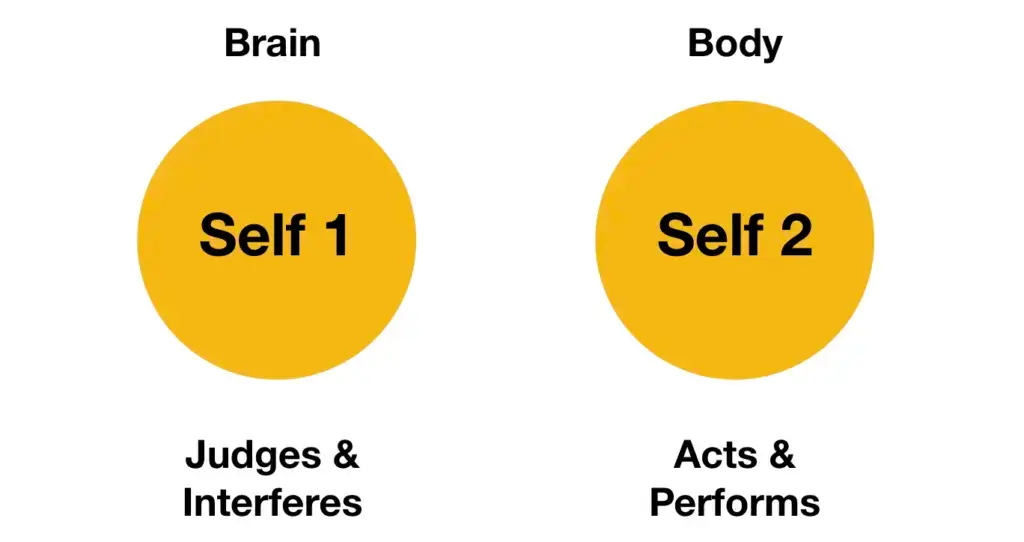 Tim Gallwey’s Self 1 vs Self 2
Overcoming the Inner Saboteur
So if we’re open to the idea that we have an inborn, authentic swing in whatever field interests us—why do most of us rarely experience it?
Why are peak experiences the exception, not the rule?
The answer is that we get hijacked by an aspect of the mind sometimes called the inner critic or inner saboteur.
If we observe our minds, there’s a constant internal dialogue between multiple voices or parts.
In his Inner Game series, Gallwey distinguishes two selves: Self 1 and Self 2.
Self 1 is the voice that commands and criticizes. It represents the brain (prefrontal cortex), and it likes to instruct.
Self 2 stays quiet and does the actions. It represents the subconscious mind or body, and it likes to act.
When we watch this inner dialogue between Self 1 and Self 2, we observe several things:
- Self 1 is very bossy, critical, and often unfriendly.
- The conversation is one-sided; Self 2 doesn’t say much.
- There’s little trust between these two selves.
Even though Self 2 does the work, Self 1 often intervenes and tries to take control.
Understanding Self 1 and Self 2 is the key that unlocks everything that follows. The practices below only work when you know which self you’re feeding.
The Inner Critic and Self‑Interference
Put simply, when Self 1 tries to dominate Self 2, we tense up and make mistakes.
Self 2 is more akin to our natural Center. It’s intuitive; it knows what to do. Self 1 only knows about what to do.
Self 1 is essentially our personality, or what the Taoists call the acquired mind. This acquired mind is conditioned by our environment, which includes anyone who has ever judged us.
First, someone judges us (usually our parents, teachers, and peers), and then an inner judge or inner critic is born in us.
And so Self 1, when in control, hijacks our performance in anything we do. When Self 1 is at the wheel, we can not have a peak experience.
Imagine having someone stand next to you as you write, play music, or compete in sports who continuously tells you why you’ll fail, what you’re doing wrong, and why you can’t improve.
It’s like being a comedian with a heckler sitting in the front row.
Well, that’s what happens most of the time internally for the majority of us.
When Self 1 doesn’t trust Self 2, we get tripped up by a myriad of interferences.
Performance = Potential – Interference
Gallwey offers a simple formula:
Performance = Potential – Interference
When Self 1 doesn’t intervene, we can enter a state of flow and become immersed in whatever we are doing.
That is, the absence of interference gives way to peak experiences.
Said another way: a peak experience can arise when we’re in Self 2, not Self 1.
In Self 2, we “get out of our own way and let our swing find us.”
Three Elements of Focus
The key to optimal performance is to maintain attention and focus on whatever we’re doing. Attention is critical for learning and proficiency in anything.
Distraction inhibits attention. While some distractions are external (like noises, other people, etc.), most of what disrupts our attention is internal, or what Gallwey calls self-interference.
Gallwey highlights three factors that enable us to focus (stay in Self 2):
1 – Awareness
Focus of attention on a particular task.
2 – Choice
Our desires determine where we place our focus. Desire drives focus.
Choice determines which desires we invest energy in and nourish, and which ones we starve and let die.
Nourishing the desires of Self 2, Gallwey explains, builds stability and leads to inner fulfillment.
Feeding Self 1 desires reinforces self-interference and creates inner tension and distraction.
3 – Trust
We can focus when we let go of mental control. When Self 1 is in command, it provides instructions on what to do or poses questions that lead to doubt.
Doubt, Gallway clarifies, leads to confusion and paralysis.
When focused, you’re aware of your purpose and engaged in the present moment. Under these conditions, Self 1 is not heard.
Again, notice how these desired attributes for higher performance are in alignment with peak experiences.
Silencing the Inner Critic = Shifting to Self 2
How do you usually try to focus on or improve your performance?
If you’re like me, you may at first try to force your inner critic into submission or just try harder.
In a sense, we try to fight with Self 1. It doesn’t work. What we resist grows stronger.
Resisting the impulses of Self 1 only makes the voice of Self 1 stronger and louder.
So what’s the alternative?
Gallwey suggests choosing Self 2—acknowledge its desire and allow it to express itself. He observes:6Ibid.
Once I can acknowledge Self 2, I can reach for it and give it whatever attention I have at my disposal. By that conscious choice, I am ignoring the voices of self-interference. A little attention is withdrawn from Self 1, diminishing its influence, and I simultaneously gain greater access to the resources of Self 2.
That makes sense, right? But how do we choose Self 2?

Training for Flow and Effortless Mastery
The first step is always to increase self-awareness.
We learn to feel the difference between the compulsive forces of Self 1 and Self 2’s natural drives.
Self 1’s drives are tight and restrictive. In contrast, Self 2 is relaxed and joyous (“flow-like”). Self 1 has something to prove; Self 2 acts for its own sake.
Sound familiar? Non-striving, effortlessness, joyfulness—the inherent qualities of a peak experience.
Setting the Foundation for Flow
A recent article in Nature offers a new guide for studying flow in the lab.7Durcan, O., Holland, P., & Bhattacharya, J. (2024). A framework for neurophysiological experiments on flow states. Communications Psychology, 2(1), 66. https://doi.org/10.1038/s44271-024-00115-3
It explains that flow depends on more than matching challenge and skill—it also requires personal freedom, clear goals, and real interest in the activity.
By setting these conditions, people are much more likely to enter a state where control feels easy and time seems to disappear.
The Power of Attention
If you’ve read many of my guides on this website, perhaps you’ve noticed a common theme: self-awareness and the skill of attention.
Whether it’s owning your shadow, strengthening self-leadership, changing your mindset, or integrating your body and mind, the skill of directing attention inward is vital.
Directing attention inward also helps promote peak experiences and optimal performance.
With greater attention and focus, you strengthen the muscles of conscious choice.
You choose the body’s instinctual drives (Self 2) while weakening the tendencies of your mental chatter (Self 1).
How to Develop Stronger Body Awareness
Peak experiences require immersion.
Integrative practices that enable you to sink awareness into the body help you access Self 2 and silence the Inner Critic.
1 – Breathwork
Somatic breathing regulates the bridge between body and mind through conscious respiration.
Slow, diaphragmatic breathing activates the parasympathetic response, quieting mental noise and anchoring you in the effortless flow necessary for peak performance.
2 – Centering
Centering draws your attention inward to the body’s midpoint—usually the abdomen or “lower dantien”—so awareness rests in stability instead of scattered thought.
It dissolves emotional turbulence and prepares the nervous system for calm, focused action.
3 – Grounding
Grounding reconnects the mind to sensory reality and the Earth’s steady rhythm.
Whether you stand barefoot, visualize roots, or use tactile awareness, it rebalances overstimulated energy and restores psychological presence.
4 – Standing
Zhan Zhuang—meaning “standing like a tree”—is a classical Taoist posture practice that cultivates internal energy and structural alignment.
Though motionless, it builds deep strength, steadiness, and the relaxed awareness vital for entering sustained flow states.
These types of foundational skills help put us on the road to self-actualization and to more peak experiences.
Use them frequently. Master them. Make them a part of you.
Learn to center yourself before you train, practice, or engage in any activity that requires your focus and attention.
A peak experience is only a moment away …
Integrating Peak Experiences into Daily Life
In Religions, Values, and Peak Experiences, Maslow writes, “Man has a higher and transcendent nature, and this is part of his essence, i.e., his biological nature as a member of a species which has evolved.”
Instead of seeing peak experiences as something relegated to a gifted few, Maslow understood that these experiences are part of our biological destiny.
There are things you can do to quiet Self 1’s interference with peak states.
Remember Self 1 is the mind/brain; Self 2 is the body.
Self 1 lowers our performance because it’s usually in the driver’s seat.
In essence, our minds can impede optimal performance. The conscious mind must be stilled for a peak experience to manifest.
Removing internal resistance is a key to achieving optimal performance in virtually any activity—and experiencing more frequent peak experiences.
So, to silence Self 1, get rooted in your body first.
Make this your daily practice.
Read Next
Peak experiences are temporary glimpses of the state Maslow called self-transcendence—where the self expands beyond its usual boundaries. To learn more about higher states and effortless mastery, see:
Self-Transcendence: The Complete Guide to Going Beyond the Self
Wu Wei: The Middle Way to Effortless Mastery
How to Center Yourself: 12 Powerful Methods to Reduce Stress, Increase Focus, and Recharge
Books Related to the Peak Experience
(Disclaimer: affiliate links to Amazon below.)
Toward a Psychology of Being by Abraham Maslow
Religions, Values, and Peak Experiences by Abraham Maslow
Flow: The Psychology of Optimal Experience by Mihaly Csikszentmihalyi
The Talent Code by Daniel Coyle
The Inner Game of Tennis by W. Timothy Gallwey
References
- Coyle, D. (2009). The talent code: Greatness isn’t born. It’s grown. Here’s how. Bantam Books.
- Csikszentmihalyi, M. (1975). Beyond boredom and anxiety: Experiencing flow in work and play. Jossey-Bass.
- Csikszentmihalyi, M. (2008). Flow: The psychology of optimal experience. Harper Perennial Modern Classics.
- Durcan, O., Holland, P., & Bhattacharya, J. (2024). A framework for neurophysiological experiments on flow states. Communications Psychology, 2(1), 66. https://doi.org/10.1038/s44271-024-00115-3
- Gallwey, W. T. (2001). The inner game of work: Focus, learning, pleasure, and mobility in the workplace. Random House Trade Paperbacks.
- Maslow, A. H. (1962). Toward a psychology of being. D. Van Nostrand Company. https://doi.org/10.1037/10793-000
- Privette, G. (1983). Peak experience, peak performance, and flow: A comparative analysis of positive human experiences. Journal of Personality and Social Psychology, 45(6), 1361–1368. https://doi.org/10.1037/0022-3514.45.6.1361
- Tops, M., & Bakker, A. B. (2021). Go with the flow: A neuroscientific view on being fully engaged. European Journal of Neuroscience, 53(4), 947-963. https://doi.org/10.1111/ejn.15014
- van der Linden, D., Tops, M., & Bakker, A. B. (2021). Go with the flow: A neuroscientific view on being fully engaged. The European journal of neuroscience, 53(4), 947–963. https://doi.org/10.1111/ejn.15014
I understood.
I am a kind of person whose performance is measured by the processes set in place, and see the product of my labour to be fruitful, not.
For instance, I learnt rap. I was not good at it at all at first. However, having to relate a lot of my energy with Eminem’s actions, I decided to learn through a mentor.
As time went by, my conscious acquired mind was concerned with feeling ‘more right’, meanwhile my subconscious mind dealt with my persuasive writing skills in a form of writing punchlines.
And here’s a funny experience while crafting a punchline, I would not care how right I am… In my subconscious, I am ‘less wrong’. The energy was different to Eminem’s action, but the common link in between us was that as much as the flow isn’t as good as his [Eminem], I was deliberately practicing to ‘copy and paste’ the best of my abilities through emulating him.
My mentor picked this up. And gave me feedback.
“Tshepang, throw your mind in the sea.”
Maybe that was an allegory for self 1 to get loose it, and let self 2 take the drive.
And maybe, self 1 is the conscious mind that intervenes the subconscious self 2. Self 2 relates to emotions, the punchline maker. Self 1 relates to logic, rationalising why you should not make the punchline to be as good as emoting it mindlessly.
As time went, I had myself to emulate as I was conscious competent. However, I skewed more on gauging my performance with self 1, limiting self 2.
It was a bit hard, as I was only around 11 to 14 at the time. I did not understand myself that well, let alone, deal with my internal resistance in a thoughtful manner that did not disrupt me to being too emotional.
As time went by, yeah…
… I dodged rap. Although, with benefits.
I unconsciously became competent in persuasive writing. Because you are using emotions when you write, right?
Anyways, it was a reflective experience while reading this article. Hope you understood well by what I explained.
It sounds like you’re mostly sharing your experience, Tshepang, so I don’t have much to comment on. In terms of using emotions when you write, you can be — it depends on the “mental” and “emotional” state in which you’re writing, and from which archetype you’re writing. For example, the poet might be emotional, while the philosopher is more analytical.
First, I want to say that your material always resonates with me. It’s always well done. Thanks so much for your effort. Next, I wanted to say how closely the techniques in this article align with yoga philosophy. Yogis use the breath and body to bypass the mind (self 1) to overcome Avidya (ignorance) so that the observer / Purusha can emerge (self 2). The 8 rungs of yoga ultimately lead to samadhi (integration) which sounds a lot like the flow state. Anyway I digress. It’s fascinating. Thanks again!
Yes, Timothy Gallwey actually arrived at the insights about the Inner Game after meeting with a Yogi.
All of the Eastern traditions use methods to overcome Self 1 and rest in Self 2. Only they use it not for higher performance, but for transcending the mind.
I love it! Very insightful and practical. That’s why professional athletes are practicing meditation. Thanks for all your amazing work Scott!
Exactly, Chio. Anything we can do to quiet the mind helps increase our performance. Thanks for your comment. :-)
And another Magnificent instructional by Mr.Jeffrey. Wow. Who knew that somebody could organize information in such a profoundly effective manner as the way you do. I honestly deeply admire you for some of these behavior manuels that you have put on here, and am so glad i have the chance to look and learn about the things you write about.
Your great dude! Your success in presentation and source refferencing is boldly evident.
I promise you that any people i come across that have an ear to listen, will hear me giving a full blooded reccomendation to your work.
Thank you so much for all the work you do!!
:]
Thank you for the glowing testimonial, Zack.
After reading many hundreds of books, writing well over a million words, and making tons of mistakes, I’m confident anyone could produce similar results — as long as they are playing to their interests.
Scott, another masterpiece! I really enjoyed this article and it connected many dots for me. Thank you very much!
Thank you, Michael. That’s great to hear! You’re most welcome.
Wow! How selfless of you to share this with us. I coached, more than 40 years, and my teams used many of these techniques. Today I am still involved in human performance and always looking for ways to improve. You have amassed important information and gifted it to those who will use it. Positive Karma is yours.
Thanks for the comments, Peter. Given your background, I’m sure much of the material presented here was just a good review. Best wishes.
I sensed that the pyramid was not true , we have to turn it upside down to be in touch with our creativity. The way it was presented was to encourage consumerism which makes people fodder for the capitalist system . Thank you for making me feel I am right.
I assume you’re referring to Maslow.
I don’t think it’s accurate to say Maslow’s pyramid should be turned upside down. Biological and safety drivers are far more important to meet than self-actualization. The point was that a pyramid isn’t necessarily a pyramid in the first place.
Thank you for your amazing generosity and for the exceptionally high quality of the material presented.
I am a yoga teacher and really appreciate the weaving of mindfulness/meditation with psychology.
Thank you for the feedback, Lisa.
Those two worlds (meditation and psychology) can certainly dance together nicely.
Thanks for the inspiration. However, personally I believe my self 1 is actually the trainer of self 2. Like you write when I learn something new I have to consciously see the errors and correct pathways. This is what self 1 does. After a lot of this a new activity becomes unconscious and ideally I become competent at it. So self 1 and 2 are one. Our task is just to let both parts act where they are needed – self 1 for conscious step-by-step improvement and training of self 2. Self 2 whenever we do things we already trained well with self 1. A good driver (self 2) needs no instructor (self 1). A bad driver however can’t improve without it.
You would be surprised what Self 2 is capable of without the inner criticism and commentary of Self 1 — even when learning things that are new to you.
Self 2 adapts and learns by feeling, sensing, and intuitive knowing. It has access to information Self 1 can never “learn.” The body is far wiser than most of us realize.
In the context of the information presented in this guide, as long as Self 1 is the driver, mastery of anything will never be reached. But this statement can only be verified via experience.
I love reading your posts very informative and extremely helpful thank you
Thank you for your feedback, Sharon.
This is amazing and fascinating. Thank you Scott. I’m looking for the Tiger Woods video which I can’t seem to find again. Could you please assist me.
You’re welcome, Khanyisani. I don’t know what you’re referring to regarding Tiger Woods.
Wow thank you Scott! Every e-mail I find myself growing more and more. You have a very grounded way of explaining everything. I will definitely be enrolling in one of your courses in due time. Keep up the good work!
Glad to hear that you’re enjoying the material, Jonathan. Thank you for the feedback.
This is a great summary, thank you so much for sharing your insights Scott!
You’re welcome, Casey!
My Dear, I am very happy and sufficient with these materials above all all the psychological fields I like too. I have some problem of health, thanks to God I am becoming better and better . So thank you so much.
You’re welcome, Kifle.
Thank you Scott, you are doing a great job and I have learnt alots through your materials, very helpful!
Thank you, I enjoyed reading this. We need to listen to our intuition (self 2) more.
Agreed, Caroline.
Thank you Scott for all the free resources. I appreciate you sharing your expertise so generously. Looking forward to going through them
You’re welcome, Deepa.
Thank you for this guide. I grew up in a world that only knew self 1 while I was operating from self 2, like you say it takes longer but once you get your stride with self 2 things are effortless and on a whole new level, there is however one thing that is a struggle while functioning at self 2 there is this constant outside interference that seems to want to pull one back, for me it was not self 1 but it was emanating from others.
Yes, Tony. Navigating self 2 around others is far more challenging. Perhaps that’s why Maslow found that self-actualizing individuals tend to be fairly private and keep to themselves.
The Art of Impossible is also an excellent reference for this subject.
Love it man
Thank you Scott for your amazing insights. I have enjoyed every one of your articles and this one strikes an even more harmonious chord with me!
Wishing you a wonderfull 2024!
Thanks for the feedback, Mauritz.
You too!