
You’ve met someone who leaves you exhausted, anxious, or strangely hollow after only a short conversation.
You might think this type of energetic exchange is just your imagination, but it often isn’t.
From a depth‑psychological lens, psychic vampires represent archetypal forces that feed on unintegrated emotion and shadow material.
Every human psyche participates in this exchange at some level, yet most remain unaware of its mechanisms.
Understanding these dynamics transforms superstition into self‑knowledge—an essential step in shadow work and energetic hygiene.
This in-depth guide maps the subtle symptoms and strategies of psychic vampirism so you can reclaim your inner equilibrium.
This guide is Part 2 in my vampire archetype series.
Let’s dive in …
What Is a Psychic Vampire?
A psychic vampire is an archetypal pattern that unconsciously siphons emotional or life‑force energy from others to offset internal deficiency or trauma.
A “psychic vampire” is not a horror‑movie figure but an archetypal constellation—a pattern operating below awareness.
This vampire archetype has numerous variations, including the emotional, energetic, psychic, and sexual. All of these variations can draw psychic energy from an individual.
In Jungian terms, this symbol emerges when unhealed shadow material seeks external energy. The transfer feels asymmetrical: one person leaves drained while the other feels momentarily empowered.
Energy loss can manifest psychologically (fatigue, confusion) and emotionally (guilt, shame, self‑doubt).
Across traditions—from Taoist chi models to modern trauma research—the underlying dynamic is depletion through imbalance.
Seven Common Psychic Vampire Symptoms
Please keep in mind that a phenomenon like psychic vampires operates at an archetypal, and therefore mostly unconscious, level.
If you don’t stay aware of this, you can easily make it “personal,” which will only trigger other archetypal patterns within your psyche. (For example, you’ll become the “helpless victim” or “innocent one” archetype.)
The key is to simply observe this type of psychic phenomenon from a neutral state.
How do you know if an energy vampire has stolen your light and energy?
Here are seven potential psychic vampire symptoms:
1 – Chronic Fatigue
When you interact with a specific person, you’re always left feeling drained while they feel energized.
Note: Carl Jung (1923) noted that extroverts draw energy from others while introverts draw energy from themselves. So at a very basic level, extroversion can be interpreted as a form of psychic vampirism. However, here we’re examining more extreme cases.
2 – Severe Self-Doubt
After engaging with a psychic vampire, you wrestle with strong feelings of self-doubt and lack confidence at an almost unbearable level.
3 – Distorted Self-Image
You hate looking at yourself in the mirror, or you reject your self-image entirely while the psychic vampire is obsessed with their image (for example, on social media).
4 – Persistent Shame or Guilt
It’s normal to feel shame and guilt for certain behaviors, but when you’re in the field of a psychic vampire, that feeling of shame and guilt is highly elevated; it becomes pervasive, persistent, and unrelenting.
5 – Enduring Sense of Lack
Compared to the psychic vampire, you feel like you have nothing. In fact, a theme of lack may run through much of your life experience (while the other person experiences “abundance”).
6 – Feelings of Inadequacy or Incompetence
When you’re around this archetype, you feel completely inadequate and incompetent.
7 – Unexplained Dread or “Impending Doom”
A feeling of impending doom is often an unconscious response to a psychic attack. When the body’s energy field is being invaded or drained, it can feel like “life is over” and that there’s “no reason for living.” Neurotic fear, when you feel immobilized and unable to take action, could be another related sign of a psychic attack.
_________________
These symptoms mark energetic asymmetry rather than moral blame. Observation—without judgment—begins the process of reclamation.
There are many other psychic vampire symptoms, and just because you’re experiencing any or all of the above doesn’t necessarily mean there’s a psychic vampire in your midst. Discernment, as always, is necessary.
But most of us can relate to the above experiences to varying degrees.

How Psychic Vampires Drain Energy
Okay, now let’s examine some of the ways the psychic vampire archetype operates.
In brief, these methods include:
Ultimately, all of these ways represent additional psychic vampire symptoms. For example, when someone is intimidating you, psychically, they are also attempting to steal your light.
Remember, the goal here is to increase our awareness of what’s happening beneath the surface.
1 – Manipulation
I’ve come to view praise as a highly destructive psychological pattern in modern culture.
Praise is tricky because our minds associate positive attributes with it. Parents feel good about themselves when they praise their child’s character. And the inflated child feels good when praised.
The shadow implications behind praise, however, are monumental. We’ve already learned from psychologist Carol Dweck’s research that character praising fosters a fixed mindset that impairs a child’s ability to learn and grow throughout life.
But from my experience, this is just the beginning. The unconscious intention behind most forms of praise is manipulation. That is, the Trickster archetype uses praise as a tool to get others to do what it wants and to steal their light.
What do I mean? Let’s look at some examples …
Praising Children
Parents praise their children to get them to behave in a certain manner.
We often raise High-Chair Tyrants by “serving” our children, and then we don’t know how to handle the tyrant’s demands.
But by praising the tyrant and telling them they are “good,” we are subtly forcing them to repress this inner tyrant archetype.
Then, they become more compliant and repress aspects of the tyrant. This repression helps explain why the shadow in most individuals grows large by age 18.
Praising Adults
Genuine adults don’t seek or desire praise. As mature adults, we do what we do because of who we are.
The child in us, however, might have been conditioned for praise. So if someone praises us for something we are doing—for example, for being generous, diligent, or disciplined—it can activate a child archetype within us.
Magically, these innate qualities begin to leave us. Then, we struggle with discipline and critical thinking, and we don’t know why.
With the Child in charge, most of us act for the approval of others, not by our “inner directive.” In psychology, this is called being driven by extrinsic rather than intrinsic motivation.
If the child stays at the forefront of one’s consciousness, it means the Puer Aeternus archetype is in control. This is commonly referred to as the Eternal Child or Peter Pan syndrome.
Seeking approval creates an unhealthy dependency on others, stripping us of the qualities of adulthood: autonomy, responsibility, and inner strength.
Praise has a way of triggering the Innocent One archetype in us that then falls prey to the Manipulator in others. The Innocent One and the Manipulator are bipolar shadows of the Magician archetype.
2 – Intimidation
Archetypes like the Sadist, or its younger counterpart, the Bully, love using intimidation to draw energy and light from others. At its core, the bully is an energy vampire.
In a “civilized” culture, intimidation isn’t always blatant. Instead, this form of aggression manifests as unconscious cues: a quick downward glance, crossed arms, a threatening tone of voice, a gentle smirk, or an air of arrogance.
The common term for this psychic vampire sign is “gaslighting,” and it is extraordinarily pervasive in today’s society, on a global scale.
When someone puts another person down (judges them), they are attempting to steal their light. When someone unconsciously tells you, “Not for you,” they are trying to steal from you psychically. (For example, “You will own nothing and be happy.”)
This form of energetic and psychic vampirism most often occurs when an individual has a lot of repressed envy, fear, and anger.
When a person sees something they want in another, and they can’t fully acknowledge their desire, envy, or jealousy, they will unconsciously try to steal it from them.
3 – Touch
This psychic vampire sign is like something out of science fiction. I would never have believed it was valid before developing energetic sensitivity through various qigong and neigong practices.
While qigong is about cultivating life force, or chi, energy, there are dark-art techniques for stealing energy from others. I once met a seasoned qigong practitioner who claimed to have first-hand accounts of these dark arts.
Even with the most gentle touch (or just proximity), one can steal energy from another and block the flow of energy in others as well. These patterns are quintessential of the psychic vampire.
Do you recall as a child, not wanting to be hugged by your parents or other relatives when they came over for the holidays?
Parents often shame their children for this behavior. (“Go hug your grandmother.”) As a consequence, many of us forget about our natural aversion to hugging.
But the reality is that most kids don’t want to hug, and it’s not because they are being nasty, unloving, or uncaring.
Consciously, they don’t know why, but it’s because they’re still more intuitively connected to their energy field. Their unconscious (body) is telling them to stay away.
How Parents Unknowingly Take Energy From Their Children
If you’re a parent, have you ever come home from a bad day at work and couldn’t wait to hug your child?
Do you feel like hugging and being around your kid(s) instantly makes you feel better? Have you reflected on why that might be so?
Depleted parents frequently “steal” energy from their children through hugs, kisses, and touch (without realizing it, of course).
Kissing a child on the top of the head, for example, is one common way to draw their energy.
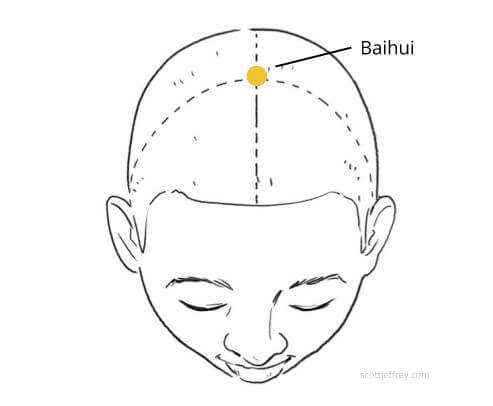
Baihui Point at the crown of the head
The crown of the head is called the baihui point in Chinese medicine and the Taoist arts. The baihui point is also the spiritual access point for a person’s higher consciousness.
Another way parents and elders “steal” the energy of children psychically, especially babies, is through their feet.
Consciously, a mother might kiss a baby’s foot because “it’s so cute.” Unconsciously, however, they are drawing energy from the child’s primary access point, called K1 in acupuncture, Yongquan, or the bubbling well.

Yongquan or Bubbling Well Point
If you’re a parent, when you feel like you’re tired or experiencing emotional imbalance, consider staying clear of your kids until you restore yourself.
Children have considerably more energy than adults (more Jing, or life essence, and Yang Chi), so it’s natural for adults to habitually seek to “energize” themselves when they feel depleted.
Watch Out for Anger, Guilt, or Shame
If you’re a parent reading this, it’s easy to get angry about what was expressed above (which represents a shadow trigger) or to feel guilt and shame, perhaps even a sense of hopelessness.
Remember that everyone unconsciously engages in these psychic activities: your parents did it to their parents … on and on throughout history. These psychic vampire symptoms are archetypal, not personal.
The idea here is to bring what’s happening unconsciously to consciousness. As you begin to detect and observe this type of psychic phenomenon, you’re already on the road to changing this unconscious archetypal pattern.
Simply start from where you are right now. The past is in the past.
4 – Emotional Evocation
The primary goal of psychic vampires is to trigger an emotional reaction—the more intense the emotion, the stronger the energetic charge.
Weaponizing Empathy
Shame and guilt are two of the most potent weapons a psychic vampire can use to sap your life force energy.
- How could you…
- You should know better…
- Who do you think we are…
Phrases like these can collapse your energetic system, leaving you susceptible to further psychic attacks.
Official narratives and propaganda often use this tactic consciously.
When officialdom wants to change the behaviors of the masses, it uses campaigns that associate shame and guilt with the old behaviors. (The entire “green agenda” is an expression of this type of psychic attack.)
They also evoke outrage to manipulate people and throw them off balance.
Irritate, Annoy, Shock, and Surprise
Another tactic psychic vampires use is to irritate a person, as well as to surprise, shock, or terrify them.
Again, with babies (who are like infinite balls of energy), beyond the perceived innocence of games like peek-a-boo, there’s a darker, shadowy intent.
Surprising, shocking, and tickling are effective patterns of the psychic vampire archetype. How?
Tickling itself is a behavioral pattern of the sadist archetype. It’s a form of torture, especially for a helpless baby who can’t escape or defend itself.
If you look closely (and with neutrality) in the eyes of a baby or child as you tickle them, you will see fear. Conversely, if you closely observe the tickler’s eyes, you’ll see a Sadist.
If you doubt that tickling induces fear, go tickle a child and watch their shoulders. The child’s shoulders immediately rise.
Or even better, imagine someone tickling you. Notice the tension around your kidneys and the muscles surrounding your spine.
All of these indicators relate to the physiology of fear. In the dark arts, if you can evoke fear, it’s easier to drain a person’s energy psychically.
5 – Directed Thought
One of the most common tools of psychic vampires is the direct use of thought forms. A vampire will send “psychic signals” directed at a specific individual.
Although we might prefer to believe that our thoughts are private, this simply isn’t the case. As Nobel laureate Sir John Carew Eccles (1997) discovered decades ago, the mind is like a sending-and-receiving center.
Thoughts as a Directed Weapon
We’ve all experienced a person from our past entering our stream of consciousness. These experiences aren’t random. In most cases, this occurs because the other person is thinking about you.
Psychic vampires will repeatedly direct negative thoughts and ill will toward you. The challenge here is that the individual sending these negative thoughts is often unaware of it.
Again, this type of psychic attack is most often unconscious. Keep in mind that approximately 95% of thoughts occur below our conscious radar.1Young, E. (2018, July 28). Lifting the lid on the unconscious. New Scientist, 239(3188), 28–32. https://www.newscientist.com/article/2174794-lifting-the-lid-on-the-unconscious-2/
In witchcraft, there are specific spells that are used to draw energy from others psychically. Because we are mostly unconscious of this occult knowledge, the archetypes within us can conduct these practices without our awareness.
Worrying as a Subtle Form of Psychic Vampirism
For example, someone who often worries about another person (including a mother) is likely unaware that part of them wishes them harm (perhaps because they are unconscious of their own hatred or resentment).
A part of this person consciously wants the individual they are worrying about to be safe or careful, while another disowned part might want them to get hit by a car.
The individual, however, is only conscious of the positive intention because they haven’t yet integrated their shadow. In fact, in most cases, the individual hasn’t even begun to confront their shadow.
6 – Seduction
We already covered seduction as a form of psychic attack in Part 1 on energy vampires.
Modern culture is obsessed with image and sexual attraction. (This is a massive topic that deserves separate treatment.)
The intense desire for sexual attraction in an individual is largely an expression of trauma and old psychological wounds. Social media, and perhaps the Internet in general, seem to be amplifying this type of trauma.
Healing these psychic wounds is a necessary part of inner work as one moves toward mature adulthood.
The Masochist and the Addicted Lover archetypes are the counterparts to the Seductress. That is, while the seductress (or Succubus archetype) wants to drain your energy, the Masochist is a willing participant.
Family and Social Dynamics of Vampirism
If you wrestle with high levels of self-doubt while your sibling or parents are brimming with confidence, you’re more than likely under the influence of the Black Sheep archetype.
In family systems, the Black Sheep often becomes an energetic dumping ground for unacknowledged emotions of parents or siblings.
This is a very common phenomenon (also related to the orphan archetype) that occurs in many homes, especially those with multiple siblings. One sibling excels to a high degree while the others languish.
On the surface, this may appear like “healthy competition,” but if you examine the family dynamics more closely, one child is stuck playing the black sheep.
They are unconsciously holding the negative or passive side of specific archetypal patterns for others, causing an interior imbalance to the downside.
In organizations, charismatic “gurus” or managers may absorb others’ projection of competence and power, leaving teams depleted.
These are not villains—they are archetypal roles acted out through the unconscious collective field.
The solution to this psychic dynamic is to reclaim your “inner gold”—that is, to recollect your projections.
Transforming Vampiric Patterns
The first step is to realize that vampirism is a psychic fact. That is, psychic vampires express a universal archetypal pattern within the psyche.
At some level, everyone is a psychic vampire.
That is, under the right conditions, we are each susceptible to unconsciously stealing energy and light from others via the vampire archetype.
But it’s also accurate to say that no one is a psychic vampire.
Vampires, witches, and warlocks are archetypal forces that abide in us, but it’s not what we are.
If we remain unconscious of them, however, they can operate within us whether we want them to or not.
The key, then, is to become conscious of these archetypal forces within us.
When you’re in the Center—neutral, light-hearted, open, calm, alert, and free—psychic vampires can do you no harm. All of the psychic vampire symptoms fall away.
Cultivating Your Life Force Energy
There are also methods for cultivating life force energy within us.
Qigong, Neigong, and Neidan represent vast systems of theory and practice designed to open your body’s energy channels and cultivate the energy that runs through you. If you’re new to qigong, I suggest you find a local class taught by a skilled practitioner.
A foundational practice in many qigong systems is called Zhan Zhuang, or standing like a tree.
Through this practice, you learn how to align your posture, sink your mind into your body, settle your Jing essence, and consolidate your energy.
Of the many different styles and systems I’ve studied, Zhan Zhuang has had the most impact on me physically, mentally, and emotionally.
You can get started with this in-depth, beginner’s guide to Zhan Zhuang here.
If you’re interested in additional resources, I recommend Lam Kam Chuen’s The Way of Energy and Damo Mitchell’s Daoist Nei Gong as excellent entry points into this topic. (Disclaimer: Amazon affiliate links above.)
Should You “Protect” Yourself?
I can appreciate the intention behind wanting to protect yourself from emotional, energetic, or psychic vampires.
However, there are problems with this intention: It can evoke tension and fear, and strengthen the victim archetype within you.
Fear is how energy vampires feed on us in the first place. Fear opens the doorway to further psychic attacks.
Awareness Comes First
Unconscious and repressed emotions, however, make it difficult to stay neutral.
So first, develop greater emotional awareness so we can more readily connect with how we’re feeling in the moment.
If we aren’t aware of what’s happening and how a psychic vampire is trying to hook us, there’s not much we can do.
If we can’t detect when a psychic energy transfer is unfolding, the battle is already lost.
Be Mindful of the Innocent One
The Innocent One, the passive shadow of the Magician archetype, wants to believe everyone (especially those closest to us) is purely good.
When we identify with this innocence, we certainly won’t see what’s happening in the shadows.
Remember, everyone has a shadow. We all have darker impulses that we tend to repress.
Strategies for Psychic Protection
That said, what can you do when you observe the psychic vampire signs listed above?
Here are five methods worth experimenting with:
- Ground yourself. Root yourself in your body and connect it to the earth.
- Smile inwardly at your heart. Lighten up as much as possible.
- Place one or both hands over your navel region. This hand position creates an energetic seal.
- Own your space. Everyone has an energetic field that extends out around them. When you root yourself in your field, only the most aggressive vampires will attempt to break it.
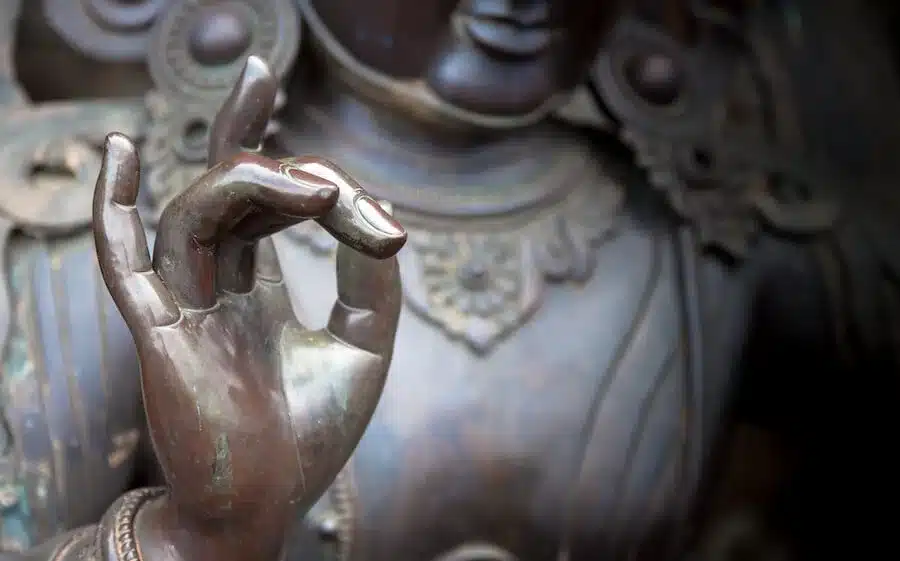
- Try a protection mudra. There are some hand positions used in Buddhist and Hindu traditions to provide psychic protection. For example, the Karana Mudra.
- Stand in the Wuji posture of Zhan Zhaung until your body feels full and “buzzing” with energy. Then, settle it down into our lower dantien.
Perhaps the single best way to ward off psychic attacks is to stay neutral. Hold to the Center.
Self-Guided Prayer
If you feel overwhelmed or desperate from a psychic attack and you don’t know what else to do in the moment, pray to your Higher Self.
Access the deepest part of you—the one that transcends your ego, personal identifications, and conditioning—and ask for protection. What’s yours is yours; what’s theirs is theirs.
Ask the self to shield and protect you from any external (or internal) entities or psychic formations that are attacking your field.
Alight in the Self. Rest in the Self. Abide in the Center of the Self.
This is perhaps the single most powerful way to ward off psychic vampires and other “spirits and monsters.”
Moving Toward Wholeness
Everyone participates in energetic exchange.
When we own both sides—the feeder and the fed—we end the unconscious economy of depletion.
If you continuously feel like you’re only the victim of psychic attacks, it’s important to examine your interior: pay attention to the weak and passive archetypes that are likely dominating your consciousness.
Since we all engage in projection, we all participate in psychic vampirism on varying levels.
With a sense of inner authority and responsibility, what once drained you becomes fuel for self-awareness.
Recollecting these projections and consolidating our psychic energy within not only reduces the influence of vampirism but also moves us toward wholeness.
Continue Reading
This completes Part 2 of a 2-part series on the vampire archetype.
If you haven’t already, read Part 1: The Ultimate Guide to the Vampire Archetype.
Read Next
Jungian Synchronicity: Decoding the Psychology of Meaningful Coincidences
A Beginner’s Guide to Female Archetypes (Including a List of 55+ Feminine Examples)
King Warrior Magician Lover: Four Foundational Masculine Archetypes
What is Jing? A Practical Guide to Rejuvenation and Longevity
References
- Bessel van der Kolk, B. A. (2014). The body keeps the score: Brain, mind, and body in the healing of trauma. New York, NY: Viking / Penguin.
- Castaneda, C. (1998). The active side of infinity. New York, NY: Harper Collins.
- Dweck, C. S. (2006). Mindset: The new psychology of success. New York, NY: Random House.
- Jung, C. G. (1921). Psychological types. (H. G. Baynes, Trans.). London, UK: Routledge & Kegan Paul. (Original work published 1921)
- Lam, K. C. (1991). The way of energy: Mastering the Chinese art of internal strength with Chi Kung exercise. New York, NY: Simon & Schuster.
- Liu Hua‑Yang (Trans. & Comment. by E. Wong). (1998). Cultivating the energy of life: A translation of the Hui‑Ming Ching and its commentaries. Boston, MA: Shambhala Publications.
- Mitchell, D. (2011). Daoist Nei Gong: The philosophical art of change. London, UK: Singing Dragon / Jessica Kingsley Publishers.
- Popper, K. R., & Eccles, J. C. (1983). The self and its brain: An argument for interactionism. New York, NY: Routledge.
- Young, E. (2018, July 28). Lifting the lid on the unconscious. New Scientist, 239(3188), 28–32. https://www.newscientist.com/article/2174794-lifting-the-lid-on-the-unconscious-2/