
OVERVIEW: An in-depth look at masculine and feminine energy with insights from analytical and developmental psychology. Explores how the psyches of men and women differ, what healthy feminine and masculine energy represent, and the defining traits of both energies.
______________
In the “modern” age, we’re supposed to tread carefully on topics related to gender, as it’s easy to offend people.
A lifetime of investigation has shown me that something is afoot whenever a topic is highly polarizing, evoking intensely strong emotional reactions in many people.
In this guide, we’ll explore:
- How the psyches of men and women are different,
- Traits of mature masculine and feminine energy,
- Common qualities of unhealthy masculine and feminine energy,
- Why do these energies often get out of balance, and
- How to approach healing and integrating these energies.
Let’s dive in…
What is Feminine and Masculine Energy?
Before writing this guide, I quickly searched through articles published on this topic.
I noticed a pattern and a common statement: “Masculine and feminine energy have nothing to do with gender.”
Let’s be clear: This is absolutely untrue!
And if we believe this to be true, we have already muddied the waters.
While it’s valid to say that men and women have both masculine and feminine energy, it is inaccurate to say that these energies aren’t related to gender.
Not only are men and women biologically different, but our psyches are fundamentally different, too.
As such, men relate to and develop masculine energy differently than women, and vice versa.
Hopefully, by the end of this guide, it will become more apparent how masculine and feminine energy relate to gender.

Splendor Solis, Plate 4 (The Lunar Queen and the Solar King)
What is Healthy Masculine Energy?
Mature masculine energy is associated with autonomy, inner strength, independence, assertiveness, and freedom.
Masculine energy allows us to be decisive, take action, and solve problems.
Healthy masculine energy is stable, strong, secure, grounded, practical, focused, and direct. This potent energy powers one’s willfulness and discipline.
The healthy masculine principle is rational, logical, lucid, and analytical.
Aligned with this vital energy, we are accountable for our actions and operate with purpose, integrity, and clear intent.
In a family context, healthy masculine energy manifests as the provider, builder, and protector. (“The home is his castle.”)
In its mature expression, the masculine is generative, providing blessings and support for the next generation.
Archetypes associated with healthy masculine energy include the King, the Warrior, the Magician, and the Lover.
What is Healthy Feminine Energy?
Mature feminine energy is associated with communion, relationship, connection, nurturance, and flow.
Healthy feminine energy is creative, intuitive, and empathic.
The feminine principle is emotionally driven—what Jung called one’s feeling function.
This relational energy perceives itself in relationship to the sensual world, possessing a deep appreciation for beauty.
Qualities of mature feminine energy include radiance, warmth, softness, sensitivity, and receptivity.
This feminine energy enables collaboration, encouragement, and open communication with others.
In a family context, the feminine energy provides essential nurturance and support for the masculine principle.
See also: A Beginner’s Guide to Female Archetypes
The Psyche of the Masculine and Feminine

Jungian Model of the Psyche
It’s helpful to borrow a few concepts from depth psychology to better understand what masculine and feminine energy represent and how they relate to each other.
The psyche represents the totality of one’s being, including the body, mind, instincts, soul, and spirit.
The personal unconscious represents everything within the individual’s psyche that is unknown to them.
The collective unconscious was psychiatrist Carl Jung’s attempt to describe the inner world of the collective psyche filled with universal and impersonal images, symbols, and motifs.
He called these universal images archetypes.
Archetypes are universal patterns of energy. These patterns influence virtually all expressions of life, including most, if not all, human behavior.
For our purposes here, these energy patterns can be divided into two categories: masculine and feminine energy.
That is, feminine and masculine energies are archetypal forces within the personal and collective unconscious.
The Masculine Psyche versus the Feminine Psyche

The Masculine Psyche
Now, here is where things get interesting.
Within every man, there is an inner woman—a contra-sexual counterpart that Jung called the Anima.
This powerful archetypal energy directs a man in fundamental ways.
Its unhealthy expression (“anima possession”) leads a man to become moody, unstable, and irrational (unhealthy feminine energy).
In its mature form, the Anima helps a man find inner meaning and connect with his soul (mature feminine energy).

The Feminine Psyche
Conversely, there is an inner man within every woman—Jung’s Animus.
A woman possessed by her Animus will lose her femininity. She will become highly opinionated, unreasonable, and subject to groupthink.
In its healthy expression, the Animus guides a woman to her spiritual life (mature masculine energy).
Differentiating the Masculine & Feminine Psyche
To reinforce the point: just as men and women are biologically different, our psyches and inner worlds are different, too.
Yes, both men and women have masculine and feminine energies, and each of us has varying degrees of these energies.
However, men and women have different internal and external make-ups.
The masculine principle is related to consciousness and the conscious world.
The feminine principle is related to the realm of feelings and our inner world.
These orientations make the experiences of men and women different.
When these differences are not understood or, worse, denied, it leads to unnecessary suffering, confusion, and mental illness.
Feminine versus Masculine Energies in Psychological Development
Because the feminine and masculine psyches are different, our psychological development is different, too.
It’s helpful to visualize feminine and masculine energy along a continuum.
The poles of this continuum can go from mental illness to positive mental health or from psychological immaturity to increasing levels of psychological maturity.
When unhealthy, masculine and feminine energy can become pathological. In a healthy state, however, these energies help us realize our higher potential.
To illustrate the nature of these continuums, we’ll call upon a few observations from developmental psychologist Carol Gilligan’s In a Different Voice.1Gilligan, In a Different Voice: Psychological Theory and Women’s Development, 2016.
Immature versus Mature Masculine Energy

Continuum of Masculine Energy Traits
According to Gilligan, a “man’s voice” tends to be based on autonomy, justice, rights, strength, independence, and freedom. A man’s world is predominantly rule-based.
In an unhealthy expression, the masculine drive for autonomy shifts toward alienation.
His inner strength mutates into a need to dominate others.
His drive toward independence leads to a formidable fear of relationships and commitment.
A man’s drive for freedom slips into a desire to destroy.
As theorist Ken Wilber writes, “The unhealthy masculine principle does not transcend in freedom, but dominates in fear.”2Wilber, Integral Spirituality, 15.
Robert Moore and Douglas Gillette’s model of the psyche also illustrates this healthy and unhealthy masculine energy more succinctly.
In their model, the King, Warrior, Magician, and Lover archetypes guide mature masculinity.
But each of these potent masculine archetypes has a bipolar shadow that expresses unhealthy, unbalanced, and destructive qualities.
For instance, the King’s bipolar shadow is the Tyrant and the Weakling, and the warrior’s shadow is the Sadist and the Masochist.
The Magician’s shadow is the Manipulator and the Innocent One. The Lover’s shadow is the Addict and the Impotent Lover.
When people speak of “toxic masculinity,” they are generally referring to unhealthy or immature masculine energy.
Immature versus Mature Feminine Energy

Continuum of Feminine Energy Attributes
Mature feminine energy is free-flowing. The energy is natural in relationships and communion with others.
In its unhealthy expression, the feminine becomes lost in a relationship instead of being in a relationship.
Instead of a healthy self in communion with others, she loses herself and often becomes dominated by the relationship.
A fusion with another replaces a healthy connection with another. Panic replaces a flow state. Communion devolves into a meltdown.
Wilber explains, “The unhealthy feminine principle does not find fullness in connection, but chaos in fusion.”3Wilber, Integral Spirituality, 15.
Differences Between the Feminine and Masculine Principles

Masculine versus Feminine Principle
The above insights into the masculine and feminine psyches and their continuums of psychological development help us understand some of the differences between their principles.
Masculine energy tends toward autonomy; feminine energy tends toward communion.
Again from Wilber:4Ibid, 12.
Men follow rules; women follow connections. Men look; women touch. Men tend toward individualism, women toward relationship.
Drawing on insights from an ancient Babylonian myth, Jungian M. Esther Harding writes,5Harding, The Parental Image, 27.
The masculine realm should be dealt with by conscious intent and willpower, and that to a considerable extent it can be so dealt with. And for this reason the education of boys and young men has always stressed the necessity of developing self-discipline and the acceptance of hardship.
In contrast, Harding continues:
But the feminine realm is far less amenable to conscious control. The emotions can be repressed by will power, perhaps, but they will not be developed or refined by repression. Thus Logos, the masculine principle, is a matter of consciousness, while Eros, the feminine principle is much less so.
The more one understands the complexities of feminine and masculine energy, the better one sees the challenges of being human.
Feminine Energy Attributes List
With the above insight in mind, let’s review a list of feminine and masculine energy traits.
Healthy feminine energy qualities include:
Free-flowing
Open
Radiant
Creative
Appreciates beauty
Nurturing
Intuitive
Empathic
Emotionally-driven
Relational
Warmth
Softness
Sensitivity
Receptive
Collaborative
Encouraging
Feminine energy provides us with a sense of meaning. As Jungian Robert Johnson explains:6Johnson, Femininity Lost and Regained, 80.
Without secure femininity in our interior psychological world, no contentment or meaning is possible. We have alienated ourselves from this fact of our being. We burden ourselves with a hundred different demands or expectations, which disguise our simple need to be and to have meaning.
Masculine Energy Characteristics List
Healthy masculine energy characteristics include:
Ordering
Action-oriented
Protective
Providing
Strong
Stable
Certain
Decisive
Clear/Lucid
Focused
Controlled
Generative
Rational
Logical
Analytical
Creative
Practical
Assertive
Independent
Autonomous
Accountable
Disciplined/Willful
Mature masculine energy enables the building of this world. It fixes problems and finds solutions. This energy can be competitive in the sense of striving for improvement. As such, it willingly takes on challenges in its development and for the greater good.
Why Feminine and Masculine Energy Are Often Out of Balance
The sad truth is that most men and women struggle with unhealthy masculine and feminine energy.
Many men have insufficient mature masculine energy, and the same goes for women.
Needless to say, when your gender-related energy is deficient, it’s challenging to access the contra-sexual energy in a balanced manner.
Understanding why these energies often don’t develop properly is highly instructive for anyone engaging in psychological development and self-actualization.
So, let’s briefly review why things go wrong before addressing solutions.
Under “Ideal” Conditions …
The father represents masculine energy (consciousness), while the mother represents feminine energy (feelings or the interior world).
Through the essence of the father and mother, the child is born.
When a relatively mature and healthy man and woman are well-matched and decide to have a child, they spontaneously set the conditions for a healthy boy or girl to enter this world.
This child will develop naturally based on the conditions of their environment. If he’s a boy, he will model himself after his father and cultivate healthy masculine energy in kind. If she’s a girl, she will model herself after her mother and effortlessly access healthy feminine energy.
The child’s unconscious witnesses the interplay of conscious and unconscious forces within its mother and father and follows suit.
The Reality of the Modern-Day Family
The conditions described above, however, are primarily hypothetical. Most of us leave childhood with unresolved trauma. And this trauma usually doesn’t surface until mid-life (if ever).
Most couples have children in their twenties and early thirties, so in most cases, the couple’s collective trauma comes with them.
Plus, many couples have children due to cultural and social pressures and not because they are actually ready for or genuinely want children.
Under these conditions, feminine and masculine energies in the mother and father are invariably out of balance. The parents are likely psychologically immature, and as a consequence, the child’s gender-related energies will be disrupted as well.
Examples of How Feminine-Masculine Energy Gets Derailed
In the presence of a weak, insecure, or absent father, his son doesn’t develop healthy masculine energy.
When a mother is overbearing, unfeeling, or overly masculine, her daughter will not naturally develop nurturing feminine energy.
Additionally, a boy who spends too much time with his mother (especially during adolescence) will have difficulty developing healthy masculine warrior energy. Instead, the Mama’s Boy archetype will likely possess him.
A girl who spends too much time with her father (who projects a boy onto her daughter) will either become the Tomboy archetype and lack natural feminine energy.
The Intentional Destruction of Healthy Masculine and Feminine Energy
It would be easy to stop the explanation here: feminine and masculine energies are unbalanced and unhealthy in many of us because of childhood trauma and early-life family problems.
But let’s probe a little deeper:
- Why is childhood trauma so prevalent?
- Why are most families so highly dysfunctional?
An investigation into these questions yields startling realizations outside the scope of modern psychology.
The nuclear family that enables healthy feminine and masculine energy to develop has been under intentional attack for over a century.
The natural order of man and woman has been subverted in nefarious ways for many generations.
Social Engineering is at the Source of the Problem
For example, the core intention behind the feminist movement in the United States wasn’t to “empower” or “liberate” women, as the narrative goes.
The actual intention was to subvert the nuclear family and create another taxpayer (women didn’t have social security numbers before World War II.7This particular agenda was funded by the Rock-e-fellers.
That is, special interest groups and NGOs (non-governmental organizations) funded by billionaire oligarchs have been intentionally disrupting the natural order for a very long time.8This subversive effort can easily be traced back to the late 1600s to the British East India Company. The World Economic Forum, for example, finds its roots in this organization.
I won’t go deeper into these agendas here because it will take us away from our core topic, but here’s the main point:
The easiest way to damage men’s and women’s psyches is to attack the source: the family structure itself.
(And yes, the entire woke and trans-gender movement is a socially engineered creation of the same group of parasitic oligarchs with malicious intent.)9See, for example, John Coleman’s The Tavistock Institute of Human Relations. The Bolsheviks ran a similar agenda in Russia in the early 1900s.

Goddess of Chaste Love (between 1468 and 1475)
What are the Divine Feminine and the Divine Masculine?
Phrases like “divine feminine” or “divine masculine” are common in new-age literature.
Jungians often use these types of elevating phrases regarding gender-related energies as well. (For example, The Sacred Prostitute by Nancy Qualls-Corbett.)
The idea is to illustrate a divine or sacred dimension of both feminine and masculine energy.
Divine feminine energy would represent the highest order of the feminine, and vice versa for divine masculine energy.
However, I caution against using these phrases. Why? In practice, they can be ungrounded and misguided.
The “Divine Energy” Spiritual Trap
When you elevate the feminine principle into something “divine,” you make it otherworldly.
Then, this energy is either:
- Out of reach (where you can’t access it), OR
- You become possessed by it (leading to ego inflation or grandiosity).
For example, I’ve noticed that women who speak of “divine feminine energy” or “goddess power” are generally not expressing healthy feminine energy.
Instead, they often appear either highly masculine or seductive (possessed by the energy vampire archetype related to the succubus).
I suspect the popularity of “divine feminine energy” and “divine masculine energy” expresses how unbalanced these energies are in our current age.
So what’s the alternative? Perceive feminine and masculine energy on a continuum, as illustrated above.
Focus on cultivating healthy expressions of your gender’s primary energy. Then, find ways of integrating the opposite energy. (More on this below.)
Examples of the Interplay of Masculine and Feminine Energies
Now, let’s look at some examples that illustrate the subtle interplay between masculine and feminine energy in various life situations:
Feminine and Masculine Energy in Relationships
Balancing the masculine and feminine energies in a relationship is no easy feat.
It’s difficult enough for individuals to access their healthy masculine or feminine energy by themselves.
And remember, each man has an inner woman (Anima), and each woman has an inner man (Animus).
The more “unhealthy” an individual is within the energetic continuum, the more chaos that will ensue within a relationship with another.
Under “ideal” conditions, healthy masculine energy provides, protects, and establishes order in a man-woman relationship. Mature feminine energy can then provide nurturance, feeling, and meaning.
Archetypally, King energy harmonizes with Queen energy, providing a strong and safe inner and outer kingdom for life to flourish.
Masculine and Feminine Energy in Learning

Masculine and Feminine Energy Applied to 4 Stages of Learning
The four stages of learning illustrate the importance of accessing both masculine and feminine energy
The classic four stages of learning are:
- Unconscious incompetence (ignorance)
- Conscious incompetence (awareness)
- Conscious competence (learning)
- Unconscious competence (mastery)
The initial stage of learning (unconscious incompetence), where we don’t know how inept we might be at something, is associated with the feminine principle (unconscious).
We access masculine energy as we build consciousness in stage 2 through awareness.
During stage 3, we continue to apply effort, will, and discipline to cultivate competence, skill, and knowledge, harnessing more healthy masculine energy.
Finally, achieving mastery in any arena—called unconscious competence—requires us to let go and allow our conscious knowledge to slip into the background.
Mastery shifts the locus of control from the mind (masculine) to the body (feminine/unconscious).
Feminine and Masculine Energies in the Creative Process

Feminine and Masculine Energy Applied to the Creative Process
The creative process also illustrates the interplay between masculine and feminine energy.
The four classic stages of the creative process are:
- Preparation
- Incubation
- Illumination
- Verification
The preparation stage requires masculine energy traits: diligence, practice, discipline, and willfulness.
The incubation stage requires feminine energy to germinate new ideas, which arise from the non-thinking (feminine/feeling) side of the brain.
Similarly, the illumination stage calls for a “letting go” where we enter a flow state—trademark qualities of the feminine principle.
The idea or creation must be tested and scrutinized in the final verification stage to determine its validity, an entirely masculine pursuit.
Masculine and Feminine Energy in Meditation
Practical meditation training requires a delicate balance of feminine and masculine energy.
The practitioner applies focus on a single object (like your breathing, thoughts, a mantra, or the mind itself). This focus accesses masculine energy.
At the same time, if you concentrate too much, you fixate on the object. Fixation creates tension, leading to distraction, which obstructs the meditative process.
Conversely, if you completely let go while meditating, accessing too much feminine energy, you slip into oblivion. When oblivious, no progress or utility unfolds.
Effective meditation requires a delicate balance of feminine and masculine energy, a gentle combination of focus and allowing, discipline and letting go.
As such, Taoist and Buddhist literature instruct us to apply a gentle focus in the Center. In this Center, feminine and masculine energy—yin and yang—find their natural balance.
Integrating Feminine and Masculine Energy

The path to integrating feminine and masculine energy is likely unique to each person, based on their temperament and childhood conditions.
In my experience, focusing on cultivating your gender-specific energy should come first.
For example, it’s more important for a man to develop healthy masculine energy before integrating qualities of feminine energy.
Likewise, it will benefit women to develop healthy, nurturing feminine energy before attempting to harness more masculine energy traits.
This suggestion is consistent with Jung’s 3-stage individuation process.
The first stage in this process is getting to know your shadow.
The second stage is integrating the contra-sexual masculine/feminine aspect of your psyche.
Shadow work can help a man access his innate masculine traits, while it can help a woman connect with her innate feminine qualities.
Through this process, we restore what was lost and cut off from us during childhood.
Healing Masculine Energy in Men
For men, I highly recommend checking out King Warrior Magician Lover. This guide (based on the book) highlights the dominant patterns of mature masculinity and their shadow archetypes that sometimes dominate us.
Accessing the energy of the King, Warrior, Magician, and Lover is an essential process for men.
King energy is ordering and generative. Warrior energy is disciplined and dutiful. Magician energy is thoughtful and reflective. Lover energy provides aliveness, sensitivity, and meaning.
Accessing these energies helps a man step into his mature masculine self.
In contrast, when a man is possessed by the shadow archetypes related to these energies, he falls from grace and becomes more disorderly, delusional, and destructive over time.
For men, the primary psychological dynamic that blocks healthy masculine energy is the Mother Complex.
With a Mother Complex, the man hasn’t psychically separated from the feminine forces from his childhood. As such, he still projects authority outside of himself. He still looks to others and institutions (groups, government, etc.) to support him and solve his problems.
For more details on this topic, see this Anima-Animus guide and read Robert A. Johnson’s He: Understanding Masculine Psychology.
Healing Feminine Energy in Women
Healing the feminine is an entirely different process for women. While men constellate their will, cultivate discipline, and take massive action to access their innate masculinity, the feminine principle guides a woman into stillness.
Using the myth of the Handless Maiden, Robert A. Johnson illustrates how the feminine heals by going into the forest and being still until she restores herself.
He explains,10Johnson, The Fisher King & The Handless Maiden, 79.
Feminine wounds are almost always cured by being still … When a woman is aware of her problem, the healing comes spontaneously and from the depths of her nature. Solitude is the feminine equivalent of masculine heroic action.
There’s little within our “modern” culture that plays to and encourages healthy feminine energy.
As Jung highlighted many generations ago, a wounded feminine function is sadly the norm (in both men and women).
We live in the Distraction Age. Unplugging from the digital world, going into nature (not in communion with others), and remaining still is the path to healing the feminine principle.
Supporting the Integration of Feminine and Masculine Energy
Remember that feminine energy and masculine energy are natural aspects of our being.
Consequently, fixating too much on these energies or over-complicating the issue doesn’t serve us.
Instead, focus on supporting the natural course of your development.
Many activities and processes we cover here will naturally help you restore and balance feminine-masculine energies, including:
- Developing self-awareness,
- Doing shadow work,
- Using active imagination,
- Recollecting your projections,
- Living by your values,
- Center yourself, and
- Cultivating cardinal virtues,
These injunctions, principles, and practices support our natural development. They can help us cultivate more of our innate feminine and masculine energy in grounded ways.
Good luck!
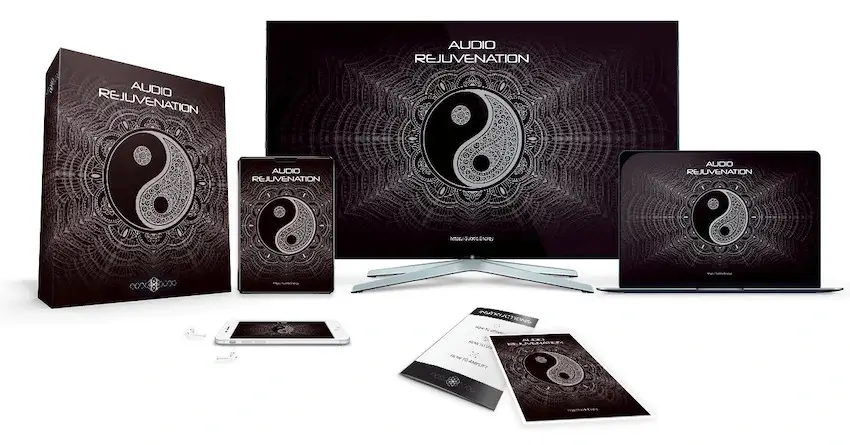
Boost Your Energy with a Digital App?
Eric Thompson is an inventor and the founder of Subtle Energy Sciences.
Using quantum resonance technology, Eric engineered a method of encoding digital images with specific energy signatures.
The result is what he calls Digital Mandalas or Quantum Energy Apps, which combine beautiful digital art with layers of various energy-related sound technology.
If you’re open to exploring new technologies to support self-development, check out Eric’s Audio Rejuvenation program—a combination of digital mandalas and audio tracks specifically designed to help replenish your primal essence.
Use code CEOSAGE30 for a 30% discount on Audio Rejuvenation.
I always have at least one digital mandala running on my desktop and my other devices. (Audio Rejuvenation is running and being amplified as I type this.)
Now, if you don’t have energetic sensitivity, you may feel nothing at first. If that’s the case, Eric offers various ways to augment and optimize the effects.
(Disclaimer: affiliate links above.)
Related Reading on Feminine and Masculine Energy
The following Jungian books highlight the differences between masculine and feminine psychology:
Books on Feminine Psychology
She: Understanding Feminine Psychology by Robert A. Johnson
Femininity Lost and Regained by Robert A. Johnson
The Way of All Women by M. Esther Harding
In a Different Voice: Psychological Theory and Women’s Development by Carol Gilligan
Books on Masculine Psychology
He: Understanding Masculine Psychology by Robert A. Johnson
King Warrior Magician Lover: Rediscovering the Archetypes of the Mature Masculine by Robert Moore and Douglas Gillette
Transformation: Understanding the Three Levels of Masculine Consciousness by Robert A. Johnson
Books on Masculine and Feminine Psychology
The Maiden King: The Reunion of Masculine and Feminine by Robert Bly and Marion Woodman
The Parental Image: Its Injury and Reconstruction by M. Esther Harding
The Fisher King & the Handless Maiden: Understanding the Wounded Feeling Function in Masculine and Feminine Psychology by Robert A. Johnson