
Most breakthroughs begin where logic ends.
When obstacles tighten your thinking, creativity becomes the way out—not a gift, but a discipline of divergent awareness.
These twelve creative problem‑solving techniques reveal how psychologists, inventors, and entrepreneurs access breakthrough ideas through perspective‑shifting and flow mastery.
This in‑depth guide shows how to remove mental rigidity, train flexible thinking, and strengthen your intuitive intelligence—so every challenge becomes a catalyst for growth.
Let’s dive in…
The Psychology Behind Creative Problem Solving
Creative problem solving integrates intuition and analysis to move from fixed thinking toward adaptive innovation.
All of the creative problem-solving techniques discussed below work some of the time.
While it’s fine to have a favorite “go-to” creative problem-solving technique, the reality is that each problem has unique elements.
The key is to mix and match various techniques and methodologies until you get a workable solution.
When faced with a difficult challenge, try a combination of the problem-solving techniques listed below.
The Power of Divergent Thinking
Creativity is everyone’s birthright.
One study with 1,500 participants found that 98 percent of children around the age of five qualify as geniuses.1Land, G., & Jarman, B. (1998). Breakpoint and beyond: Mastering the future today. Leadership 2000 Inc.
That is, virtually all children are gifted with divergent thinking—the ability to see many possible answers to a question.
For example, how many uses can you think of for a paper clip?
The average adult might offer 10 to 15 answers. Those skilled in divergent thinking divine closer to 200 answers.
Yet, something happens along the way because by adulthood, how many people score at the genius level? Only 2 percent!
That is, we see a complete inversion: from 98% being geniuses in early childhood to only 2% in adulthood.
A more recent meta-analysis verifies a fall in child creativity skill scores since the 1990s.2Kim, K. H. (2011). The Creativity Crisis: The Decrease in Creative Thinking Scores on the Torrance Tests of Creative Thinking. Creativity Research Journal, 23(4), 285–295. https://doi.org/10.1080/10400419.2011.627805
What causes this debilitating drop in creativity and the loss of an innovation mindset?
According to creativity researcher Sir Ken Robinson, the answer is our schooling.3Robinson, K. (2006, February). Do schools kill creativity? [Video]. TED Conferences. https://ted.com Through 13 years of “education,” our innate creativity is stripped out of us!
How to Recondition Your Mind for Creative Insight
To improve the efficacy of these creative problem-solving techniques, it is helpful to recondition ourselves to use divergent thinking.
The key is to overcome or remove our prior conditioning and restore our natural creative abilities. You’ll notice that many of the creative problem-solving techniques below help us do just that.
Thankfully, divergent thinking is a skill that can be developed like a muscle. So the more we use divergent thinking, the more second nature it becomes.
For this reason, when you’re presented with personal, professional, or business-related problems, celebrate them as an opportunity to exercise your creative abilities.
While the confrontation with a problem can create internal discomfort, if you stay with this dissonance long enough and apply the methods below, you’ll be amazed at the results.
Just be sure to maintain a “beginner’s mind” as you proceed, something we’ll highlight in detail below.
12 Powerful Creative Problem-Solving Techniques
Now, we’re going to cover 12 creative problem-solving techniques with examples that you can apply right away to get results.
These creative problem-solving methods are:
- Use “What If” Scenarios
- Focus on Quantity — Then Filter for Quality
- Switch Roles to Break Paradigm Blindness
- Practice de Bono’s Six Thinking Hats Technique
- Re‑Frame in a Different Context
- Take a 30,000-Foot View
- Walk Away to Invite Incubation
- Ask Your Subconscious Mind
- Mind Map Your Problem Visually
- Adopt a Beginner’s Mind
- Alter Your State of Consciousness
- Access Your Center Before Taking Action
Then, we’ll quickly review a series of problem-solving tools you can experiment with.
1 – Use “What If” Scenarios
Use “what if?” questions to project different scenarios into the future.
In A Whack on the Side of the Head, Roger Von Oech says,
“In the imaginative phase, you ask questions such as: What if? Why not? What rules can we break? What assumptions can we drop? How about if we looked at this backwards? Can we borrow a metaphor from another discipline? The motto of the imaginative phase is: Thinking something different.”
Using this creative problem-solving technique challenges you to allow your mind to play out different scenarios without judgment or criticism.
(Judgment always comes after the creative problem-solving process, not before.)
2 – Focus on Quantity — Then Filter for Quality
Creativity research shows that focusing on generating more ideas or solutions instead of on the quality of the ideas ultimately produces better results.4PAULUS, P. B., KOHN, N. W., & ARDITTI, L. E. (2011). Effects of Quantity and Quality Instructions on Brainstorming. The Journal of Creative Behavior, 45(1), 38-46. https://doi.org/10.1002/j.2162-6057.2011.tb01083.x
This phenomenon is known as the “Equal-Odds rule.” Nobel laureate Linus Pauling instinctively suggested a similar process:5Priestley Award winner says deployment of ABM’s “silly.” (1969, March 28). The Evening Sentinel, 1, 6.
I was once asked ‘How do you go about having good ideas?’ and my answer was that you have a lot of ideas and throw away the bad ones.
When I used to facilitate meetings and brainstorming sessions with leadership teams in large organizations, this was an invaluable creative problem-solving technique.
By focusing on generating more ideas first, rather than evaluating their quality, you avoid shifting into a critical mindset that often stops the ideation process.
3 – Switch Roles to Break Paradigm Blindness
Our minds tend to get locked in habitual patterns, leading to what’s called “paradigm blindness.”
Another related term is the “curse of knowledge,” a common cognitive bias observed in so-called “experts” in their field.6Hinds, P. J. (1999). The curse of expertise: The effects of expertise and debiasing methods on prediction of novice performance. Journal of Experimental Psychology: Applied, 5(2), 205–221. https://doi.org/10.1037/1076-898X.5.2.205
This cognitive bias is another illustration of how divergent thinking was conditioned out of us during our formative years.
Switching roles helps us “wear a different hat,” where we momentarily shift away from our conditioning.
For example, if you have a marketing-related problem, try putting on an engineer’s hat—or even a gardener’s hat. If you have a problem as an entrepreneur, put yourself in the customer’s mindset. See the world from their perspective.
The idea is to shift your perspective so you can approach the problem from a new angle.
Your ability to shift perspectives quickly—without privileging any one perspective—doesn’t only help you solve problems but also helps you become a stronger leader.
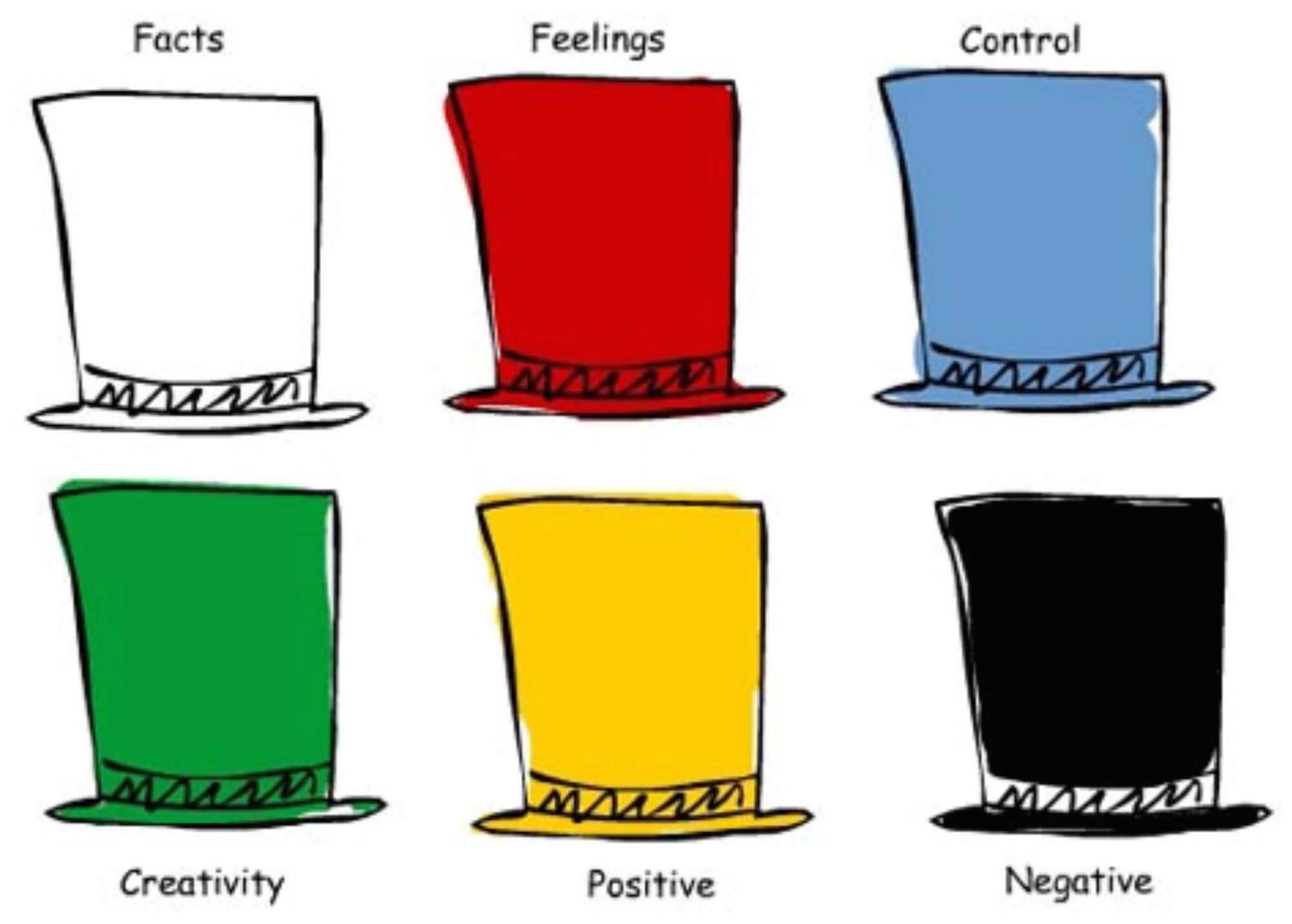
4 – Use the Six Thinking Hats Technique
Speaking of hats, creativity researcher Edward de Bono developed an effective creative problem-solving technique called the Six Thinking Hats.
The Six Thinking Hats provides you and your team with six different perspectives to utilize when tackling a problem. (You can use these six hats on your own, too.)
Each hat serves a different function. For creative problem solving, you start with the blue hat to clearly define the problem.
You then move to the white hat, where you outline all of the existing and known data regarding the issue. Next, you put on the green hat and generate as many ideas as you can (similar to the “quantity over quality” technique above).
Then, you put on the yellow hat, which represents what de Bono calls “value sensitivity.”
The yellow hat is used to build on the ideas generated from the green hat phase. Finally, you put on the black hat to evaluate your solutions and play Devil’s Advocate.
The Six Thinking Hats is an excellent technique for group brainstorming and creative problem-solving.
5 – Re‑Frame in a Different Context
Many problems arise because we neglect to zoom out from the problem and examine the larger context.
For example, long-term investments are often based on an “investment thesis.” This thesis may be based on trends in the market, consumer demands, brand recognition, dominant market share, innovation strength, or a combination of these factors. But sometimes the assumptions you base your thesis on are wrong.
So if you’re facing a problem at home or work, examine your assumptions.
If sales are down, for example, instead of revisiting your sales strategy, investigate the context of your overall industry:
- Has your industry changed?
- Is your business disconnected from your customers’ needs?
- Is your product or service becoming obsolete?
We can often find creative solutions to our problems by shifting the context.
6 – Take a 30,000-Foot View
Often, when we’re stuck on a problem, it’s because we’re “missing the forest for the trees.”
Zoom out and take a “30,000-foot view” of the situation. See your problem from above with a detached, neutral mindset. Take an expansive viewpoint before narrowing in on the specific problem.
This problem-solving technique is another variation of changing the context.
Sometimes you’ll find this to be a powerful creative problem-solving technique where the right solution spontaneously presents itself.
(You’ll think to yourself: Why didn’t I see this before?)

7 – Walk Away to Invite Incubation
Most often, the best problem-solving technique is to stop trying to solve it and walk away.
Yet, our minds often don’t like this technique. The mind tends to prefer being in control. And walking away means letting go of control.
I spent five years researching creative geniuses, trying to better understand the source of inspiration for a book I wrote many years ago.7Jeffrey, S. (2008), Creativity Revealed: Discovering the Source of Inspiration, Creative Crayon Publishing.
In studying dozens of creative geniuses, from Mozart to William Blake, a clear pattern emerged.
Creative geniuses know when to walk away from the problems they are facing. They instinctively access what can be called the Wanderer archetype.
More recent studies show that deliberate “mind-wandering” supports creativity.8Henriksen, D., Richardson, C., & Shack, K. (2020). Mindfulness and creativity: Implications for thinking and learning. Thinking Skills and Creativity, 37, 100689. https://doi.org/10.1016/j.tsc.2020.100689
Great ideas come to us when we’re not trying.9Kaplan, M. Why great ideas come when you aren’t trying. Nature (2012). https://doi.org/10.1038/nature.2012.10678
And not surprisingly, research confirms that we generate over 60% more creative ideas while walking compared to sitting!10Oppezzo, M., & Schwartz, D. L. (2014). Give your ideas some legs: The positive effect of walking on creative thinking. Journal of Experimental Psychology: Learning, Memory, and Cognition, 40(4), 1142–1152. https://doi.org/10.1037/a0036577
Wandering and reverie are essential to the creative process because they allow us to hear our Muse. The key is knowing when to let go of trying to solve the problem. Creative problem-solving can, in this way, become an effortless process.
8 – Ask Your Subconscious Mind
When we’re stuck on a problem and we need a creative solution, it means our conscious mind is stuck.
It does not, however, mean that we don’t already know the answer. The creative solution is often known below our conscious awareness in what can be termed our subconscious mind, or our unconscious.
Psychiatrist Carl Jung realized that dreams are a bridge from the wisdom of our unconscious to our conscious minds. As Jungian analyst Marie-Louise von Franz explains,11Boa, F. (1994). The way of the dream: Conversations on Jungian dream interpretation with Marie-Louise von Franz. Shambhala Publications.
Dreams are the letters of the Self that the Self writes us every night.
One of the most powerful creative problem-solving techniques is to ask your subconscious mind to solve the problem you’re facing before you go to sleep.
Then, keep a journal and pen on your nightstand, and when you awaken, record whatever comes to mind.
This is a powerful technique that will improve with practice. Many geniuses and inventors use it.
Another variation of this creative problem-solving technique that doesn’t require sleeping is to ask your inner guide. I provide a step-by-step creative technique to access your inner guide and connect to your spiritual inner knowing.
9 – Mind Map Visually
Another way to get unstuck in solving problems is to access the visual side of our brain.
In left/right hemisphere parlance, the left brain is dominated by logic, reason, and language, while images, symbols, and feelings dominate the right brain. (I realize that the “science” behind this distinction is now questionable; however, the concept is still useful.)
Our problems arise largely in our “thinking brain” as we tend to favor our thoughts over other modes of processing information.
In the language of Jung’s Psychological Types, most of us have a dominant thinking function that rules over our feelings, intuition, and sensing functions.
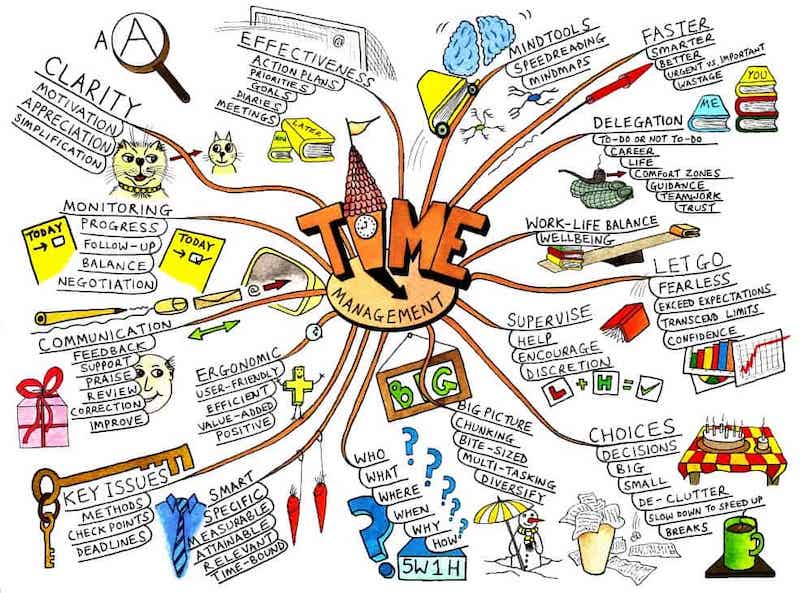
Mind mapping is a powerful, creative problem-solving technique that deploys visual brainstorming.
I learned about mind mapping in the 1990s from Tony Buzan’s The Mind Map Book and used this method for many years.
In the context of problem-solving, you draw the problem in the center of the page and then start ideating and connecting ideas from the center. Think of mind mapping as a visual outline.
You don’t need to be a skilled artist to use mind mapping. Nowadays, there are numerous apps for mind mapping, including MindMeister and Miro; however, I would still recommend using a blank piece of paper and some colored pencils or markers.
10 – Adopt a Beginner’s Mind
Our early “education” conditions us with what psychologists call functional fixedness, where we look at problems from a familiar viewpoint.
Numerous creative problem-solving techniques we discussed above—like switching the context, changing our roles, wearing the Six Thinking Hats, and taking a 30,000-foot view—are designed to overcome functional fixedness.
Another technique is found in Zen philosophy called a Beginner’s Mind.
With a beginner’s mind, we empty our minds and forget what we think we know. In doing so, we enter a more playful, childlike state. Instead of being serious and “attacking the problem,” we can tinker and play with different ideas and scenarios without any fear of “getting it wrong.”
It can be a liberating experience. Psychologist Abraham Maslow found that self-actualizing individuals enter a state like the Beginner’s Mind, where they get fully absorbed in whatever they are doing.
Holding a beginner’s mind also makes it easier to trigger peak experiences.

11 – Alter Your State of Consciousness
Another thing I noticed in my examination of artists and creative geniuses is that virtually all of them used various substances to alter their state of consciousness when producing creative work and solving intellectual problems.
The substances vary widely, including stimulants like coffee and/or cigarettes, alcohol (like absinthe), and all manner of psychedelic substances like LSD, psilocybin mushrooms, and peyote.
I’m not suggesting you should “take drugs” to solve your problems. The point is that it’s incredibly useful to alter your state of consciousness to help find creative solutions.
While using various substances is one way to accomplish this, there are many other methods, like:
- Stanislav Grof’s Holotropic Breathing Technique (similar to pranayama breathing)
- The WIM Hof Method (ice cold showers)
- Brainwave entrainment programs (binaural beats and isochronic tones)
- The Silva Method (also uses brainwave entrainment)
- Kasina Mind Media System by Mindplace (light stimulation and binaural beats)
Many of these programs shift your brain from a beta-dominant state to an alpha-dominant state, which is more conducive to creativity.
For example, Brain Awake by iAwake Technologies.
(Disclaimer: affiliate links above.)
12 – Access Your Center Before Taking Action
Perhaps the easiest and safest way to alter your state of consciousness is through meditation.
Studies show that people experience improved brainstorming and higher creativity after a single short session of open-monitoring meditation, even if they’re inexperienced meditators.12Colzato, L. S., Szapora, A., & Hommel, B. (2012). Meditate to Create: The Impact of Focused-Attention and Open-Monitoring Training on Convergent and Divergent Thinking. Frontiers in Psychology, 3, 22970. https://doi.org/10.3389/fpsyg.2012.00116
When we’re stuck on a problem or feeling confused about what we should do, we’re usually experiencing internal resistance.
Different parts of us, called archetypes, hijack our minds and give us conflicting wants, beliefs, attitudes, and perspectives. These parts hinder our ability to think clearly and find workable solutions.
As such, when you’re stuck, it helps to find your center first. It can also be highly beneficial to ground yourself on the earth. Both of these methods can help you quiet your mind chatter and shift into a more alpha-dominant brain pattern.
Centering yourself before approaching a problem is perhaps the most powerful creative problem-solving technique. It can also greatly assist you in taking a 30,000-foot view of the problem.
Tools for Creative Problem Solving
We referenced numerous problem-solving tools in the above examples, including:
- Roger von Oech’s Creative Whack Pack (a deck of cards with 64 creative strategies)
- Edward de Bono’s Six Thinking Hats method
- Mind mapping (see Tony Buzan’s How to Mind Map or research online)
- Brainwave entrainment (download free samples on iAwake or try your luck online)
- All of the mind-altering methods under “Alter Your State of Consciousness“
(Disclaimer: affiliate links above.)
If you’re looking for problem-solving tools for a business/group context, in addition to the Six Thinking Hats, you might also try:
- SWOT Analysis
- Five Whys
- Brainwriting
Let’s have a quick look at each of these tools.
SWOT Analysis
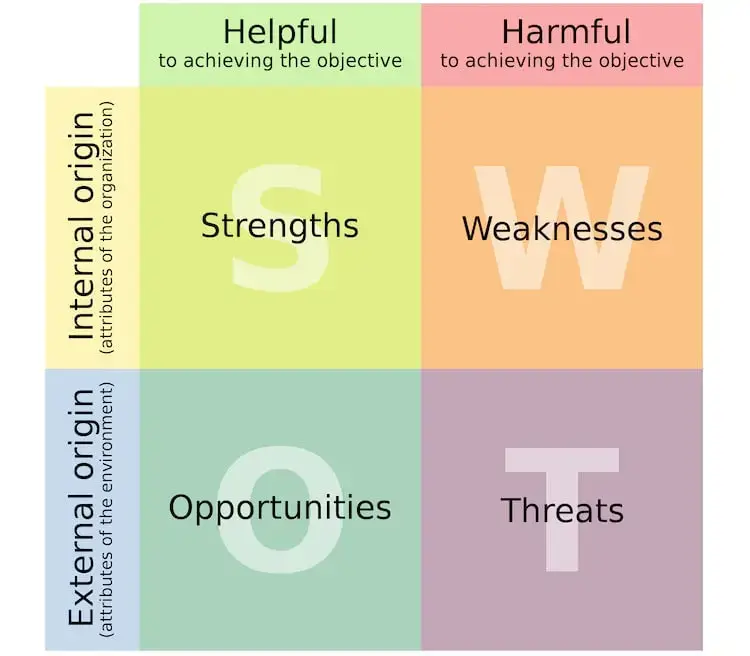
SWOT analysis is an excellent tool for business owners to help them understand their competitive landscape and make important business decisions.
SWOT stands for Strengths, Weaknesses, Opportunities, and Threats.
SWOT analysis is a practical strategic planning tool for businesses, and it can be an effective problem-solving tool for your business.
Five Whys
Five Whys can help identify the root cause of a problem when it’s not clearly understood. You start by stating the situation as you understand it.
Then you ask, “Why?” (For example, why is this occurring?) As the tool’s name implies, you ask why questions five times in total.
Brainwriting
Brainwriting is a form of brainstorming where individuals generate ideas on their own before meeting to discuss them as a group.
For a host of psychological reasons, this is often a superior way of approaching problem-solving in the workplace.
Combining brainwriting with the Six Thinking Hats method can be even more powerful.
Developing a Daily Practice of Creative Thinking
All of the techniques and tools above represent creative problem-solving methods.
These examples illustrate that there are numerous pathways to get the answers we seek.
Some pathways, however, are more effective than others. The key is to experiment with various methods to uncover which ones work best for you.
Different methods will be more effective in different contexts.
Here, wisdom and intuition come into play.
Over time, your connection with your inner guide improves, and creative problem-solving becomes a more spontaneous process.
Key Takeaways
True creativity balances divergent thinking—the free generation of possibilities—with convergent thinking, the focused refinement that transforms ideas into results.
The shift into a more open, relaxed state of consciousness quiets habitual analysis and lets spontaneous associations surface.
When discipline and intuition integrate, creative insight stops feeling accidental and becomes a repeatable expression of higher intelligence in action.
When we get “stuck,” it’s because our minds are fixed on a limited number of options. To get “unstuck,” we just need to alter our state of consciousness and examine our problems from various perspectives, which is what the above creative problem-solving techniques are designed to do.
The more you play with these techniques, the more they become second nature to you.
You may find that each technique begins to play off the other. Then, the art and subtleties of the discovery process begin to emerge.
Enjoy solving your next problem!
Read Next
15 Best Books in Psychology on Human Behavior
Leadership Symbols: How Great Leaders Use Powerful Imagery to Influence Others
The Documented Benefits of Wearing Blue Light Glasses
Jungian Synchronicity: Decoding the Psychology of Meaningful Coincidences
References
- Boa, F. (1994). The way of the dream: Conversations on Jungian dream interpretation with Marie-Louise von Franz. Shambhala Publications.
- Colzato, L. S., Szapora, A., & Hommel, B. (2012). Meditate to Create: The Impact of Focused-Attention and Open-Monitoring Training on Convergent and Divergent Thinking. Frontiers in Psychology, 3, 22970. https://doi.org/10.3389/fpsyg.2012.00116
- Henriksen, D., Richardson, C., & Shack, K. (2020). Mindfulness and creativity: Implications for thinking and learning. Thinking Skills and Creativity, 37, 100689. https://doi.org/10.1016/j.tsc.2020.100689
- Hinds, P. J. (1999). The curse of expertise: The effects of expertise and debiasing methods on prediction of novice performance. Journal of Experimental Psychology: Applied, 5(2), 205–221. https://doi.org/10.1037/1076-898X.5.2.205
- Kaplan, M. Why great ideas come when you aren’t trying. Nature (2012). https://doi.org/10.1038/nature.2012.10678
- Kim, K. H. (2011). The Creativity Crisis: The Decrease in Creative Thinking Scores on the Torrance Tests of Creative Thinking. Creativity Research Journal, 23(4), 285–295. https://doi.org/10.1080/10400419.2011.627805
- Land, G., & Jarman, B. (1992). Breakpoint and Beyond: Mastering the Future Today. HarperBusiness.
- Oppezzo, M., & Schwartz, D. L. (2014). Give your ideas some legs: The positive effect of walking on creative thinking. Journal of Experimental Psychology: Learning, Memory, and Cognition, 40(4), 1142–1152. https://doi.org/10.1037/a0036577
- PAULUS, P. B., KOHN, N. W., & ARDITTI, L. E. (2011). Effects of Quantity and Quality Instructions on Brainstorming. The Journal of Creative Behavior, 45(1), 38-46. https://doi.org/10.1002/j.2162-6057.2011.tb01083.x
- Priestley Award winner says deployment of ABM’s “silly.” (1969, March 28). The Evening Sentinel, 1, 6.
- Robinson, K. (2006, February). Do schools kill creativity? [Video]. TED Conferences. https://ted.com
Scott,
Some great ideas here. I am particularly intrigued by the "walk away" idea fulfilling the wanderer archetype. While counter intuitive, in my experience, walking away lets my mind develop subconcious connections that are sometimes the best. Sort of like letting my brain do the work instead of me! Bravo!
Todd Alexander
Thanks for your comments, Todd. It seems as though he need to train and remind ourselves to "walk away" because the mind thinks it can push its way through the problem.
e
How many times does it take for us to "absolutely know" that answers answer themselves when we take a break from forceful problem-solving and walk into the creative nature zone?! ;) The solution presents itself when we let go.
Great Post, Scott!
Very good learning strategies.
e
Really very interesting and knowledgeable
can I ask you a question please?
can I ask you a question please?
e