
You’re walking through the woods. The sun hits your face. The chatter in your head goes quiet.
For a moment—maybe thirty seconds—there’s no separation between you and the trees. You’re not observing nature. You’re part of it.
That’s self-transcendence. And it’s not reserved for monks, mystics, or people on vision quests. It’s a natural human capacity—one that Abraham Maslow spent his final years documenting as the actual peak of psychological development.
This in-depth guide covers what self-transcendence is, what it feels like, the science behind it, and the practices that make it accessible.
Let’s dive in …
What Does Transcendence Mean?
Transcendence is derived from the Latin scandere, meaning “to climb.”
To transcend means to climb above or beyond the current limits of ordinary experience or to exceed the normal limits.
Transcendence means rising above ordinary conditioning to perceive a larger reality that includes, yet surpasses, the personal self.
A transcendent experience is most often associated with a state of being beyond the mundane or material existence. This expanded awareness enters the realm of the “spiritual” or “mystical.”
Writers like Henry David Thoreau and Ralph Waldo Emerson were known as Transcendentalists. Their overall perspective points to a spiritual reality beyond reason, including basic human goodness and an interconnectivity of all things.
Maslow’s Concept of Self‑Transcendence
Self-transcendence means moving beyond the exclusive identification of oneself, or the ego.
In most situations, transcendence and self-transcendence can be used interchangeably.
In psychologist Abraham Maslow’s The Farther Reaches of Human Nature, he defined transcendence as:1Maslow, A. (1971). The Farther Reaches of Human Nature, 269.
The very highest and most inclusive or holistic levels of human consciousness, behaving and relating, as ends rather than means, to one-self, to significant others, to human beings in general, to other species, to nature, and to the cosmos.
Maslow’s definition of transcendence refers to self-transcendence.

Maslow’s Hierarchy of Human Needs (Standard Version)
Beyond Maslow’s Basic Hierarchy of Needs
Maslow is best known for his theory of motivation, particularly the Hierarchy of Needs. Usually, this hierarchy is depicted in a triangle. Something like this:
Although Maslow didn’t depict these needs as a triangle, he stated that “basic human needs are organized into a hierarchy of relative prepotency.”2Maslow, A. (1954). Motivation and Personality, 83.
Maslow’s work highlighted additional higher-level needs, like aesthetic and cognitive needs.
Also, Maslow didn’t suggest that self-actualization was the “peak” of said hierarchy.
In a few papers published posthumously in The Farther Reaches of Human Nature, Maslow emphasized the importance of self-transcendence.3Koltko‑Rivera, M. E. (2006). Rediscovering the later version of Maslow’s hierarchy of needs: Self‑transcendence and opportunities for theory, research, and unification. Review of General Psychology, 10(4), 302 – 317. https://doi.org/10.1037/1089-2680.10.4.302
Taken together, a simplified visual that captures these distinctions might look something like this:
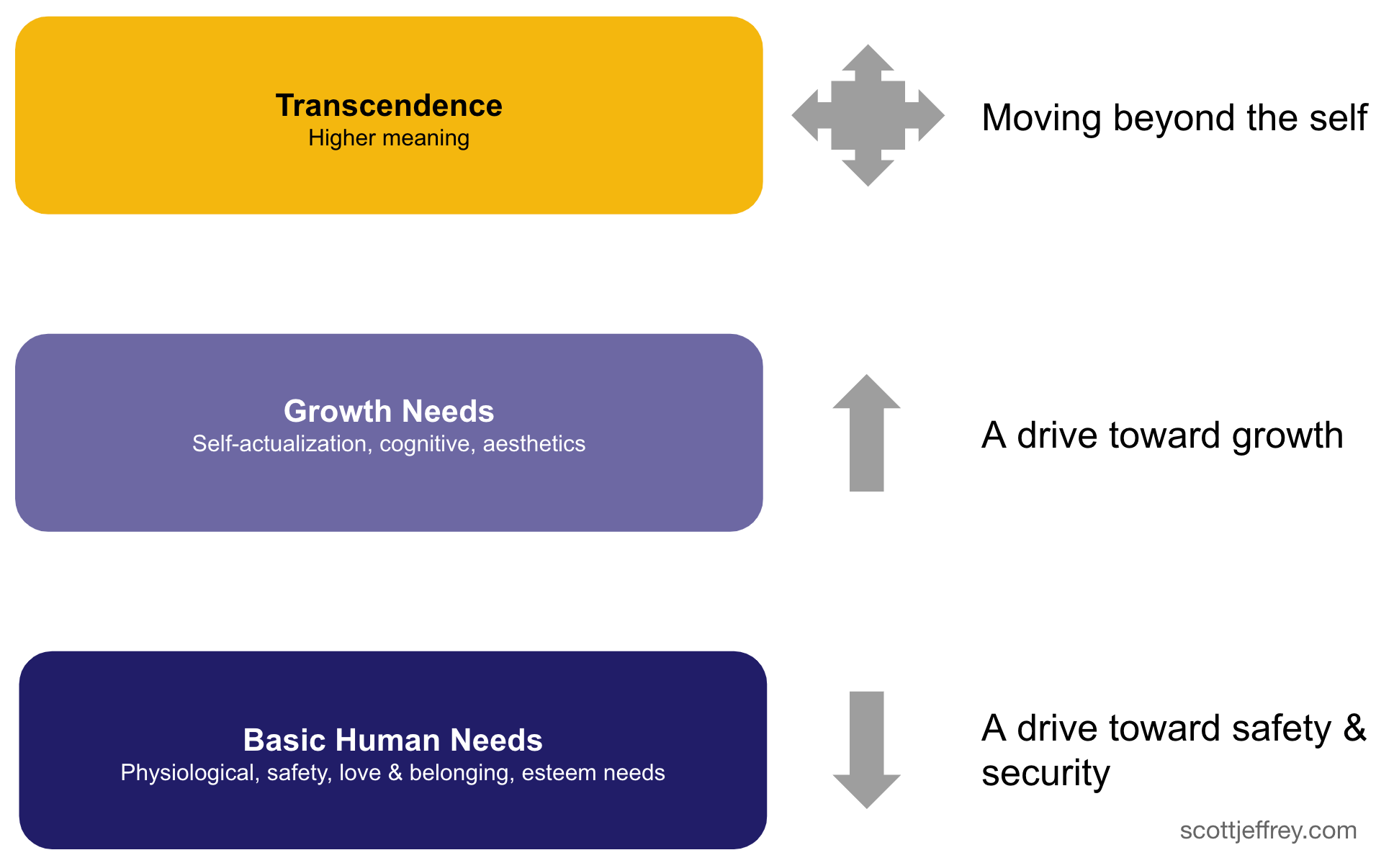
An Alternative Model of Human Development Based on Maslow’s Insights
35 Facets of Transcendence in Maslow’s Research
In The Farther Reaches, Maslow described 35 different meanings for transcendence that he observed in both self-actualizing and non-actualizing individuals.
This collection of definitions arguably provides the most precise and comprehensive understanding of what self-transcendence truly means.
I’ve done my best to synthesize Maslow’s 35 definitions of transcendence in a way that’s hopefully more palatable and practical for the reader.
All of these definitions can be grouped (with some overlap) into three categories:
- Transcendence of the Norm
- Transcendence as a Peak Experience
- Transcendence as a Sign of Mature Adulthood
First, we’ll review the meaning of self-transcendence for each group. Then, we’ll discuss why these groups are relevant for anyone interested in psychological development.
1 – Transcendence of the Norm
The “norm” in this context refers to the average “everyday” experience. Mythologist Joseph Campbell called it “the conventional world.” The Taoists call it “mundane conditioning” of the external world; it is our standard ego boundaries
Transcendence of the norm includes the transcendence of:
- Culture.
- Individual differences.
- One’s credo, system of values, or set of beliefs.
- The split between facts and values.
- “We-They polarity”—the zero-sum game of competitiveness between people.
- Every day bondage of the social order (“Getting off the merry-go-round”).
Transcendence of the norm also includes acceptance of the natural world as it is. That is, to “let things be as they are” in a Taoist fashion.
2 – Transcendence as a Peak Experience
In Maslow’s study of self-individualizing individuals, he found that they tend to have more peak experiences.
Not surprisingly, many of his definitions of self-transcendence are descriptions of these peak experiences. Why? Because individuals experiencing a peak experience momentarily enter a transcendent state.
Beyond Form, Time, and Space
Definitions of self-transcendence related to a peak experience include transcendence of:
- One’s physical body.
- Time.
- Space.
A sense of loss of self-consciousness or self-forgetfulness arises from being fully absorbed in a transcendent peak experience.
Out-of-body experiences (OBEs) and near-death experiences (NDEs) would both qualify as transcendent experiences.
Beyond Common Human Limitations and Tendencies
There’s also a transcendence of:
- Effort and striving. (In Taoism, this is referred to as Wu Wei, an expression of effortless flow.)
- Negative emotions like fear and anger.
- The present situation—so one can relate to existence in terms of the possible and the actual.
- One’s expectations and limitations—to be able to do or be more than one thought possible.
- Human limits, shortcomings, and finiteness occur as one transcends one’s self-identity.
- One’s resistance to death, pain, and evil (in a way that eliminates or reduces bitterness, rebelliousness, anger, and resentment).
A transcendence of “negatives” like evil, pain, and death was observed by Maslow in reports of peak experiences where the world is accepted as good, and one is reconciled to the evils one perceives.
Maslow also noted a transcendence of one’s will for a Higher Order or fate. “To embrace, lovingly, one’s own destiny.”
Into the Realm of the Mystical
Transcendence in this context is akin to a mystical experience—a sense of oneness with the cosmos. Maslow describes it as4Ibid, 266.
“A special phenomenological state in which the person somehow perceives the whole cosmos or at least the unity and integration of it and of everything in it, including his Self.”
In this state, one attains Taoistic objectivity marked by neutrality and noninvolvement (which transcends a purely egoic and immature lack of objectivity that tends to be highly emotionalized).
Transcendence, in this context, also means to become divine or godlike, as in going beyond the “merely human.”
With this definition, however, Maslow cautions the reader not to think in terms of “supernatural” (or “transhuman”) but rather to live the Being values.
That is, being divine here refers to an innate potential within human nature that transcends nationalism, religion, and ethnocentrism and aligns with universal cardinal virtues.
3 – A Sign of Mature Adulthood
The final category of self-transcendence definitions concerns the qualities inherent in mature psychological adulthood.
In this context, self-transcendence includes moving beyond:
- One’s past (beyond one’s storyline or childhood trauma).
- Black and white polarities and opposition. (“To bind separates together into an integration.”)
- One’s weaknesses and dependencies on one’s parents or other authority figures (constellating strength within oneself instead).
- Basic human needs (depicted above). Transcending these needs means they are no longer the dominant force within one’s life.
- The opinions of others as a self-determined individual (moving beyond common social masks, walking to the beat of one’s own drum instead).
- The Freudian superego. That is, rising above one’s inner parent to arrive at an intrinsic conscience, with intrinsic guilt, and an internal ethical framework.
There’s also the transcendence of the narcissistic ego, including selfishness and egocentricity (entering a more selfless state). In this more selfless state, one can experience unselfish love, for example, for one’s child or beloved friend.
Finally, Maslow emphasized that in a self-transcendent state, there’s a shift toward B-values (see below).
How Many Facets of Self-Transcendence Have You Experienced?
Many people have tasted self-transcendence without having the language for it. Psychologists call this subjective shift—a change in perception where the boundary between self and world softens.
You might have experienced it as a moment of awe, a sudden reframing of a problem, or a feeling of connectedness that dissolved your usual mental chatter.
The checklist below is drawn from Maslow’s 35 facets of transcendence, organized into three categories. There’s no pass or fail here—this is a self-assessment, a mirror for your own experience.
Check each item that resonates, then see where you land.
Transcendence of the Norm
I’ve had moments where cultural expectations felt irrelevant
I’ve questioned beliefs I once held as absolute
I’ve felt free from the need to compete or compare
I’ve accepted a situation exactly as it was, without resistance
Peak Experiences
I’ve lost track of time while completely absorbed in something
I’ve felt a sense of oneness with nature or the cosmos
I’ve momentarily forgotten myself—no self-consciousness, no inner critic
I’ve experienced an effortless flow state where striving disappeared
Mature Adulthood
I no longer define myself by my past or childhood wounds
I make decisions based on internal values, not others’ opinions
I’ve moved beyond black-and-white thinking on a major issue
I’ve felt genuine selfless love where another’s well-being mattered more than my own
Scoring: 1-4 facets = Glimpses | 5-8 = Familiar Territory | 9-12 = Integrated
Wherever you landed, the question worth asking is: What values emerge when you’re operating from the higher end of this spectrum? Maslow had an answer…
The B‑Values: Living in the Realm of Being
In Maslow’s study of self-actualizing individuals, he found a repeated pattern of specific values in those with positive mental health. He called these values B-values, short for Being values.
Being-values include:5Maslow, A. (1999), Toward a Psychology of Being, 93-94.
- Wholeness
- Perfection
- Completion
- Justice
- Aliveness
- Richness
- Simplicity
- Beauty
- Goodness
- Uniqueness
- Effortlessness
- Playfulness
- Truth (honesty; reality)
- Self-sufficiency
In a self-transcendent state, Maslow observed that one is primarily motivated by these B-values—one shifts into the “realm of Being” as what might unfold following a spiritual awakening.
Later research found that individuals scoring higher in self‑transcendence report greater life meaning and emotional balance, lending biological and psychological support to Maslow’s “Being‑values.”6Cloninger, C. R., Svrakic, D. M., & Przybeck, T. R. (1993). A psychobiological model of temperament and character. Archives of General Psychiatry, 50(12), 975 – 990. https://doi.org/10.1001/archpsyc.1993.01820240059008
The Link Between B-Values and Cardinal Virtues
Maslow’s emphasis on these Being values in transcendent experiences is noteworthy because it speaks to what ancient philosophers and traditions expounded upon: the importance of universal cardinal virtues.
These virtues appear to represent humans in our natural, or “highest,” state.
Examples of Self‑Transcendence in Daily Life
Now, keeping Maslow’s definitions in mind, let’s examine a few clear examples of transcendence:
1 – Experiencing Interconnectedness
You’re walking in the woods on a peaceful, sunny fall day. You feel the sun warming your face. A light breeze cuts through your path as you hear the rustling of the leaves from every direction.
All your mind chatter suddenly stops. You spontaneously stand still.
As you breathe, the forest breathes with you. In that transcendent moment, you are not separate from the trees and all of nature. You are part of it.
2 – Overcoming Human Limits
You’re running on a dirt path. After several miles, you feel your blood pumping and your muscles fatiguing. Then, all of a sudden, your body becomes as light as a feather.
Fatigue fades as you are charged with a seemingly infinite reservoir of energy.
Your breathing becomes calm and steady, almost imperceptible. You feel as though you are floating or gliding along the ground.
3 – Moving Beyond Selfishness
You look down at your newborn child, and you realize at that moment that you would do anything to protect this tiny ball of life.
Moments before, your life was all about you. Nothing else mattered as you were the center of your universe.
Now, in that moment of submission and surrender, another life takes precedence over your own.
4 – Shifting Toward Higher Virtues
Society’s values dominate your life. You are ruled by a drive for achievement, image, winning, accumulation, and material things.
A brush with death from a near-fatal skiing accident, however, is a catalyst for a spiritual awakening.
Suddenly and progressively over months, your prior values fall away as your inner life comes alive. Money is no longer the driving force in your life.
Where cheating to win was par for the course before, now, you have an internal moral framework guided by a select number of virtues like justice, integrity, and truth.
What is the “Self” in Self-Transcendence?
With the above definitions and examples in mind, let’s clarify what the “self” in self-transcendence means.
The self, in this context, refers to one’s self-identity.
Our self-identity, or self-concept, is a composite of traits, attributes, and other qualities we associate with ourselves.
Self-identity is who we perceive ourselves to be. This self-identity, or ego, is a construct we identify as “me” or “I.”
The Self in Western Psychology
In Western psychology, our self-identity is synonymous with our personality.
Our personality can change and develop through experience and practice over time.
Models such as Jane Loevinger’s Stages of Ego Development and Erik Erikson’s Stages of Psychosocial Development illustrate the ego’s stages.
That is, the ego, or self, can develop, and this development proceeds through specific sequential stages. Hence, “ego development” is synonymous with psychological development.
In developmental psychology, the term ego is often viewed on a continuum from unhealthy to healthy, from less mature to increasingly mature.
Referring back to Maslow’s definitions of self-transcendence, at least a third of his descriptions relate to more recent findings in developmental theory. That is, the higher stages of ego development relate to qualities of self-transcendence (or psychological integration).
The Self in the Eastern Traditions
The concept of the self in Eastern philosophy is somewhat different from that of the West.
The self, or ego, is considered the false self. This self represents the primary Maya or illusion.
The goal of most Eastern systems is to move beyond this false sense of self and return to the “Original,” sometimes referred to as the Original Spirit, Cosmic Spirit, Atman, Original Nature, Primordial Self, or just Self (capital “S”).
Depth psychology also emphasizes returning to the “Higher Self,” although its methods and focus differ from those of Eastern approaches.
The Self in these traditions is often used as a synonym for the Spirit.
In Jnana Yoga, the term sometimes used is purusha—the Self which abides in the heart of all things. In this Eastern context, the Self represents nonduality (“not two”; impersonal).
Great sages throughout time have provided instruction on how to “burn up” this ego—to transcend it—to bring one to Moksha (self-liberation).
Notice how this Eastern understanding of the self relates to Maslow’s definitions of a peak experience and self-transcendence.
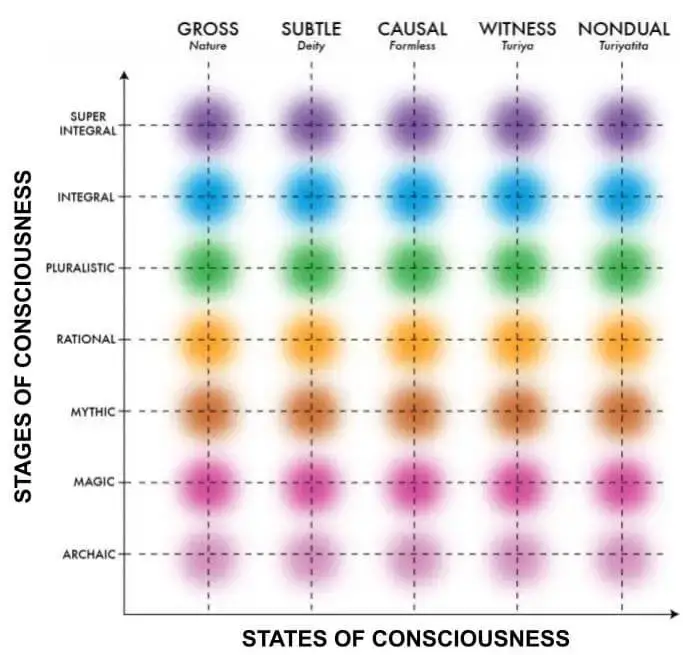
The Wilber-Combs Lattice
States vs Stages of Consciousness
The difference in emphasis between Western psychology and Eastern traditions highlights an important distinction made by integral theorist Ken Wilber.
Namely, the difference between states of consciousness and stages of consciousness.7Wilber, K. (2000). Integral psychology: Consciousness, spirit, psychology, therapy. Shambhala Publications.
States of Consciousness
States of consciousness are temporary and transitory. Anyone, including a small child, can experience a higher state of consciousness.
Individuals on various psychedelics, including LSD or psilocybin mushrooms, often experience a higher state of consciousness—a transcendent experience.
Stages of Consciousness
In contrast, stages of consciousness are not transitory but permanent structures of consciousness.
Stages of consciousness are developmental in that once you reach a particular stage of consciousness, you’re unlikely to regress to an earlier way of being.
As Wilber often said, “States are free, but structures are earned.”
How States and Stages Relate to Self-Transcendence
This distinction between states of consciousness and structural stages helps illuminate many attributes of Maslow’s observations about self-transcendence. It’s also why I categorized Maslow’s definitions as I did above.
Peak experiences represent a momentary state of consciousness. These peak states can occur spontaneously, but they can also result from internal development related to meditative training, athletic focus, and other spiritual practices.
Studies of astronauts and awe experiences support this idea. David Yaden and team (2016) documented how overwhelming awe can trigger a self‑transcendent state—brief yet deeply transformative—similar to Maslow’s “peak experience.”8Yaden, D. B., Ihamba, A., Zaleski, A. J., Park, G., Chang, H. J., & Newberg, A. B. (2017). The overview effect: Awe and self‑transcendent experience in space flight. Psychology of Consciousness: Theory, Research, and Practice, 4(1), 1 – 11. https://psycnet.apa.org/doi/10.1037/cns0000086
Maslow also found that self-actualizing individuals tend to have more peak experiences on average than “non-actualizers”.9Maslow, A. H. (1968). Toward a psychology of being (2nd ed.). Van Nostrand Reinhold.
The signs of mature psychological adulthood tend to represent permanent stages of development. These qualities of self-transcendence generally result from an intentional effort to cultivate consciousness through various forms of inner work.

Authentic Transcendence vs Transhumanism
Like so many other important terms, “transcendence” has been hijacked by various special interest groups.
Propagandistic documentaries like Transcendent Man (2009), featuring Ray Kurzweil, and films like Transcendence (2014), starring Johnny Depp, have unfortunately co-opted many people’s perceptions of what “transcendence” means.
Consequently, many people incorrectly associate transcendence with topics like artificial intelligence, genetics, nanotechnology, and cybernetics.
Simply put, the transhumanist movement has twisted and distorted “transcendence” into an image of science fiction.
In the transhumanist view, humans cannot “transcend” without the help of technology. To them, “becoming god-like” means merging their consciousness with machines.
This transhumanist vision is born from pure material reductionism (Cartesian thinking) that demonstrates virtually no understanding of the nature of consciousness.
Not only is this ideology ungrounded, but it’s arguably highly destructive to humanity.
The underlying message of the transhumanists is that you don’t need to develop or cultivate yourself. You just need to submit to the gods of technology in the name of “progress.” In my opinion, this is the antithesis of authentic transcendence.
How to Achieve Self-Transcendence
From the above definitions of transcendence combined with the distinctions between states versus stages, we can clarify two different kinds of self-transcendence:
- Realizing a self-transcendent state
- Developing to higher transcendent stages
Let’s take a closer look at each one.
How to Experience a Self-Transcendent State
In a transcendent state, we momentarily move beyond our personal boundaries and limitations.
As illustrated in the transcendence examples above, there are many ways to achieve this state:
- Going for a walk alone in nature.
- Having a stimulating dialogue with a friend.
- Reflecting on the nature of existence or the meaning of life.
- Fully immersing yourself in something you love doing.
- Meditating deeply on the nature of the mind or the source of one’s awareness.
- Listening to advanced brain entrainment field technology.
- Deeply releasing a negative emotion you’ve been holding on to.
- Using a sensory deprivation tank.
- Doing Stanislav Grof’s holotropic breathwork (similar to pranayama breathing).
- Taking various psychedelic substances in the appropriate “set and setting.”
- Practicing the Wim Hof method (including breathing and cold therapy techniques).
- Pushing beyond one’s limits in athletics, personal training, or extreme sports.
There are countless ways to experience transcendence. In these states, your sense of self expands beyond prior perceived limits.
How to Develop to Higher Transcendent Stages
The approach to developing higher transcendent stages, however, is different.
Here, we look to developmental processes that lead to structural (permanent) changes in our sense of self. We ascend through higher levels of existence (or being) through our internal development and effort.
We have covered many tools, methods, and processes that support self-transcendence in many previous guides. Here, let’s highlight a few examples:
1 – Shadow Work and Psychological Integration
Shadow work is an essential process for psychological development that eventually leads to self-transcendence.
Your self-identity before you know your shadow is radically different from what it is after you’ve integrated your shadow.
2 – Individuation and Inner Work
Individuation was Jung’s term for the process of psychological development that begins with shadow work and culminates in the attainment of one’s Self. The final stage of individuation is a self-transcendent experience of reality.
Inner work is a more general term that includes various methods that help us turn toward ourselves.
The overall purpose of inner work is to address past trauma and heal the splits in one’s psyche. Inner work and shadow work guide us to move beyond the storyline of our past.
3 – Body-Mind Practices
Anything that supports the integration of the body-mind, including qigong, neigong, and various forms of yoga, encourages individual development and, therefore, can move you toward self-transcendence of prior boundaries and limitations.
Zhan Zhuang is a powerful standing practice that supports body-mind integration.
4 – Meditative Stabilization and Awareness
Meditation can help you cultivate and stabilize the mind, leading to greater self-awareness. Many of our perceived limitations are a consequence of our prior conditioning.
Stabilizing the mind helps us observe this conditioning, enabling us to build a consciousness that leads us to transcend it.
5 – Creative Transcendence as Flow
The creative process is itself a transcendent experience when fully understood and approached with reverence and dedication.
The observations of creative geniuses throughout time speak to the transcendent nature of creativity.
Self‑Transcendence Is Your Birthright
To stress a point that Maslow makes throughout his writings, transcendence and peak experiences are not something for only a “special few.”
Instead, transcendence is everyone’s birthright.
Transcendence is not esoteric—it is the natural unfolding of mature psychological development.
Arguably, the world may try to rob us of this birthright. It distracts us. It hijacks us. Heck, in many real ways, it even poisons us—mentally, emotionally, and physically.
In a structural sense, the pathway to transcendence is largely about undoing prior damage and unsupportive conditioning.
Then, as we strip away layer upon layer of what we are not, transcendence becomes what it was designed to be: a natural process of healthy development.
If you remember that transcendence is a natural process—part of your birthright—you can embrace it with open arms.
Enjoy!
References
- American Psychological Association. (n.d.). APA dictionary of psychology: Self‑transcendence. Retrieved from https://dictionary.apa.org/self-transcendence
- Cloninger, C. R., Svrakic, D. M., & Przybeck, T. R. (1993). A psychobiological model of temperament and character. Archives of General Psychiatry, 50(12), 975 – 990. https://doi.org/10.1001/archpsyc.1993.01820240059008
- Koltko‑Rivera, M. E. (2006). Rediscovering the later version of Maslow’s hierarchy of needs: Self‑transcendence and opportunities for theory, research, and unification. Review of General Psychology, 10(4), 302 – 317. https://doi.org/10.1037/1089-2680.10.4.302
- Maslow, A. H. (1954). Motivation and personality. Harper & Row.
- Maslow, A. H. (1968). Toward a psychology of being (2nd ed.). Van Nostrand Reinhold.
- Maslow, A. H. (1971). The farther reaches of human nature. Viking Press.
- Newberg, A. B., & d’Aquili, E. G. (2001). Why God won’t go away: Brain science and the biology of belief. Ballantine Books.
- Wilber, K. (2000). Integral psychology: Consciousness, spirit, psychology, therapy. Shambhala Publications.
- Wim Hof Method. (n.d.). Practice the method. Retrieved from https://www.wimhofmethod.com/practice-the-method
- Yaden, D. B., Ihamba, A., Zaleski, A. J., Park, G., Chang, H. J., & Newberg, A. B. (2017). The overview effect: Awe and self‑transcendent experience in space flight. Psychology of Consciousness: Theory, Research, and Practice, 4(1), 1 – 11. https://psycnet.apa.org/doi/10.1037/cns0000086