
Most modern psychology dwells on what we can observe: thoughts, behavior, measurable patterns. Yet the real theater of human experience unfolds below our awareness.
Depth psychology invites us into that invisible realm—the domain of dreams, symbols, and unspoken motives where meaning and mystery intertwine.
Are you interested in exploring the psyche?
To enter the DEEP—the world of the unknown?
To go where most fear to tread … to return home to the Self?
This guide distills the essential frameworks of depth psychology—tracing its origins, core ideas, and daily applications—so you can directly explore your own unconscious terrain.
Let’s dive in …
What is Depth Psychology?
Depth psychology is the study of the unconscious layers of the psyche—the hidden forces that influence personality, behavior, and experience.
Psychiatrist Eugen Bleuler coined the phrase Tiefenpsychologie (literally “psychology of depth”) in the early 1900s while directing the Burghölzli Asylum in Zürich, where a young Carl Jung began his career.
The new field sought to understand why human beings act and feel as they do—looking beneath conscious reasoning to the symbolic currents driving it.
Depth psychology rests on one principle: what we are not conscious of controls us from the shadows.
Unlike the behavioral or cognitive perspectives that would later dominate psychology, the depth tradition retrieves insight from mythology, alchemy, literature, and religion to map inner realities that logic alone can’t decode.
Freud’s instinct theories, Adler’s striving for significance, Rank’s creativity‑based model—each illuminated different doorways into this subterranean field. Carl G. Jung carried the idea further. He envisioned the psyche not simply as a reservoir of repressed impulses, but as an intelligent system seeking wholeness.
His school of Analytical Psychology became the most expansive expression of the depth perspective—bridging science with imagination, myth, and spirituality. Today, the International Association for Analytical Psychology oversees training institutes across 50 countries.
Why Depth Psychology Still Matters
A century later, we’re surrounded by data yet starved for meaning. Depth psychology refocuses the question from “How do I fix myself?” to “What does the unconscious seek to reveal through this?”
Where behaviorism counts stimuli and responses, depth work listens for images, dreams, and intuitions—the psyche’s native language. The goal of depth psychology isn’t to “fix”, but to build consciousness.
By bringing the individual’s unconscious material to consciousness—both personal and collective—one moves from fragmentation and “one-sidedness” toward wholeness.
Jung believed that we were all searching for the same thing: the soul. From his view (and direct experience), one needs to embrace one’s inner world—exploring one’s dreams and imagination—to eventually arrive at a stage of wholeness where one’s soul is realized.
In this way, Jungian psychology shares many insights with Eastern philosophy and Western mysticism, even though Jung’s methods were different.

How Depth Psychology Differs from Classic Psychoanalysis
Early in Carl Jung’s career, Sigmund Freud was like a father figure to him.
In fact, Freud was grooming the younger Jung to be his successor. But the two men didn’t see eye to eye. (In the end, their professional relationship ended rather abruptly.)
Psychoanalysis vs Psyche-Analysis
Before their breakup, Sigmund Freud named his field psychoanalysis, as in the study of psychotic and mentally ill people.
Freud saw the unconscious as a vault of repressed drives—primarily aggressive and sexual impulses seeking release. Freud perceived his patients to be ill, while he, as an analyst, was not.
Unfortunately, Freud’s psychoanalysis set the tone for the next century of psychology, which mainly focused on mental illness.
However, Jung suggested a different name for their emerging field: psyche-analysis.
Psyche is a term representing the totality of a person’s being. Jung saw their role as an analysis of the human mind, soul, and spirit. He proposed that the psyche wasn’t simply sick or deviant; it was alive and communicative.
| Dimension | Psychoanalysis (Freud) | Depth Psychology (Jung) |
|---|---|---|
| Goal | Cure illness | Wholeness / individuation |
| View of unconscious | Repressed drives | Intelligent, communicative system |
| Analyst role | Expert treating patient | Fellow traveler |
| Methods | Free association | Dreams, active imagination |
| Scope | Personal unconscious | Personal + collective unconscious |
Wholeness Over Normalcy
That is, Jung saw a very different picture of the human condition from Freud. Where Freud’s psychoanalysis focused on curing illness, Jung’s analytical approach aimed at realizing potential.
Instead of a one‑sided doctor‑patient hierarchy, Jung believed analyst and client alike were fellow travelers in the same human labyrinth.
For Jung, we are ALL fragmented and divided, and knowingly or not, we’re all searching for our souls. This search for one’s soul is central to depth psychology.
This perspective changed everything—the goal shifted from adjustment and normalcy to seeking wholeness. While psychoanalysis dissects the individual’s psychic content, depth psychology dialogues with it.

The Challenge and Reward of Inner Work
Approaching, examining, and integrating one’s unconscious is no easy feat.
While the conscious mind is at home with logic, reason, concepts, and language, the unconscious is a repository of images, symbols, and feelings.
The conscious mind likes order and reason, while the unconscious often seems guided by chaos and irrationality. Together, they represent opposing forces—yin and yang.
For this reason, depth practitioners had to develop a new language for studying and interpreting symbols and new methods for communicating through images.
Harmonizing the opposites can be difficult, as it requires an alchemical process that ultimately leads to psychological integration.
Depth psychology requires participation, not mere analysis. Every journey inward begins with disorientation, before clarity can emerge.
Facing the Shadow
The conscious mind (or ego) has a host of defense mechanisms to maintain its current self-identity.
To get to know one’s shadow—the parts of oneself that one is cut off from and divorced from—requires repeatedly confronting one’s ego identity.
Depending on one’s level of internal resistance and will, this process can be challenging for many individuals.
Jung called this the moral problem of the modern individual: learning to own what consciousness rejects.
Doing so releases psychic energy that had been locked away in resistance.
For this reason, practitioners like Jung (and scholars like Joseph Campbell) consider it a “heroic act” to bridge the gap between the conscious and the unconscious.
The Alchemy of Transformation
Before you begin these inner processes, it’s challenging to appreciate the profound influence that unconscious forces have on your everyday life, regardless of how much information you read.
Consciousness and unconsciousness behave like opposing elements: fire and water, order and chaos. Inner work is the slow fusion between these divergent forces.
Dreams, emotions, and symbols act as catalysts in this psychological alchemy, melting rigid attitudes and reforming them into new awareness.
As contradictions reconcile, a third, unseen force begins to emerge: the Self. It’s the organizing principle within the psyche, sitting silently in the background.
As you move toward this Center, life feels less random; meaning becomes self-evident rather than something to be searched for.
With fewer internal triggers ruling your behavior, communication with others becomes more fluid.
This is the reward depth psychology offers: not escape from struggle, but transformation through it.
Although the process of inner work can be arduous, its rewards are great.
Why Depth Psychology Remains Outside the Mainstream
Despite its century‑long lineage, depth psychology sits at the margins of academia.
In fact, if you pursue a Ph.D. in psychology, you aren’t likely to interact with Jungian theory except perhaps in a history class (where they teach you that psychoanalysis was the “first wave”).
The academic field of psychology is, as Jung would say, one-sided. It’s almost exclusively focused on the conscious mind (what he called the thinking function).
Modern psychology favors the measurable—thought patterns, neurotransmitters, and behavior protocols. Inner experience resists quantification, and institutions distrust what they can’t chart.
Methods like Cognitive Behavioral Therapy (CBT) dominate because they yield quick, surface‑level outcomes that look clean in data tables.
Depth work, by contrast, is unpredictable and individual. It takes time, imagination, and self‑honesty—qualities harder to monetize, standardize, or legislate.
Yet this very unconformity is its strength. In giving voice to the unmeasured, depth psychology keeps the psyche human.
Its persistence outside the mainstream is proof that the soul continues to seek conversation, even when the culture pretends not to hear.

Jung’s Model of the Psyche
Ten Core Concepts in Jung’s Depth Psychology
These key ideas form the scaffolding of Jung’s analytical approach.
This is not meant to be an exhaustive list but is designed merely to give you a sense of what analytical psychology is all about.
1 – Personal Unconscious
The personal unconscious represents everything within the individual’s psyche that is unknown to them.
One of the distinguishing characteristics of depth psychology is its recognition of multiple levels of the unconscious. In classic psychoanalysis, there’s just the unconscious, which is mainly at odds with the individual’s conscious identity.
Depth psychology distinguishes between the personal and collective unconscious. Decades later, in transpersonal theory, Ken Wilber differentiated five unconscious levels.1Wilber, K. (1980). The Atman project: A transpersonal view of human development. Theosophical Publishing House.
2 – Collective Unconscious
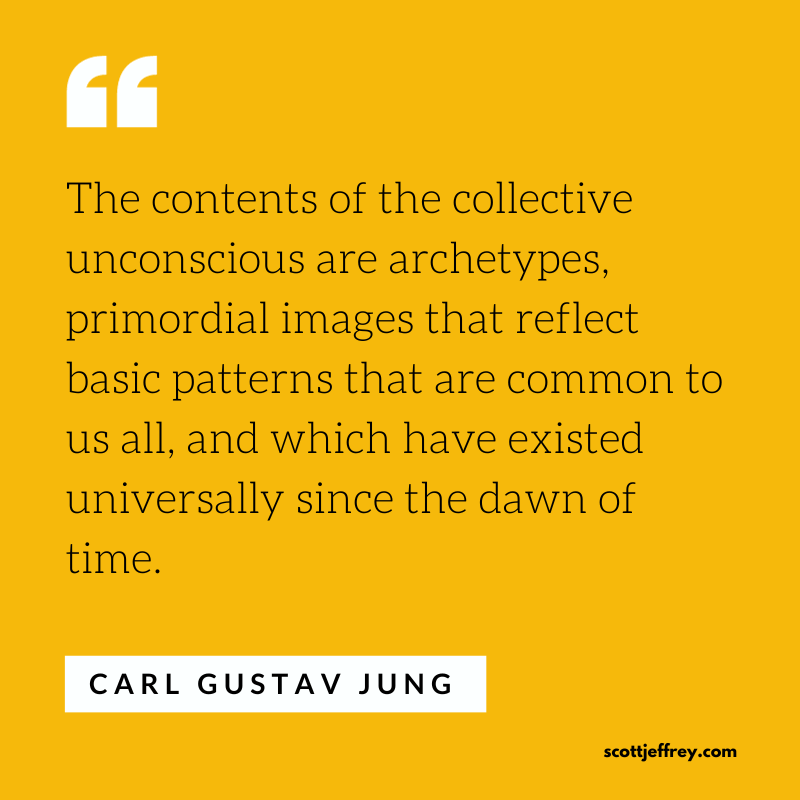
Jung attempted to describe the collective unconscious, the inner world of the collective psyche filled with universal and impersonal images, symbols, and motifs (archetypes).
He turned to mythology and fairy tales to help him relate to the repetitive themes in his and his patients’ dreams. For Jung, the collective unconscious is a repository of primordial images (archetypes) and behavioral patterns that are universal (cross-cultural) and age-old.
Jung considered these images “collective” because they were not acquired by individuals in their lifetime. That is, the archetypes within the collective unconscious didn’t represent learned behavior. Yet, they were accessible to all. (This concept is similar to biochemist Rupert Sheldrake’s morphogenetic fields.2Sheldrake, R. (2009). Morphic resonance: The nature of formative causation (4th rev. & exp. ed.). Park Street Press.)
3 – The Psyche
The psyche represents the totality of one’s being, including the body, mind, instincts, soul, and spirit.
For Jung, there was a personal psyche related to the individual’s personality and lived experiences, and a collective psyche shared by all.
The modern term “mind” captures only a fraction of this total system.
The psyche is a living field of meaning constantly attempting to adjust toward balance. From a Jungian perspective, wholeness depends on harmonizing, not eliminating, its opposing energies.

4 – Psychological Types
In Psychological Types (1971), Jung explains in great detail the various ways humans process information. Extroverts draw information predominantly from the outside world, while introverts tend to utilize information from within themselves.
Jung outlined two core orientations—introversion and extraversion—and four primary functions: thinking, feeling, sensing, and intuiting.
People’s orientation toward each function differs depending on whether they are introverts or extroverts. For example, introverted thinkers process information differently from extroverted thinkers.
This typology later influenced personality systems like the MBTI, though Jung’s aim wasn’t labeling—it was self‑knowledge.
Each of us has a dominant function and an inferior function. Your dominant function is your primary means of evaluating information. It’s the internal muscle that you’ve exercised the most since birth. Your inferior function is the opposite of your dominant function; it represents your weakest muscle in terms of processing information.
The goal here is to arrive at the transcendent function in the Center.
5 – Archetypes
Archetypes are timeless motifs that organize instinct and imagination. They surface as mythic figures in story and dream, yet operate as invisible patterns directing behavior.
These primordial images represent the set patterns of behaviors found in the collective unconscious. Archetypes represent semi-autonomous subpersonalities within the psyche that influence most human behavior.
Jung’s work focused on only a handful of archetypes, including the mother, the father, the child, the wise old man, the hero, the trickster, the anima/animus, the shadow, the maiden, and the self.
Each archetype reveals a fragment of the collective psyche; understanding them teaches us how imagination structures consciousness itself.
For readers interested in Jung’s original framework, see my guide on the Classic Jungian Archetypes, which outlines the core motifs in his writing.
6 – The Complexes
While the archetypes are universal and impersonal, the complexes are entirely personal. They form when emotionally charged experiences cluster around a theme—such as rejection, authority, or love.
A complex behaves like an autonomous subpersonality; it can momentarily take over thought and action. Rather than suppressing a complex, Jung advised listening to it.
Each one guards a fragment of unlived energy or forgotten truth, calling to be integrated into consciousness.
A classic example is the Mother complex. With this complex, a boy’s psyche doesn’t separate from his mother as he enters adulthood.
As a consequence, he becomes emotionally dependent on her and seeks a woman to play this nurturing role for him. A man with a mother complex cannot channel his masculine energy to become an autonomous, mature adult.
7 – The Shadow
The shadow contains what we deny, fear, or condemn in ourselves. It represents everything we were divorced or cut off from during early development. It’s sometimes referred to as the disowned self.
Meeting this disowned self illuminates the boundaries of identity and the roots of projection—those quick judgments we cast onto others.
Integrating the shadow grounds us in our humanity. This reconciliation restores integrity: the capacity to stand in one’s full range of being without shame or inflation.
8 – Anima / Animus
In Jung’s approach to the psyche, the anima is the feminine aspect of a man’s personality, while the animus is the masculine counterpart of a woman’s psyche.
Jung saw the anima-animus as enlivening souls or spirits within men and women. These archetypes play an essential role in an individual’s life, especially in their primary relationship.
When disowned, they distort relationships; when integrated, they refine intimacy and intuition.
For Jung, anima and animus are essential building blocks in the psychic structure of every man and woman. Integrating the anima-animus is focused on after integrating one’s shadow. It’s considered far more challenging as well.
9 – The Self
The Self is the central archetype—the organizing totality of the psyche. It transcends the ego yet includes it, much like the ocean includes the wave.
Dreams of mandalas, wise figures, or unifying symbols often signal that one is moving toward it. Experiencing the Self feels like coming home to something both intimate and infinite.
Here, personal identity aligns with a broader order that quietly guides psychological evolution. Realizing or returning to the Self represents the final stage of Jungian psychology.
10 – Individuation
Jung described individuation as becoming who you inherently are. It is the lifelong process of differentiating from collective norms while integrating your inner multiplicity (the various parts or archetypal impulses within you).
Jung writes in Two Essays on Analytical Psychology (1972):
Individuation means becoming an “in-dividual,” and, in so far as “individuality” embraces our innermost, last, and incomparable uniqueness, it also implies becoming one’s own self. We could therefore translate individuation as “coming to selfhood” or “self-realization.”
Individuation passes through encounters with the shadow, anima/animus, and finally the Self. Its outcome isn’t perfection but authenticity—living a life shaped from the inside out.
To individuate is to take responsibility for one’s unique pattern within the collective whole.
Core Methods of Inner Work
The process of analysis varies from school to school.
In the case of C.G. Jung’s analytical psychology, the two primary methods are used:
- Dream analysis
- Active imagination
The primary goal of depth psychology is to develop consciousness so that the individual can bring the unconscious into consciousness to achieve psychic wholeness.
Patients (the analysands) meet with their analyst usually weekly.
However, untrained individuals can also apply Jung’s principles, insights, and methods to their inner work without an analyst.
Dream Analysis
Dream analysis (or “dream work”) was the central method for revealing the psyche in Jung’s analytical approach.
For Jung, dreams provided a way for us to bridge the gap between our conscious mind and our unconscious. He perceived dreams as a kind of love letter from the unconscious.
In analysis, the patient (analysand) recalls a specific dream or series of dreams, and the analyst then asks probing questions to delve deeper into the dream’s meaning.
Active Imagination
Active imagination is the process of actively engaging with internal “characters” and figures from within one’s unconscious.
Jung used active imagination to augment his dream analysis.

Depth Psychology FAQ
Now, let’s run through some commonly asked questions about depth psychology.
How is depth psychology different from psychoanalysis?
Freud’s psychoanalysis focused on curing mental illness by excavating repressed drives.
Jung’s depth psychology aims at realizing human potential.
Where Freud saw a sick patient and a healthy analyst, Jung saw two fellow travelers exploring the same labyrinth. Depth work seeks wholeness, not just normalcy.
What’s the difference between the personal and collective unconscious?
The personal unconscious holds everything unique to your individual life—forgotten memories, repressed experiences, emotional complexes.
The collective unconscious contains impersonal, inherited patterns that belong to humanity as a whole, surfacing as archetypes in myths, fairy tales, and dreams across every civilization.
Can depth psychology help with trauma?
Yes. Depth therapy doesn’t just manage symptoms—it explores how trauma shapes meaning, identity, and internal narratives.
Bringing unconscious material into consciousness creates space for genuine integration rather than surface-level coping. The psyche’s natural movement toward wholeness becomes the foundation for healing.
Do I need to remember my past for depth work to help?
Not necessarily. While memories sometimes surface organically, the psyche communicates through many channels—emotion, dreams, bodily sensations, recurring patterns, and intuition.
Healing unfolds from the present moment, working with whatever material arises naturally rather than requiring you to excavate every detail.
Can I practice depth psychology on my own?
You can apply Jung’s principles without an analyst. Dream journaling, active imagination exercises, and shadow work are accessible starting points.
The work requires self-honesty and willingness to face discomfort, but the psyche rewards genuine engagement. For deeper patterns, working with a trained analyst accelerates the process.
How long does Jungian analysis take?
There’s no fixed timeline. Some work through a focused issue in months; deeper individuation unfolds over years. The psyche moves at its own pace.
Weekly sessions with an analyst are typical, but the real work continues between meetings—in dreams, reflection, and daily life.
Who should not do depth therapy?
Depth work may not suit those seeking highly structured, short-term, or purely symptom-focused interventions.
People in acute crisis who need immediate stabilization may benefit from establishing a sense of groundedness first. The work requires a willingness to sit with emotional discomfort and explore internal imagery over time.
What’s the difference between the ego and the Self?
The ego is your conscious identity—the “I” you know. The Self is the organizing totality of the psyche, transcending yet including the ego.
Dreams of mandalas or wise figures often signal movement toward it. Experiencing the Self feels like coming home to something both intimate and infinite.
Benefits of Depth Psychology and Inner Work
Depth psychology opens a channel between the conscious and unconscious mind, dissolving the inner tension that drains vitality.
Bringing shadow material to light reduces anxiety, compulsive behavior, and projection—freeing energy for authentic expression.
As unconscious patterns surface, relationships stabilize; reactivity softens into understanding. The psyche no longer needs to whisper through symptoms or crisis; awareness becomes our common language.
On a physiological level, many people experience enhanced sleep, focus, and creativity once inner conflict subsides. Emotionally, life gains texture; meaning replaces impulse.
Conclusion: The Deep Mind and the Whole Self
Depth psychology reminds us that we grow less by addition and more by integration. Each symbol, dream, and emotion is consciousness attempting to complete itself.
The unconscious is not an abyss to escape but an ecosystem of intelligence awaiting dialogue.
In a culture obsessed with metrics and performance, inner work reclaims the forgotten dimensions of being: imagination, intuition, and the soul.
By understanding the psyche’s symbolic code, we translate disorder into meaning.
When the conscious and unconscious cooperate, behavior becomes a personal choice rather than a compulsion.
That is the quiet revolution of depth psychology—one person at a time returning to inner order, restoring the whole mind.
Further Reading in Jungian Psychology
Many of the guides linked above include a “reading list” for those who want to explore these concepts in greater detail. Here, I’ll highlight a few good “entry points” to this work:
(Disclaimer: affiliate links to Amazon below.)
Memories, Dreams, Reflections by C.G. Jung
Jung’s autobiographical journey through dream, vision, and discovery—an intimate portrait of how analytical psychology emerged from lived experience.
The Portable Jung edited by Joseph Campbell
A concise anthology of Jung’s major writings, thoughtfully arranged with commentary that traces his evolving view of the psyche and the collective unconscious.
Individuation in Fairy Tales by Marie-Louise von Franz
Explores how timeless folk stories illustrate the individuation process, revealing the psyche’s path toward wholeness through symbolic narrative.
The Shadow and Evil in Fairy Tales by Marie-Louise von Franz
Analyzes fairy‑tale imagery to show how darkness, conflict, and moral tension serve psychological transformation.
Read Related Guides
Since 2014, I’ve been publishing in-depth guides on this website. Many of these guides directly relate to Jung’s depth psychology. In addition to the guides listed above, see also:
Psychological Projection: How to Reclaim Your Inner Gold
Projection is an essential concept in psychoanalytic theory. This guide, inspired by Jungian Robert A. Johnson’s excellent book Inner Gold, highlights how we often project the best parts of ourselves onto others (and how we can take them back).
Self‑Deception: How the Mind Tricks Itself
The conscious mind (or ego) often resists internal processes like shadow work. Understanding the patterns of resistance and avoidance can help practitioners bring them to consciousness so they can move beyond these games.
Puer Aeternus Archetype: A Deep Decoding of the Peter Pan Syndrome
This in‑depth guide examines the archetype of the Eternal Child, exploring its creative gifts and its immature shadow that avoids responsibility and growth.
21 Best Carl Jung Books and Best Jungian Psychology Books
A curated selection of foundational and advanced readings for students of depth psychology—ideal for building a library of transformative texts on Jungian ideas and their modern applications.
References
- Edinger, E. (1992). Ego and Archetype. Shambhala.
- Hillman, J. (1997). Re‑Visioning Psychology. Harper Perennial.
- Johnson, R. A. (1989). Inner Work: Using Dreams and Active Imagination for Personal Growth. HarperOne.
- Jung, C.G. (1972). Two Essays on Analytical Psychology. Collected Works, Vol. 7. Princeton University Press.
- Jung, C. G. (1971). The collected works of C. G. Jung: Vol. 6. Psychological types (H. G. Baynes, Trans.; R. F. C. Hull, Rev.). Princeton University Press. (Original work published 1921)
- Jung, C.G. (1969). The Archetypes and the Collective Unconscious. Collected Works, Vol. 9 (I). Princeton University Press.
- Jung, C.G. (1968). Man and His Symbols. Doubleday.
- Jung, C.G. (1961). Memories, Dreams, Reflections. Vintage Books.
- von Franz, Marie‑Louise (1980). Archetypal Dimensions of the Psyche. Shambhala.
- Sheldrake, R. (2009). Morphic resonance: The nature of formative causation (4th rev. & exp. ed.). Park Street Press.
- Wilber, K. (1980). The Atman project: A transpersonal view of human development. Theosophical Publishing House.