
OVERVIEW: This guide explains how to relieve jaw tension from stress and TMJ by taking a four-pronged integrative approach.
______________
Jaw tension causes a great deal of suffering for many of us.
While some people know they clench their jaw, the majority do not.
I wrestled with jaw tension for many years. I started grinding my teeth in my sleep when I was around ten years old—a horrible habit that continued into my 20s.
Even though I didn’t grind my teeth during the day, I always had a tight jaw and frequently experienced jaw pain.
Jaw tension can sap your energy, cause frequent headaches, and make you feel miserable.
So let’s highlight how to relieve jaw tension once and for all.
Let’s dive in …
What is Jaw Tension?
Jaw tension results from the masseter muscles in the jaw remaining clenched.
No other muscle in your body can exert more force than the masseter muscles. According to the Library of Congress, with all the jaw muscles working together, it can close the teeth with force greater than 200 pounds on the molars.1https://www.loc.gov/rr/scitech/mysteries/muscles.html
Richard Hofman holds the world record for the strongest human bite at a whopping 975 pounds!2https://www.guinnessworldrecords.com/world-records/75273-strongest-human-bite
Not only is the jaw the strongest muscle, but it’s also the place where many people tend to hold tension.
What Causes Jaw Tension?
There are numerous causes of jaw tension.
Common physical causes cited include TMJ disorders, teeth grinding (bruxism), and rheumatoid arthritis.
However, the primary cause of jaw tension is likely psychological and emotional. Stress and anxiety are often cited in the medical literature.
For example, researchers examined 113 dentistry students and found a correlation between their reported level of anxiety and increased tension in their jaw (by measuring their masseter muscles).3Owczarek JE, Lion KM, Radwan-Oczko M. Manifestation of stress and anxiety in the stomatognathic system of undergraduate dentistry students. J Int Med Res. 2020 Feb;48(2):300060519889487. doi: 10.1177/0300060519889487.
Another 2020 review found a correlation between people who experience stress and those who grind their teeth.4Chemelo VDS, et al. Is There Association Between Stress and Bruxism? A Systematic Review and Meta-Analysis. Front Neurol. 2020 Dec 7;11:590779. doi: 10.3389/fneur.2020.590779.

The Temporomandibular Joint (TMJ)
Is There a Deeper Cause for Jaw Tension?
While these types of studies are interesting, it’s important to remember that correlation doesn’t mean causality.
Just because there’s an association between stress/anxiety and jaw tension doesn’t mean it’s the cause.
What if there’s a more deeply rooted issue here? Something that only fields like depth psychology can address? That is, could there be an unconscious mechanism that causes many of us to clench and tighten our jaws?
Dr. John Sarno was a medical pioneer and a highly controversial figure in his field. While his peers were trying to treat things like chronic back pain with multiple surgeries, Dr. Sarno took a very different approach.
Sarno’s Insights into Chronic Pain
Sarno arrived at the insight that most chronic pain was the result of repressed emotions. That is, the true cause of physical pain and chronic tension was from emotions stored within the body that were not accessible to our conscious minds.
(If you’re dealing with chronic pain of any kind, I highly recommend Sarno’s books: Healing Back Pain, The Mind-Body Prescription, and The Divided Mind. They were incredibly helpful for me when I was dealing with teeth grinding and jaw tension.)
Interestingly, a 2019 study found that a person’s inability to express and identify emotions (called alexithymia) was a relevant psychological factor in predicting teeth grinding and clenching (bruxism).5Przystańska A, et al. Psychosocial Predictors of Bruxism. Biomed Res Int. 2019 Oct 13;2019:2069716. doi: 10.1155/2019/2069716. PMID: 31737656; PMCID: PMC6815662.
This repressed rage begins developing in childhood and builds into adulthood.
According to this theory, our bodies hold tension in the masseter muscles of the jaw as a way of mitigating some of this repressed rage. (The neck, shoulders, lower back, and knees are other common rage-holding regions.)
What Happens When You Can’t Relax Your Jaw?
Most people tend to hold tension in their jaw unconsciously. That is, many of us can go our entire lives without even knowing the amount of clenching pressure we’re holding in our jaws—24/7.
Even when you think your jaw is relaxed, you’re most likely holding some tension.
When the jaw muscles fully relax, your lower jaw can swing from side to side, as if on a hinge.
When this tension goes to an extreme, Bruxism or teeth grinding occurs. Approximately 8% to 30% of adults grind their teeth, usually during their sleep.6Manfredini D, Winocur E, Guarda-Nardini L, Paesani D, Lobbezoo F. Epidemiology of bruxism in adults: a systematic review of the literature. J Orofac Pain. 2013 Spring;27(2):99-110. doi: 10.11607/jop.921. PMID: 23630682.
When We Can’t Relieve Jaw Tension, This Happens …
But most of us merely clench the jaw muscles during sleep and throughout the day. Clenching can lead to:
- Fatigue,
- Headaches,
- Dizziness,
- Toothaches,
- Earaches, and
- Reduced quality of sleep.
Even more concerning, the more tension we hold, the more energy we expend. Less energy translates to:
- Lower emotional resilience,
- Less adaptability to stress,
- Reduced focus, and
- Inferior mental performance.
In effect, when we can’t relax this jaw tension, it can lead us on a downward spiral that we don’t even realize until years later.
How to Relieve Jaw Tension: An Integrative 4-Stage Approach
If you’re reading this, there’s a good chance you’re serious about ending the pain and discomfort caused by intense jaw tension.
With problems like this, I find it best to take an integrative approach that addresses multiple modalities simultaneously.
In the case of relieving jaw tension, these modalities include:
- Physical/behavioral
- Biochemical
- Topical
- Psychological
The protocols outlined below approach the problem from different modalities to help you eliminate your pain and discomfort.
However, if you were going to use one approach, the psychological is arguably the most important as it gets you to the source of the problem.
The challenge is that discovering the root cause of your unconscious tension can take time. This process often takes months to see results.
So it’s helpful to use “external” methods to relieve your jaw in the interim to reduce discomfort.
Physical Exercises to Relieve Jaw Tension and TMJ
Let’s start with physical exercises to help you relieve your jaw and reduce tension in the here and now.
We’re going to cover five different exercises you can do to relieve jaw tension right now:
- Jaw Massage
- Energy Tapping
- Let It Hang Loose
- Correct Mouth Position
- Modified Lion Pose
Let’s dive in…

Exercise 1: Jaw Massage to Relax Your Face
Place your fingers on your cheeks. Open and close your jaw to feel where the upper and lower jaw meet.
Massage this area on both sides with your fingers.
It might feel sore. Don’t dig in too deeply at first. Just gently try to release the tension with a light massage.
Consciously relax your jaw muscles as you do this. (At the very least, ensure your teeth aren’t touching.)
Exercise 2: Energy Tapping to Relieve Jaw Tension
Instead of rubbing the masseter region, try tapping the area with the tips of your fingers. Tapping quickly and frequently.
An alternative healing modality called the Emotional Freedom Technique (EFT) uses this form of energy tapping.
I found using various tapping methods far more effective than rubbing or massaging the area.
Also, instead of just tapping around your jaw muscles, tap around your entire head: temples, forehead, crown, behind your ears, and all around your eyes.
The reality is that when you’re holding tension in your jaw, you’re also tensing up other muscles in your facial region.
Notice if you feel any sensations after tapping for a few minutes.
Exercise 3: Let It Hang Loose
I realize this instruction can sound insensitive and even enraging when you can’t relax your jaw, but this method works too.
Jaw tension is an unconscious habit. That is, over time, your body becomes accustomed to holding tension in your jaw muscles without you being aware of it.
Now, we can begin reversing the process by consciously doing the opposite: let your jaw hang loose.
You’re going to allow your lower jaw to open as much as you can, BUT WITHOUT any additional strain or discomfort.
So this isn’t a stretch. Instead, you’re just going to let your lower jaw hang loose.
How to Use the “Let It Hang Loose” Method
Maintain some of your attention in your jaw region as you do this exercise. Slowly and gently, allow your lower jaw to succumb to gravity. It might start to feel heavy (which is a good thing).
Make sure you’re not tilting your head backward (which you might do if you try to open your upper jaw) or forward. Just keep your head in an upright position.
This exercise is good to do while you’re just sitting around, walking, or watching something. It seems passive, but you’re slowly reminding your jaw that it isn’t in a battle and it can relax.
It’s best to do this exercise when no one is watching, as you can look a bit “dim-witted” while you do it.
Exercise 4: Train Yourself in the Correct Mouth Position
In the Eastern meditative traditions, there’s a great deal of instruction on how to correctly align your posture to facilitate more attention and better blood and energy flow.
In a practice called Zhan Zhuang, one of the first things you learn is how to relax your facial muscles (because if you’re holding tension in your face, you can’t sink and stabilize your body’s energy).
The correct mouth position according to the traditions is straightforward:
- Upper and lower teeth never touch (except when eating)
- Your lips are gently touching (but also very slightly open and relaxed)
- The tip of your tongue is gently pressed to the roof of your mouth (behind your upper teeth)
Your tongue should always be in this position except when you’re eating, drinking, or talking.7Professor John Mew, 2014. Normal Tongue Posture. (Youtube)
More Tips for the Correct Mouth Posture
Try making the sound, “Nnnnnnnnnnnn,” and your tongue should be in the right position automatically.
Also, inhaling and exhaling are both done through the nose (not the mouth).
It’s pretty much guaranteed that if you can’t relax your jaw, your default (unconscious) position does not follow the above criteria.
However, if you practice this correct alignment at various intervals throughout the day, you can retrain your mouth to maintain this posture in a matter of weeks.
In this position, you will feel more relaxed, which can help break the unconscious cycle of stress and anxiety.
Exercise 5: Modified Lion Pose to Relieve Jaw Tension
Finally, if you’re a yoga practitioner, you’re probably familiar with the lion pose.
If not, here’s a modified version you can use in a seated position.
Take a slow, steady inhale. On the exhale:
- Open your mouth as wide as you can
- Look up toward the center of your forehead
- Stick out your tongue as far as you can
- Open your eyes as much as possible
- Make a roaring “Haaaaa” sound out of your mouth.
Repeat this two to five times.
Here’s a 90-second video on how to do the lion pose:
The lion pose was recommended to me by numerous people when I was suffering from teeth clenching. I tried using this exercise numerous times, but I didn’t observe any benefits from it.
In my opinion, this exercise is a little too aggressive for someone with serious jaw tension. Anything aggressive tends to have a counterforce within our unconscious.
So I would suggest trying the other methods listed above first, as they did help me relax my jaw.
Foods to Avoid During This Protocol
The following foods promote inflammation and will likely work against your efforts to relieve jaw tension from stress:
- Alcohol
- Sugar
- Caffeine
- Trans fats
While you’re following this protocol, do your best to reduce or eliminate your intake of these substances.
At the same time, if any of the above are your common vices, trying to eliminate them can cause more internal tension.
So, for example, if you’re addicted to sugar, instead of completely removing it from your diet, look for natural substitutes or just apply the principle of moderation.
Supplements and Topical Oils Proven to Promote Muscle Relaxation
Supplements will not relieve jaw tension permanently; however, they can help you relax your muscles, reduce inflammation, and alleviate pain.
Two Supplements to Relieve Jaw Tension
Here are two science-backed supplements with muscle-relaxing and anti-inflammatory properties:
Turmeric
There are over 10,000 peer-reviewed articles on the benefits of turmeric. For our purposes here, turmeric has been found to have superior anti-inflammatory properties compared to most other substances.8Hewlings SJ, Kalman DS. Curcumin: A Review of Its Effects on Human Health. Foods. 2017 Oct 22;6(10):92. doi: 10.3390/foods6100092. PMID: 29065496; PMCID: PMC5664031.
Rhodiola Rosea
I cover this well-researched herb in this nootropic supplements guide. Studies show that Rhodiola helps reduce muscle soreness and headaches.
Topical Oils to Relieve Jaw Tension
Based on clinical research, here are four oils that can help reduce inflammation, pain, and soreness in your jaw region:
Cannabidiol Oil (CBD Oil)
A 2008 study shows that cannabinoids work efficiently as a muscle relaxer.9Russo EB. Cannabinoids in the management of difficult to treat pain. Ther Clin Risk Manag. 2008 Feb;4(1):245-59. doi: 10.2147/tcrm.s1928. PMID: 18728714; PMCID: PMC2503660.
Another 2011 study shows that CBD helps reduce pain symptoms in fibromyalgia.10Fiz J, Durán M, Capellà D, Carbonell J, Farré M. Cannabis use in patients with fibromyalgia: effect on symptoms relief and health-related quality of life. PLoS One. 2011 Apr 21;6(4):e18440. doi: 10.1371/journal.pone.0018440. PMID: 21533029; PMCID: PMC3080871.
Arnica Oil
A 2013 study shows that arnica helps reduce muscle pain and damage.11Pumpa KL, Fallon KE, Bensoussan A, Papalia S. The effects of topical Arnica on performance, pain and muscle damage after intense eccentric exercise. Eur J Sport Sci. 2014;14(3):294-300. doi: 10.1080/17461391.2013.829126. Epub 2013 Aug 16. PMID: 23947690.
Peppermint Oil
Peppermint oil has been shown to provide pain relief from fibromyalgia and myofascial pain syndrome.12Argoff CE. A review of the use of topical analgesics for myofascial pain. Curr Pain Headache Rep. 2002 Oct;6(5):375-8. doi: 10.1007/s11916-002-0079-5. PMID: 12207850.
Magnesium Oil
Studies show magnesium helps relieve migraines and improves workout recovery.13Mauskop A, Altura BM. Role of magnesium in the pathogenesis and treatment of migraines. Clin Neurosci. 1998;5(1):24-7. PMID: 9523054.,14Nielsen FH, Lukaski HC. Update on the relationship between magnesium and exercise. Magnes Res. 2006 Sep;19(3):180-9. PMID: 17172008.
How to Relieve Jaw Tension: Psychological Approach
Sarno’s prescription for undoing these repressed emotions, like rage, has two parts.
First, you repeatedly remind yourself that repressed emotions are the source of your jaw tension (and any other chronic pain you’re experiencing in your body).
That is, the source of our tension and pain most often isn’t physical but psychological.
Somehow, acknowledging and accepting this fact reduces the repressed rage, thereby decreasing the unconscious tension. (I witnessed a noticeable change in my nighttime teeth-grinding behavior and daytime clenching within two months.)
Second, familiarize yourself with all the potential sources of this rage.
Sources of rage can include:
- Childhood trauma,
- High expectations of yourself,
- Perfectionism,
- Inner criticism,
- Sensitivities,
- People pleasing,
- Worrying,
- The need to be good,
- Life pressures,
- Responsibilities,
- Being a parent,
- Having parents,
- Getting old.
The list isn’t short. See Sarno’s The Divided Mind for a complete treatment protocol.

Practice Inner Work
If Dr. Sarno is correct, and I fundamentally believe he is, the key to addressing chronic tension is to bring the unconscious material that’s causing the issue into consciousness.
As strange as it may sound, oftentimes we don’t even have to resolve the underlying issue. The reality is, sometimes we can’t!
By simply bringing the issue to full consciousness, however, the unconscious pattern drops away.
Subconsciously, most of us invest a great deal of psychic energy in maintaining suppressed emotions. That is, cutting ourselves off from our past and negative emotions we don’t want to deal with comes at a cost.
Teeth grinding, teeth clenching, and general jaw tension are symptoms of this repression.
So if you’re interested in diving into your unconscious to discover the source of the issue, engaging in inner work and getting to know your shadow are great ways to do it.
Recap: How to Relieve Your Jaw
We covered numerous modalities to help you relieve jaw tension.
- Experiment with the physical exercises until you find what works for you.
- The tapping technique and letting the jaw hang loose were the most effective for me.
- Train yourself to maintain the correct mouth posture throughout the day.
- Find a supplement or topical oil that provides you with some temporary relief (if needed).
- Acknowledge that the true source of the tension is repressed emotions (or at least be open to the idea).
- Get to the source of the problem by exploring your inner, subjective terrain.
When you feel stressed or anxious, just place your attention on your clenching jaw and allow it to relax as much as possible.
Interestingly, relaxing your jaw is one of the fastest ways to relax your entire body.
The key is to perform “quick checks” on your jaw throughout the day.
In the beginning, you may forget about these quick checks, but if you stick with this practice, it becomes a habit.
If you remind yourself of the correct tongue and mouth posture periodically throughout the day, eventually, you will train your tongue to stay in the correct position all the time.
Eventually, you’ll break the unconscious habit of clenching.
Good luck!
Book Recommendation for Relieving Jaw Tension and Chronic Pain
All of Dr. John Sarno’s books can help you learn how to relieve jaw tension:
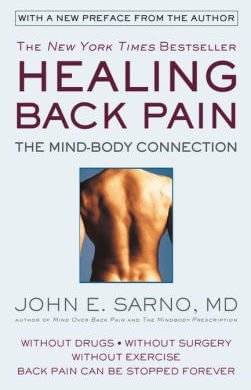
Healing Back Pain
by John E. Sarno
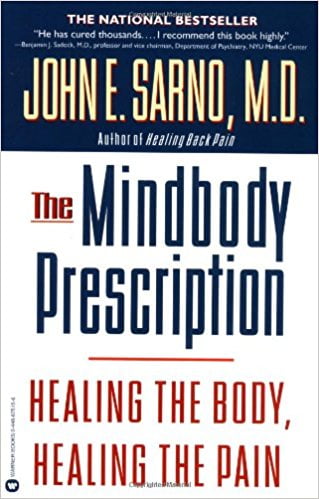
The Mindbody Prescription
by John E. Sarno

The Divided Mind
by John E. Sarno
Read Next
The Best EMF Protection for the Home: A Practical Step-by-Step Guide
The Benefits of Wearing Anti-Blue Light Glasses