
Our brains are wired to pursue pleasure and avoid pain.
When we feel good, we have less resistance to what needs to be done.
With less resistance, things tend to flow more effortlessly in everything we do.
Less conflict arises. Greater creativity occurs. More enjoyment follows.
The more content and in flow we are, the more at ease everyone around us can be.
In Authentic Happiness, the founder of positive psychology, Martin Seligman, points out that we have two distinct ways of experiencing happiness in the present:
- Pleasures and
- Gratifications.
Let’s start with pleasures.
Pleasure vs. Gratification: The Two Paths to Well‑Being
Pleasure rewards the senses and briefly satisfies our biological and social needs—good food, comfort, praise, a scroll of positive comments.
Pleasures have sensory and emotional components like delight, ecstasy, excitement, and orgasm.
Pleasures, however, tend to be short-lived, and many of them have negative consequences.
In contrast, gratification asks more of us. They require attention, effort, and potential risk.
In the context of positive psychology, pleasure relates to short‑term relief; gratification links to personal growth.
When our attention meets a sense of purpose, time dissolves, the ego quiets down, and authentic happiness begins.
That is, gratifications provide deeper moments of engagement and skillful challenge that expand our identity (who we perceive ourselves to be).
Simply put, pleasures are fleeting, while gratifications support self‑actualization.
How to Maximize Pleasure
Still, pleasures are an enjoyable part of life, and Seligman and positive psychology don’t suggest eliminating these sources of “transitory happiness.”
Instead, Seligman offers ways to maximize our experience of them.
He offers three suggestions based on current research:
- Avoid Habituation of Pleasures
- Savor Pleasure More Deeply
- Become More Mindful of Pleasures
Let’s take a closer look at each strategy.
1 – Avoid Habituation of Pleasures
Did you ever find a cookie you loved so much that you couldn’t get enough? But eventually, you had had enough and lost interest in that cookie.
Indulging in pleasures repeatedly and rapidly reduces the pleasure of the experience—something we’ve all had firsthand experience with.
This process is called habituation, and it occurs with all sensorial pleasures.
Did you ever have a song you loved so much that you listened to it over and over again? How much pleasure does that song give you now?
Seligman suggests taking a band you enjoy and experimenting with listening to them more or less frequently. The goal is to discover the optimal period to keep the music freshest and your enjoyment at its highest.
Put into your life as many events that produce pleasures as you can, but increase the amount of time between these events more than you usually do.
Try to find the optimal time-lapse that prevents your pleasures from experiencing diminishing returns.
2 – Savor Pleasure More Deeply
The more awareness we bring to a pleasurable event, the more pleasure we can experience.
Savoring is the act of consciously attending to the experience of pleasure.
Seligman offers four kinds of savoring based on the work of Fred Bryant and Joseph Veroff (2006):
- Basking: receiving praise and congratulations
- Thanksgiving: expressing gratitude for blessings
- Marveling: losing the self in the wonder of the moment
- Luxuriating: indulging the senses
There are numerous ways to promote savoring, including sharing the experience with others and anchoring mental memories of the event.
In the case of basking, allow yourself to feel a sense of pride for the occurrence.
3 – Become More Mindful of Pleasures
Much of human activity is performed without focus or attention. Living on autopilot, we fail to notice much of our overall experience.
Bringing mindful attention to any act is a worthy experience. In the case of our pleasures, mindfulness can elevate these experiences to have almost transcendent qualities.
For example, eating a piece of chocolate while you’re focusing your eyes on your computer screen produces a certain class of experience.
Eating it mindfully with your eyes closed, and your full attention on the smell, texture, and sensations in your mouth and the experiences in your brain is an entirely different class of experience.
It is difficult to engage in mindful activities when we’re stressed, and our minds are racing. A few slow, steady, quiet, deep breaths are helpful before you fully tune into the sensations of pleasure.
To support the use of this strategy, read How to Center Yourself to Increase Focus.
Gratifications Address Higher Level Needs
Like pleasures, gratifications are also very enjoyable, but they don’t necessarily evoke any raw feelings like pleasures.
Whereas pleasures require little, if any, thought, gratifications often involve thought and interpretation.
Examples of gratifications include:
- Reading an engaging book,
- Spontaneous dancing,
- Playing a sport you love, or
- Immersing yourself in a stimulating dialogue.
When engaged in gratifying activities, time stops, we lose self-consciousness, and we become fully absorbed in the activity.
Pleasures tend to be short-lived; gratifications last longer than pleasures. Also, gratifications don’t habituate as easily as pleasures do.
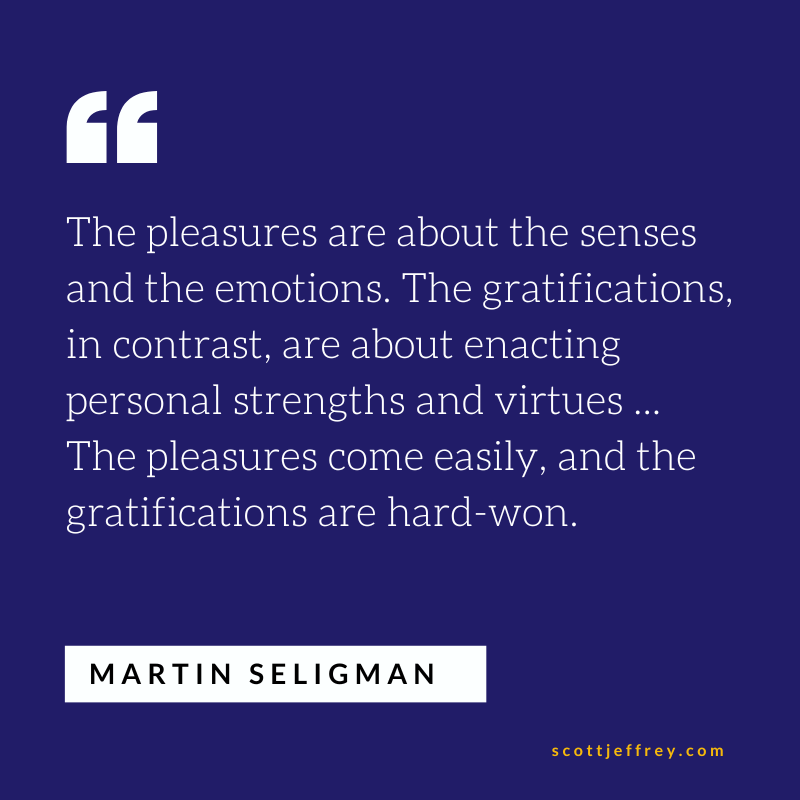
While pleasures engage the senses and evoke emotions, gratifications connect us to a higher part of ourselves: our internal strengths and virtues.
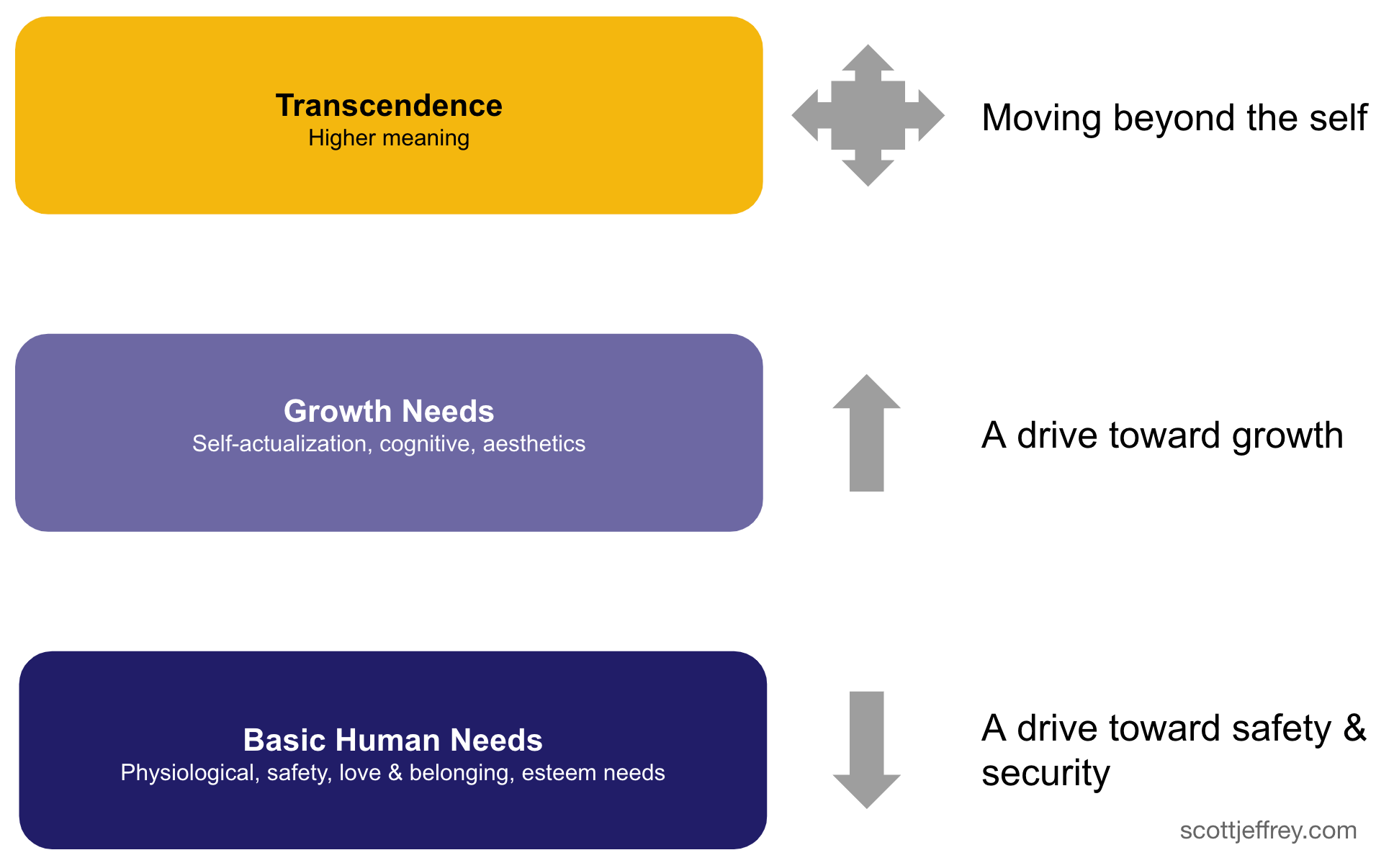
In terms of Maslow’s Hierarchy of Human Needs, pleasures are the satisfaction of our basic human needs, especially biological ones.
Gratifications, in contrast, address higher-level needs, such as cognitive, aesthetic, self-actualization, and self-transcendence.
Why Gratifications Lead to Flow and Peak Experience
This is where Seligman’s research on authentic happiness intersects with Mihaly Csikszentmihalyi’s research on flow and Maslow’s work on peak experiences.
In a state of flow, we generally don’t feel what we classically call “emotions.”
Instead, we are focused; we have a clear goal. Entering a timeless state, we are absorbed in deep, effortless activity. Perhaps most interestingly, our sense of self vanishes.
Gratifications can produce a state of flow, but unlike pleasure, gratifications require skill and effort. Gratifications also offer the possibility of failing.
While pleasures come easily, gratifications from exercising our strengths are hard-won. Is it any wonder we so often seek pleasure instead of focusing on cultivating our strengths?
A further challenge is that there are no shortcuts to gratification. They require effort, practice, and regular exercise of our natural strengths as we move toward self-mastery.
Building these strengths requires a conscious choice and daily micro-decisions: Do you want to acquire them? Do you want to continue cultivating them?
Understanding Character Strengths in Positive Psychology
Martin Seligman and Christopher Peterson distilled 24 character strengths—universal patterns of virtue observed across languages, cultures, and religions.
In Authentic Happiness, Seligman outlines two characteristics of what he calls strengths:
- A strength is a trait, a psychological characteristic that can be seen across different situations and over time.
- A strength is valued in its own right. The strengths represent states we desire that require no further justification.
This second characteristic highlights another important difference between gratifications and pleasures; unlike pleasures, gratifications are undertaken for their own sake, not for any positive emotion they may produce.
When we honor these virtues in daily action, these traits become powerful engines of well‑being.

Seligman’s 24 Character Strengths
Based on his team’s research, Seligman and positive psychology identify 24 measurable, acquirable strengths.
Each strength expresses a facet of what ancient philosophy called virtue ethics: the practice of being, not just doing, good.
The six virtues Seligman and Peterson identified are:
Now, let’s review the 24 character strengths, along with their descriptions.
The Virtues of Wisdom & Knowledge
Wisdom & Knowledge represent cognitive strengths that expand perception and guide sound judgment.
These virtues embody curiosity, learning, and perspective—the mental disciplines that turn raw experience into understanding.
1 – Creativity
Creativity is the urge to generate original ideas or combinations of existing ones. Creativity thrives on curiosity and courage to help bring unseen possibilities into form.
See also: The Four Archetypes of the Creative Process
2 – Curiosity
Curiosity is a sustained openness to new experience. Curiosity dissolves fear by replacing it with wonder, turning uncertainty into discovery. Curiosity is that restless tug to find out what lives behind the next question. Curiosity keeps the mind fresh and dissolves fear of the unknown.
3 – Judgment / Critical Thinking
Judgment is the ability to examine evidence, question assumptions, and arrive at balanced conclusions. Judgment requires us to pause long enough to think for ourselves. It’s weighing evidence until truth feels steady—not loudest. Critical thinking helps protect the mind from biases and transforms information into knowledge.
4 – Love of Learning
The love of learning is akin to the joy of acquiring competence and insight. This strength continually widens one’s perception by linking knowledge to meaning rather than merely accumulating data.
5- Perspective
Perspective is a synthesis of wisdom and empathy—the capacity to view situations through multiple lenses. It helps us convert complexity into understanding and guides sound judgment. Perspective is like wisdom built from seeing the long-distance view and the side-view at once.
The Virtues of Courage
Courageous virtues are emotional strengths that transform fear into purposeful action.
Courageous virtues convert conviction into movement, blending endurance, integrity, and enthusiasm in service of what matters most.
6 – Bravery / Valor
Bravery is the willingness to act despite fear or risk. Bravery manifests when conviction outweighs comfort and integrity precedes safety.
7 – Perseverance
Perseverance is sustained effort in pursuit of worthy goals. Perseverance transforms obstacles into fuel, giving endurance a moral dimension.
8 – Honesty / Integrity
Honesty and integrity are an alignment between words, values, and actions. It’s saying and doing the same thing, even when you’re “off‑camera” and behind closed doors. Integrity is when your outer life doesn’t need a translator for your inner one.
See also: How to Do Shadow Work
9 – Zest
Zest is full engagement and enthusiasm for life. Zest channels physical vitality into purposeful action and contagious optimism.
Humanity-Related Virtues
Humanity virtues represent relational strengths that cultivate empathy and authentic connection.
These traits invite compassion and reciprocity, weaving emotional intelligence into every expression of human interaction.
10 – Love
Love is the capacity to both give and receive care unconditionally. Love integrates the intellect with the heart, while dissolving the illusion of separation. It’s choosing vulnerability over egoic pride, again and again.
11 – Kindness
Kindness is an active regard for the welfare of others without expectation of return. It’s small, quiet actions that restore faith in people. Kindness is generosity without a receipt.
12 – Social Intelligence
Social intelligence is an awareness of emotions—one’s own and others’—and how they influence behavior. It’s sensing the unspoken in a room and responding with tact.
The Virtues of Justice
Justice virtues represent social strengths that sustain fairness, leadership, and cooperation.
Justice‑based virtues transform moral intention into collective integrity, ensuring individual excellence contributes to the greater good.
13 – Teamwork
Teamwork is the ability to collaborate toward shared goals through trust and accountability. It’s a collaboration that multiplies rather than diluting effort.
14 – Fairness
Fairness is the strength of treating everyone according to the same moral standard, independent of bias or self‑interest. It means giving each person a clean slate before judgment. Fairness is justice practiced in daily gestures, not decrees.
15 – Leadership
Leadership is guiding others with vision and empathy while fostering their autonomy. True leadership empowers rather than dominates. The best leaders set rhythm, not rules, and leave others stronger than they found them.
See also: How to Unlock the Visionary Leadership Style
Temperance Virtues
The virtues of Temperance are regulatory strengths that create balance, humility, and self‑control.
Temperance tempers impulse with reflection, allowing forgiveness, prudence, and moderation to stabilize both emotion and conduct.
16 – Forgiveness
Forgiveness is the ability to let go of resentment while retaining wisdom from pain. Forgiveness frees energy once trapped in past injury and redirects it toward growth. It’s releasing someone—often yourself—from a story that’s run too long.
17 – Humility / Modesty
Humility is an accurate self‑appraisal that neither inflates nor diminishes one’s worth. Humility grounds you in gratitude instead of ego. It lets accomplishment speak for itself.
18 – Prudence
Prudence is foresight joined with self‑discipline—the skill of making choices aligned with long‑term values rather than short‑term impulses. It’s choosing the timing as carefully as one’s actions.
19 – Self‑Regulation / Self‑Control
Self-regulation is the inner capacity to manage thoughts, emotions, and behavior in harmony with chosen goals. Regulation keeps one’s passions honest rather than erratic. Self-control is a critical strength for building emotional intelligence.
See also: How to Make Positive Changes that Stick
Transcendence Virtues
Transcendence represents spiritual strengths that elevate meaning, gratitude, and purpose.
Transcendent virtues anchor daily life in a sense of sacredness—reminding us that joy, humor, and faith can turn ordinary moments into a sense of wonder.
20 – Appreciation of Beauty & Excellence
This aesthetic value represents the sensitivity to patterns of truth, grace, and mastery in people or nature. This strength awakens awe and reconnects perception with a sense of reverence.
21 – Gratitude
Gratitude is the conscious recognition of life’s gifts. It’s the quiet inventory at day’s end: what went right, who showed up, how much was already enough. Gratitude restores the present moment.
22 – Hope / Optimism
Hope is the enduring expectation that good outcomes are possible. Hope organizes perception around potential rather than limitation. With optimism, we can consider possibilities without focusing exclusively on difficulties.
23 – Humor / Playfulness
Humor and playfulness are about seeing joy and incongruity amidst daily routine. Humor unites humility with a more expansive perspective. It’s observing the cosmic wink in everyday absurdity. Laughter resets perspective faster than logic ever can.
24 – Spirituality / Faith
Spirituality and faith are a felt connection to something larger than oneself—nature, community, or the divine. Spirituality is a felt sense that life means more than biology or materialism. It’s an acknowledgment of one’s Higher Self.
See also: 3 Essential Stages of Spiritual Growth
Reviewing the above list, do any strengths stand out to you?
For a more detailed description of each of these strengths, see the VIA website.
Discover Your Character Strengths
Do you want to discover your character strengths right now?
You have two options:
- Register for a free account on the University of Pennsylvania Authentic Happiness website and take the VIA Survey of Character Strengths.
- The VIA Institute on Character website also offers the survey.
These are not the same test. The VIA Institute assessment has half as many questions and takes 10 to 15 minutes to complete. The University of Pennsylvania assessment takes approximately 25 minutes to complete.
According to the sites, they are both scientifically validated.
Play to Your Signature Strengths for Authentic Happiness
In Authentic Happiness, Seligman suggests that each of us has a set of core strengths, what he calls signature strengths.
Your signature strengths are the top five strengths from their survey.
Discovering your signature strengths can be an instructive process. It may clarify what you already know about yourself or highlight strengths you aren’t fully conscious of.
It can also suggest where to invest your time best to increase your gratification (i.e., experience more authentic happiness).
But I also found it equally helpful to see what strengths ranked low on my list.
If you tend toward perfectionism or strive to excel in all that you do, you may also find it instructive to see what ranks at the bottom of your strength list.
Although we may aspire to high proficiency in all 24 strengths to master every valued human virtue, the reality of limitations exists.
For me, the experience led to greater self-acceptance of my shortcomings and a renewed interest in developing my actual strengths.
Capitalize on Your Signature Strengths
How does Seligman suggest you increase your level of authentic happiness?
Use your signature strengths every day in the main areas of your work and life.
Once you know your top five signature strengths, take each strength and ask the following:
- Where am I using this strength in my work now?
- What are three to five ways I can use this strength more consciously in my work?
Next, you can answer the same questions about your home life.
According to Seligman, the more effort you invest in developing skills in your strength areas, the more gratification you will experience in the present. (My life experiences confirm Seligman’s assertion.)
Surveying Your Level of Authentic Happiness
Now, pause for a moment. Take a gentle breath and consider: how happy do you feel as you read this?
If you’re not feeling happy, how do you feel about that?
Survey your feelings carefully and be honest. (And if you’re feeling happy, please keep feeling happy.)
We have a cultural bias toward happiness. The prevailing belief is that we’re supposed to be happy most of the time, and when we’re not, something is amiss.
Back to my question: If you aren’t feeling happy as you read this, do you notice any tension in your body?
Do you feel any mental or emotional distress? Not feeling happy is one thing; how we relate to unpleasant feelings is something else.
The tension we often feel is based on an underlying assumption: that we should be happy.
But why? Why should happiness be the aim or ideal in our everyday human experience?
Should We Stop the Pursuit of Authentic Happiness?
Life is filled with difficulties, trials, upsets, and pain. There’s a great deal of suffering within the human experience.
Is it reasonable to expect to be happy most of the time?
By the way, researchers on authentic happiness have found that each of us has a different happiness set point. For example, roughly 25 percent of people are naturally happy; they are born this way. Another 25 percent of people tend toward depression and pessimism.
Could our collective bias toward happiness be an attempt to repress the darker (but equally real) side of life?
Doesn’t suppressing the darkness make our shadow grow stronger?
Could this collective repression help explain why America is one of the most depressed nations in the world?
Might the “pursuit of happiness” be placing our expectations on the wrong thing?
Shift from Pursuing Happiness to Cultivating Contentment
In Spontaneous Happiness, Dr. Andrew Weil suggests that it would serve us to replace the ideal of happiness with contentment.
Contentment is a general feeling of “okayness” with life. With contentment, we can more easily accept what is and be okay with whatever we’re experiencing, positive or negative.
To be clear, I’m not suggesting that we shouldn’t try to find ways to increase our level of pleasure, happiness, and optimism. That’s what this guide is about.
Optimistic people with positive feelings, for example, are 50 percent less likely to have a heart attack or get sick.1Boehm, J. K., & Kubzansky, L. D. (2012). The heart’s content: the association between positive psychological well-being and cardiovascular health. Psychological bulletin, 138(4), 655–691. https://doi.org/10.1037/a0027448
It is also fruitful to improve our emotional states by consciously learning to work with negative and repressed emotions.
Knowing that it’s okay to be down, depressed, anxious, and fearful is important, too.
We reduce our suffering when we accept whatever we are feeling.
To cultivate contentment:
- Accept all moods as transient weather.
- Reflect daily on experiences that evoked gratitude or awe.
- Use setbacks as opportunities to consciously practice your strengths—especially patience, courage, and forgiveness.
Accepting what we’re experiencing also gives us more internal resources to shift into a positive space. It feels more like authentic happiness. That, at least, has been my experience.
See my Emotional Awareness Guide for an exercise that helps you process negative emotions.
Closing Reflection: Following Your Bliss
Finally, let’s end this guide with wise words from the late mythology expert Joseph Campbell from The Power of Myth:
“The way to find out about your happiness is to keep your mind on those moments when you really are happy—not excited, not just thrilled, but deeply happy. This requires a little bit of self-analysis. What is it that makes you happy? Stay with it, no matter what people tell you. This is what I call, ‘following your bliss’.”
Character strengths show you where that bliss resides: in disciplined creativity, ethical courage, sincere love, or patient curiosity.
Cultivate them, and the question of “how to be happy” quietly fades.
What remains is a flowing sense of meaning—the felt sense that life and virtue are one.
Enjoy!
Further Reading: Authentic Happiness
Authentic Happiness: Using the New Positive Psychology to Realize Your Potential for Lasting Fulfillment
by Martin Seligman
Seligman is considered the father of the positive psychology movement. What I appreciate most about this book is that Seligman provides practical methods for increasing one’s happiness, grounded in decades of research in the field.
Seligman demonstrates that lasting fulfillment is found not in fleeting pleasures but in cultivating our natural strengths. Perhaps you’ve heard about the research on the benefits of maintaining a gratitude journal. This book is one of the first I’m aware of that highlights this research.
Read Next
How to Change Your Fixed Mindset (to Growth)
Intrinsic versus Extrinsic Motivation: A Definitive Guide
15 Best Books in Psychology on Human Behavior
Best Carl Jung Books and Best Jungian Books
References
- Boehm, J. K., & Kubzansky, L. D. (2012). The heart’s content: the association between positive psychological well-being and cardiovascular health. Psychological bulletin, 138(4), 655–691. https://doi.org/10.1037/a0027448
- Bryant, F. B., & Veroff, J. (2006). Savoring: A new model of positive experience. Mahwah, NJ: Erlbaum.
- Csikszentmihalyi, M. (1990). Flow: The psychology of optimal experience. New York, NY: Harper & Row.
- Peterson, C., & Seligman, M. E. P. (2004). Character strengths and virtues: A handbook and classification. New York, NY: Oxford University Press.
- Seligman, M. E. P. (2002). Authentic happiness: Using the new positive psychology to realize your potential for lasting fulfillment. New York, NY: Free Press.
- Weil, A. (2011). Spontaneous happiness. New York, NY: Little, Brown and Company.