
Few ideas are as ancient—and as misunderstood—as Chi energy.
The Taoist masters described it as the invisible current linking body, mind, and cosmos.
Modern biophysics now echoes that intuition: beneath every heartbeat and nerve impulse, an electrical rhythm flows that mirrors life itself.
What is Chi energy? Can you experience the feeling of Chi in your body?
Can Chi energy be developed?
In this in‑depth guide, we’ll unpack what Chi truly is, how it moves through meridians, what blocks it, and Taoist‑based ways to restore its natural flow.
Let’s dive in …
What is Chi Energy?
The Chinese word qi (Chinese: 氣) literally means “air” or “breath,” yet its deeper meaning points to a life force energy behind life itself.
Chi energy (Qi) is the body’s life‑sustaining current—a subtle bioelectrical flow that governs movement, metabolism, and conscious awareness.
Taoist texts refer to it as the “thread” connecting spirit and substance (matter). The Chinese have long believed Chi is the fundamental energy that sustains all life.
Physiologically, Chi parallels the body’s microcurrents—nerve impulses, ionic gradients, and electromagnetic communication among cells.
In fact, studies in Frontiers in Physiology show measurable low‑frequency biofields around living tissue, suggesting that ancient insight may describe a real layer of human physiology.1McCraty, R. (2017). New frontiers in heart rate variability and social coherence research: Techniques, technologies, and implications for improving group dynamics and outcomes. Frontiers in Public Health, 5, 290543. https://doi.org/10.3389/fpubh.2017.00267
When practitioners speak of “feeling Chi,” they notice tingling, warmth, subtle internal movement, a gentle magnetic pull, or a pulsing sensation in the lower abdomen during stillness. These are the sensations that reveal life’s current in motion.
At its fundamental level, Chi is electromagnetic information transmitted through the human body and the environment.
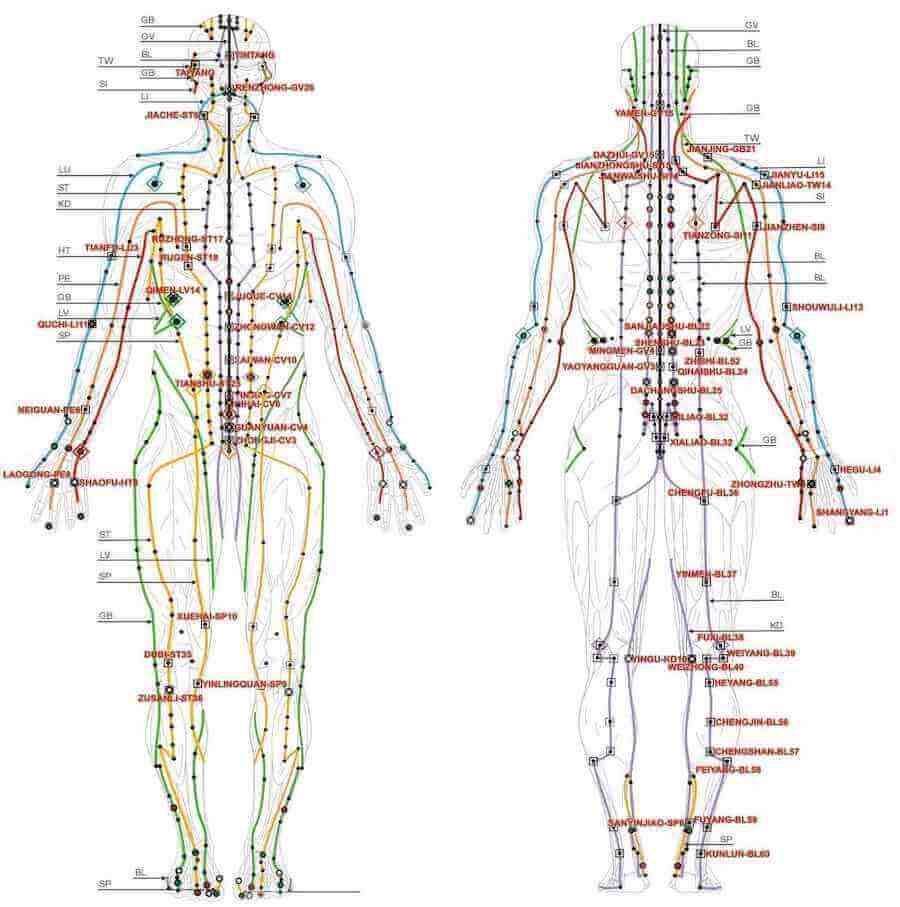
How Chi Circulates Through the Body
Chi moves through a network of energy channels called meridians, connecting organs, tissues, and emotions into one coherent field of communication.
As Dr. Stephen T. Chang explains in The Book of Internal Exercises:2Chang, S. T., & Miller, R. C. (1980). The book of internal exercises (2nd ed.). Strawberry Hill Press.
The meridians are symmetrical and bilateral channels with a diameter ranging between 20 and 50 millicrons. They exist beneath the surface of the skin and have a thin membranous wall which is filled with transparent, colorless fluid.
Taoist science describes twelve primary meridians woven through the body like rivers distributing life force.
The main meridians develop intricate subsidiary branches. The places where these branches reach closest to the skin are classically used as acupuncture target points.
Traditional acupuncture maps them as pathways of balance: when the energetic flow is free, the body thrives; when it is blocked, pain and fatigue arise.
Many centuries ago, Taoist adepts mapped out these vast meridian channels through deep meditation.
Modern Evidence of Chi
If you’re unfamiliar with the concept or experience of Chi energy, it’s natural to question its existence.
When I first started practicing various forms of Qigong and internal martial arts over 15 years ago, I was skeptical. However, as I began to have direct experiences with Chi, my skepticism waned.
Modern imaging, including infrared thermography and bio‑electrical mapping, suggests that the body’s meridian lines follow fascia planes and micro‑circulation paths.3Álvarez‑Prats, D. et al. (2019). Acupuncture points and perforating cutaneous vessels identified using infrared thermography: A cross‑sectional pilot study. Evidence‑Based Complementary and Alternative Medicine, 2019(1), Article 7126439. https://doi.org/10.1155/2019/7126439,4Langevin, H. M., & Yandow, J. A. (2002). Relationship of acupuncture points and meridians to connective tissue planes. Anatomical Record, 269(6), 257–265. https://doi.org/10.1002/ar.10185
Together they form biological “rivers,” moving ions and subtle electrical signals that support communication between tissues and organs.
Research at the HeartMath Institute links this concept to physiological coherence: a state in which heart‑rate variability becomes rhythmically ordered and bio‑electrical communication between organs synchronizes.5McCraty, R. (2017). New frontiers in heart rate variability and social coherence research: Techniques, technologies, and implications for improving group dynamics and outcomes. Frontiers in Public Health, 5, 290543. https://doi.org/10.3389/fpubh.2017.00267
At its core, Chi circulation mirrors what they call psychophysiological coherence—a measurable rhythmic alignment between heart, breath, and brain that supports calm energy and focused awareness.
Perhaps the most compelling evidence comes from numerous documented cases of Chi transmission from qigong masters like Dr. Yan Xin to heal their patients.6Xin, Y. (1994). Secrets and benefits of internal qigong cultivation. China Healthways Institute
There have also been many demonstrations by Chi-cultivation practitioners that defy modern science. (See this brief documentary on a Chi healer’s extraordinary abilities.)
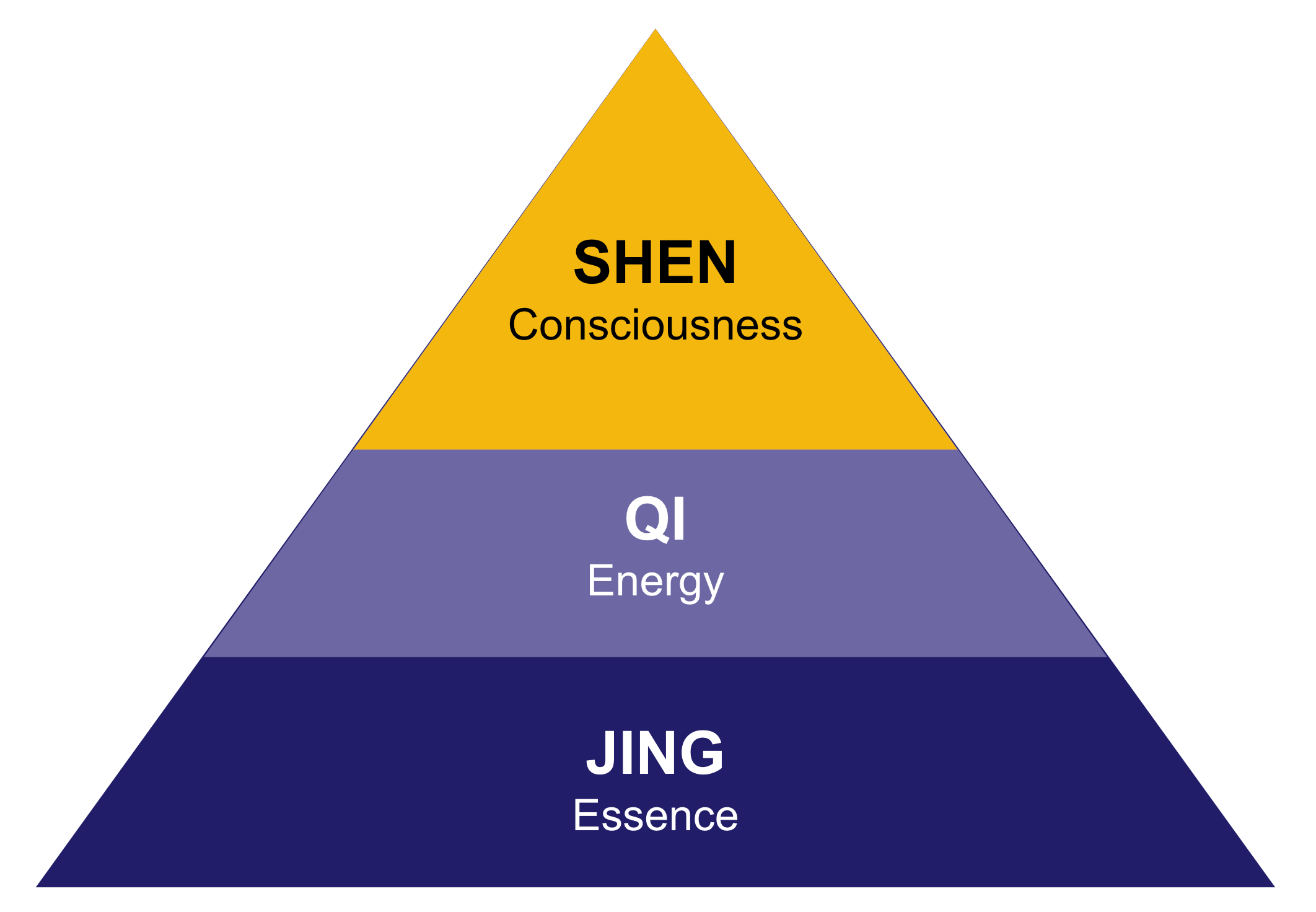
The Three Treasures — Jing, Chi, and Shen
In Taoist philosophy, human vitality is perceived as a spectrum of vibration.
The three treasures are Jing, Chi, and Shen, energetic substances or frequencies that control many aspects of our health, behavior, psyche, and spiritual growth.
Although these three treasures are considered three different substances, they are of the same essence, similar to how water can take the form of gas, liquid, or solid (ice).
Let’s take a closer look at each of the three treasures:
1 – Jing (Essence)
Jing is the lowest vibration of the three treasures.
Many people mistakenly think Jing is synonymous with sexual energy or seminal fluid. While Jing does include this sexual energy, it’s not technically the same thing. (However, excessive sex does deplete one’s Jing.)
Jing most closely translates in English to Life’s Essence.
2 – Chi (Energy)
The Essence (Jing) of the body converts to Chi (or Qi), which most closely translates to energy.
Chi is a higher vibration than Jing, and it transports information throughout the body’s energy system.
The food we eat also converts to Chi energy.
3 – Shen (Spirit)
Shen, the highest or most refined vibration, is the energy of consciousness itself. Many schools of Taoism consider Shen the individual’s Spirit.
In Western integrative psychologies, Shen is akin to the higher self or higher consciousness. Shen manifests as a bright white light, and its frequency is closest to “Heaven.” In its purest expression, Shen is nondual.
Jing, Chi, and Shen — A Modern Correlate
Each “vibration” transforms into the next through breath, nutrition, and intentional practice.
Modern neuroendocrinology offers a parallel: hormones (Jing) drive metabolism (Chi), which in turn alters neural coherence and mood (Shen).
When all three levels are aligned, the entire biofield stabilizes into a state of clarity.
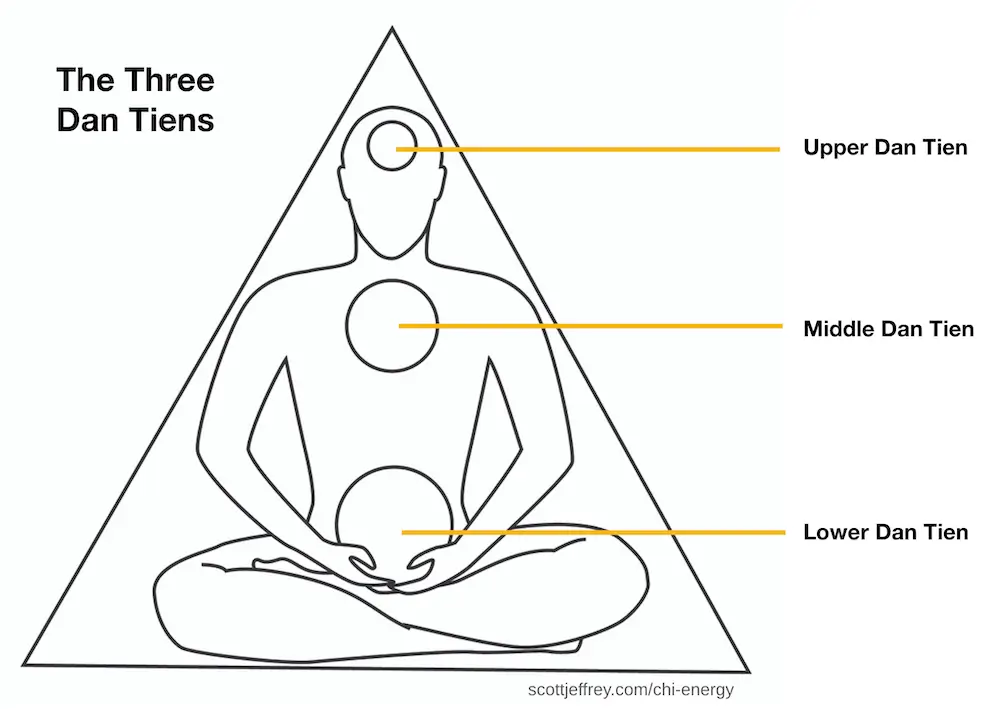
The Three Dan Tiens
In addition to the meridian system and the three treasures, the Taoist internal arts also include the three Dan Tiens.
These Dan Tiens are primary energy centers within the human body, connected by the central branch called the thrusting meridian.
The three substances—Jing, Chi, and Shen—can be transported and converted through internal energy work, such as Nei Gong and Nei Dan practices.
From Damo Mitchell’s Daoist Nei Gong (2011):
Each Dan Tien is a sphere of Qi which is held together within a type of energetic/magnetic field formed from the surrounding meridians. The center point of each Dan Tien is empty and able to fill with Jing, Qi or Shen so that it may be transformed into its next state.
The Lower Dan Tien
The lower Dan Tien is located behind and below the navel and at the midway point within the lower torso. (See instructions below.)
The lower dantien is considered the primary cauldron where the Chi energy is cultivated and distributed throughout the body.
The Middle Dan Tien
The middle Dan Tien is located in the heart region. It connects our energetic body with consciousness.
This energetic sphere relates to our transient emotions.
The Upper Dan Tien
The upper Dan Tien is within the head behind the Yintang point—the third eye region.
Shen is directed to the upper Dan Tien when it moves into the head and then into the “consciousness body.”
The Energetic Mechanics of the Lower Dan Tien
The bioelectric field of the lower Dan Tien is present at birth; however, by puberty, it is dispersed. As a consequence, adults looking to cultivate their Chi need to rebuild this field.
The lower Dan Tien is like a vehicle’s gas tank. If the tank is damaged or filled with holes, it can’t hold fuel. The same goes for the lower Dan Tien.
Yin and Yang of the Lower Energy Center
Everything in the Taoist arts has both yin and yang components.
In this case, the yin represents the form or organizing field of the lower Dan Tien, while the yang represents the energy, substance, or Chi that fills this organizing field.
To cultivate Chi, one must first learn to locate the lower Dan Tien region with breathing and awareness (Yi).
Then, one can begin rebuilding this bioenergetic field. Once this Yin field is rebuilt, Chi can be gathered and cultivated.
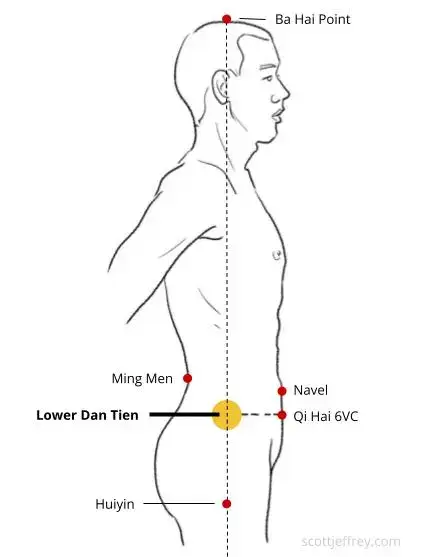
The Location of the Lower Dan Tien
How to Locate the Lower Dan Tien
Anyone interested in cultivating their chi will need to learn how to locate the lower Dan Tien with their minds.
First, place two fingers directly below the navel. Locate the Qi Hai point (REN 6) approximately two-finger thickness below the navel. (If you gently massage this point, it will feel slightly bruised.)
Qi Hai means “sea of qi.” Many practitioners mistakenly think the lower Dan Tien is located here, so this point is also called the false Dan Tien.
Next, constrict your perineum, located between your genitals and the anus. This point is called Huiyin.
Imagine a vertical line going from the perineum up toward the crown of your head (Ba Hai) as illustrated above.
Another horizontal line goes from the Qi Hai toward your back.
In the crosshairs where these two lines intersect is the approximate location of the lower Dan Tien.
When you can sink your awareness into this region and comfortably sustain it, a feeling of heat or a slight pulling sensation will signal that you’re in the correct location.
Benefits of Strong Chi Flow
Qigong master Lam Kam Chuen (1991) explains :
The energy in our bodies is so natural and so spontaneous, we almost never stop to think about it. It is like the constant rhythm of our lungs and the ceaseless circulation of our blood.
When Chi energy flows freely, everything feels connected.
Our breathing naturally deepens, our movement becomes graceful, and our emotions quiet without suppression.
Ancient Taoist teachers said that strong Chi makes life “effortless yet alert.”
In modern terms, it’s when the body’s electrical, chemical, and emotional systems fall into sync—energy circulating with clarity instead of friction.
1 – Physical Vitality
Smooth energy flow keeps your muscles warm, joints supple, and circulation steady.
You feel grounded and alive instead of wired or drained.
Many individuals notice that skin tone improves, digestion steadies, and recovery from fatigue shortens.
These are simple signs that Chi is reaching all areas of the body instead of pooling or stagnating.
2 – Emotional Stability and Focus
When Chi is balanced, emotion moves like weather—passing through, not getting stuck.
The heart feels open but steady. Focus sharpens, yet the mind stays calm.
Small irritations fade more quickly because internal currents stay even rather than spiking or collapsing.
Taoists called this “clarity through still energy.”
3 – Self‑Healing and Longevity
Unblocked Chi activates the body’s natural repair system. Cells renew faster, tension dissolves, sleep deepens.
Over time, this steadiness becomes the true foundation of longevity: energy that restores rather than leaks away.
Taoist philosophy saw this not as magic but as correct maintenance—chi energy circulating instead of scattering.
The body is innately designed to heal itself. When Chi flows freely, this innate self-healing mechanism carries us through life.
What Blocks the Flow of Chi Energy
Even though Chi moves through everyone, most adults experience some degree of stagnation.
As Lam Kam Chuen (1991) explains,
Our bodies are filled with energy, but it is blocked within us. We are born bursting with life, yet we grow old depleted of vitality.
Blockages arise when poor posture, emotional strain, artificial light, or environmental toxins interrupt the body’s natural rhythm.
Taoists compared this to a river slowly clogging with silt: flow weakens not because the river disappears, but because it can’t move freely through the bends.
So what blocks the natural flow of Chi energy within our bodies?
1 – Negative Emotions & Chronic Stress
Notice how newborns and very young children have incredible flexibility.
Most little kids look like they are triple-jointed. But as we grow up, emotionally-induced tension causes us to become rigid and immobile. This rigidity reinforces Chi blockage throughout our bodies.
Fear, resentment, or chronic stress constrict the body. Shoulders tighten, breath shortens, and circulation slows.
Every unexpressed emotion becomes a micro‑blockage that reroutes chi energy.
Over time, these constrictions translate into fatigue, anxiety, or physical pain.
Release begins with awareness—allowing suppressed and repressed emotions to move rather than holding them back.
2 – Physical Inactivity
Hours of sitting, screen light, and shallow breathing dull the body’s electrical rhythm.
Movement generates Chi; stillness without breath drains it.
Digital overstimulation fragments attention, scattering subtle energy across too many inputs.
Additionally, dominant cultural values, such as competition, image, accumulation, material possessions, and a constant striving for higher self-esteem, can block our natural life force energy.
Restoring flow requires cycles of motion, deep rest, and returning to the Self.
3 – Internal Inconsistencies
The Taoist idea of integrity meant alignment on every level—physical, emotional, and moral. When we act out of tune with ourselves, the flow falters.
Dishonesty is another aspect of improper living that influences our Chi. Lying, for example, collapses various acupuncture meridians.
However, a more significant issue is self-deception—being dishonest with oneself.
Self-deception is a sign that we’re divorced from our Self or, as they would say in depth psychology, one’s psyche is split.
These types of psychic splits, reinforced by unconscious behavior, disrupt the natural flow of Chi.
4 – Environmental & Energetic Noise
The human body constantly exchanges charge with its surroundings.
Processed foods, polluted air, “junk light,” fluorinated water, alcohol and drugs, non-native electromagnetic fields, and artificial blue light influence the flow of chi.
The more tuned in you become to your subtle energy field and the movement of chi within your body, the easier it will be to identify and remove these common environmental pollutants.
Clean environments, clean intentions, and truthful living remain the ultimate energy detox.
How to Unblock Chi Energy
When your Chi energy is unblocked, your experience of the body is very different. Most individuals have little awareness of the inner workings of their bodies. Most of us are completely numb in many regions of our bodies.
For example, when there’s no blockage, you can feel virtually every region of your body, including the movement of all your organs. This sensitivity level helps you detect and feel the flow of Chi (which is different from blood flow).
Some of the practices one can explore to help unblock their Chi include:
Let’s examine each one.
Tuning the Breath
As we saw above, Chi energy blockage is primarily caused by unprocessed emotions. When we experience negative emotions, such as fear, for a prolonged period, it can change how we breathe.
As a consequence, to support the free flow of energy within the body, we must train ourselves to breathe properly, allowing the body to become properly oxygenated and relaxed. In Eastern traditions, this is often referred to as “tuning the breath.”
Tuning the breath is less about exerting effort to breathe a certain way. It’s more about learning the principles of natural breathing and then allowing the body to return to this state.
Learn how to breathe properly according to Taoist principles.
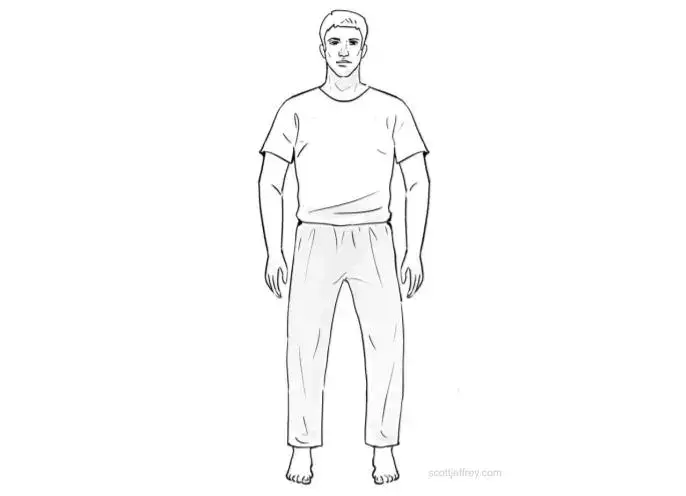
Wuji Standing Posture in Zhan Zhuang
Practicing Qigong
Qigong translates to the way of energy or energy skill. It is said that there are multiple qigong systems, each comprising thousands of exercises (3,600) in the East. Qigong systems encompass a range of exercises, movements, standing postures, forms, and breathing techniques.
Many people are familiar with Tai Chi, an internal martial art form primarily based on the principles of qigong. (Many Tai Chi practitioners also train in qigong.)
One qigong practice that I highly recommend is called Zhan Zhuang, which translates to pole-standing or standing like a tree.
Zhan Zhuang helps you stabilize your energy and learn how to sink your awareness into your body.
Learn how to stand correctly in Zhan Zhuang to unblock your chi.
Trauma-Release Exercises
For many individuals, qigong may not be sufficient for opening their bodies. In my experience, most qigong practices in the West are too gentle. (Gentle or soft qigong is more appropriate for elderly individuals.)
Western approaches to breaking up trauma within the body can be beneficial to many individuals interested in unblocking their Chi.
Dr. David Berceli’s Trauma Release Exercises (TRE) can be highly useful. They are designed to induce spontaneous shaking in the body that helps release trauma stored in the psoas muscle region. (Zhan Zhuang can produce a similar result if you stand for long enough.)
Here’s an introduction to TRE by Berceli.
Another option is Bioenergetic Analysis, pioneered by Dr. Alexander Lowen. This system is also designed to help you release chronic muscular tension through deep stretches, movements, and breathing exercises. (Just search for “bioenergetic analysis.” There’s a lot of information available online.)
Deep Stretching
At the core of methods like TRE and Bioenergetic Analysis are deep stretching systems that target specific body regions where most people have energetic blockage.
Learning how to stretch intentionally and carefully, while breathing deeply and maintaining awareness in a specific area, is a vital skill for releasing stored tension and trauma.
For example, many individuals unconsciously hold tremendous jaw tension, which blocks the flow of chi energy.
Deep stretching and conscious relaxation help you develop greater kinesthetic intelligence or body awareness.
Yoga-style stretches can also be helpful here. The key is to learn to sink your awareness into your body.
All of the above methods offer various stretching routines. Eventually, you can develop your own.
Acupuncture
Another classical approach to releasing energetic blockage in the Eastern arts is acupuncture. This ancient system uses an understanding of the body’s energy meridians to address physical symptoms related to blockages in specific branches.
Early on in my journey, I visited five or six different acupuncturists, including one who’s considered a multi-generational master. My results were marginal at best, but they will vary from individual to individual.
You can also learn to perform “self-acupuncture” without needles, using only your awareness (called Yi). For example, see Damo Mitchell’s Heavenly Streams (2013).
Shadow Work
During childhood, we unconsciously divorce ourselves from various parts of us. Any qualities, attributes, or even emotions that we don’t accept become relegated to what psychiatrist Carl Jung called the shadow.
The psyche is one’s total being, including body, mind, and spirit. When we are cut off from parts of ourselves, it’s a sign of energetic blockage.
Shadow work is the process of getting to know and integrating the disowned parts of ourselves.
Consequently, at a psychic level, shadow work helps unblock long-term stagnant energy.
As we integrate our shadow, a newfound reservoir of energy re-emerges.
How to Cultivate Chi Energy
The original alchemists were Taoist practitioners. These internal alchemists sought methods of cultivating this primal life-force energy within their bodies. They developed numerous pathways for cultivating Chi energy.
The first step is to open one’s energetic channels via a combination of stretching, movements, postures, and breathing techniques.
Methods for cultivating Chi energy include:
- Qigong and Neigong Practices
- Internal Martial Arts
- Virtues Cultivation
- Jing Stabilization
- Seated Meditation
- Conscious Eating
Now, let’s look at each of these options.
Qigong and Neigong Practices
We already covered qigong above. One of the best ways to begin cultivating life force energy is by practicing Zhan Zhuang standing daily.
Neigong is a more advanced set of practices and understanding of Chi. It is specifically focused on cultivating Chi. Below, I provide a few recommended books on this topic.
Internal Martial Arts
Generally speaking, the internal martial arts include three “sister forms”:
- Tai Chi
- Bagua
- Xingyiquan
All three sister forms have interrelated principles and different mechanics for cultivating and moving energy through the body.
Spontaneous movements can also serve the same function for some individuals.
Cultivation of Virtues
The Taoist classic, the Tao Te Ching, translates to “The Book of the Way and Its Virtues.”
Virtues play a central role in Chi energy cultivation within the Taoist arts. (Recall above how self-deception and lying disrupt the flow of Chi.)
As Qigong Master Dr. Yan Xin (1994) explains:
In the cultivation and application of qigong, virtue always plays a technical role that is uniquely central, pivotal, and sustaining. The source of the qi of qigong contains substances and energies based on highly unified matter and spirit. Virtue determines our ability to access this source.
According to Dr. Xin, virtues represent 70% of one’s Qigong energy cultivation.
Jing Stabilization
As we saw above from the Three Treasures, Jing (Life’s Essence) converts to Chi within the body.
Sadly, many of us regularly leak and rapidly destroy our Jing via excitation, over-stimulation, and sexual activity. For men, in particular, sex/ejaculation is the primary way Jing is depleted.
Anyone interested in cultivating their Chi for longevity and long-term health should learn and apply the principles of sexual energy transmutation.
Seated Meditation
Another way to stabilize Jing and cultivate Chi energy is through various forms of seated meditation.
However, meditative practices for energy cultivation are not the same as mindfulness-based meditations or other consciousness-based approaches (like Vipassana).
Cultivating energy through meditation is the focus of many Nei Gong methods, which are employed after establishing a foundation in proper sitting, standing, and movement-based practices. The body must be open before sitting practices can consolidate and circulate one’s Chi.
Corrected seated practice also helps stabilize Jing and calm the Shen (spirit).
Conscious Eating
In addition to the primordial energy we’re born with (also called Yang Qi), the primary way we build energy in our bodies is by converting the energy from food.
Ideally, the food we eat converts into Chi energy. In my experience, learning the principles of energy and how Chi works in the body can significantly alter one’s approach to food and eating habits.
Most people associate eating with pleasure. In effect, most of us eat to “get high” and change our emotional state. For example, eating wheat produces effects akin to morphine.7Heubner, F., Lieberman, K., Rubino, R., & Wall, J. (1984). Demonstration of high opioid‑like activity in isolated peptides from wheat gluten hydrolysates. Peptides, 5(6), 1139–1147. https://doi.org/10.1016/0196-9781(84)90180-3
That is, we use food as a way of self-medicating without being fully conscious of what we’re doing.
However, when we understand the principles of energy and develop sensitivity or body awareness, we start to eat very differently.
From the perspective of the Taoist arts, we are meant to eat mainly for energy conversion—not for pleasure. When we eat for energy, we naturally eat less and become highly selective about what we eat.
Chi Energy FAQ
Now, let’s run through some common chi-related questions.
What does chi feel like?
Most people first notice chi as warmth, tingling, or a subtle magnetic pulling sensation—especially in the hands and lower abdomen during stillness.
Some describe it as a gentle internal current, like water flowing through the body. Others feel heat building in the lower Dan Tien during Zhan Zhuang practice.
The sensation varies, but it’s rarely dramatic at first. It’s more like noticing a quiet hum you’d previously tuned out. With consistent practice, the feeling becomes unmistakable. It can feel like a warm current—thick and much slower-moving than you might expect.
Is chi scientifically proven?
While chi doesn’t fit neatly into a Western lab framework, research is catching up.
Studies using infrared thermography and bioelectrical mapping show that acupuncture meridians align with fascia planes and microcirculatory pathways.
The HeartMath Institute has documented physiological coherence—a measurable rhythmic alignment between heart, breath, and brain. This concept mirrors what Taoists described as a balanced flow of chi. It’s not magic. It’s just a layer of human physiology that mainstream science is only beginning to map.
How long does it take to feel chi?
Some people feel sensations in their first Zhan Zhuang session. For others, it takes weeks of daily practice before anything registers. (I personally felt nothing even after many weeks of practice.)
The variables: how numb you are to your body, how much tension you’re holding, and whether you can sink your awareness below the neck.
People who’ve done yoga or martial arts tend to feel it faster. The key isn’t chasing the sensation—it’s showing up consistently and letting the sensitivity develop on its own.
Can anyone learn to cultivate chi?
Yes. Age, fitness level, and even skepticism don’t matter—chi is already moving through you whether you believe in it or not.
Cultivation is just learning to notice and direct what’s already there. Elderly practitioners do soft qigong. Athletes do more vigorous forms.
If you’re completely sedentary, start with five minutes of conscious breathing. The body knows what to do once you get out of its way.
What’s the difference between chi and prana?
They describe the same underlying reality through different cultural lenses. Chi (Chinese) and prana (Indian) both refer to the vital life force that animates the body.
The frameworks differ—chi moves through meridians and is worked with via qigong and acupuncture; prana moves through nadis and is regulated through pranayama and yoga.
Think of them as two maps of the same territory, drawn by different cartographers.
Is chi the same as kundalini?
No, though they’re related. Kundalini is a specific concentrated energy said to lie dormant at the base of the spine—often depicted as a coiled serpent. Chi is the broader life force circulating throughout the entire body at all times.
Kundalini awakening is a dramatic, often destabilizing event. Chi cultivation is gradual and grounding. Confusing them is like mistaking your entire circulatory system for a single heartbeat.
How do you know if your chi is depleted?
Chronic fatigue that sleep doesn’t fix, brain fog, emotional flatness, and a sense of being “scattered” or ungrounded are the big ones.
You might also notice poor digestion, a weak immune system, or feeling cold when others are comfortable.
From the Taoist perspective, these are signs your Jing (life essence) is being burned faster than it’s being replenished. The fix isn’t more caffeine; instead, it’s conservation, proper breathing, and rebuilding through practice.
Does chi cultivation conflict with Western medicine?
Not at all. Chi practices work alongside conventional treatment, not against it. Think of Western medicine as crisis intervention—it’s good at fixing acute problems.
Chi cultivation is more like preventative maintenance and system optimization. Plenty of practitioners use both.
The real conflict is philosophical, not practical: one views the body as a machine, the other as an energetic system. You don’t have to pick a side.
Integrating Chi into Daily Life
Cultivation means little if it stays confined to practice sessions.
True integration happens in movement, conversation, even in silence. Every ordinary act becomes part of the energy circuit.
Walk with awareness of the feet contacting the ground—miniature earthing sessions built into daily life.
Stretch your spine at the desk, look at real daylight, breathe through transitions instead of rushing.
By leaving brief pauses between tasks, Chi settles rather than scattering.
Alignment also extends to relationships. Speak honestly but calmly; listen fully instead of reloading the next thought.
Each micro‑moment of attention keeps the heart field open and energy continuous.
That’s the real purpose of practice—to carry inner coherence into a chaotic world.
Chi Energy as the Source of Life
Chi is the rhythm behind everything that lives—a current that moves through breath, thought, and intention.
When you cultivate it, you aren’t adding something new; you’re uncovering what’s already alive underneath distraction and fatigue.
Taoist texts described this as “returning to the Origin,” the state where effort dissolves, and life flows of its own accord.
Science now observes similar harmony in balanced nervous systems and synchronized cellular oscillations. In simpler language: you feel clear, strong, and quietly joyful.
Regular practice of breathing, grounding, and self‑honesty keeps this current strong.
When Chi flows freely, vitality is no longer something you chase. Instead, it’s the natural state of a body in truth with itself.
Related Books on Energy Cultivation
(Amazon affiliate links below.)
Daoist Nei Gong: The Philosophical Art of Change
by Damo Mitchell
A Comprehensive Guide to Daoist Nei Gong
by Damo Mitchell
The Way of Energy
by Lam Kam Chuen
Reads Next
The Ultimate List of Spiritual Practices (200+)
Best Earthing Shoes Review: Do Grounding Shoes Really Work?
7 Psychic Vampire Symptoms and How Vampires Perform Psychic Attacks
Masculine and Feminine Energy Explained: Harmonizing the Opposites
References
- Álvarez‑Prats, D., Carvajal‑Fernández, O., Garrido, F. V., Pecos‑Martín, D., García‑Godino, A., Santafé, M. M., & Medina‑Mirapeix, F. (2019). Acupuncture points and perforating cutaneous vessels identified using infrared thermography: A cross‑sectional pilot study. Evidence‑Based Complementary and Alternative Medicine, 2019(1), Article 7126439. https://doi.org/10.1155/2019/7126439
- Chang, S. T., & Miller, R. C. (1980). The book of internal exercises (2nd ed.). Strawberry Hill Press.
- Heubner, F., Lieberman, K., Rubino, R., & Wall, J. (1984). Demonstration of high opioid‑like activity in isolated peptides from wheat gluten hydrolysates. Peptides, 5(6), 1139–1147. https://doi.org/10.1016/0196-9781(84)90180-3
- Lam, K. C. (1991). The way of energy: Mastering the Chinese art of internal strength with Chi Kung exercise. Fireside.
- Langevin, H. M., & Yandow, J. A. (2002). Relationship of acupuncture points and meridians to connective tissue planes. Anatomical Record, 269(6), 257–265. https://doi.org/10.1002/ar.10185
- McCraty, R. (2017). New frontiers in heart rate variability and social coherence research: Techniques, technologies, and implications for improving group dynamics and outcomes. Frontiers in Public Health, 5, 290543. https://doi.org/10.3389/fpubh.2017.00267
- Mitchell, D. (2013) Heavenly Streams: Meridian Theory in Nei Gong. Singing Dragon.
- Mitchell, D. (2011). Daoist nei gong: The philosophical art of change. Singing Dragon.
- Xin, Y. (1994). Secrets and benefits of internal qigong cultivation. China Healthways Institute.
Thank you very much for such valuable information. Greetings from Spain.
You’re most welcome, Rafa!
Dynamo Jack! I wish we could know what his meditation routine is.
Excellent, I lived in China for 10 years, Taiwan for 7 years, and the Mainland for 3 years.
Thanks, Richard. Sounds like you’re spent a great deal of time in the East.
Thanks for making these articles! This is correlating to my current journey/practice of being more body aware and to what Eckhart Tolle talks about in his book “Power of Now” to be more rooted in the body and how that brings many positives for mind and body. Still an on going practice and this article, including your various others like centeredness, helps shed further light and interest. Thanks again Scott!
Sure thing, John. Thank you for your comments.
Many thanks for daring to explore these uncharted areas of spiritual depth.
Thanks its as you say a very important think to cultivate own energy. I been cronically doing various kind of exercise last 20 years. And that is one way too ;))
Muy interesante
There are references given in your writeup. I am interested in #4. Where can I find that ? Thanks
Charlie, are you asking me where you can find that particular book? I suppose you could search online. I don’t know if it’s still in print, but I’m sure you can find a digital version if you do a little digging.