
Emotions shape nearly every decision we make—usually without our noticing.
They whisper behind every preference, every relationship dynamic, every internal storm.
Yet most of us move through life half‑aware of the powerful emotional currents driving us.
Developing emotional awareness brings these patterns into consciousness.
By learning how feelings arise, move through the body, and resolve, we can reclaim authorship over our inner state.
This is not simply about “controlling” emotions, but transforming these raw impulses into conscious energy.
In the in-depth guide, we’ll explore:
- What emotional awareness actually means in psychological terms,
- Why we unconsciously resist unpleasant feelings, and
- Step‑by‑step methods to transmute emotion into balance and insight.
True self‑leadership begins here—by observing the emotions that once ruled from the shadows.
Let’s dive in …
What is Self-Awareness?
Self‑awareness is our ability to observe what’s happening inside us as it unfolds. It helps us notice our thoughts, impulses, and motives in real time before they solidify into action.
When we see why we feel irritated, inspired, or anxious, we can choose our next move rather than being ruled by habit.
Self-awareness is knowing what we’re experiencing while enabling us to monitor and regulate what’s occurring internally. It is the ability to know what we are doing as we do it and understand why we are doing it.
This capacity underpins every school of inner work. In both mindfulness practice and depth psychology, self‑awareness creates the internal feedback loop that connects thought, emotion, and behavior.
As that loop strengthens, perception becomes sharper and our choices more deliberate.
What is Emotional Awareness?
If self‑awareness is seeing, emotional awareness is feeling what we see. It means noticing the sensations and movements that precede emotion, naming what we feel, and understanding how those states affect our body, thoughts, and relationships.
Emotional awareness is the conscious ability to sense, name, and interpret one’s emotions—transforming reactive feeling into responsive understanding. This form of intelligence enables us to regulate our emotional landscape without becoming overwhelmed.
Research in affective neuroscience shows that emotions begin as changes in heart rhythm, breath, and muscle tension long before the mind interprets them as anger, joy, or fear.1Damasio, A. (2003). Looking for Spinoza: Joy, sorrow, and the feeling brain. New York, NY: Harcourt.
By tuning in to those signals, we learn to read emotion as information rather than as a threat.
Without emotional awareness, feelings drive behavior from the shadows; with it, they become a source of energy and insight.
Psychologist Daniel Goleman (2004)—whose research helped define emotional intelligence—describes emotional awareness as the core skill that determines how well we use every other ability.
When we can feel an emotion fully without reacting to it, the nervous system stabilizes. Practices such as breath retraining, centering, and meditation training build this regulation from the inside out.
What Does it Mean to Lack Emotional Awareness?
When we have emotional awareness, we can:
- Accurately perceive our emotional landscape,
- Navigate our emotions with the help of reasoning, and
- Effectively self-regulate our emotions.
If we are not conscious of what we’re feeling, in the language of depth psychology, we are said to be mostly unconscious.
This lack of consciousness leads to psychological projection, internal tension, or compulsive behavior.
People with low emotional awareness often misread situations, overreact to minor stress, or retreat into emotional numbness.
Internally, unrecognized feelings accumulate as pressure in the body—tight shoulders, shallow breathing, digestive unease. This internal tension eventually leads to chronic illness, inflammation, and disease.
How Emotional Disconnection Affects the Body and Mind
Neuroscience research on body awareness (interoception) shows that when the brain’s connection to bodily sensation weakens, emotional clarity declines, and self‑regulation suffers.2Füstös, J., Gramann, K., Herbert, B. M., & Pollatos, O. (2013). On the embodiment of emotion regulation: Interoceptive awareness facilitates reappraisal. Social Cognitive and Affective Neuroscience, 8(8), 911-917. https://doi.org/10.1093/scan/nss089
The result is disconnection—from the body, from self, and from others.
When emotion remains below awareness, reason alone cannot restore equilibrium. The intellect has no access to what it cannot sense.
Restoring connection begins not with thought but with present awareness: slowing down enough to feel what the body already knows. The encouraging fact is that emotional awareness can be developed.
Through attention training, somatic grounding, and reflective practice, even long‑suppressed emotions reveal themselves as readable signals pointing us back toward integration.
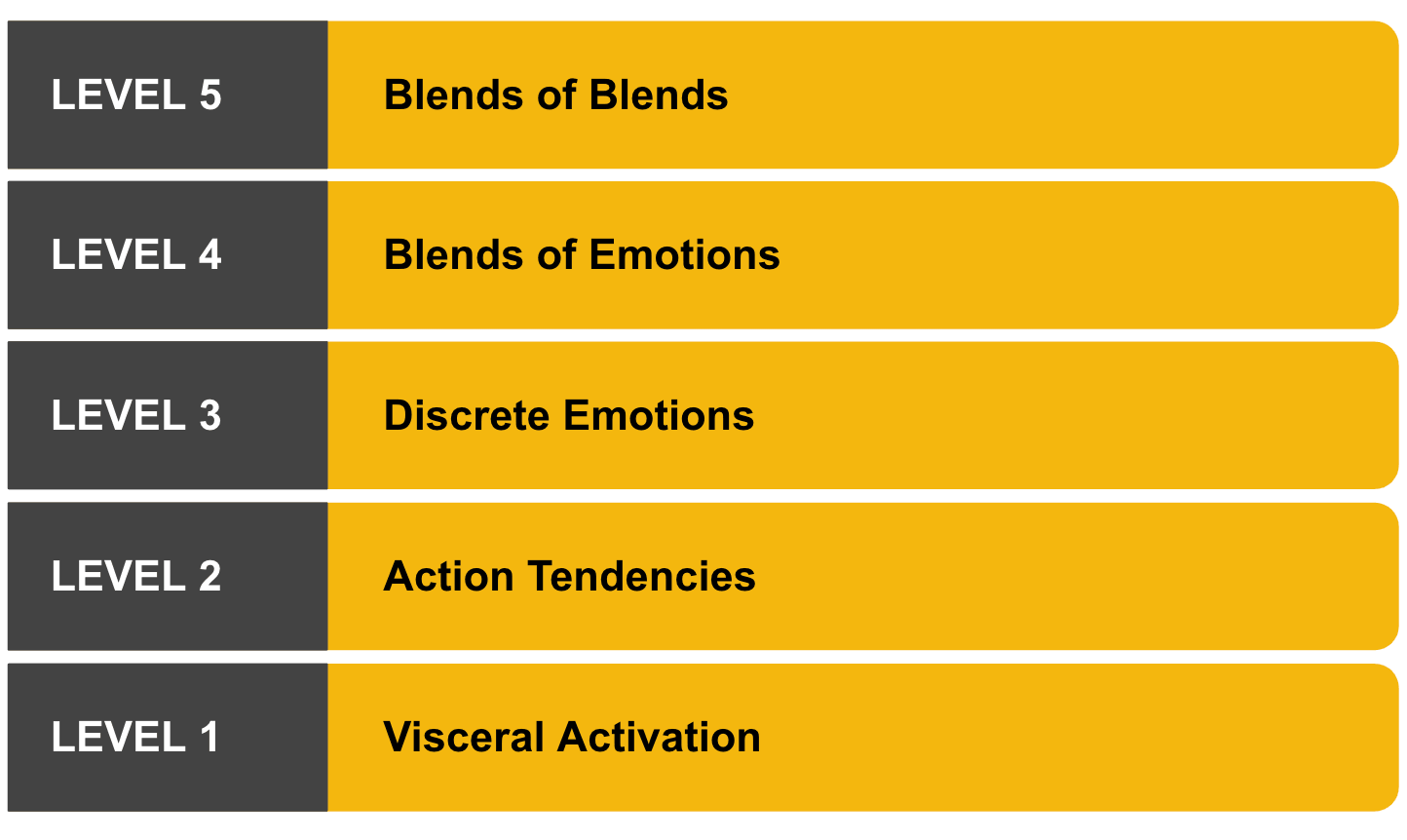 Levels of Emotional Awareness Scale
The Five Levels of Emotional Perception
Emotional awareness isn’t all‑or‑nothing—it develops in stages, like language or cognition.
Psychologist Richard Lane developed the Levels of Emotional Awareness Scale (LEAS) to show how emotional understanding evolves—from raw bodily sensation to refined empathy.3Lane, R. D., & Smith, R. (2021). Levels of Emotional Awareness: Theory and Measurement of a Socio-Emotional Skill. Journal of Intelligence, 9(3), 42. https://doi.org/10.3390/jintelligence9030042
The LEAS is part of a developmental model of emotions based on Swiss psychologist Jean Piaget’s theory of cognitive development. The framework aligns with current neuroscience research demonstrating how body awareness shapes emotion regulation and self‑reflection.
Below is a summary of the five levels:
- Body Sensations: The earliest layer. Emotion registers as physical signals—tightness in the chest, heaviness in the gut—without a specific emotional label.
- Action Tendencies: Feelings translate into impulse: the drive to move toward pleasure or away from pain.
- Individual Feelings: Distinct emotional states like anger, fear, or joy become recognizable and nameable.
- Blends of Feelings: Awareness matures to include complexity; we can feel both sadness and relief, or anger and love, simultaneously.
- Blends of Blends: The highest level: the ability to perceive multilayered emotion in ourselves and others at once—compassion mixed with grief, pride tempered by humility.
Each step up the ladder expands our emotional vocabulary and our capacity for empathy.
As perception refines, the nervous system becomes more balanced; emotions shift from being a disruptive force into an expression of relational intelligence.
In essence, these five levels of emotional awareness represent increasing development in one’s perception of feelings: from more basic (bodily sensations) to complex (multi-dimensional and nuanced states of one’s own and others’ feelings). This distinction will be important later on in this guide.
How Do You Relate to Negative Emotions?
Before learning to develop greater emotional awareness, it is instructive to become more conscious of our general orientation toward emotions.
Our orientation toward negative emotions will significantly affect how we approach them.
Consider your orientation toward negative emotions like anger, fear, grief, and shame:
- Do you get irritated or tense up when you experience these emotions?
- Are you afraid of these feelings?
- Judge these feelings? (e.g., They’re only for weak people.)
- Try to distract yourself?
- Do you believe you’re capable of accepting whatever you’re feeling?
Take a minute to reflect on how you perceive and relate to negative emotions within yourself.
If we view negative emotions as something we shouldn’t have to experience, we will naturally resist them. Resistance increases internal pressure—what we ignore intensifies.
Acceptance, on the other hand, reduces resistance and restores flow through the nervous system. With acceptance of these feelings, we’re more open and curious to work with them.
Also, I find it helpful to remember that we are not our emotions; they reside within us.
The feelings we don’t contain are necessarily “spread” onto those around us.
Emotion as Energy, Not Enemy
Most of us subconsciously develop the habit of trying to control, judge, or avoid our feelings.
That’s understandable—our culture rewards composure over vulnerability—but it also keeps us disconnected from our inner data stream.
Reframing emotion as information changes everything.
Emotion as Energy and Data
In my understanding, emotions are just a form of energy like thought.
There are no “wrong” feelings; emotions are not moral judgments.
Feelings often seem irrational until we understand their source. They are energy patterns carrying meaning.
Body‑based traditions and depth psychology both describe feeling as movement in consciousness—vibrations that reveal where attention is needed.
When we stop labeling feelings as good or bad, we can perceive their actual message: protection, loss, desire, fatigue, longing, or joy.
Acceptance Over Resistance
We either accept the emotion or resist it. Resistance makes the feeling grow stronger within us. Acceptance puts us on a path of resolution.
The body will always complete what the mind resists. In a sense, emotions are simply energy seeking conscious acknowledgment.
Psychological studies consistently show that emotional suppression increases physiological stress while acceptance enhances regulation and cognitive clarity.
When we welcome an uncomfortable emotion rather than fight it, heart rate variability improves, and cortisol levels drop.
In short, we can’t “think our way out” of a feeling (as much as we might try to do so); we have to feel our way through it.
If your general approach to feelings is resistance, turning towards them can feel overwhelming at first. The process may feel raw, but this is exactly how awareness expands.

Before Emotional Awareness: Address What’s in the Way
The body plays a profound role in our ability to apprehend what’s going on inside of us.
As I explained in this Integrated Approach to Self-Awareness, it’s essential to focus on two key areas:
- Address existing trauma that’s stored in the body.
- Learn how to sink your awareness into your body.
Both of these areas are integral to cultivating emotional awareness.
Address Unprocessed Emotion in the Body
Our lack of emotional awareness (numbness) is a result of unprocessed trauma, as Dr. Bessel van der Kolk points out in The Body Keeps the Score.
This early trauma leads to energetic blockage (which causes numbness) and divorces us from our bodies. By addressing this trauma and reforging our connection to the body, our emotional awareness often improves on its own.
The more you sink your awareness into your body, the more present you become. With a deeper presence, more conscious attention goes to your emotional and energetic body.
As you facilitate greater body-mind integration, you can also focus on specific exercises for emotional awareness.
Return to the Body and Slow Down
To avoid embracing our true feelings, we often follow two predictable patterns:
- Distracting ourselves, and
- Moving too quickly.
Both of these patterns are so “normal” that we don’t even think about them. “Well, everyone does that!”
Yet, by staying distracted—for example, constantly checking our devices—and moving too quickly from one thing to the next, we ensure that we don’t pay attention to what’s going on inside of us.
Ultimately, these two “normal habits” are a sly form of avoidance behavior. An essential part of developing emotional awareness is learning to slow down with whatever we’re doing.
Slowing down—literally pausing between tasks—reintroduces micro‑moments where emotion can surface and be recognized.
Then we can become more receptive to internal information (like feelings) that we’re currently repressing.
Reconnect with Your Center
Before we attempt to cultivate emotional awareness, it’s vital to get acquainted with the concept of the Center.
The Center is that at-home feeling within ourselves. When we’re in the Center, we are calm, clear, alert, and neutral. That is, in the Center, the ego isn’t reactive or easily triggered.
The Center is our natural home. Trauma draws us out of the Center early in life. As we address our trauma, there’s a natural movement back toward our inner home.
Learning how to center yourself is a vital step in building emotional awareness because it increases our focus and attention.
Attention is essential for learning, understanding, and developing in any area. The quality of our attention will determine the efficacy of any emotional awareness exercise you use.
Thankfully, we have many practices available to cultivate attention, and many of these methods also help us build emotional awareness.
(For a powerful and simple practice you can use each day to access your Center quickly and consistently, check out The Mastery Method: Activate Your Higher Potential.)
Cultivating the Inner Observer
The key to many forms of meditation is to develop what’s called the inner observer.
Psychologists call this faculty metacognition; mystics call it the witness or observing mind. It’s the fulcrum of emotional awareness—the space between stimulus and response.
Here, we’re not so interested in the content of the mind (thoughts, sensory perception); instead, we want to meditate on the meditator.
The Neuroscience of Observation
Brain‑imaging studies show that activating the medial prefrontal cortex—the reasoning hub just behind the forehead—dampens amygdala reactivity.4Etkin, A. et al. (2006). Resolving emotional conflict: a role for the rostral anterior cingulate cortex in modulating activity in the amygdala. Neuron, 51(6), 871–882. https://doi.org/10.1016/j.neuron.2006.07.029
In practical terms, observing a feeling literally changes how the brain processes it.
Focused attention integrates emotional and rational circuits, allowing us to regulate from awareness rather than suppression.
This aligns with findings in neuroscience research linking the perception of internal sensations to higher emotional intelligence: the more accurately we sense our inner landscape, the better we can navigate it.5Füstös, J. et al. (2013). On the embodiment of emotion regulation: Interoceptive awareness facilitates reappraisal. Social Cognitive and Affective Neuroscience, 8(8), 911-917.
From Observer to Integration
Developing an inner observer doesn’t mean cold detachment—it means being present with experience from a state of neutrality.
By cultivating the inner observer, we create a space between the doer of actions, the thinker of thoughts, and the feeler of feelings.
The observing self can then monitor our thoughts, feelings, actions, and gut reactions with objectivity.
Training the Observer Muscle
Treat the observer like any other muscle: repetition breeds strength. Each time you notice “I’m angry” instead of acting from anger, synaptic wiring shifts slightly toward freedom.
It’s important to understand that most of us don’t have this observing self to a high degree unless we cultivate it through conscious practice.
Without this inner observer, we can’t develop emotional awareness.
Also, remember, early trauma makes the Center elusive; only in the Center does the observing mind come alive.
Meditation, journaling, and breathwork all strengthen this meta‑awareness. If you’re new to meditation, see this in-depth guide on meditation training.
Five Ways We Handle Negative Emotions
Now, let’s examine the various ways we manage negative emotions. We have a variety of options:
1 – Repressing Emotion – The Hidden Pressure
We repress the feelings to the point where we’re not conscious of them. In such cases, we project our emotions onto other people, groups, institutions, or ideas.
Repressing emotions can lead to passive-aggressive and neurotic behavior. It undermines our relationships.
As Dr. John Sarno, Dr. Bessel van der Kolk, and others have demonstrated, repressed emotions, especially rage, are the cause of most chronic pain and many illnesses.
2 – Suppressing Emotion – The Temporary Pause
We can suppress or push down negative emotions. Here, we are aware of the negative emotion to some extent, but we focus most of our attention on something else.
Suppression is sometimes necessary when we’re at work or when someone needs our help. But many of us often use suppression when there’s no immediate demand for our attention.
Many of our compulsive behaviors, impulse control issues, poor habits, and aimless pursuits of pleasure are the result of suppressing negative feelings.
3 – Expressing Emotion – The Release and Risk
When we’re angry, some of us let the world know about it. When we’re sad, we might share our misery with others.
Expressing emotions, when done maturely, can provide moderate, temporary relief. But more often, these emotions are expressed without self-control.
Expressing rage, for instance, often harms our relationships and tends to feed the emotion rather than resolve it.
4 – “Releasing” Emotion – The Illusion of Escape
There are many methods offered in the marketplace for “releasing” emotions, including the Sedona Method, Releasing Technique, Emotional Freedom Technique, and other practices of “letting go” of negative emotions.
These methods all have some therapeutic value when used appropriately. If you have no means of working effectively with negative emotions, any technique is better than none.
I’ve worked extensively with many of these methods with varying results. But I believe they are less valuable than how they are marketed to us.
Here’s why: The goal of these methods is to “remove” the emotion, but in my experience, if we’re not conscious of the source or trigger of the emotion, we can’t “remove” it.
My observation is that these methods trick our minds into believing we’ve “released the emotion” when we’ve just created another way to repress or suppress it. That is, releasing can quickly become a deceptive form of dissociation, in which we separate ourselves from the emotion rather than integrating it.
5 – Transmuting Emotion – The Conscious Approach
A fifth way is a more conscious approach. Here, by developing self-awareness skills, an individual seeks to consciously work with the emotions to process through and unlock the energy they contain.
Instead of being drained by emotions, we build our energy reserves by breaking down the resistance around them. This method isn’t always applicable, but it’s still worth learning.
The Transmutation Practice: A 5-Step Exercise
Here’s a five-step emotional awareness exercise you can use to transmute negative emotions. If used repeatedly, this process can help build emotional awareness.
Step 1: Pause and Find Your Center
The faster we move through life, the less we feel. As we slow down, pausing occasionally, we can “stop and see” what’s going on.
The more you can root yourself in your Center, the more easily and readily emotions will bubble to the surface. With these emotions, you’ll often see images and memories (perhaps from childhood) where you originally experienced these emotions.
Let’s say you’ve done this and you’re aware of a specific negative emotion.
Step 2: Tune in to Your Body
Tune in to the feeling state in your body. What is the feeling state? (Anger, sadness, frustration, fear, grief, depression, or shame.)
Where exactly are you experiencing it in your body? (Head, throat, chest, gut, feet, or multiple locations.)
How does it feel? (Hard, soft, cool, hot, sticky, pulsating, vibrating, or heavy.)
Focus your attention on the physical sensations and the overall feeling. Allow the feelings and sensations to be as they are, welcoming the feelings and embracing them with full awareness.
Step 3: Relax All Judgments
We tend to judge our feelings. I shouldn’t feel like this, we might say to ourselves.
Relax the tendency to judge or react to the emotion. Just be with whatever you’re feeling.
Take full responsibility for the emotions. Notice that the emotional energy is arising within you, instead of happening to you. As long as you hold someone or something else as the source of your emotions (“his actions are making me feel this way”), you’ll have limited resources to process it.
For the moment, relax your relationship with the person or object if the feeling is about someone or something.
Step 4: Allow the Emotional Energy to Flow
Breathe deeply from your belly. Take slow, steady, deep breaths, allowing the emotional energy to flow freely through you.
While consciously breathing, observe how your sensory and emotional experiences change as the emotional energy moves through you.
Continue to pay attention to your emotions in a relaxed, centered space. This alone can be highly insightful for cultivating emotional awareness.
Step 5: Experience the Liberated Emotional Energy
After a while, the raw energy of the emotion is set free. Here, you may observe another negative emotion hidden behind it (“blending”); in this case, go through the process from the beginning.
But often, you’ll experience the unobstructed positive energy (or neutrality) from this transmutation process. You will feel more open, lighter, liberated, and free.
With repetition, this becomes an automatic form of self‑healing.
Daily Practices to Build Emotional Awareness
Putting together everything we discussed above, here are five sets of exercises to improve your emotional awareness:
1 – Shift Your Orientation to Emotion
The first step in developing your emotional awareness is to examine your orientation toward emotions, especially negative ones.
If you often try to avoid paying attention to your feelings, you probably have a mindset that supports this pattern of behavior. Change your mindset, and your orientation towards emotions changes as well.
Emotions are just data. They represent information that informs our life experiences. Review the section above, “Create a New Orientation Toward Emotions.”
2 – Address Stored Tension and Trauma
If you’re feeling emotionally numb, it’s instructive to address your trauma. That is, find ways to unlock the emotional (energetic) blockage within your body.
See this guide for specific exercises on how to release repressed emotions.
3: Improve Your Body-Mind Integration
This step is an ongoing process. The more you bring your awareness (mind) into your body, the more your emotional awareness will come alive.
As you improve your body-mind integration, you will naturally access your emotional field that can inform your actions and decisions, without being ruled by your emotions.
Qigong and yoga are commonly used for this function.
See this guide on self-awareness activities for over 15 different exercises.
4 – Strengthen the Inner Observer
Your ability to stay present with your emotions is a function of how centered you are. When you hold to the Center, you can experience any emotion without being overwhelmed by it.
Refer to this guide on seated meditation postures and how to center yourself for clarity.
But keep in mind that meditation alone will not improve your emotional awareness.
Meditation helps you cultivate attention. That attention must then be focused on your emotional landscape to support the development of emotional awareness.
5 – Practice Conscious Transmutation
The above 5-step emotional awareness exercise offers one method for managing negative emotions.
Remember that emotional awareness is ultimately a skill. Applying this method more frequently will help you begin building this skill.
It’s not a matter of “getting it right” every time. Many people become frustrated when they fail to transform their emotions. However, failure is an integral part of the four stages of learning.
The more you work with this exercise in conjunction with the other principles and methods we discussed above, the more competence you’ll build with emotional awareness.
Over time, the nervous system begins to respond with awareness rather than resistance—true evidence that emotional mastery is forming.
Reading List for Emotional Awareness
These titles deepen the integration of psychology, mindfulness, and self‑regulation explored in this guide:
(Disclaimer: Amazon affiliate links below.)
The Body Keeps the Score by Bessel van der Kolk
Explains how emotions and trauma imprint on the body, offering somatic methods for release and reconnection.
Search Inside Yourself by Chade‑Meng Tan
A mindfulness‑based program linking meditation, neuroscience, and emotional intelligence originally developed at Google.
Emotional Intelligence by Daniel Goleman
The classic that introduced emotional literacy into mainstream psychology and business leadership.
Emotions Revealed by Paul Ekman
A deep dive into micro‑expressions and the universality of emotional signals across cultures.
The Emotional Life of Your Brain by Richard J. Davidson & Sharon Begley
Illustrates how neuroplasticity enables conscious shaping of emotional style through meditation and awareness.
Together, these works offer an integrated education: brain science, contemplative practice, and applied psychology converging toward authentic emotional intelligence.
Read Next
Jungian Synchronicity: Decoding the Psychology of Meaningful Coincidences
Puer Aeternus: A Deep Archetypal Decoding of Peter Pan Syndrome
A Beginner’s Guide to Classic Jungian Archetypes
How to Access the Higher Self: An Integrated Approach
References
- Damasio, A. (2003). Looking for Spinoza: Joy, sorrow, and the feeling brain. New York, NY: Harcourt.
- Davidson, R. J., & Begley, S. (2012). The emotional life of your brain: How its unique patterns affect the way you think, feel, and live—and how you can change them. New York, NY: Hudson Street Press.
- Ekman, P. (2003). Emotions revealed: Recognizing faces and feelings to improve communication and emotional life. New York, NY: Times Books.
- Etkin, A. et al. (2006). Resolving emotional conflict: a role for the rostral anterior cingulate cortex in modulating activity in the amygdala. Neuron, 51(6), 871–882. https://doi.org/10.1016/j.neuron.2006.07.029[
- Füstös, J., Gramann, K., Herbert, B. M., & Pollatos, O. (2013). On the embodiment of emotion regulation: Interoceptive awareness facilitates reappraisal. Social Cognitive and Affective Neuroscience, 8(8), 911-917. https://doi.org/10.1093/scan/nss089
- Goleman, D. (2004). What makes a leader? Harvard Business Review, 82(1), 82–91. https://hbr.org/2004/01/what-makes-a-leader
- Lane, R. D., & Smith, R. (2021). Levels of Emotional Awareness: Theory and Measurement of a Socio-Emotional Skill. Journal of Intelligence, 9(3), 42. https://doi.org/10.3390/jintelligence9030042
- Tan, C.‑M. (2012). Search inside yourself: The unexpected path to achieving success, happiness (and world peace). New York, NY: HarperOne.
- Van der Kolk, B. A. (2014). The body keeps the score: Brain, mind, and body in the healing of trauma. New York, NY: Viking.
amazing post! just on point, thanks a lot
I want to add a method I use all the time that goes under transmuting the negative emotion into a positive one ( just like alchemy ), it is called PEAT ( Primordial Energy Activation and Transcendence ) and is developed by Zivorad Slavinski.
works like magic!
Great resource.