
How well do you know yourself?
Are you introspective?
Can you accurately predict how you’ll behave in a particular scenario?
Are you tuned in to how you’re feeling throughout the day?
Do you reflect on your experiences from events to understand their meaning?
These questions represent various qualities of intrapersonal intelligence—an essential set of abilities for psychological development and internal growth.
Self‑knowledge is the anchor of psychological maturity and meaningful self-leadership.
This comprehensive guide explores the science and practice of intrapersonal intelligence—how it refines self‑awareness, emotional regulation, and intrinsic motivation.
Let’s dive in …
What is Intrapersonal Intelligence?
Intrapersonal intelligence is the capacity to observe, interpret, and guide one’s own mental and emotional life. It’s what allows you to notice what you feel, understand why you feel it, and respond with awareness rather than impulse.
Intrapersonal intelligence is everything that occurs or exists within an individual. Intrapersonal intelligence is marked by the ability to know oneself.
Individuals with intrapersonal intelligence are adept at understanding their own feelings and thoughts. Introspective at their core, they can regulate their emotions and negotiate with their impulses.
Psychologist Howard Gardner identified it as one of eight intelligences in his Frames of Mind (1983). Later research on emotional intelligence shows that internal awareness predicts performance and creativity more reliably than IQ alone.1Goleman, D. (2004). “What Makes a Leader?” Harvard Business Review, 82(1), 82–91. https://hbr.org/2004/01/what-makes-a-leader,2Kahneman, D. (2013). Thinking, Fast and Slow. Farrar, Straus & Giroux.
Self-reflection, self-analysis, and self-observation are key elements to understanding one’s subjective experience.
For practical purposes, intrapersonal intelligence unites emotional awareness, self‑regulation, and intrinsic motivation. Building this capacity deepens your relationship with yourself and stabilizes your psyche through mindful observation.
Why Intrapersonal Intelligence Matters
Your inner world shapes every thought, choice, and relationship you experience.
When you cultivate intrapersonal intelligence, you increase psychological resilience, emotional balance, and the sense of meaning that stabilizes your life.
People with strong self‑awareness generally report higher well‑being and lower stress, according to studies in positive psychology and emotion regulation.3Gross, J. J. (2015). “Emotion Regulation: Current Status and Future Prospects.” Psychological Inquiry, 26(1), 1–26. https://doi.org/10.1080/1047840X.2014.940781,4Barrett L. F. (2017). The theory of constructed emotion: an active inference account of interoception and categorization. Social cognitive and affective neuroscience, 12(1), 1–23. https://doi.org/10.1093/scan/nsw154
In ordinary terms, this means you can recognize emotions before they overflow, make grounded decisions, and act from inner clarity rather than confusion or social pressure.
Over time, this form of intelligence becomes a daily spiritual practice—uniting attention, integrity, and compassion.
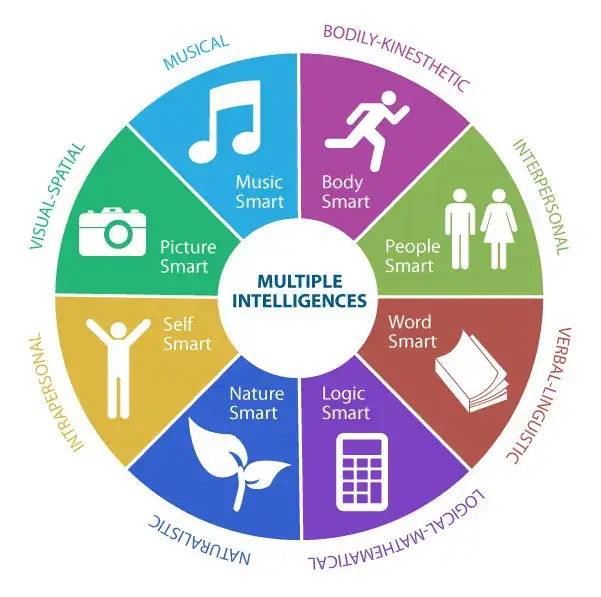 Gardner’s Multiple Intelligences
Intrapersonal vs. Interpersonal Intelligence: What’s the Difference?
Let’s clarify a few definitions to avoid confusion.
Intrapersonal intelligence is the ability to examine, understand, and regulate oneself.
Interpersonal intelligence is the ability to manage social situations.
Intrapersonal intelligence directs one’s attention inward. Intrapersonal communication, for example, is the ability to dialogue with oneself.
In contrast, interpersonal intelligence directs one’s attention outward. Interpersonal communication is the ability to relate to and empathize with others.
Intrapersonal Intelligence vs. Emotional Intelligence
You’re probably familiar with the term emotional intelligence (EI). EI was popularized by psychologist Daniel Goleman’s bestseller Emotional Intelligence (1995).
The five components Goleman outlines for emotional intelligence are:5Daniel Goleman, “What Makes a Leader?” Harvard Business Review, 2004.
- Self-awareness
- Self-regulation
- Empathy
- Social Skills
- Motivation
Self-awareness, self-regulation, and motivation are also defining characteristics of intrapersonal intelligence.
Social skills are part of interpersonal intelligence. Empathy is an aspect of both interpersonal and intrapersonal intelligence because, to empathize, you need to understand your own feelings and be able to read and relate to other people’s emotions.
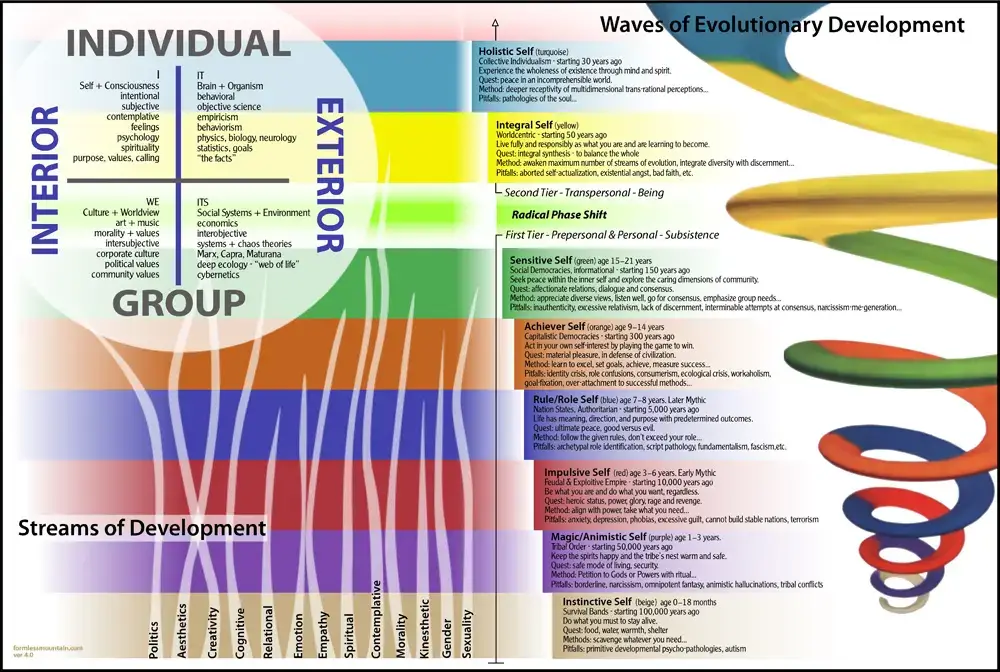
Lines of Development from Ken Wilber’s “AQAL” Integral Map
(source: formlessmountain.com)
Five Intrapersonal Intelligence Examples
Let’s run through a few real-life examples that highlight various aspects of intrapersonal intelligence:
1 – Evaluating Your Accomplishments and Failures
Anyone can set a goal for themselves, and they will either achieve it or fail. However, people with intrapersonal skills are likely to spend time reflecting on their goals, accomplishments, and failures.
- Was it worth my time investment?
- Was the emotional payout worthwhile?
- Would I pursue the same objectives if I knew then what I know now?
- What could I have done differently to avoid setbacks?
- What could I have done differently to make it go smoother?
These types of questions spring to mind for the intrapersonally-minded.
2 – Preparing Ahead of Time
Individuals with intrapersonal communication skills know themselves well. This helps them plan and prepare accordingly.
For example, if they know they have an intense, stressful work meeting the next morning, they will take action in advance.
They will likely ensure they are fully ready the night before. To help them relax, they may block off extra time in the morning to meditate or do breathwork. They’ll also prepare or order a light breakfast that they know won’t upset their stomach.
3 – Reflecting on a Difficult Conversation
In general, those who have developed intrapersonal intelligence are highly reflective. If they have a difficult conversation with their spouse, friend, or co-worker, they are more likely to examine what transpired.
They’ll want to understand what they are feeling and why. If they are doing shadow work, they’ll evaluate if they got emotionally triggered and seek to understand how it happened.
They may replay the conversation in their minds multiple times to gather more information they missed when it happened.
4 – Evaluating Habits and Changing Behaviors
Everyone wrestles with issues of impulse control. Someone with intrapersonal skills is likely hyper-aware of their various tendencies and habits that don’t support them.
They are more likely to analyze their behavioral patterns to understand the sequence of events that lead to unsupportive habits. They are also more effective at negotiating with the various parts of themselves than others.
5 – Pondering the Meaning of Life
The average person observes what others are doing and tries to follow along or conform to their style. For the intrapersonally adept, this is unacceptable behavior.
They want to understand why. Why are people doing this or that? For example, why are we forced to go to school and get conditioned with all sorts of nonsense that don’t serve us at all in later life? Why?
As individuals develop greater levels of intrapersonal intelligence, they often reflect on the meaning of life. Existentialism is often a part of this investigation. They may read the classics from Ancient Greece or study various philosophers, mystics, or religious teachings.
Ultimately, they will not settle for any meaning imposed from the outside. Instead, they will need to discover meaning within themselves.
Intrapersonal Skills for the Workplace
While intrapersonal intelligence is vital for understanding ourselves, it also provides many benefits in our work life.
Examples of intrapersonal skills include:
- Focusing on a task
- Discipline and motivation
- Effective decision making
- Time management
- Giving and receiving feedback
- Emotional resilience
- Brainstorming
- Strategic planning
- Visualization
- Delegation of responsibility
Let’s take a closer look at each example of an intrapersonal skill.
Focus on Important Tasks
As you work toward your results, you can more easily focus on a task and overcome common distractions.
With intrapersonal intelligence, you’re more aware of when you’re overdoing it, when you need to take a break, and when it’s time to “power through.” You’re also more adept at noticing when you’re getting distracted or procrastinating.
Discipline & Motivation to Follow Through
As we covered above, with intrapersonal skills, you understand your true motivations, which is essential for self-regulation. This insight helps raise your standards and drives you toward your end objectives (that you likely clarified initially).
Self-determination theory highlights that rather than being driven by money, our deeper motivations stem from purpose, autonomy, and mastery—all three of which are related to intrapersonal intelligence.6Ryan, R. M., & Deci, E. L. (2000). Self-determination theory and the facilitation of intrinsic motivation, social development, and well-being. American Psychologist, 55(1), 68–78. https://doi.org/10.1037/0003-066X.55.1.68
Effective Decision Making
With greater insight into one’s personality, motivations, and behavior, making effective decisions that lead to positive work results is easier.
Skillful Time Management
While the business world loves the idea of “time management apps” and techniques, the reality is that knowing yourself helps you better gauge how long something will take.
With discipline, you block off time to accomplish the task without needless distractions.
Effective Feedback
Feedback is essential for learning and growth. Effective feedback is a decisive leadership and management skill. Receiving and evaluating feedback from others is also highly beneficial.
Emotional Resilience
It’s difficult to appreciate the profound role emotions play in the workplace. That’s why emotional intelligence is a more critical factor than IQ when it comes to outperforming leadership in business.7Goleman, D. (2004). “What Makes a Leader?” Harvard Business Review, 82(1), 82–91. https://hbr.org/2004/01/what-makes-a-leader
Emotional regulation and resilience are vital intrapersonal skills that benefit us greatly. Are your thoughts and attitudes becoming negative and unproductive? An important intrapersonal skill is identifying and addressing negative thoughts as they arise.
Brainstorming & Idea Generation
Individuals with intrapersonal skills are very comfortable in their minds; they enjoy playing with concepts and generating new ideas.
Under the right conditions, they become a key resource for brainstorming and creative problem-solving sessions.
Strategic Thinking & Planning
How can you make informed decisions that solve complex problems while staying focused on the future? How do you map out plans and strategies for moving forward within your business or organization?
With intrapersonal skills, strategic thinking becomes second nature.
Visualization
Visualization is an intrapersonal skill that builds on several other abilities we highlighted above.
Visualization helps us “begin with the end in mind,” allowing us to focus on our end goals and follow through with greater discipline. Visualization also helps create mental pictures of various scenarios. This helps with brainstorming and strategic planning.
Delegation of Responsibility
Understanding your own strengths and weaknesses helps you observe others’ strengths and weaknesses. This insight is powerful in team dynamics as it helps you delegate responsibility in ways that benefit everyone.
Careers Oriented Toward the Intrapersonal Intelligence
Like each personality type, each expression of intelligence provides a disposition to one form of vocation or another. Instinctively, we all try to find ways to play to our strengths.
Here are some examples of vocations someone with higher intrapersonal intelligence may be attracted to:
- Psychologist / Therapist
- Philosopher / Theorist
- Entrepreneur / Self-employed
- Writer
- Counselor
- Historian
- Theologian
- Coach (Life, Business, or Behavioral)
Individuals with intrapersonal intelligence tend to enjoy solitude, making them more likely to pursue professions that allow for either solo work or collaboration in small teams.
How Intrapersonal Intelligence Influences Personality
Intrapersonal intelligence influences virtually every aspect of one’s personality, including one’s type, motivations, emotions, and archetypal expressions.
Let’s take a closer look at these essential dimensions.
Intrapersonal Intelligence and Personality Types
Why do some people seem to have more intrapersonal intelligence than others?
The answer largely comes down to personality types. In the language of Swiss psychiatrist Carl Jung’s Psychological Types, intuitive thinkers and intuitive feelers have a natural edge with intrapersonal intelligence.
In general, intrapersonal skills also tend to come more naturally to introverted types (as opposed to extroverts). This is because introverts direct their energy inward while extroverts direct their attention outward.
For example, in the Enneagram personality system, Type 5 (Investigator) is intrinsically wired with intrapersonal skills.
Of course, this doesn’t mean that any personality type doesn’t have or can’t develop intrapersonal skills. Again, this “intelligence” encompasses essential cognitive faculties that support healthy psychological development in general.
Intrinsic Motivation and Intrapersonal Skills
One of the greatest benefits of developing intrapersonal skills lies in motivation.
Many don’t realize how much of our behavior is externally driven (i.e., extrinsically motivated).
That is, the average person is driven almost exclusively by social forces:
- What we believe
- What we wear
- Who we associate with
- Where we live
- How we live
- Daily patterns of behavior
- Social media habits
Often, the drive to “fit in” is subconscious. Psychologist Abraham Maslow referred to this drive as the need to belong.
When our behaviors and decisions are shaped solely by observing others, we operate largely through subconscious programming, which the ancient Taoists referred to as mundane conditioning.
Even basic habits the masses adopt—for example, using a mobile phone—are largely driven by external forces.
(In fact, savvy marketers understand the principle of “social proof” and conformity all too well. They use this psychological tension to increase mass adoption of their goods and services.)
As you become more adept at navigating your internal terrain, you shift the locus of control within yourself.
Now, you can evaluate what matters most to you. You become intrinsically motivated and adapt your behavior accordingly. This shift from extrinsic to intrinsic motivation is essential for individuation.
Intrapersonal Intelligence and Your Emotional Life
Intrapersonal intelligence isn’t just about thinking and evaluating; it’s also about navigating your emotional landscape.
Cultivating emotional awareness is an integral aspect of knowing oneself.
When we’re tuned into our emotional field, it’s easier to:
- Enjoy what we do,
- Make effective decisions,
- Understand ourselves, and
- Relate to others.
For example, with decision-making, it’s easy to rationalize any decision. But the reality is that we make decisions from our unconscious and emotional field (subconscious) first; then we rationalize them afterward.8Kahneman, D. (2013). Thinking, Fast and Slow. Farrar, Straus & Giroux.
Intrapersonally skilled individuals are connected to their emotions and can use this “information” to guide their decisions.
Consciously, we often think we like doing something, but unconsciously we resist it.
With intrapersonal intelligence, we can explore the nature of this internal resistance and find ways of resolving these tensions.

The Archetypes of Intrapersonal Intelligence
Another way of illustrating intrapersonal traits is through archetypes.
Archetypes represent set patterns of behavior that exist within what Carl Jung called the collective unconscious. Archetypes are impersonal, universal images, so when we understand an archetypal expression, we can decode its patterns.
For example, here’s a list of archetypes related to intrapersonal intelligence:
Think, for example, of the archetypal philosopher sitting in self-reflection, smoking a pipe.
In J.R.R. Tolkien’s The Lord of the Rings, Gandalf the Wizard embodied the quintessential philosopher-sage archetype.
Gandalf is highly knowledgeable, thoughtful, and introspective.
When he comes into possession of the One Ring, he doesn’t rush to hide it, get rid of it, or destroy it. Instead, he lights up his pipe and sits by the fire in Bilbo’s house for a long time. Thinking. Reflecting. Musing.
The great wizard stayed relatively still as if waiting for the right answer to present itself.
How to Develop Intrapersonal Intelligence
Whether we call it “intelligence” or something else, we’re ultimately talking about developing and cultivating skills.
The skills, in this context, relate to the ability to understand yourself:
- What you think
- What you feel
- What you want
- What you don’t want
- And why.
To gain self-knowledge, we must cultivate self-awareness.
Self-awareness requires two related skills:
- Self-observation: our ability to observe without judgment our thoughts, behaviors, feelings, attitudes, moods, and impulses.
- Self-regulation: our ability to negotiate and manage what we internally observe.
Attention is the key to cultivating skill in any area. By focusing our attention (energy) on something, we can naturally learn through feedback.
Those who possess a high degree of intrapersonal intelligence have, either consciously or instinctively, directed a significant portion of their attention on their inner terrain and learned from repeated experiences.
But anyone can do this. It mainly requires an internal decision that’s reinforced daily.
How to Build Intrapersonal Skills (Beginner)
If you’re early in developing intrapersonal skills, it’s useful to take various assessments, learn about your personality, and then reflect on your life experiences and how you currently perceive yourself.
This process leads to greater self-knowledge. Also, as you pay closer attention to what you learn from these assessments, you’ll naturally improve your intrapersonal skill set.
Here are a few assessments you might explore:
Personality Assessments
Popular personality assessments include the Enneagram, the Myers-Briggs Type Indicator, and Human Design Engineering. Each assessment will reveal different aspects of your personality.
The Enneagram, for instance, highlights your primary desires, fears, strengths, weaknesses, and common behavioral patterns, which you likely exhibit during stress and healthy development.
You can easily find free and paid personality assessments online.
Values Assessment
Individuals with highly developed intrapersonal skills know what they value. (According to Daniel Goleman, knowing one’s values is also part of emotional intelligence.)
Intrapersonally aware individuals know their values and hierarchy of importance. This knowledge helps them make effective decisions and find greater contentment in their work, leading to stronger motivation skills.
Everyone has a different set of core values. Here’s a list of over 270 core values to give you an idea of what’s available. If you want to determine your values, here’s my 7-Step Discovery Assessment you can go through on your own.
Strengths Assessment
Those with intrapersonal skills also know their innate strengths and weaknesses. As with values, knowing your character strengths and blind spots is integral to understanding your personality.
You can take the VIA Character Institute free survey to help determine your strengths and weaknesses.
How to Use These Assessments
The key to using the above assessments for intrapersonal skill-building is to take the insights you gain from them and apply self-observation.
For example:
- Watch yourself expressing your personality type tendencies throughout the day.
- Notice how it feels to live in alignment with your values and strengths.
- Observe what happens when you violate your core values.
Now, here are some other exercises and activities to help promote intrapersonal intelligence.
Spend More Time Alone
Extroverts sometimes lack intrapersonal skills because they draw their energy from others. Introverts, in contrast, draw energy from themselves.9Jung, C. G. (1971). Psychological types (H. G. Baynes, Trans., R. F. C. Hull, Rev.). Princeton University Press. (Original work published 1921)
As a consequence, extroverts frequently have an aversion to being alone. Yet to develop intrapersonal skills, we need to sit with ourselves and draw our attention fully inward.
So do what you can to spend more time in solitude. Go for walks in nature—not as a social activity with others—but to enjoy being alone in the woods. It can be an incredibly instructive and healing experience.
Meditation Practice
Meditation is another quintessential intrapersonal skill-building exercise. With meditation, you sit alone with your thoughts.
Focusing on a 20-minute-a-day meditation practice is not enough. You should also cultivate a more meditative and reflective mindset, observing your thoughts, breathing, and feelings.
If you’re new to this topic, here’s an in-depth meditation training guide for beginners.
Reflective Journalling
Finally, another useful tool for building intrapersonal skills is keeping a journal to record your thoughts, dreams, aspirations, fears, and other aspects of your inner world.
In general, the process of recording your thoughts, feelings, and dreams helps cultivate greater self-reflection.10Blake TK. “Journaling; an active learning technique.” Int J Nurs Educ Scholarsh. 2005. http://dx.doi.org/10.2202/1548-923X.1116
When you’re using a journal, it’s unlikely that you’re going to record what you’re doing in life as you might with a diary. Instead, you’re going to have a kind of dialogue with yourself. Over time, you’ll develop an “inner voice” that you write from.
The key to using a journal in this way is to remain curious about yourself and ask questions about your inner world.
How to Deepen Your Intrapersonal Practice (Advanced)
Exercising your intrapersonal muscles more deeply brings us into the realm of depth psychology and the unconscious.
At one level, the personal unconscious is everything we don’t know about ourselves, often referred to as the Shadow. On another level, the unconscious represents our physical bodies.
Both of these dimensions—the shadow and our bodies—are important if you want to deepen your intrapersonal skills.
In becoming more intimate with your unconscious, you gain access to a wide range of information that is otherwise unavailable to you (hence “unconscious”).
These insights can then inform your:
- Knowledge of yourself
- Understanding your behavior and that of others
- Emotional landscape
- Perception of reality
- Methods of dealing with problems
- Ways of communicating with others
So, how can we forge a stronger connection with our unconscious?
Cognitive Development
For starters, it’s highly instructive to invest time learning from the pioneers and mind voyagers who spent their lives navigating the psyche.
Jung’s body of work is a prime example of this type of inquiry. If you’re new to Jung’s work, see this Beginner’s Guide to Jungian Psychology.
The Jungian community also has many insightful authors. Some of my favorites include Marie-Louise von Franz, Jung’s protege, Esther Harding, and Robert A. Johnson. Johnson’s work is arguably the most accessible to laypeople.
See my picks for the best Jungian books for specific recommendations.

Read Hermann Hesse
If you enjoy reading fiction, author Hermann Hesse’s work is brilliant. Hesse, greatly influenced by Jung’s insights, captures much of their essence in his writings. See, for example, Demian or Siddhartha.
Here’s a small excerpt from Hesse’s classic Siddhartha:
Slower, he walked along in his thoughts and asked himself: “But what is this, what you have sought to learn from teachings and from teachers, and what they, who have taught you much, were still unable to teach you?”
And he found: “It was the self, the purpose and essence of which I sought to learn. It was the self, I wanted to free myself from, which I sought to overcome. But I was not able to overcome it, could only deceive it, could only flee from it, only hide from it. Truly, no thing in this world has kept my thoughts thus busy, as this my very own self, this mystery of me being alive, of me being one and being separated and isolated from all others, of me being Siddhartha! And there is no thing in this world I know less about than about me, about Siddhartha!”
In 150 words, Hesse captures the essence of the intrapersonal life.
Get to Know Your Shadow
I don’t think you can develop any true depth in intrapersonal intelligence without confronting, getting to know, and integrating your shadow.
Again, the shadow is everything we currently don’t know about ourselves. It’s our disowned self that influences virtually everything we do.
In getting to know our shadow, we bring all of our hidden traits, impulses, attitudes, and judgments to consciousness and reconcile with them.
See this in-depth guide to shadow work.
Embrace Your Dream World
Jung used two primary methods of inner work to help his patients understand and heal their psyches.
The primary method was dream analysis. For Jung, our dreams were ultimately our unconscious trying to communicate with our conscious minds. By analyzing his dreams and those of his patients, he was able to cultivate consciousness and heal the divided psyche in many of them.
Thankfully, you don’t need to be a dream symbol expert or go to an analyst to benefit from your dreams. Simply paying more attention to and recording your dreams can be highly instructive—even if you don’t understand their full meaning.
Jung’s other method, active imagination, is an even more practical way of developing intrapersonal intelligence. We’ll discuss it in the intrapersonal communication section below.
Familiarize Yourself with Universal Virtues
While values are integral to developing intrapersonal skills early on, virtues play a more central role later in our development. While values are personal, virtues are universal. They represent the highest moral qualities of our humanity.
Recall from above that the quintessential intrapersonal archetype is the philosopher-sage. The philosopher-sage plays two vital roles: cognitive development and moral refinement. It’s this latter role of moral refinement that brings virtues to the forefront of our consciousness.
Here’s a master list of virtues from the ancient traditions.
What Are the Downsides of Intrapersonal Intelligence?
Individuals with high levels of intrapersonal intelligence risk becoming too inwardly focused. They can get lost in their minds.
At the extreme, they become divorced from any objective reality and are subsumed by their subjective fantasies, entering a state of delusion.
They risk becoming overly intellectual or cerebral at the expense of other lines of intelligence and important areas of focus within one’s life. (For example, this happens when academics are stuck in their ivory towers and divorced from the real world.)
I suspect this is why many educators and laypersons appreciate Gardner’s theory of multiple intelligences: it reminds us that many dimensions of our humanity exist that can benefit from our attention.
Overcoming these potential pitfalls requires full engagement with one’s life, both internal and external.
Also, those with strong intrapersonal skills will benefit from developing stronger body-kinesthetic intelligence.
Using intrapersonal intelligence requires investing mental energy. Too much energy in our heads leads to rumination, anxiety, and burnout.
By developing greater body awareness, we can rebalance this energy into our whole being. One highly beneficial practice in this area is called Zhan Zhuang (an ancient standing method).
Thank you for the comprehensive article Scott.
It appears to me that “intrapersonal” is relevant to a human being’s creative potential in addition to being viewed as an intelligence. Maybe it can be viewed as creative intelligence.
Without this active and operational it seems that an individual cannot easily initiate/navigate individuation which to me seems more like a “phenomenon of meaningful emergence (as understood in systems theory/life systems/complexity theory).
Could it be that as individuals we do not realize how we disregard the importance of the intrapersonal and its nurturance in young children so they can move through successful individuation in later years?
This lack of realizing its relevance leading to the stunted growth of so many people who view it as an intelligence that only a few possess. I will add that from personal experience it is available to some people more easily than others, however I think it needs to be brought into awareness to everyone at an early enough age and built over time for everyone to benefit from it within their lifetime.
Just some reflections on this article.
Thanks for your reflections, Ava.
I think the disregard for the importance of the intrapersonal occurs at a cultural level. Various cultures in the past, for example, honored contemplatives while modern culture certainly does not. I liken this to how we have an absence of ritual elders who are guiding humanity.
We are thrown into an environment that’s purely driven by external factors. So cultivating intrapersonal intelligence is something that can only take place on an individual level.
And yes, certain personality types are differently more naturally wired for introspective and other intrapersonal skills than others.
Very much true. As a parent myself who has the responsibility to guide my child with a hope that she is capable of “individuating”-whatever that would mean for her…the only thing I can do is to help her understand the intrapersonal depth she possesses within her. I can clearly see she doesn’t have as much access to it as myself. At least for now.
I typically do this through conversation whereby I have to help/guide her to notice her internal dialogue that can be quite unproductive (if I simply leave it to her own).
I find it immensely important that parents also see how they impact their children and thwart a potential growth that utilizes their individual creativity within their own lives. This is quite lacking within parents too these days. But, what concerns me when parents themselves have not been paying attention to their own inner workings, it isn’t easy to just start parenting in a way that facilitates that for their children.
It is a complex problem that needs to be addressed at so many levels, all of which focuses on the individual.
Thanks for your efforts in driving this movement forward.
And, very appreciative of your time to respond and share your thoughts.
I completely agree with your statements, Ava.
The challenge is that most parents have children before they have much (if any) consciousness.
Only a small percentage of parents do inner work during their children’s formative years. As a consequence, tremendous psychic damage is done during the first 10 years.
And the cycle of samsara continues to the next generation …
The individual can only break this cycle within themselves.
Thank you Scott for the sharing your views. There are certain aspects of it that I am not in resonance with you. It seems to be more personally oriented and I might land up needlessly entering into objections with you. It could be that our views differ based on personal experience and spiritual /philosophical beliefs.
The point you make about psychic damage done before 10 years of age and the cycle of samsara continuing to the next generation in particular.
The first point is too complicated and debatable.
To a large extent I can agree that unresolved issues and suffering that is deeply held can pass down unprocessed to future generations. It then becomes the opportunity for an individual who can recognize and resolve, bringing an end to that “passing down/inheriting” process through their own conscious actions…which to me is a great act of love, compassion and liberation.
Given each person’s life experience, understanding among many other things is so unique can account for our perceptual differences.
Thanks again for sharing your thoughts.
By your comments, Ava, you seem to be echoing exactly what I said above …