
OVERVIEW: Wu Wei (無為) means “non‑forcing.” It is the Taoist art of effortless action—acting in rhythm with nature rather than against it.
______________
We are told to “live with passion”—to invest every ounce of energy into our work, relationships, interests, and goals.
Yet, passion, when pursued as a constant high, can burn through our vitality.
Rumination, continuous cycles of negative emotions, and other internal tensions do the same: they drain our energy. The ancients called it “leakage.”
The Taoists observed that true beingness emerges when one is aligned with the natural way.
The principle of Wu Wei represents this naturalness—a steady center within us where energy flows without friction.
Let’s dive in …
Should We Live With Passion?
Wu Wei translates to non-doing, non-action, and non-governing. But it’s better understood as non-striving or non-straining.
To better understand the nature of Wu Wei, let’s first examine the concept of passion.
I became obsessed with Tony Robbins’ seminars and audio programs in the early 1990s.
He ended each session by saying, “Live with passion!”
Many of us seek passion in our work, relationships (romance), and life itself. Being passionate is considered a sign of success for many of us.
The long-term effects of seeking passion, if you pay close attention, however, aren’t too impressive.
Seeking passion in a relationship can lead to extreme highs and lows, resulting in breakups and divorce. Passion in our work often leads to burnout.
Pursuing passions in life itself can paradoxically lead us to a state of prevailing mundaneness and meaninglessness over time.
Why? What’s going on here? And what’s the alternative to passion that can provide us with what we’re looking for?
Passion as a Mental Construct
Passion is a lot like excitement. When we’re starting as young adults, we might expect to be excited about our work and family life.
While we might have both passion and excitement when we start a new job or a new business venture, these feelings don’t last.
Our emotions often swing to the opposite pole over time. The result is that we become disinterested, uninspired, or even depressed.
The same goes for relationships: we might be passionate and excited about our partner in the early stages, but that passion is short-lived.
It all comes down to a belief—a basic program running in our mental operating system.
The program says, “You’re supposed to live with passion, so be excited about life.”
This program isn’t running in everyone’s mind, however. Certain cultures have it more than others. It seems most pervasive in Western culture, largely driven by the media (Hollywood).
How the Passion Program Gets Installed
Unknowingly, our parents installed this program when we were infants.
They get us excited about eating certain foods, going on a trip, or receiving presents on birthdays and holidays.
Parents often assume that when their children are excited, they’re doing a good job. It’s considered “normal.”
They don’t realize they are installing a program in the child’s brain that leads to a drive for stimulation and unnecessary suffering. (After all, the same program was installed early when they were kids.)
If you believe you’re supposed to feel passion and excitement about your work and relationships, what happens when those feelings aren’t sustained? What happens when these feelings dwindle and fade away?
You’ll feel like something’s wrong. Discontent will rise. You may try to rekindle your passion. It might even work temporarily, but eventually, this newfound motivation fades.
The problem, however, isn’t the loss of passion and excitement.
The issue is that we believe these feelings are necessary and desirable in the first place.

Hidden Behind the Drive for Passion and Excitement
From my observations, the core reason we seek passion and excitement is fear. This fear lies largely beyond our awareness; we are mostly unconscious of it.
However, this fear influences our behaviors, actions, decisions, and worldviews.
Let’s examine this fear more closely. By bringing this fear to our awareness, its hold on us can loosen and begin to dissolve.
Then, the principle of Wu Wei can take center stage.
The fear behind passion and excitement has at least three dimensions:
1 – Fear of Boredom
Our brains seem to crave stimulation.
Thanks to television, the Internet, junk food, intensely sweetened foods and beverages, and video games, today’s children have become accustomed to a constant stream of stimulation as their brains form.
Today, over-stimulation has been normalized. It’s as if we’re all adrenaline junkies now, and we don’t even notice it.
It’s considered “normal” to glance down at your mobile device 100+ times per day. For instance, in the United States, Americans check their phones 186 times a day.1Wheelwright, T. (2025, January 1). Cell phone usage stats 2026. Reviews.org.
The challenge is that instead of appeasing our desires, stimulation increases our appetite for them.
Once constant stimulation becomes our set point, we feel bored and disinterested without it— like coming down from a “high.” And we all have an aversion to feeling this boredom.
Ultimately, the problem here is that we haven’t learned how to settle and stabilize our internal energy.
2 – Fear of Laziness
Many people are terrified of their propensity for laziness. We know how easy it is to lose our motivation.
If we don’t have passion or excitement, we fear our lazy side will dominate us.
Then, we will lose our drive to work and “be productive.”
The problem here is that we haven’t learned how to make friends with laziness.
3 – Fear of Meaninglessness
This existential fear is deeply rooted within our psyche. Some people can easily connect with this fear, but for most of us, it is repressed in our unconscious.
Due to this deeply-rooted fear that our lives have no meaning, a lack of excitement can trigger a sense of inner angst, apathy, despair, and existential depression. (It’s the “Dark Night of the Soul” looming in the background.)
Most people will do anything to avoid these feelings.
Often, the problem is that we have aborted self-actualization and stepped off our growth path.
The Polar Opposites of Passion
These three fears of boredom, laziness, and meaninglessness drive us to seek passion, excitement, success, and even happiness, without end.
Seeking one end of the spectrum while running away from the other doesn’t bring contentment, peace, or even okayness. Instead, it leads to self-inflicted suffering.
So what’s an alternative approach?
Understanding Wu Wei (The Taoist Middle Way)
In contrast to “seeking passion,” we have the Taoist principle of Wu Wei.
Wu Wei translates literally as non‑doing or non-action, but it doesn’t mean inaction. It means non‑strain—acting in alignment with what the situation calls for.
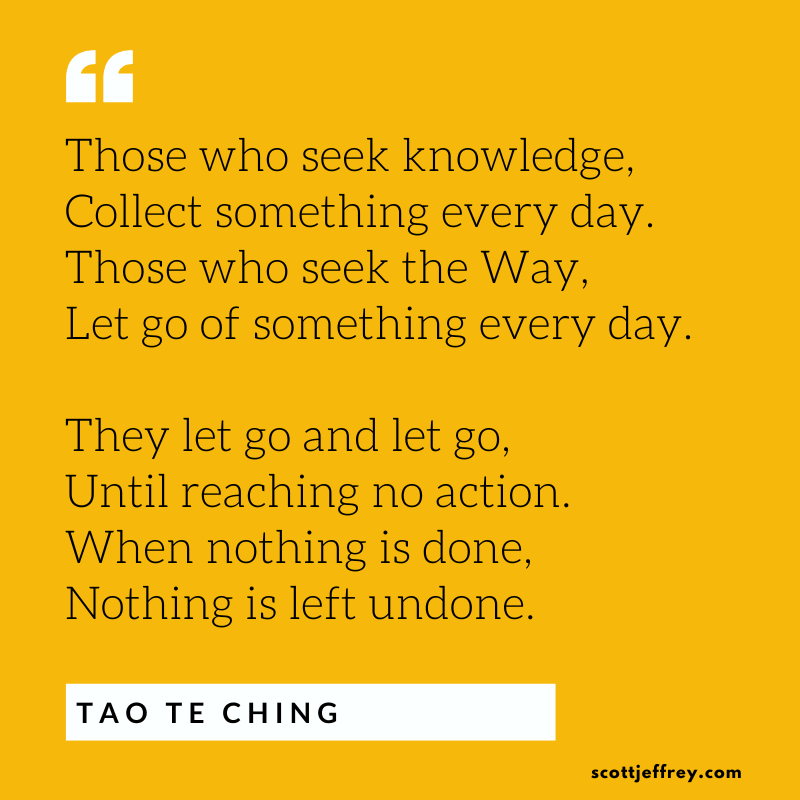
From the Tao Te Ching:
Those who seek knowledge,
Collect something every day.
Those who seek the Way,
Let go of something every day.They let go and let go,
Until reaching no action.
When nothing is done,
Nothing is left undone.
“Nothing is left undone” when we stop forcing outcomes, when we stop exerting needless effort.
Wu Wei is acting with natural momentum—effortless because beingness and environment move as one.
“Non-action” can be a misleading interpretation. As Eastern translator Thomas Cleary (1991) explains, Wu Wei is purposeful action without striving.
Balanced living isn’t passive; it’s supremely responsive. Wu Wei refines skill until discipline becomes grace—the hallmark of self‑mastery.
Moderation: The Alternative to Passion
Modern people aren’t the first ones to wrestle with passion, excitement, stimulation, and their opposites.
In antiquity, great thinkers like Aristotle (“Golden Mean”) and Confucius sought to define the “Good life.”
Four cardinal virtues arose across ancient Greece, Rome, India, and China:
- Justice
- Courage
- Wisdom
- Moderation
While these four virtues are interconnected, the solution to the passion problem is moderation.
The virtue of moderation means doing nothing in excess; nothing carried to extremes; nothing pushed so far that it becomes harmful to ourselves or others.
Wu Wei and the Middle Way
The Buddhist correlate to the Taoist principle of Wu Wei is called the Middle Way, or the Middle Path.
In the Dhammacakkappavattana Sutta, considered the Buddha’s first teaching after his awakening, he describes the Noble Eightfold Path.
This Noble Eightfold Path is considered the Middle Way.
In the Middle Way, we aren’t pulled by attraction or pushed by aversion. We avoid the extremes of sensual indulgence and self-punishment.
We avoid excessiveness and scarcity. We operate from the virtue of moderation.

The Middle Way
The Archetypes of Extremes
In the language of archetypes, the Wu Wei and the Middle Way represent the center between two archetypal forces:
- The Hedonist is in a continuous pursuit of pleasure, indulgence, excitement, and stimulation.
- The Masochist is in constant need of pain, punishment, overexertion, and burning out.
These archetypal forces are within the collective unconscious. That is, they reside within each of us.
By holding to the Middle Way, we avoid going to extremes and activating these behavioral patterns.
From Extremes to Equilibrium
We most often live between two poles: overdrive and apathy. Both of these poles waste energy.
Wu Wei points toward an equilibrium that regulates the nervous system and restores internal balance.
Rather than fighting emotion or chasing stimulation, we begin by observing ourselves—balancing yin and yang within our daily behavior.
Instead of alternating between intensity and apathy, we find steadiness in the Middle. We learn to gently direct our vitality—what the Taoists call Jing—without tension or unnecessary effort.
Psychological Parallels: Flow, Self‑Regulation, and Mastery
Flow states are the Western cousin of Wu Wei. In both, self‑conscious effort disappears, and action unfolds with precision, ease, and spontaneity.
When mind and movement synchronize, the ego’s interference dissolves—this is the essence of self‑regulation.
Wu Wei also translates as non-governing. In this state, the ego takes a backseat, allowing the creative spontaneity of the Self to shine forth.
Scientists describe it as a temporary quieting of the brain’s over‑analytic centers.2Dietrich A. Functional neuroanatomy of altered states of consciousness: the transient hypofrontality hypothesis. Conscious Cogn. 2003 Jun;12(2):231-56. https://doi.org/10.1016/s1053-8100(02)00046-6
The takeaway: Instead of being lost to internal friction, energy’s directed toward awareness, creativity, and mastery.
Addressing Underlying Fears First
How do you overcome the conditioning belief in passion as a way of life?
First, we need to accept the fears outlined above that drive us to seek passion in the first place. Otherwise, our prior conditioning will continue to assert itself.
Overcoming Boredom
Is boredom so horrible?
When was the last time you allowed yourself to be completely bored?
If you go through the initial discomfort, you’ll discover a sense of contentment most people rarely experience.
Accepting Laziness
Many of us avoid laziness, too. Do you ever allow yourself to be lazy without any shame or guilt?
If you’re committed to personal development, it’s not usually an easy task.
Parents, teachers, and the entire self-improvement industry have shamed our lazy part.
But it’s just a part of us. If you repress, suppress, or fight it, this laziness will fester inside you and grow. If you allow it to be, it will let go.
Embracing Meaninglessness
Our fear of meaninglessness is rooted in a reality that existential philosophers like Friedrich Nietzsche articulated over a century ago.
To summarize: Despite our varied attempts to find a grand universal meaning in mythology, there is NO grand universal meaning. We have infinite choices, and none of these options mean anything on the grand scale.
Instead, as humanistic psychology articulated, we can create personal meaning. From their perspective, meaninglessness is only a problem if you perceive it to be one.
Similar to the fear of boredom or laziness, experiencing a sense of meaninglessness and angst is simply a part of psychological development. It’s often experienced as a “mid-life crisis” or “existential crisis.”
It too shall pass. The fastest route beyond this is arguably to reconnect with the Self.

Applying Wu Wei in Modern Life
Visualize a continuum with boredom/laziness at the far left and passion/excitement at the far right (see above).
What’s in the middle?
Moderation and steadiness are the antidotes to passion.
Neuroscience shows that chronic arousal overactivates dopamine pathways and erodes sustained focus—explaining modern burnout.3Ashby, F. G., Isen, A. M., & Turken, A. U. (1999). A neuropsychological theory of positive affect and its influence on cognition. Psychological Review, 106(3), 529–550. https://doi.org/10.1037/0033-295X.106.3.529
In contrast, the principle of Wu Wei inspires a calm alertness and steadiness, encouraging us to conserve energy rather than squander it.
Neutrality: The Power of Calm Focus
Moderation allows you to abide in the Center each day without needing a “high” to keep you going.
The Center is a fundamental principle in Taoist philosophy.
In the Center, you aren’t passionate or excited, fearful or bored.
Instead, you’re neutral, calm, alert, and clear. You are active and ready, not anxious or hyper.
Because we are accustomed to toggling between apathy and adrenaline, neutrality is often mistaken for a negative quality. It can be mistakenly associated with listlessness, deadness, or voidness.
However, neutrality is what allows spontaneity rather than contrivance. Neutrality enables us to conserve our energy instead of “leaking” it through passion or stagnation (apathy).
Neutrality is an alert stillness. From this neutral space, you can achieve virtually anything, slowly and incrementally, without over-exertion. Each movement becomes deliberate.
Behavioral research now calls this optimal arousal—the sweet spot for learning and creativity.4Gustafsson, E., Ibáñez de Aldecoa, P., & Burdett, E. R. R. (2024). A shared “optimal-level of arousal”: Seeking basis for creativity and curiosity. Behavioral and Brain Sciences, 47, e100. doi:10.1017/S0140525X23003552
Should You “Kill” Your Passion?
If Wu Wei is the antidote to the inherent problems of passion, does this mean you should try to kill your passions?
Of course not. When passion arises, ride it like a wave.
Just know that it’s fleeting; don’t expect it to last.
This way, when the wave dissipates, you’re not left out at sea without fuel in your engine.
If you place your awareness on what you’re doing at the moment—holding to the Center—you may discover that you don’t need or even want passion.
Wu Wei Supports Self-Cultivation
The main problem with passion is that it causes us to leak our energy. It can lead to Jing depletion, a loss of life essence.
Stagnating our energy via apathy or depression is equally problematic.
Both approaches will reduce our vitality over time.
But by staying in the Center and abiding by the principle of Wu Wei, we preserve our internal vitality.
With steadiness, we can maintain our focus and attention for far longer.
This focus and attention can be applied to something external (professional or personal) or internal (inner work, contemplation, etc.). That’s up to you.
Pay closer attention to what’s going on, inside and out. Notice what happens to your vitality when you’re engaged in stimulation (especially how you feel afterward).
Then, contrast this experience with how you feel when you stay steady within yourself.
That’s how you can begin cultivating a sustainable source of fuel within you.
Cultivating the State of Non‑Forcing
Wu Wei isn’t about doing nothing or avoiding things. Instead, the principle of Wu Wei is about naturalness.
In a state of Wu Wei, one remains empty so that the ego isn’t exerting itself (depleting energy or chi).
When the ego exerts itself by “trying,” it does something unnatural, which invariably leads to tension.
We’re all accustomed to internal tensions. One way or another, most of us are battling with ourselves every day.
Without internal tensions, for example, shadow work happens naturally; the bridge between the conscious and unconscious mind naturally forms.
Without tension, we go through the four stages of learning any skill without resistance. “Practice” in this context takes on a life of its own.
While in the state of Wu Wei, we forgo the internal battles by entering a state of allowing. It’s a powerful principle that anyone can benefit from.
Moving at 70 Percent: The Qigong Principle
Did you ever hear that you should give 110% of your effort? From the perspective of Wu Wei, this is perceived as a malaligned concept.
You can’t give 110% without depleting yourself rapidly. It’s unsustainable and destructive to our biology and mental energy reserves.
In Qigong, an ancient system for cultivating energy in the body, they teach the principle of moderation.
Some instructors suggest performing various exercises at 70% of your capacity.
Why? Because overexertion creates internal tension. It causes the ego to revolt, pushing your biology out of equilibrium.
Exercising at 70% enables you to focus and make purposeful movements without needlessly tensing your muscles, allowing the energy to flow.
This principle enables Qigong practitioners to maintain their health into old age without burnout, disease, or physical pain.
For inspiration, check out this two-minute video of a 118-year-old grandmaster performing an internal martial art called Bagua:
So consider:
How can you apply the principle of moderation to your life, work, relationships, and internal practices right now?
Read Next
A Complete Guide to Jungian Synchronicity
Do Earthing Sheets Improve Your Sleep?
Feminine Energy and Masculine Energy Explained
References
- Ashby, F. G., Isen, A. M., & Turken, A. U. (1999). A neuropsychological theory of positive affect and its influence on cognition. Psychological Review, 106(3), 529–550. https://doi.org/10.1037/0033-295X.106.3.529
- Cleary, T. (1991). The Secret of the Golden Flower. HarperOne.
- Dietrich A. Functional neuroanatomy of altered states of consciousness: the transient hypofrontality hypothesis. Conscious Cogn. 2003 Jun;12(2):231-56. https://doi.org/10.1016/s1053-8100(02)00046-6
- Gustafsson, E., Ibáñez de Aldecoa, P., & Burdett, E. R. R. (2024). A shared “optimal-level of arousal”: Seeking basis for creativity and curiosity. Behavioral and Brain Sciences, 47, e100. doi:10.1017/S0140525X23003552
- Stennudd, S. (2015) Tao Te Ching: The Taoism of Lao Tzu Explained. CreateSpace.
- Wheelwright, T. (2025, January 1). Cell phone usage stats 2026. Reviews.org.
To keep things in perspective, I can say no to overtime, schedule time for all my interests (not just my passion), and keep a running list of what I’m grateful for (for when passion subsides or times I don’t seem to be making progress).
Yes, Justin, those are all things you can do. The question is: when the passion subsides, can you genuinely *feel* grateful? That’s the real trick.
Dear Scott,
I wrote to you, time ago about this matter.We are all fishermen in a boat. Our passions start like a breeze and can end in storms, that’s what it’s all about. The word “passion” implies pain and suffering in its terminology. Pain we cannot avoid, it is part of life. I think that the way to “moderate” the passions is missing in your considerations and this is only possible knowing who, what we are. It is interesting to know other solutions, mystical, unknown, thank you very much for spreading them. The solution is in us, in what we know, in what they preach to us only if we have the structure to analyze what is correct. That is what is missing in our world. And the solution that I found was because of living a great passion.
Thank you!
Sir pl help unable to down load your article
Vijay k jain
I love it!
You really described everything that has been moving inside me in clear, still moments lately. The word gentle has been coming to me all the time. When I feel myself speed up and try to “get somewhere”, I hear my soul whispering “gentle”.
I’m learning to ride all the waves, not get attached to them because of the ideas I have created around them and the meanings I have given them.
I want all parts of me to be cared after and seen.
Gentle is one of the messages the Self often whispers, Julia. Slow and steady can be two others. Riding the waves without attachment sums up what’s happening when we’re not striving for passion and stimulation.
I feel this too Julia. Mine feels like a “hold back”…I’ll feel the old pattern of my energy rushing, speeding up and then feel the “hold back or pull back.” It feels very different, more sustainable, mature and powerful. Like the turtle who finishes the race rather than the hare who burns out partway through.
“Gentle”. I love that. The whispers of your soul and learning to ride the waves of life remind me of a mantra I repeat often: “I savor the moments I enjoy and know those I don’t will pass.”
Scott, I am grateful for your perspective. Your articles are are thought-provoking, “deep” and written in a way that makes them easy to grasp. Keep up the good work. You’re making a difference!
Thank you, Michael.
Hi Scott, another great piece of wisdom from you! I m one of those people who needs constant excitement to get me going and if that excitement is not there it feels like I m not ‘living’. And when I feel lazy or bored I feel bad about it! Its like I constantly feel the need to ‘be’ or ‘do’ something to feel life has a meaning. So your piece was extremely thought provoking and its something I ll need to reflect upon for sure. Thank you for sharing. Serena
Sure thing, Serena. My sense is that these patterns operate in all of us (to varying degrees). It mainly depends on how much inner honesty and self-awareness we have to become conscious of these patterns and the hidden drives behind them.
Instead of trying to change anything, I find it helpful to simply just pay attention to what’s going on “behind the scenes.” When you feel bad about being lazy or bored, for example, listen to what the voice in your mind or thoughts are saying. It can be insightful.
Thank you my friend. ?
You are most welcome, Jared.
Thank you for articulating this subject so well. Accepting mundanity and banality in life allows us to stay more present and centred. Being present is a gift we give ourselves and our family and our work environment. Deeper connections are formed by being present and ultimately that’s what each individual is looking for.
That’s true, but our unconscious is tricky, Shonali. If you call it “mundane” or “banal,” you will find an internal revolt again staying present.
With curiosity and neutrality, new wonders open it. Vividness. Aliveness. Alertness. While it may be mundane from the standpoint of a mind overstimulated by the digital world, it can still be quite marvelous.
Brilliant! Resonates with me. I’m passionate about pleasure. Ha ha ha. I live for connection with the Qi, the All. Is that guy really 118? Time for Qigong.
Thanks, Sam. I hear you on the pleasure front.
Yes, I believe he passed away at age 118. Apparently, if we didn’t live the way we currently do, we could all live well past 100.
If you are in the pursuit of passion it is because you fo not have it. Emotion is what makes us (e)move. Emotions comes before thoughts. When we are caught by those good emotions we will dream something good and define some grandiose goals. Being passionate is not a prison, might be some freedom at that particular moment.,
Marcos, I find your comment difficult to interpret. If you’re referring to the old adage “emotion creates motion” used in the personal development field, this sentiment is important only if you’re stuck in lethargy or apathy. This article, however, is addressing something much deeper than this idea.
Also, the article didn’t state that passion was a prison. It suggests that the pursuit of passion leads to suffering. Whether or not this idea will resonate with you may depend on various factors like your age, experience, degree of self-honesty, and self-reflective abilities.
I have a tendency towards passionate behaviors/ideologies/whatever other noun fits here. I have also experienced relatively severe burn out, and being a single person, living alone, attempting a freelance/entrepreneur lifestyle, I did not have the option to quit. I needed to read this SO BAD. and honestly, Scott, I consider myself one of your biggest fans, but I was skeptical about this read. But wow, it hit me hard. I had a moment not too long ago (and several other fleeting), where I was briefly in the center/middle way. That feeling is gold. I hope to soon figure out how to mostly stay there. I feel optimistic about all the hard work I’ve been doing, but is there truly an easy road in any choice?
One thing to keep in mind, Melanie, is that most of us have a Sadist within us that wants to make the road difficult. We need to “work hard” and “earn it.” That is, this part won’t let us “just be” in the Center.
The Center is available at any moment. The challenge is that the conscious mind wants to “get there” while it’s already “here.” In this way, you have to find a way to navigate around, beneath or above the mind, to abide in the Center.
The Qigong way, for example, is to “sink your mind into your body.”
Thank you, Scott, for this timely article. A friend told me the other day that I’m “too intense” and take everything far too seriously, and “overthink things”. She is not the first to tell me this and I am well aware of how I deal with life. I have an intense fear of wasting the time I have left in this existence, with pointless activity. I am able to take things easy and relax as I am often urged to do, but only in my way. Rather than go shoe shopping with friends (to them relaxing, to me incredibly stressful) I would rather go for a walk in the woods by myself. But I take your point. I will think about the middle way on my five-mile before-breakfast “get-in-touch-with-my-angels” walk in the woods – or should I just stay in bed and do it?
The activity itself is less in important that the conscious state you’re in during the activity, Jennie. (Although I have a preference to the woods as well.)
You can be in the Center while walking through a mall or you can neurotically walk in the woods. If the mind is unstable — if it’s seeking excitement or stimulation — it kind of doesn’t matter where you are because something else is possessing you.
Thanks Scott – all I seek is peace and quiet and I find chaotic environments – well… chaotic ;)
This really flies in the face of what we have been conditioned to do. I have always said what brought my business startups success is the fact we always outworked the competition. Maybe not.
Gary, what you say is probably true. Achievement in this world most often comes through sheer will and a lot of force.
But that’s also why so many entrepreneurs burn out; it’s simply unsustainable. The reason the conditioning for passion is so strong is that it works — in the short run…
Passion is what ignites the spark but beyond that you need to find purpose and meaning and then it’s going to take discipline. Gratitude and healthy boundaries between all that you do to ensure that you are 100% focused on the right things in the right moments. Work, Creative pursuits projects and interests, family, spiritual life etc. should not bleed over into each other. There’s a time for everything to have your undivided attention…
I agree, Barry.
Hmmm. Never thought of it this way. Could be helpful.
Time and reflection will tell …
Scott:
I am 73.
I believe (without knowing) I have lived a middle way life better and better over time.
How do I get those around me who love and support me (wife, children. grandchildren, relatives, friends, social and business contacts) to foster my middle way of life (or change theirs to more middle way)?
Dennis:
The short answer is: you can’t.
But more accurately, the only way to truly influence others is by “being it.”
Those closest to us are a reflection of us. So if your wife, for example, is out of her Center, there’s a good chance you’re a contributing factor.
Often times we think we’re in the middle, but that feeling is coming at the cost of subconsciously dumping certain attributes and emotions onto others. I’m not suggesting this is what you’re doing, but its the norm in terms of how our psyches operate.
Liberating! Liberating indeed. As an OCD/”Type A” Personality to the core and since Day One, nothing has proved as freeing as the thoughts presented here. THANK YOU! The philosophy Scott shares is for me truly life changing. Much appreciated, for sure!
Great to hear you found the article liberating, Peter!
Great insights Scott and really benefit and enjoy reading your articles. Keep it up, it is creating impact.
Thank you for the feedback, Sean.
Another awesome article Scott! Love your work. The mindset of trying to find my passion has resulted in a lot of negativity and not a lot of progress. This article reminds me of the message in the book “So Good They Cant Ignore You.” The book suggests acquiring rare and valuable skills rather than chasing your passions.
Thanks Matt.
That idea from the book is consistent with Martin Seligman’s research on authentic happiness.
But “acquiring rare and valuable skills” seems to imply that you’re doing what you’re doing to advance your career. (That is, extrinsic motivation instead of intrinsic motivation.)
In the context of fulfillment, it would be more supportive to simply follow your interests.
Scott,
I appreciate this post so much. I think without even consciously noticing, I’ve been getting trapped in states of meaninglessness, fear and self-criticism when I am passionless, when you are in fact right; passion is unsustainable and really is just a passing wave we should enjoy but not depend on. Thank you so much for this insight!
Sure thing, Veronica.
We tend to cling to the highs and run from the lows. Attraction and aversion — this is what creates our continuous suffering. The more you can observe both sides without clinging, the more “okayness” you can experience.
I’ve been using the word passion incorrectly then, I always saw it as.. to do something with passion.. Like putting my heart into something. When there is joy, the energy is different and the job becomes effortless. I guess also like excitement vs enthusiasm, happy vs contented. I suppose when there is too much unnecessary energy behind the emotion, it would wear one down. The trouble with words, is they can mean different things to different people, according to their experience. Thanks Scott, your writings create awareness.
Sure thing, Patsy.
I understand what you’re saying. I guess the question it brings up is: if you need joy to complete a task without effort, what happens when you can’t access joy?
The value of the middle way is that you move beyond the strong influence of positive and negative emotions to guide your actions.
I woke this morning asking myself why I just do not have the same drive about my business. After reading this article I now understand and I actually feel more excited. By letting go of striving and self criticism I can in fact be more! Live more and have the energy to love more. Thank you.
Heather
What if one is stuck at the other end.. not just lazy/bored but worse.. lethargy/apathy? How can one shift out of that without using external stimulus? As you pointed out, that excitement is short lived. But when one is stuck in the swamp, how can one generate some internal revs to even move to moderation? It seems easier to come down from excitement to calm and steady. But how does one rise up from inactivity?
When we stabilize in the “low,” it’s usually because we’ve established a pattern that continues to reinforce it. Depression and apathy then become a downward spiral.
Generally speaking, when any negative emotions persist it’s because we’re resisting it. For example, you don’t want to be lethargic or apathetic. (It’s “bad” to be feeling that way.) Perhaps you hate feeling lethargic or apathetic. One of the great lessons for understanding how the psych works is that what you resist persists and tends to grow stronger.
As such, what would happen if you became “okay” with being lethargic and apathetic? What would happen if you even dove deeper into these feelings without any judgment or expectations of wanting things to be different? What might you discover then?
Can you explain further your first sentence – Established a pattern..
Meaning, when any negative emotional state becomes pervasive, it means that you’ve established patterns of behaviors that are reinforcing the state you’re in.
There are patterns of thoughts (rumination) and beliefs. Patterns of activities. Patterns of media consumption. Patterns of eating. Patterns of judgment. And so on.
Often times, you can change the state you’re stuck in simply by changing the pattern.
For example, if you’re feeling lethargic for a long time, you can take a cold shower. (This doesn’t address the underlying issue, but it can help break the pattern.)
Also, Patsy, lethargy and apathy can result from biological and environmental factors as well (e.g. geoengineering, a build-up of heavy metals, nanotoxicity, mineral deficiency, pH imbalance, nutritional or hormonal imbalance, energetic stagnation). So there are a lot of factors to consider. Things like kidney, liver, colon, and/or blood detoxes can sometimes reset things internally.
A great idea indeed. I agree totally that passion is a necessary part of our active life but it is somehow fleeting. Hence the middle way – moderation- enables us to live sustainably into old age.
I am so grateful for this article because moderation is something I have only recently learned to see the value of. Truthfully I have enjoyed the high that comes from striving, being future-focussed, fully committed towards future goals. But lately I’ve recognized a pattern in me. I pick myself up and hussle only to later collapse and burnout. These ups and downs are getting me nowhere and are completely unsustainable. I’m excited about this new middle ground and a bit embarrased that although I’ve been centering every morning for years, I’ve obviously been losing my center during the day when it matters most.
We’ve been socially and culturally conditioned to seek out and “ride the high.” So we have an unconscious bias toward striving and excitement. It means we’re ambitious and that we’re moving toward “achievement.”
We just don’t see the game we’re playing with ourselves. Without interrupting consciousness and clearly observing what’s going on, this old conditioning persists.
I like to be passionate , but I understand passion mostly as flow. And, yes, I experimented flow, not as an athlete, though :))
Hi I’m part of a 12 step group and we focus on an addiction to excitement. I have a hard time enduring quite times. I become afraid and seek compulsive behaviors. You post has given me a lot to think about.
Hi Rob,
Yes, this is quite common. The brain is wired to seek stimulation and the mind fears boredom. We get conditioned to swing from one extreme to the other. Somehow, most of us aren’t exposed to the idea of a neutral middle ground where neither force on either extreme controls us.
I enjoyed this read. I’ve noticed people call me “passionate” but I think they confuse that with “assertive/I actually give a toss” vs being in an “excited” state. I would not call myself excited… in fact I’m middle-lazy :) More middle in some aspects of life and more lazy/excited in others. I will be considering further why that may be. Thank you.
You’re welcome, Kay.
Well written, thanks for the lesson! Moderation is key, my deceased mother use to always tell me that..
Thank you, Dermot. Yes, moderation is a powerful virtue.
Wow! Thank you. Something realistic! Yippee!
Being a life coach and keeping up the passion energy level to guide and motivate others is practically impossible every day, so this insight is most useful. At times I was feeling shame even guilt, and that’s even more depleting. I love this alternative thought and will study and even use it in coaching others searching for their passion and purpose. Everything in moderation!
Sure thing, Maxine. Thanks for your comments.
And yes, it can be exhausting trying to have passion and high energy all of the time. Definitely not sustainable.
Just re-read this article today after a week.
This part really clicks with my experience:
“Become more curious. Pay closer attention to what’s going on, inside and out.
That’s how to cultivate a sustainable source of fuel within you.”
Thanks.
Sure thing, Ron.
Hey Scott:
Very interesting article.
I do have a question though —
When you mean by ‘passion’ you really mean that feeling of excitement right? Like that intense drive to do something?
Because my idea of passion is like something that you like doing. Something that keeps you up and going.
I am not sure if I agree with letting that kind of passion die (2nd definition). I don’t know how to live a world doing things I don’t even like just to survive. Some life is that. I’d just rather kill myself than live that kind of life.
This is just my take / understanding though. Please correct me if I have misunderstood.
Thanks.
Hey White Bishop:
Passion is a “strong feeling of enthusiasm or excitement for something.”
Doing things that you don’t like doing would be making the same error, but in the opposite direction. It would reinforce apathy and boredom.
So I’m in no way suggesting that you should invest your time doing things you don’t like to do.
Thank you, Scott, for your wisdom and insight! This is a great article and something I have been struggling with lately. The moment I started reading your article it hit me that it was no coincidence – it came to me in perfect timing.
You’re welcome, Mihaela.
strive for a constant inner state of love beauty & inspiration at it”s higest level michael singer
Striving for these qualities will ultimately bring their opposite (as it will strengthen the opposites within one’s psyche). This striving in itself will create more self-inflicted suffering.
There seems to be [at my age] a daily dose of pain-suffering-continuous work and uncertainty. I take a deep breath to face the adversity- yet remain alert – enjoying these precious moments while pursuing the opportunities hidden within the challenges first with passion which turns into curiosity and then into abundance and transforms into projects.
only the good things yet to come
robert from kentucky
pS thank you for your work
Fabulous article. Really got me thinking. Thank you
Thank you for sharing this article. This article helps me to understand so much about myself and human nature in general. I am definitely enlightened.
Sure thing, Zadina.