
OVERVIEW: This in-depth guide explores the science and benefits of grounding and earthing, including how to ground yourself using a wide range of practical methods.
______________
You’re walking barefoot on the beach.
Feel the warmth of the sun on your skin.
Listen to the rhythm of the crashing waves.
Smell the ocean wind as it brushes by you.
Now, notice your feet. Do your feet tingle? Is warmth rising through your body?
Perhaps you’ve noticed a similar feeling while walking barefoot on the grass.
In those moments, you are grounded. It’s one reason many people are drawn to the ocean.
Thankfully, there are grounding techniques that help produce a similar effect. These techniques can help you reduce anxiety, clear your mind, recharge your body, and calm yourself.
Let’s dive in …
What is Grounding?
Grounding (also called earthing) can mean two different things:
- Becoming fully present in your body
- Electrically connecting yourself to the earth.
We’ve all experienced this feeling of being grounded. We feel “at home” within our bodies. In this state, we’re less anxious and more focused and calm.
Grounding techniques are methods and exercises that help us become grounded. Grounding techniques can be physical, mental, emotional, or energetic.
13 Signs You’re Not Grounded
So, how do you know if you’re grounded right now?
You are ungrounded if you:
- Get distracted easily
- Space out often
- Overthink or ruminate
- Engage in personal drama (in an addictive way)
- Experience perpetual anxiety and worrying
You are also ungrounded if you are:
- Obsessed with your personal image
- Possessed by a strong desire for material things (“brands”)
- Easily deceived by yourself or others
Physical signs of being ungrounded include:
- Inflammation
- Poor sleep
- Chronic pain
- Fatigue
- Poor circulation
It’s fair to say that being ungrounded is a worldwide epidemic. This epidemic is so entrenched that few of us even recognize the problem.
Grounding Benefits: Does It Work?
Research on grounding and earthing began emerging over the last 20 years. It’s still in its infancy, but the results and benefits of grounding are promising.
Over twenty peer-reviewed research studies show the positive effects of grounding.
For example, grounding yourself to the Earth is shown to:
- Reduce inflammation1Chevalier, G., Melvin, G. and Barsotti, T. (2015) One-Hour Contact with the Earth’s Surface (Grounding) Improves Inflammation and Blood Flow—A Randomized, Double-Blind, Pilot Study. Health, 7, 1022-1059. doi: 10.4236/health.2015.78119.
- Improve immune response2Oschman J, Chevalier G, Brown R. The effects of grounding (earthing) on inflammation, the immune response, wound healing, and prevention and treatment of chronic inflammatory and autoimmune diseases. J Inflamm Res. 2015;8:83-96 https://doi.org/10.2147/JIR.S69656
- Reduce emotional stress3Chevalier G. The effect of grounding the human body on mood. Psychol Rep. 2015 Apr;116(2):534-42. doi: 10.2466/06.PR0.116k21w5. Epub 2015 Mar 6. PMID: 25748085.
- Improve blood flow4Chevalier, G., Melvin, G. and Barsotti, T. (2015) One-Hour Contact with the Earth’s Surface (Grounding) Improves Inflammation and Blood Flow—A Randomized, Double-Blind, Pilot Study. Health, 7, 1022-1059. doi: 10.4236/health.2015.78119.
- Elevate mood5Chevalier, G. (2015). The Effect of Grounding the Human Body on Mood. Psychological Reports, 116(2), 534-542. https://doi.org/10.2466/06.PR0.116k21w5
The lead scientist on all these studies is Gaétan Chevalier, PhD, an engineering physicist and the director of the Earthing Institute. These studies are all encouraging, but you don’t need external scientific evidence to determine the efficacy of grounding and earthing.
If you take the mindset of an objective scientist, you can let your body be your laboratory. Then, you can evaluate the results of grounding and earthing techniques for yourself.
How to Ground Yourself: An Earthing Perspective
The idea captivated me when I read the book Earthing (Amazon) years ago. It seemed both natural and obvious.
Earthing, as stated above, means connecting your physical body (skin layer) to the Earth.
The ground wire is found in the third prong in every household outlet (that semi-circular hole beneath the other two prongs).
In case there’s a short circuit, the ground wire provides a path for an electrical current to be absorbed into the ground.
Without a ground wire, your body touching the device (electrical box, appliance, power tool, etc.) may complete the ground path. This causes a shock if not electrocution.
From an earthing perspective, our bodies are already short-circuiting, resulting in the prevalence of physical, emotional, and mental disorders and diseases.
The authors of Earthing explain:6Clinto Ober et al, Earthing, 2010.
Earthing naturally protects the body’s delicate bioelectrical circuitry against static electrical charges and interference. Most importantly, it facilitates the reception of free electrons and the stabilizing electrical signals and energy of the Earth. Earthing remedies an electrical instability and electron deficiency you never knew you had. It refills and recharges your body with something you never knew you were missing … or needed.
Connecting to the Earth grounds us, rebalancing our electrical system.
Earthing Theory: Why It Works
The theory is that earthing allows a transfer of negatively charged electrons from the Earth’s surface into the body.
These electrons neutralize positively charged free radicals that cause chronic inflammation.
Excess free radicals damage our cell membranes and DNA, leading to cancer and other diseases.
Because earthing has been shown to reduce blood viscosity (thickness) and inflammation, it has the potential to support cardiovascular health.7Earthing (Grounding) the Human Body Reduces Blood Viscosity—a Major Factor in Cardiovascular Disease. THE JOURNAL OF ALTERNATIVE AND COMPLEMENTARY MEDICINE. Volume 19, Number 2, 2013, pp. 102–110
Most of us have an overactive sympathetic nervous system—an effect of excessive emotional stress.
Preliminary studies show that earthing has a calming and balancing effect on the nervous system.8Gaétan Chevalier, PhD; Stephen T. Sinatra, MD. Emotional Stress, Heart Rate Variability, Grounding, and Improved Autonomic Tone: Clinical Applications. Integrative Medicine, Vol. 10, No. 3, Jun/Jul 2011.
Biophysicist James Oschman explains:9James L. Oschman, Energy Medicine: The Scientific Basis. 2015.
The moment your foot touches the Earth, or you connect to the Earth through a wire, your physiology changes. An immediate normalization begins. And an anti-inflammatory switch is turned on. People stay inflamed because they never connect with the Earth, the source of free electrons which can neutralize the free radicals in the body that cause disease and cellular destruction. Earthing is the easiest and most profound lifestyle change anyone can make.
Earthing Has Profound Implications for Physical Health
A growing body of research suggests that earthing helps naturally heal humans from a wide variety of ailments.10Gaétan Chevalier. Earthing: Health Implications of Reconnecting the Human Body to the Earth’s Surface Electrons. Volume 2012 | Article ID 291541 | https://doi.org/10.1155/2012/291541
Cyclists in the Tour de France often suffer from sickness, tendonitis, and poor sleep from the extreme physical and mental stress caused by the race.
The American team experimented with earthing after their daily competition. They reported better sleep, fewer illnesses, no tendonitis, and faster recovery from illnesses.
From my experience, the benefits of earthing go far beyond healing disease.
I believe earthing has unspoken mental and emotional benefits that support our psychological development and peak experiences.

Ground Yourself in Your Bioelectrical Body
Humans are beings of electromagnetic energy. Electrical currents and their associated magnetic fields fill and surround the human organism.
These currents comprise a web or system of interactive energy fields that govern the body’s functioning. In energy medicine, it’s called the human biofield.
This subtle energy is called prana in Ayurvedic medicine and qi (or chi energy) in Chinese medicine.
However, these ancient terms likely include other forms of energy beyond electromagnetic fields (for example, sound energy).
In ancient Indian and Chinese traditions, the understanding is that a life force energy flows through the body (and extends beyond it).
Blockages and imbalances in this energy’s flow lead to physical, mental, and emotional illness.
More modern forms of energy therapies like Reiki operate on a similar principle.
The Electromagnetic Earth
In Chinese thought, the qi from our bodies comes from what they call Heavenly Qi and Earth Qi.
Heavenly Qi refers to the energy of the sun and the cosmos.
Earth Qi is formed from the Earth’s natural web of energy, its magnetic field, and its natural heat.
As it turns out, the Earth also has an energetic anatomy consistent with our own. (As the saying goes, “As above, so below.’)
Energy centers, channels, and magnetic fields emanate from the Earth (sometimes called ley lines).
The Earth is like a massive battery that’s replenished by solar radiation and lightning. It gets recharged every minute by 5,000 lightning strikes somewhere in the world.
The principles of earthing tap into this powerful, natural source of grounding energy.
How to Ground Yourself: 20+ Grounding Techniques
The key to using any of these types of methods is to pay attention to how you feel both during and after using the technique.
By paying attention and noticing positive results, you help anchor the experience.
Doing so will help you remember to use these techniques again in the future.

How to Ground Yourself Outside: Stand Barefoot
Grounding techniques to connect you to the Earth are straightforward: take off your shoes and socks and get outside!
Taken from a modern perspective, walking barefoot on the ground might seem primitive.
From an instinctual perspective, however, walking barefoot is how we are meant to travel.
Stand on the Earth: grass, stone, sand, or dirt work best. You can stand in one place, walk, or lie down.
As in any electrical circuit, you only need one point of contact to establish a ground connection.
One foot alone on the Earth will ground you, but I’ve found that two feet on the ground provide a more substantial grounding effect.
For healing, the researchers behind the Earthing movement recommend staying barefoot on the Earth for at least 20 minutes, twice a day.
But even if you can only walk barefoot for 10 minutes during lunch, it will still serve you.
- Avoid grass sprayed with pesticides as they will get absorbed through your feet.
- Be careful in areas that may have broken glass or debris.
- Avoid walking barefoot on asphalt.
If you can’t be barefoot, you can also wear earthing shoes.
Time: 10 – 20 minutes.

Touch a Tree
Don’t want to stand or walk barefoot? No problem.
Holding your hand on a tree will instantly ground you.
And no, you don’t need to be a “tree hugger,” although embracing a tree with both hands also works.
You can also sit at the base of a tree to receive strong earthing effects:
- Find a tree that resonates with you
- Sit in a comfortable position at the tree’s base
- Take a few slow, deep breaths to settle yourself
- Place your hands on nearby roots
Stay in this position for as long as you need, or until you feel revitalized.
Note: Avoid using this grounding technique in the winter when most trees are dormant—unless you’re using a conifer tree (like pine).
Time: 1 – 20 minutes
Ground with Your Hands
What if you don’t want to take off your shoes or have no trees around?
You can still ground yourself!
Sit on the ground and touch your hands to the Earth.
As long as you’re wearing 100% natural fibers (like cotton), you can ground yourself simply by sitting on the bare ground (rocks, dirt, grass, etc).
But the effects are arguably stronger when you have direct skin contact with the Earth. So reach down and touch the earth to increase the earthing effects.
Time: 10 – 20 minutes

Do the Garland Pose (Squatting)
Want to increase the benefits of grounding with your hands?
Perform a squat while you ground yourself with your hands
In Yoga, the Garland Pose (also called Malasana) is known to be grounding. Qigong has a similar position/stretch used to help strengthen and align the body.
This type of squat requires a certain level of flexibility, but can be performed by virtually anyone with a bit of practice.
In general, squatting has loads of benefits for your body, so if you learn how to squat correctly, you can perform this vital exercise AND ground yourself to the Earth at the same time.
Note: In the image above, the woman is extending the stretch by curling her spine and reaching with her hands behind her feet. Alternatively, you can keep your spine straight and head upright. Then, place your hands on the ground in front of you while your elbows gently push your knees outward to stretch your hip flexors.
Time: ~ 5 minutes
Take a Cold Shower
This grounding technique has many health benefits. It was popularized by Wim Hof.
Cold exposure has been shown to:
- Increase immunity11Shevchuk NA, Radoja S. Possible stimulation of anti-tumor immunity using repeated cold stress: a hypothesis. Infectious Agent Cancer. 2007 Nov 13;2:20. doi: 10.1186/1750-9378-2-20.
- Reduce fat12Ouellet V, et al. Brown adipose tissue oxidative metabolism contributes to energy expenditure during acute cold exposure in humans. J Clin Invest. 2012 Feb;122(2):545-52. doi: 10.1172/JCI60433.
- Elevate mood (by triggering dopamine)13Srámek P, et al. Human physiological responses to immersion into water of different temperatures. Eur J Appl Physiol. 2000 Mar;81(5):436-42. doi: 10.1007/s004210050065.
If you’re not accustomed to taking cold showers, make the water warm/cool for 30 seconds at the end of your hot shower.
Over the next three weeks, make the water slightly cooler and stay under it for longer.
By the end of the three weeks, your body will get used to the cold temperature. It’s an invigorating and grounding experience.
Especially target the cold water on the back of your neck and the top of your head.
I recommend experimenting with it unless you have high blood pressure. (Not “health advice”.)
Time: 30 seconds to 5 minutes.
Observe Your Breath
Mindful breathing is a classic way of grounding yourself.
Direct your attention inward. Allow your awareness to sink inside your body. (One to two minutes.)
Now, witness the process of breathing—how your body inhales and exhales on its own.
Instead of trying to change your breath or improve it in any way, simply witness the involuntary process of inhalation and exhalation.
In Eastern traditions, this method is often referred to as “tuning the breath” or placing your mind on the breath.
This grounding technique gets more effective with practice. The key is to observe the breath instead of forcing it with your mind. Let your body lead, and your mind will follow.
Time: 1 minute to 10 minutes.
Feel Your Feet
This is another fast and effective method. I used to use this grounding technique with my clients because it’s so efficient.
Sitting or standing, place all of your awareness on the bottom of your feet.
Pay attention to any sensations. If you’re very unsettled, it can take a few minutes to start feeling any sensations.
(Using the above method on breathing first can make this technique more effective.)
Time: 30 seconds to 5 minutes.
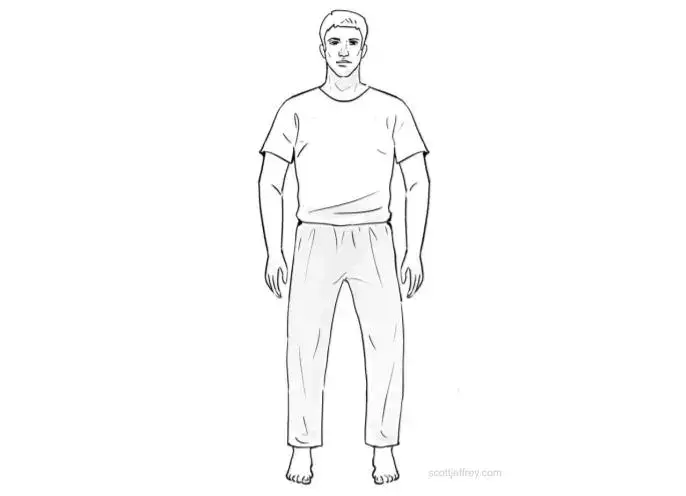
Stand Like a Tree
Stand with your feet parallel and at least shoulder-width apart.
Keep your head floating above your body without letting it drop forward.
Your chin is slightly tucked. Your shoulders rest comfortably at your sides.
Rest your hands at your side or place them over your navel.
Allow the weight of your body, along with all the tension you’re holding, to sink downward without collapsing your posture.
If possible, allow this tension to sink into your feet and be absorbed into the ground.
If you like visualizations, imagine roots growing out of the bottom of your feet, extending deep into the ground beneath you.
This grounding technique works best in nature (or just outside). You’ll derive even more benefits if you combine this method with earthing. That is, stand barefoot on the earth.
The above is a very abbreviated version of an ancient standing practice called Zhan Zhuang.
Time: 5 to 10 minutes.
Cover Your Crown
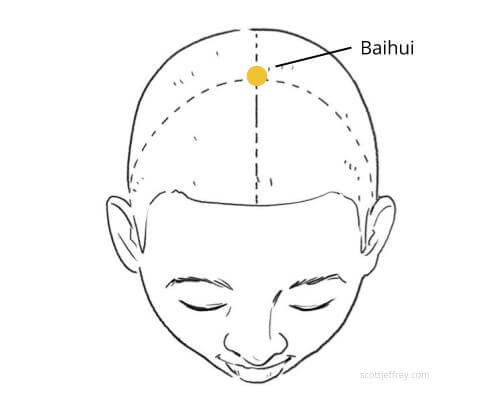
In Chinese medicine and the energy arts, there’s a point at the top of the head called Baihui.
It is the center point of the crown of your head.
Very simply, when you feel ungrounded, place one hand over the crown of your head. That’s it.
If it helps, close your eyes to avoid distractions.
Time: 30 seconds to 1 minute.
Eat Grounding Foods
If you pay close attention to what you eat, you’ll notice that certain foods have more of a grounding quality than others.
Grounding foods include:
- Meats
- Root vegetables like sweet potatoes, carrots, parsnips, beets, turnips, and ginger
- Winter squashes like acorn and butternut
Simply eating these types of foods can help ground you. A warm sweet potato can often do the trick.
Mindful Walking (Barefoot or with Shoes)
Walk and stay present in the process of walking.
My preferred way of earthing is to walk barefoot on my property. Depending on how active my mind is, it takes only a few minutes before I am more mentally calm and centered.
Walking barefoot has the added benefit of massaging acupuncture points in your feet, like in reflexology.
A point of particular interest is the Kidney-1 (K-1) point or “bubbling well” in the center of your foot.
Walking barefoot helps stimulate this point. Be sure to use your whole foot when you walk: heel, ball, toes.
But you don’t need to be barefoot to ground yourself with mindful walking. Just keep your attention directed inward. Watch your thoughts without engaging with them.
Time: 10 to 20 minutes.
Roll Around Like a Cat
Have you ever noticed how cats and some dogs roll around on the Earth?
I suspect that they instinctively know how to discharge negative energy.
Try getting dirty and rolling around on the Earth. You’ll understand why cats do it. It feels good!
Time: However long you want.

Photo by David L Smith
Spend More Time in Nature
It’s difficult for many people to appreciate the connection between nature and our overall mental health.
Being divorced from the physical world, in general, is a clear sign that we’re ungrounded.
Thankfully, reforging our connection to the Earth takes no advanced methods.
Instead, make a conscious effort to spend less time indoors and in front of a screen and more time in the woods, fields, beaches, or whatever you have easy access to.
Central Park is nearby, even in a bustling city like New York. And if you can find nature in NYC, you can find it anywhere!
If you’re “wired” from a lot of screen time, spend as much time as you can walking, sitting, or standing in nature to counteract the many harmful effects of technology.
It works!
Time: 30 minutes to all day long.
Earthing Visualization
Feel the ground beneath you and center yourself.
Now, focus on your heart.
Become present with the energy of life emanating from your heart.
Now, imagine the center of the Earth. It could be a magma core, a circle of light, or whatever comes to mind.
Next, visualize a curved beam of light or energy from your heart to the Earth’s core.
A complementary curved energy beam extends from the core to your heart (completing a pointed oval).
Feel the connection between your heart and the Earth’s core.
Time: 2 to 5 minutes.

Photo by Shaurya Kauhsish
Mindful Stretching
Take any stretching routine you may already know from yoga, qigong, or elsewhere. (Or look one up on YouTube.)
It’s easy to mindlessly engage in stretching where you do the exercise while your mind wanders. (We’ve all done it!)
The key to using stretching as a grounding technique, however, is to bring your awareness to the act of stretching and the experience within your body.
Mindful stretching helps integrate the body and mind; it’s an underrated yet highly effective way to ground yourself.
Hint: It’s also wise to use this type of stretching before meditation training.
Time: 5 to 10 minutes.
Mindful Body Scan
A typical mindfulness method is to perform a basic body scan.
You can perform a body scan while sitting, standing, or lying down.
First, settle your breath. Then, with your eyes closed, place your awareness within your head.
Slowly begin to scan down through your body as if you’re in a small sailboat following a natural current.
Scan down through your neck, shoulder, arms, chest, lower torso, hips, legs, and down into your feet.
A body scan can be a very settling and grounding process.
Time: 5 – 20 minutes
54321 Method
54321 is another popular method within the mindfulness movement.
The purpose of the 54321 method is to ground in your physical senses. For example:
5 – SEE: Notice and acknowledge five things you can see around you.
4 – TOUCH: Notice and acknowledge four things you can touch, including body parts, furniture textures, etc.
3 – HEAR: Notice and acknowledge three things you hear in your environment (focus on sounds, not your thoughts).
2 – SMELL: Acknowledge two things you can smell. This can be done outside, but virtually everything within your home has a distinct smell.
1 – TASTE: Acknowledge one thing you can taste. What did you eat for breakfast? How was that toothpaste?
You can repeat this process as often as you want.
Time: As long as it takes.

Photo by Martin Bennie
Powerful Grounding Technique Combos
Before we move on to grounding indoors, I wanted to highlight how you can combine the abovementioned grounding techniques to improve their overall efficacy.
By stacking various grounding techniques, you can:
- Achieve results more quickly,
- Ground more deeply, and
- Have the positive effects last longer.
For example, if you’re wound up and you try standing barefoot on the Earth, you may not feel any different right away.
However, if you breathe deeply for a few minutes, direct your awareness into your body, correct your alignment (Zhan Zhuang), and stand barefoot, you may find your anxiety level drop substantially within minutes.
For illustration purposes, here are a few grounding technique combos you can try:
Grounding Combo #1
- Stand barefoot
- Observe your breath
- Sink your awareness into your feet
- Cover the crown of your head
Grounding Combo #2
- Stand barefoot
- Squat (Garland Pose)
- Observe your breath
- Sink your awareness into your feet
- End with a gentle upward stretch
Grounding Combo #3
- Sit down at the base of a tree
- Place one hand on the exposed roots
- Observe your breath and breathe deeply
- Gently smile
I’m sure you get the idea. These types of combinations will help you calm down and settle yourself rather quickly.
Time: However long it’s necessary to achieve the desired result.

How to Ground Yourself Indoors (Electrically)
One of the primary reasons we need to learn how to ground ourselves is that we’re being bombarded by harmful electromagnetic radiation (EMF) from devices (smartphones, computers, WIFI, etc.) in our homes.
There are numerous ways to ground yourself indoors:
- Assuming your house is wired with a ground (copper rod), you can touch your finger to the center screw in a wall electrical outlet to yourself yourself
- Touching a radiator
- Touching a copper pipe
- Using a grounding mat (see below)
If you have a concrete basement, you can stand barefoot to ground yourself as well.
How to Ground Yourself Electrically When Using a PC
It’s also a good idea to stay electrically grounded when working in front of a computer or any device.
Earthing pads are made of conductive material plugged into any electric outlet’s grounding port.
You’re technically grounded as long as your skin is in contact with the pad.
You can purchase a universal earthing mat or make your own.
To make your own, you need a conductive material like copper mesh and a grounding plug with an alligator clip to connect to the copper. (See this review for step-by-step instructions.)
I use both options. I have a Universal Earthing Pad under my keyboard and built a grounding mat with copper mesh, wood, and a grounding plug. The copper mat is under my feet as I type.
I explain more about earthing products below, including my experiences using them for years.
Time: Whenever you’re in front of a screen.
How to Ground Yourself Using Earthing Products
When I first read about earthing years ago, it was during the winter.
I wasn’t ready to walk on the frozen ground, so I invested in some Earthing products.
Behind the Earthing movement is a new industry of products designed to ground you by connecting the product to the ground wire in your home.
You can get:
- Earthing bed sheets
- Pillow covers
- Grounding mats for your desk
- Chair mats
- Patches
- Earthing shoes
These products appear to work, but the positive results reported could be a placebo effect.
I honestly don’t know for certain, but preliminary research suggests they provide genuine health benefits.14Chevalier G, et al. Earthing: health implications of reconnecting the human body to the Earth’s surface electrons. J Environ Public Health. 2012;2012:291541. doi: 10.1155/2012/291541.
While earthing shoes don’t provide me with the same experience as being barefoot, I can still feel a grounding effect.
You can also still ground yourself in your home without any products. When indoors, ceramic tile and concrete flooring can ground you if you walk barefoot. (Carpet, vinyl, and wood flooring will not ground you.) But the effects aren’t as powerful as direct contact with the Earth itself.
(Disclaimer: affiliate links above.)
Can You Feel the Grounding Effects with Earthing Products?
If I tried earthing twenty-plus years ago, I probably wouldn’t have felt anything. I had minor energetic sensitivity to the movements and sensations in my body.
However, I have greater body awareness after practicing Qigong for over 15 years.
I can instantly observe specific sensations when I connect my feet to the Earth. I can also detect a slight vibration emanating from the ground when I’m centered.
I have used earthing pads and sheets for years, believing the principle behind earthing is sound.
However, except for earthing shoes, I can’t detect many, if any, effects from using these products. Of course, this doesn’t mean earthing products don’t work. Had I not already blocked out blue light and restored my circadian rhythm, I might have experienced the benefits of earthing sheets, as many others report.

Ground Yourself with a Digital App?
Okay, so what I’m going to share with you now may sound like science fiction.
Eric Thompson is the founder of a company called Subtle Energy Sciences. Using quantum resonance technology, Eric engineered a method of encoding digital images and sound files with specific energy signatures. The result is what he calls Digital Mandalas or Quantum Energy Apps, which combine beautiful digital art with layers of various energy-related sound technology.
If you’re open to exploring new technologies, check out Earth Pulse.
This digital media program broadcasts the amplified energetic signature of the Schumann Resonance through your electronic devices. Basically, you can use it to turn the devices producing harmful EMFs into something that protects you from EMFs—and makes you feel more grounded!
I always have at least one of Eric’s mandalas running on my computer and other devices (usually more than one). Earth Pulse is open on my desktop as I write this.
Use code CEOSAGE30 for a 30% discount on Earth Pulse.
Now, if you don’t have energetic sensitivity, you may feel nothing at first. If that’s the case, Eric offers various ways to augment and optimize the effects.
(Disclaimer: affiliate link)
Maximize the Effectiveness of Grounding Techniques and Earthing
If you consciously ground yourself in your body and then root yourself to the Earth, you can augment the effects of grounding and earthing.
The more time you spend in front of a computer or connected to your phone, the more you’ll benefit from grounding and earthing techniques.
Some people believe there isn’t valid evidence to prove that electromagnetic frequencies (EMF) and radiation waves from electronic devices like mobile phones are harmful.
To me, that’s total nonsense. The evidence continues to mount.15Peer-reviewed scientific studies on EMF-related subjects, https://www.powerwatch.org.uk/science/studies.asp
Ultimately, you need only get more rooted in your body to end the debate. The harmful effects of EMF radiation from these devices become noticeable in your energetic body.
See also: Best EMF Test Meters: A User-Friendly Review
It’s not a question of whether these electromagnetic and radiation waves are affecting you; it’s to what degree you’re able to feel them.
Regardless, grounding yourself in your body and daily earthing practices may be an essential lifestyle choice for those interested in a long, vibrant life.
Learning qigong or practicing something like The Mastery Method (if you don’t have a lot of time) can teach you how to feel the energy in your body.
Recap: How to Ground Yourself
Grounding techniques provide powerful methods for increasing your awareness of your body. These exercises offer a diverse range of health benefits.
Earthing is a grounding exercise that reforges your connection to the Earth.
Research shows that earthing reduces inflammation by scavenging free radicals.
Grounding techniques and earthing are ways of:
- Quieting and clearing your mind,
- Recharging your energy, and
- Calming your emotions.
Therefore, grounding exercises will help increase your overall mental and physical performance as well as your overall well-being.
It’s a calming and enjoyable experience to walk barefoot on the Earth.
These grounding techniques help awaken your instincts and bring you closer to yourself.
Enjoy!
Related Books on How to Ground Yourself

Earthing by Clinton Ober, Et Al.

The Body Electric by Robert Becker and Gary Selden
Read Next
Grounding Sheets: Do They Really Help Improve Your Sleep?
How to Use Earthing Shoes to Increase Energy and Mental Clarity
How to Block Blue Light and Restore the Circadian Rhythm
The Benefits of Wearing Anti-Blue Light Glasses (Improved Sleep)
What Do You Think?
Add your comments below.
Brilliant.
Thank you, Yolo.
Thank you for sharing. It’s Wonderful!
You’re welcome, Maria.
Good read ! I am feeling so out of balance and crappy because I have not been able to go grounding because of all the snow on the ground. In the summer I ground for more than an hour a day minimum. I NEED to feel good again but I’m skeptical with the earthing products plus they are expensive so I don’t see myself ordering any products anytime soon. Do you have any ideas for grounding in the winter ??
Thanks, Hayle
I know what you mean. I ground daily as well, and with the winter, it’s undoubtedly more difficult. I own all of the earthing products. They work, but it’s not the same thing as grounding on the earth. Are you familiar with Zhan Zhuang? Doing this practice can certainly provide similar effects:
https://scottjeffrey.com/zhan-zhuang/
You can put your hands on a tree while imagining how your energy travels down into the earth with the roots
I actually don’t recommend doing that in the winter, Julia. In the winter, most trees (especially deciduous trees) can take energy from you.
Hi Hayle, Im new to grounding so am still learning, I’m in Brisbane Australia and we’ve just had 6 mths of rain, havent been able to do much outside grounding, so I bought 30 kilos of beautiful white sand from my local garden centre, (was only $11.00) then I bought a deep, long and large kitty litter tray (60cm long) to put it in, I’m still on the lookout for a timber try, but I’m grounding in the sand box while I can’t ground outside, my sand is about 10 inches thick so my feet dint touch the bottom, I also read that you can ground through your hands so maybe you can obtain some natural things, anything to do with trees and plants and just handle them, our ground is still so wet right now but I go out and pat and the tree trunks and caress the leaves,
hope this helps you..
cheers
For what it’s worth, I don’t suggest that anyone uses Jaelyn’s method outlined above. You’ll have limited results because you’re still standing in a plastic bin. You’re much better off just getting a sheet of copper (or copper mesh) and standing on that. Plus, there’s no mess like there will be with the sand.
Even better: add a grounding plug with an alligator clip to the copper sheet and you have a complete and inexpensive grounding mat for your home.
If you’re a DIY type of person, you can even make your own plug: https://www.youtube.com/watch?v=VXNigepWtaQ
Standing in 10 inches of sand is NOT standing in a plastic bin as you said, there is almost a foot inbetween the bottom of the container, in fact using my sand box has been very good for me .. but of course you’ll reply saying its not good enough ..
fancy saying your just standing in a plastic bin, wow, for your information its not a bin .. its a very large long and wide container as I first said ..
My point was that there’s no reason to do this because there are easier (and cleaner) methods.
If it’s working for you, great. (I have no way of evaluating the efficacy of standing in a bin of sand. But I suspect that it should be helpful for grounding.)
Also, my comment wasn’t for you — it was for other people reading these comments.
You may be standing in the sand, but the sand isn’t touching earth, so you are not grounding.
Exactly
You don’t need to touch two points of your body to complete an electrical circuit. The earth has one charge and your body has another. By simply touching the earth, the electricity will transfer and equalize. Think about it: if you touch an electrical wire you got shocked. You don’t need to touch it with two hands. If lighting strikes you, you get shocked. Two lightning bolts don’t need to strike you to complete a circuit. The only benefit of touching the ground with two points is that the electrical current can flow in a path through your body as opposed to just equalizing through one point. Maximum benefit of transferring electrical current through your body (or anything for that matter) would be to attach opposite ends to the electrical source (your head and feet for example)
That’s probably true, Josh. The main point is that there’s an experiential difference (if you have the sensitivity to feel it) of having one point versus two points. And from a grounding perspective for health, two points is advisable.
Thank you for sharing. Grounding and earthing are truly sacred to me. When I’m centered and really able to calm my mind I can feel the earths heartbeat beating underneath me, it’s such a beautiful experience to FEEL the aliveness of the Earth Mother.
Do you have any advice for staying in your body and staying present while feeling intense emotions from past trauma coming up? All my previous ways of staying with me emotions doesn’t work anymore as the experience can be so intense that if feels like I will go mad.
Hi Julie,
You can try these techniques on centering here:
https://scottjeffrey.com/center-yourself/
Also, I have an audio program that helps with what you’re describing. You can learn more here:
https://scottjeffrey.com/mastery/
Are the effects of grounding still there when walking barefoot on the grass when it is freezing?
Yes.
Awesome guide. Thank you.
Great to hear. You’re welcome.
very practical easy and concise
Thank you, Maria.
Hi Scott, thanks for your info on grounding its something I’ve looked into but not practiced as my area isn’t very suitable do you know if i can pluck grass and leave in a container with both feet on the grass to benefit the effects i was also thinking of sand from the beach but grass is alot closer to home thanks, Andrew.
Hi Andrew,
No, I wouldn’t recommend doing what you’re suggesting. You can ground yourself just as well on dirt, large rocks, and gravel. I don’t know what area you’re in, but I think every environment has places where you can do grounding.
Hi Scott, thank you for quick reply i have some old rocks that were used for building a wall when they done stonemason were i live il give them a try this week cheers, Andrew
Hi Andrew,
You want to be on the ground itself. So don’t put something on the ground to stand on. If the large stones are protruding from the Earth, great. If not, just stand on the ground itself.
Thankyou .. this is helpful . So it doesn’t have to be grass . That gives me more options . I can stand under my gazebo on the pavers that are laid on the ground even if it’s raining. That’s more possible than cold grass although and probably not inclined to do it when it’s cold warm ways can I utilise if it’s winter rainy? I think I will try and earthing Matt or earthing sheet. Do you know the most economical option to buy? How much percentage of silver thread should it be?
See the links at the bottom of the guide under “Read Next.” You’ll find a review of earthing sheets and grounding mats. Alternatively, you can stand on sheets of copper.
Love it!
This is fantsastic!
Thank you, Niranjan.
Thank you for such a helpful article. I recently started working in a high rise on the 17th floor. Is there a difference between being on a second floor and a 17th floor? I’m also not very close to a park. What do you recommend one to do during the day to keep grounded in a big city (if there are other things in addition to the exercises you mentioned)? Thanks!
The universal earthing mat I mentioned above is a great idea as you can use it for your feet (barefoot) while seated at your desk. Or, you can place it on your desk and keep your palms on it as you type.
I’m not sure if it matters whether you’re on the 2nd or 17th floor. But either way, you can still learn to hold the “correct shape” and allow your energy to flow downward. It may not be “earthing” but you can still “ground” your energy in your body.
See this post for instructions on how to hold the correct shape:
https://scottjeffrey.com/zhan-zhuang/
This is a very new subject to me, but now it makes so much sense, grounding is very necessary in our lives. Rolling on grass always felt good , walking bare feet on a beach, it was all part of grounding. What an interesting article.
Enjoy the grounding experience, Mumtaz! Thanks for your comments.
Thank you for this information! What if I don’t have grounded outlets in my home? I have 2 only- in the bathroom and basement -for washer and dryer.
I’m not sure where you live, but in the US, every outlet has a grounding port. It’s required by law.
I read on a Czech site about earthing that you can be grounded on a cement floor. The floor in my basement is cement, but too cold to ground on. It said to fill a metal container with warm tap water and put the feet in it, and you would still benefit from grounding. Is that true? If so, what sort of metal should the container be made from? I’d like to try grounding.
It said in the article above that when you aren’t grounded, to cover the crown of the head. With what, your hand, metal, or something made with cotton, like a t-shirt?
Cement and concrete are great for grounding because they are made from conductive materials. I’ve never heard of putting your feet in water to ground yourself. That sounds unnecessary to me. Grounding is best done outside, on the earth. When you can’t that, you might try practicing something like Zhan Zhuang:
https://scottjeffrey.com/zhan-zhuang/
The crown exercise describes how to do it. You place the center of one of your hands over your crown.
I meant to write put the metal container of warm water on the cement, then put the feet into it.
Theoretically, that might work but it seems unnecessary. And the more steps involved, the less likely you’ll be to do over time.
The tree grounding works. Even before I knew what grounding was I would do the above and tell people to pick me up. When they couldn’t I would tell them in order to pick me up you would have to pick up the earth. I only wear shoes when I absolutely have to. However, I have an extreme sensitivity to cold. Here in the desert where it reaches 110 whenever I get overheated all is needed is to step into the shade and within 5 minutes I will be shivering and have goose bumps. Anything below 70 requires a jacket and the instant something cold touches my skin I shiver violently. Doctors will not give an explanation other then low blood pressure. Do you know why I am this sensitive to cold? Can it be fixed? Thank you for sharing you knowledge. It has been very helpful.
Christine, I’m not in a position to offer you an explanation or solution, but based on what you’ve described, I would highly recommend finding a good acupuncturist / Chinese medicine practitioner. While allopathic doctors don’t have a reference point for understanding heat and cold within the body — this is foundational factor/symptom in Chinese medicine.
For example, a deficiency in heat may relate to a weakness of the hear or a Yang deficiency in the kidneys.
It can most certainly be resolved.
how can a person that’s in a wheelchair ground?
You just need to make direct skin contact with the earth.
THANX… I ORDERED A GROUNDING SHEET AND GROUNDING MAT.. THANK YOU SCOTT..
Sure thing!
Maybe you have vata body type (Ayurveda) excessive air and either energy in your body
Thank you I am excited to try out these techniques
Sure thing, Mattie.
Hi Scott,
I just finished watching “THE EARTHING MOVIE” documentary about the science and benefit to an earthlings health via grounding/ earthing. I am really inspired to give it a try for all of my inflammation issues, mostly for my clinical depression. Many people do not know that depression is disease caused by inflammation in the body. I believe earthing/grounding will help me heal. My question for you is rather simple. I live in the center of my busy little city. There are parks and plots of grass around me. But not a whole lot near my apartment. I went to go do a grounding session up the street on the edge of a condominium where there is landscaping. While practicing my mind started to wonder if I was even receiving the earths charge thru this landscaped area if it is earth on top of building materials. I’m assuming that most plots of grass in the city are earth placed on top on cement or who knows what’s underneath. Am I still receiving the benefits of earthing if I go sit on the earthly grounds of a complex, city hall, hospital , pretty much all urban green areas? Also are the grounding outlets just a regular outlet anywhere in your office? (I’m considering getting the grounding mat for my office)
Hi Klara,
There’s a wide variety of reasons and causes of depression (as well as various kinds of depression). Inflammation may potentially be one of the causes of depression, but it’s equally likely that depression can trigger inflammation in the body via energetic stagnation.
The challenge with grounding in cities is that the amount of EMF is so substantial that it can be difficult to get the full benefits.
I definitely do not recommend grounding on landscaped grass. It’s usually treated with weed killers and pesticides which will be absorbed through the bottom of your feet. The best thing would be to find a rock or a patch of dirt in a park (where dogs don’t go).
Yes, the grounding outlet is the third prong in any standard outlet.
Can you put a ground wire into your shoes
You can place copper mesh in your shoes to help ground excessive EMF discharges.
There’s a company that also makes scandals with copper ports that connects your feet to the ground. (I review them here: https://scottjeffrey.com/earthing-shoes/)
have you ever heard of double grounding – using more 2 earthing products at the same time. does this provide even greater health benefits?
I don’t really see what that would accomplish unless the first grounding product wasn’t fully connected and helping you to discharge.
I was just asking cause this company said that double grounding is better.
It’s quite possibly accurate.
The reality is that if when you’re being bombarded with EMF while working in front of a computer (or simply in a building), having multiple grounding tools can be helpful.
I use more than one in my home office environment as well.
would you be grounding yourself if sitting in a metal “stock” tank used as a swimming pool?
I don’t exactly know what you’re describing. But is this question really relevant?
Grounding is simple. You stand on the earth with your bare feet.
I guess not. thx for rply
I haven’t been able to find an answer to this question, but what part of the day is the best time to ground?
Any time you can ground is the best time.
I thought of another way of answering your question, Adriane.
In the context of grounding to discharge harmful EMF to reduce inflammation, it doesn’t matter when you ground.
However, if you put grounding in a more meditative context, then one could say that the best time to ground is between 11 pm and 1 am. Why? In Taoist energetics, this is considered the height of Yin when the mind tends to be the quietest. So grounding/meditating/standing during this period may provide additional benefits.
Hi Scott,
What’s the connection between grounding oneself and one’s pH ?
Thanks
Hi Andy,
If you’re asking if grounding can influence your body’s pH balance, I can’t say for certain. I haven’t seen any research on this topic. pH is a more biochemical measurement while with grounding you’re working with bioelectricity.
However, since acidic pH levels lead to inflammation and grounding helps reduce inflammation, it is possible that grounding may help reduce acidity and balance your pH. It would be difficult to test this hypothesis though because there are many factors that might be difficult to control.
Hi Scott, I have only just begun to ground myself with the Earth, meaning being in the present moment, barefoot on the grass standing up and visualising myself as tree, with roots growing underneath the soil through the rocks deeply embedded to the core of the Earth. Its really important to ground yourself when meditating, as I have often found myself in the past, ascending higher, being a gamma state of consciousness but totally way up there, and being dizzy, a little disoriented disconnected from the earth, more in a transcendental state, I was way off balance. For me learning about grounding during meditation or just having the awareness of grounding in the now moment made me feel more balanced and earthed. Which has increased my sensitivity to the earths energies, electric pulses vibrations that emanate from the crystalline grid of Earth energies, its also made me more sensitive to nature, animals, constructive insects, and seeing the auric field of the plant and tree and flowers, being totally connected with Earth and her heartbeat. This is my experience of fusing and grounding my energies with the energies of Earth.
Hi Madalene,
Yes, in Daoist practices like Zhan Zhaung, you learn that you’re supposed to spend most of your time sinking your energy down (80%) before learning how to raise it (20%).
Much of the New Age literature is focused on “ascension” and raising one’s energy, which actually can cause all sorts of mental, emotional, and energetic problems if you don’t learn how to root yourself first.
I just purchased a grounding mat, but I’m not sure how long I should have my feet on it. Do I start off for just a few minutes and than gradually add more time?
Ground as much as you can. There’s no reason to start off with just a few minutes.
I keep a ground pad under my keyboard and mouse so that I’m touching it whenever I’m working. I use another one beneath my feet.
Is there a maximum amount of time I should be on it?
No, Claudia. There’s no maximum amount of time. If you were somehow grounding yourself 24/7, it would only support you.
Thank you Scott, I appreciate your quick and helpful response.
Claudia
Love this! Shared your wisdom on my blog…
Thank You for this wonderful article! Questions:
1) How can one ground oneself during the winter?
2) Walking barefoot inside?
3) Also, are Asian tabi-shoes (separate toe) grounding? They’re quite flat & protect feet from glass etc.
Thanks! Any other advise for those of us living in a cold climate/no ocean?
Namaste~
In the winter, you can ground yourself using an Earthing Universal Mat (linked above) or you can build your own.
You can also try grounding yourself on a tiled floor or a concrete basement floor.
You can also purchase some sheets of copper or a roll of copper mesh and stand on that to ground you.
Ultimately, you still want to try to avoid or reduce harmful EMF as much as possible. And learn how to sink your energy down into your body — regardless of the season or weather.
If a shoe has a rubber sole, it’s going to insulate you, not ground you.
HI Scott-
Thanks for your fantastic advice! I went to the river today – could FEEL the vibrations barefoot! In response to your advice:
1) How can I build my own? I see different ‘methods’ but what do YOU suggest, please?
2) I’m on the 4th floor- is a tiled floor here effective? Is barefoot up here beneficial?
3) And Best of all: Where may I “learn how to sink……energy down into (my) body — regardless of the season or weather.
I so Appreciate your expertise, Scott!
Namaste~
Hi Sharyn,
1) You can take a piece of plywood, wrap it in a high-quality copper mesh, and then you need a grounding cord. A grounding cord looks like a regular plug, but only the ground is active. The plug connects a grounding wire to an alligator clip and you simply clip the copper mesh board so it makes contact.
2) In my opinion, we should all be walking barefoot whenever we can. There are numerous health benefits for not having our feet constricted. But on the fourth floor of an apartment complex, you’ll probably need to use grounding devices like the ones mentioned above in the article — devices that plug into the grounding port in an outlet.
3) See this guide: https://scottjeffrey.com/zhan-zhuang/
Hi
Maybe Scott will comment too. I think you can ground yourself via trees. As a beginner I think a damp trunk works well. Put both hands on the trunk and see if you feel a very slight sense of pins and needles in your feet and perhaps arms as the energy moves. My doctor tells me its best to ask the tree’s permission first and later any dry trunk will also work or even not actually touching it. I’ m still at the beginner level. Try it and see if it works
Hi Stephanie.
Indeed, there are actually many methods of exchanging energy with trees in qigong.
Your doctor is correct. It’s advisable to ask the tree’s permission first. Also, it’s best to do this during the day when the sun is on the tree. And avoid this practice with hardwoods in the winter (as they can actually draw energy from you).
Anything in nature can be used for grounding.
I’d truly enjoyed reading your story about walking barefoot. I’ve been doing walking barefoot for a long time and it feels very awesome walking barefoot.
It sure does, Jay!
Thoroughly excellent article. I sit barefoot in the garden when the weather permits and created an aluminium covered sheet of cardboard connected to earth to rest my fete on when watching TV.
Thank you for sharing. If an outside area has a lot of gravel if I place a redwood board down on it and then stand on the board will I be grounded?
Wood is an insulating material so it will shield you from the earth (which you don’t want).
Stand directly on the gravel. Not only is it grounding, you’ll give yourself free reflexology/acupuncture via the bottom of your feet!
Hi I did build myself a grounding connection using a copper plate to place my feet on , an aluminium wire and a galvanize grounding metal plate buried in the ground , but when I use I feel a metal taste in my mouth , is it ok or is it dangerous ?
I don’t really see how that’s possible if the copper plate is 99.9% pure copper. Are you standing on it outside or inside?
Thank you, Scott, I enjoyed reading the guide <3 question:
I live in Greenland, where the ground is covered in snow majority of the year, and I don't want to take my shoes off when there's snow. I'm wondering if touching the rock/stone (the ground is all rocks and peat) with my hand/hands will ground me since you write:
"As in any electrical circuit, you only need one point of contact to establish a ground connection".
The best thing I can suggest is to try it and see what happens for you over time.
You can also use indoor grounding tools like the ones I’ve listed above or create your own.
Touching rocks/stone that are in contact with the earth with your hands will ground you! As will touching plants and trees.
Thank you, Tina, that’s very nice to know
Hi! Scott,
Just writing to get some clarification about a previous post and your comments.
Given that it’s winter here where I am, would getting some sand from the beach and putting it in a large container and immersing my feet in the sand be grounding?
Also, would keeping my feet on a large stone while working on my laptop be grounding?
Lastly, my house is built on a concrete slab. I work from our family room under which is the concrete slab. The floor covering is Congoleum which is primarily vinyl with some felt and fiberglass. Does the Congoleum block the potential earthing benefits/
Thank you for all this very valuable info. Much appreciated.
Yanni
Hi Yanni,
You’re better off getting a sheet of copper or a roll of copper mesh and use that for grounding. You can also get a wall plug that’s designed for grounding that connects with an alligator clip to the copper wire and plugs into the wall (but only the third prong grounding wire is present).
Obviously, vinyl and felt are insulators so you can’t ground on them. You can ground on a concrete slab if it’s exposed.
Thank. That’s simple enough.
Hi, I have a question. I bought a grounding sheet and have and pillow case. At first I felt nothing, then I began to have good sleeps were I found I dreamt a lot and was also (really different for me!) groggy when I woke up. However, I also found I got dizzy way more easily. So I took the sheet and pillow case away and the dizziness stopped. I am now sleeping only on the sheet, but the dizziness is back. I am not 100% sure it is the sheet or grounding that is doing this but I did not feel this before I got these items. I just want to make sure I am not doing myself damage. Thank you in advance!
While I can’t say for certain, I think it’s highly unlikely that the grounding sheets are the cause of your dizziness. I’m unaware of any mechanism of grounding (in general) that can cause this symptom.
This, of course, isn’t medical advice.
It sounds more likely that you’re projecting causality on two things that are unrelated.
Mari, If you are highly sensitive your body may need time to acclimate.
Awesome
Very helpful & informative.
Question- I’m 64 and I feel awful. Sciatica has flared again and I’m exhausted. I want to lie down on the earth right now, but it’s muddy. Can I ground myself through a layer of cardboard? Thank you for all your efforts Scott.
Hi Carol,
Putting any nonconductive material between you and the ground defeats the purpose.
Either find a flat rock or dry gravel. If not, even cement (not asphalt) will do.
If you can’t comfortably stand for a long period of time, use a portable folding chair and simply keep your feet on the dry ground.
That’s right. Cardboard isn’t the answer to everything. I did sit there for a while with my bare feet flat on the ground. It actually brought relief! Plus I love being in nature, so more healing there. Thank you again!
I really want to thank the author for such a nice blog that helped me to understand how to make life comfortable.
Do you know a good source for how to ground your home? We are building a health and wellbeing centre in am old building and want to bring the ground in. Can you please advise… it was literally the only thing your wonderful article missed!
Catherine
The Old Bakehouse
Isle of Bute
Scotland
I don’t know of any such resource, Catherine.
But I would say that poured concrete works great for the ground level of any home. This obviously isn’t relevant for a reconstruction project though.
However, it is advisable to take an EMF meter and use it around the building to test the levels of “dirty electricity.”
Thank you for your great article. It has been very helpful. I could not find an answer to a question I have.
Can you tell me if someone who is a professional fisherman that spends most of their day in a boat out in the ocean would be getting grounded. His hands are usually gloved and he wears protective clothing for most of the day. Perth, Western Australia.
Pamela
Regardless of what they are wearing, they wouldn’t be “grounded” because they are standing on a boat — and over water, not ground.
However, they are getting negative ions from the ocean that can also have many beneficial effects including being anti-inflammatory.
Thankyou for your response Scott…. That makes perfect sense !
I liked the opening of the article so much. Thank you
Hi Scott,
If you were to pick one indoor earthing product to buy, which one wold it be? Also, how effective would it be compared to earthing outside on the grass? I have limited opportunities to be outside so I need to know if in indoore product would work just as well. Thanks
Hi Sue,
It really depends on your lifestyle. If you spend a lot of time in front of a computer, a grounding product that relates to this (like the universal grounding mat) might be a good choice.
As I stated above, I can definitely feel the effects of earthing outside. I can’t say that I feel the effects of earthing products that I use indoors. So I definitely recommend earthing/grounding outside as much as possible.
what i learnt in physical science when I was a child is being recollected in my memory
good information to put in practice immediately!
Scott – your stuff is amazing! I love it! And as with Self Actualization I would love to use some of it in our training. Will reference you. hope I can do so?
Hi Scott, just want to say this is amazing info. As with the Self Actualisation, I would love to use some of it in our training. Please with your permission.
AMAZING!
There is so much information and so many links here, it has taken me two nights to go through it and my mind is blown. I am so impressed with the work you’ve done here to explain multiple different platforms. I will be passing along information to this site. Also, thank you for sharing the products you have tried and experienced. All this is so very helpful!
Erin
You’re welcome, Erin. Thank you for the feedback. Enjoy the grounding process.
Hi, I would like to say how this is amazing, There is so much information from beginners to advance. I meditate most days and all this grounding information I will use now. Thank you
You’re welcome, Diane.
Fascinating, I feel as though I have rediscovered lost information. Grateful.
I recall walking slowly back and forth in the grass in front of a house where I was working, attempting to draw energy from the Earth to ease my exhaustion.
(I had to finish the remodeling job)
It worked quite well even though I was wearing work shoes. Perhaps, the firm belief or vivid visualization ( walking in a sacred manner. As Black Elk might say.) was more important than my shoes or lack thereof.
Or, it could have been better barefoot. Don’t know.
Anyway, I’ve been using some of your suggested techniques lately and deriving great benefits.
However, I’m still not sure whether it’s the techniques or my trust in them that makes the most difference. Thanks either way .
One thing, Mark: no need to “draw energy from the Earth”. This type of visualization is counter-productive for this exercise.
In fact, what you’re actually doing is discharging energy when you ground yourself. But no mentalization is needed. It’s best to simply feel the Earth beneath your feet. Sink your awareness into your body instead of visualizing anything (which activates/stimulates the mind).
Great article. I will start today. Thank you ❤🙏
Hello.
Knowing that just being in contact with the ground is helpful I am wondering if there are simple architectural building techniques or modifications to take advantage?
As an example most of my home is built on rafters 3 feet off of the ground. Probably not utilizing earths energy. My back porch area is basically a concrete slab. Always feel pretty good on my back porch especially in the summer.
So I’m looking for building techniques (roofing materials etc) for residential homes that may be considering natural energy flow.
If we can build a home that makes people feel recharged it seems like this could be as helpful as outlawing TV lol
As I think I covered above, concrete and tile do provide better grounding than say wood or carpet. I’m not aware of building techniques that would provide more grounding, except perhaps building a home underground (like underground domes or perhaps Earthship-style homes).
But the main problem is that any modern home is essentially an electrical box filled with frequencies that go against our natural biological and energetic fields.
Hi Scott, great read! I work at a senior living community and feel this can greatly benefit the residents here. Is there a medical specialist I should be in search of specifically (i.e. environmental medical professional, grounding therapist, yoga instructor, etc.)?
Hi Kaitlin,
I am unaware of any medical specialists who cover this. Sadly, there are very few people in the medical community who understand these types of principles. But thankfully, no “specialist” is required. Just encourage barefoot walking, sitting, and standing (in a safe way).
hi, just wanted your thoughts on making a sand bed (wood frame to contain sand) on concrete in the screened room. i’ve come up with so many allergies to chemicals to mattresses, etc, i thought this might work. i think i would need an organic cotton 3″ mattress on top of sand? do you think this might work?
Someone else mentioned using sand for grounding. Here’s the thing: the beach works great for grounding because of everything in the environment (negative ions). It’s not that sand is the ultimate grounding element. Might what you’re suggesting work? How can you ground yourself if you’re on a 3″ cotton mattress? That mattress is going to insulate you.
So I just don’t see the point. Copper and silver materials attached to a grounding wire should work much better — and without all that sand.
And yes, most mattresses are incredibly toxic.
thanks for your fast reply, scott. i have tried grounding mats, and sheets, which help, but i’m also having problems even with so called nontoxic mattresses with my sensitivities/allergies to chemicals. i thought i’d try a sand on concrete bed (softer than concrete to sleep on) in the screen room. i know it seems drastic, but i’m tired of hurting all the time and not waking with feeling i got any sleep. i thought the all-cotton cover would work, but according to you it would insulate me from the grounding effects. not sure what to do from here.
An all-cotton mat would resolve the toxic mat issue. Then, add the grounding sheet to reduce EMF.
But putting a 3-inch cotton mat over the sand will not provide grounding. If you’re using the sand to replace the concrete (for comfort), that’s another story.
You can also try natural latex.
thank you…
thanks a lot, very good article, will go through again and again, regards
I sit with a straight spine touching a tree to ground myself and go barefoot even in the winter so when I find a patch of grass I kick off my shoes and walk a bit. This may sound strange but when I walk on grass, sand at my local beach I can honestly say I can feel the energy entering my body and feel I have come back to my center in the present, it’s a very distinct feeling like my body is one with my surroundings, it’s so renewing..Namasté
Doesn’t sound strange at all (at least to me)!
thanks for the reminder I did this as a child all the time
Hi Scott,
I live in an RV in the woods and yes there is plenty of space to earth/ground. Though, sometimes its too cold and i was wondering if a cement block that i brought from outside (1.5ftx5in.) would do the trick.
Thanks for this article and the info you provide. Its very much appreciated. -Alex
Alex,
If you’re referring to a cinder block, I wouldn’t recommend it as I don’t know exactly what materials are used to make it. Either way, you want to be grounded to the earth. So if you’re inside an RV, you would still want to have a connection to a grounding wire connected outside. In terms of materials, copper is excellent for grounding.
Best,
Scott
Six months ago i became aware of the Gaia belief,then i read about it,today my neighbour suggest to read about grounding,The dramas in my life are a scratch that has healed and today i will grow and feel more positive.Thankyou.
I just started grounding a couple of months ago, trying to daily, 10-15 minutes at a local grassy park in addition to breath work and (early morning) sunning. Heard about it first from Gary Brecka.
Your guide here is the best I’ve found online so far – thanks!
One question I haven’t found an answer to (haven’t read all the comments if it’s there):
I live in an apartment on the 2nd floor, and we have a backyard that is built on the 2nd floor over an unused area on the first floor. I assume that the soil and grass are on a concrete base/roof. Is doing it here considered grounding, meaning does the 2nd floor of the building connect to the ground for this purpose?
Thanks again, Scott!
Thank you for the feedback, Gary.
While it’s not going to be the same as grounding directly with the earth, I would assume you’ll still get plenty of grounding benefits from standing on that soil/grass from the second floor. You just might want to make sure there aren’t any 5G or major powerlines in the vicinity.
Giving it a try starting today. Great article on the grounding aspect.
Want to learn more. I find this fascinating!
Another superb article, but really love this one!! we hear the word, grounded a lot , but I personally think most of us take it for granted , most of us humans are so disconnected from the earth , the rivers , mountains and the forests, that our bodies are crying out to be grounded, instead we are in our heads all the time. By being grounded we can be supported us in so many ways , emotional regulation for starters , & the crazy thing its free , you don’t have to spend on a gadget , as mentioned in this article all you have to do is take your shoes off barefoot (if it safe to do so) , walk on the grass etc , touch the trees, or even better give them a hug (which has been proved by science to be effective) and ”voila” Thank you Scott