
“I can’t stop eating,” says comedian Jim Gaffigan.
“I haven’t been hungry in like 12 years.
“Did you ever see medication that says ‘Don’t take on an empty stomach’?
“Never a concern of mine.”
Gaffigan isn’t alone. Overeating is a worldwide cultural phenomenon.
And I’m not just talking about the obesity epidemic.
I’m a relatively fit person. I eat moderately, and I’m highly conscious of the quality of the food I consume.
Yet like Gaffigan, I hadn’t been hungry in over a decade. Until a few years ago, I never knew what it was like to feel my stomach empty. Feeling my stomach organ led to the realization that I, too, habitually overeat.
The cost of this unconscious behavior is great. The rewards of eating less in terms of physical and mental energy are even greater.
Let’s dive in …
An Untapped Storehouse of Energy
In the Chinese energy arts called Qigong, the theory is that we can cultivate a storehouse of energy in the lower abdomen (called the lower Dantien).
This energy moves through the body’s meridians to heal and revitalize the organs and other systems.
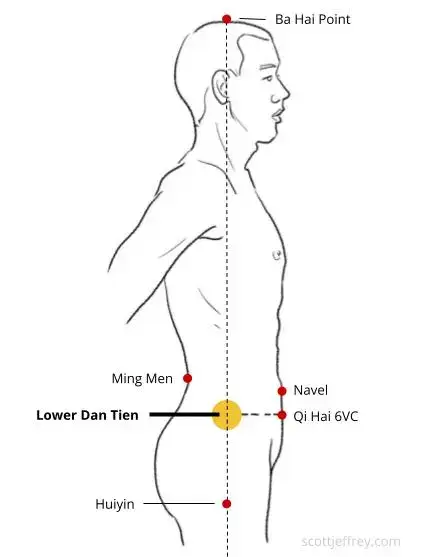
Approximate location of the lower dantian
When cultivated, this energy, or chi, emanates heat. When the body’s channels are open, you can feel this energy moving throughout your body.
But in most people, this energy is blocked in many areas.
Is Chi Real?
When I first learned about the body’s energy systems, I was fascinated. But I was still skeptical.
I have seen amazing feats by people like Qigong Master Zhou, who can make a wet paper towel produce visible steam simply by directing his body’s energy through his palms (without actually touching the paper towel).
However, having spent a considerable amount of time around magicians and illusionists, I remained skeptical. Many con artists walk among us.
Zhou, like many stories of qigong adepts, trained with various teachers starting at an unusually early age. Perhaps that was a prerequisite, I reasoned.
Now, however, having experienced this heat myself, my doubts have waned.
Excessive Food Blocks Energy
Consider this: The stomach is about the size of your fist.
How big is your average meal?
Sure, your stomach can expand more than 50 times its empty size to hold a large meal.1https://hypertextbook.com/facts/2000/JonathanCheng.shtml But that doesn’t mean it should.
Not surprisingly, too much food blocks the flow of energy in your body. When you eat less, you potentially have more vitality.
The body allocates energy to digestion. The average daily energy expenditure of digestion is 10%, but it varies depending on the type (protein vs. carbohydrate) and quality (whole food vs. processed) of the food.2https://www.precisionnutrition.com/digesting-whole-vs-processed-foods
More than that, excessive food trapped in your digestive system blocks the energetic channels in your body.
Partially digested food in the small intestines and fecal matter in the large intestines are like a series of traffic jams, keeping the energy from flowing smoothly.
Interestingly, as you learn to cultivate the body’s natural energy, the impulse to eat becomes less. Also, the amount you choose to eat decreases dramatically. (That is, you naturally start to eat less.)
Why Consider Changing Your Orientation Toward Food
The challenge that most of us face is that we’ve been conditioned from childhood to relate to food and eating in unsupportive ways.
For most, eating is primarily a form of pleasure-seeking. We’ve come to use food as a drug. We eat to elevate our moods. Eating has become a form of self-medication.
This orientation towards food leads to weight problems, obesity, fatigue, and poor health. More importantly, this orientation entirely misses the point of why we eat.
Food is meant to be fuel. The food we eat is supposed to be converted into energy (chi) that helps sustain us and keep us functioning properly into old age.
That is, food is primarily a source of energy for the human body.
However, when we primarily eat for pleasure, we invariably violate the principles of energy in favor of a temporary “high.”
When our eating habits are centered on pleasure, our food choices and eating patterns become yet another factor that leads to fatigue and illness over time.

Bigu Qigong: The Way of Eating Less
Bigu translates from Chinese to “grain avoidance.”
For many ancient Daoist adepts, bigu was an integral part of their internal training and self-cultivation.
Bigu qigong is often associated with the path of the immortals. For example, as it says in The Tao of the Huainan Masters:
Those who eat meat are brave but cruel.
Those who eat Qi have bright spirits and long lives.
Those who eat grains are intelligent but die early.
Those that do not eat at all are immortal.
But it’s more likely that the ancient Daoists mainly practiced grain avoidance because they were focused on self-cultivation and didn’t want to depend on society, especially when it was in cycles of chaos and destruction (which happen continuously).
By removing grains from one’s diet, one unlocks a storehouse of energy and other benefits, which can be used for further self-cultivation. You naturally begin to eat less.
A 2021 study in The Journal of Nutrition found that a 5-day Bigu-style fasting period reduces factors associated with inflammation and cardiovascular disease, among other benefits. (There are related studies on “intermittent fasting” discussed below.)
Regardless, grain avoidance is arguably one of the most effective strategies for eating less. Why?
Ketosis: A Key to Unlocking Your Energy and Eating Less
Bigu might seem outrageous if there weren’t major movements within the health and wellness arena that are science-based and operating on the same principles—for example, Paleo and Keto diets.
Ketosis is a metabolic state where your blood has a high concentration of ketones. Ketones are like energy fuel for your cells.
Many cells in the body generally use glucose for energy. However, when the body can’t access sufficient glucose (from grains, sugars, etc.) to energize its cells, insulin levels decrease, causing fatty acids from stored body fat to be released.3Tinsley GM, Willoughby DS. Fat-Free Mass Changes During Ketogenic Diets and the Potential Role of Resistance Training. Int J Sport Nutr Exerc Metab. 2016 Feb;26(1):78-92. doi: 10.1123/ijsnem.2015-0070.
This fatty acid is transported to the liver, where it’s turned into ketones. Then, these ketones are used as an alternative energy source throughout the body.4Ibid. These ketones can cross the blood-brain barrier, providing energy for brain functioning as well.
Essentially, when the body has a limited supply of glucose (blood sugar), it starts using excess fat as a main source of energy.
Bigu and a Ketogenic Diet
Entering a state of ketosis, however, can be challenging for some individuals who have been conditioned to eat grains and sugars their entire lives.
To access this state, less than 20 to 50 grams of carbohydrates are consumed per day.5Sukkar SG, Muscaritoli M. A Clinical Perspective of Low Carbohydrate Ketogenic Diets: A Narrative Review. Front Nutr. 2021 Jul 12;8:642628. doi: 10.3389/fnut.2021.642628.
Generally, for a ketogenic diet, you remove most if not all foods rich in carbohydrates (because they convert to sugar), including:
- All types of grains (wheat, rice, etc.)
- Legumes
- Potatoes
- Fruit
- Candy and desserts
- Soft drinks
Outside of fruits, all of the above are also omitted in a bigu-style approach. In bigu, they refer to the avoidance of the “five grains” or “five cereals,” which usually include:
- Wheat
- Rice
- Millet
- Soybeans
The fifth grain is sometimes listed as other legumes, barley, oats, glutinous millet, panicled millet, or sesame seeds.
When you achieve ketosis either through intermittent fasting, a ketogenic diet, or practicing bigu, you’ll experience a noticeable reduction in appetite. You naturally want to eat less.
The Problem with Grains
There’s a reason that grains are so prevalent in the majority of the world’s diet, and it’s probably not what you think.
Grains are addictive.
Numerous research groups, including one led by C. Zioudrou in 1979, found opioid activity (exorphins) in wheat, barley, and maize.6Zioudrou C, Streaty RA, Klee WA. Opioid peptides derived from food proteins. The exorphins. J Biol Chem. 1979 Apr 10;254(7):2446-9. https://pubmed.ncbi.nlm.nih.gov/372181/
Since then, researchers have measured the potency of these exorphins in grains. Their potency is comparable to morphine and enkephalin.7Heubner, F., Liebeman, K., Rubino, R. & Wall, J., 1984, Demonstration of high opioid-like activity in isolated peptides from wheat gluten hydrolysates, Peptides 5:1139-47.
When absorbed in the intestines, these exorphins can produce effects such as analgesia and anxiety reduction.8Greksch, G., Schweiger C., Matthies, H., 1981, Evidence for analgesic activity of beta-casomorphin in rats, Neuroscience Letters 27:325~8.
Numerous studies note that patients often exhibit cravings, addictions, and withdrawal symptoms related to grains (and dairy).9Egger, J., 1988, Food allergy and the central nervous system, in Reinhardt, D. & Schmidt E., eds, Food allergy, Raven, New York.,10Kroker, G. F., 1987, Chronic candiosis and allergy, in Brostoff, J. & Challacombe, S.J., eds, Food allergy and intolerance, Bailliere Tindall, London.
In fact, withdrawal symptoms from excluding grains can be similar to those associated with drug addictions.11Radcliffe, M. J., 1987, Diagnostic use of dietary regimes, in Brostoff, J. & Challacombe, S. J., eds, Food allergy and intolerance, Bailliere Tindall, London.
Simply put, grains are a drug that most of us have become dependent on. We eat grains primarily for psychological (comfort) and biochemical (numbness and sedation) reasons.
The implications of this understanding are far-reaching. This information is presented here simply as further evidence of what the ancient Taoists realized intuitively.
A Fundamental Reason Most People Overeat and Crave Carbs
But why do many people overeat and crave carbs?
The answer lies in an area that’s somewhat taboo in the Western “modern” world:
Parasites.
We are infested with parasites. This is an accepted fact in many countries, but somehow, in so-called “first-world nations” we think we’re different. (All indications suggest otherwise.)
Interestingly, bigu—avoiding grains—was considered a medical cure for eliminating parasites. In bigu qigong literature, these parasites are referred to as “corpses” or “worms.”
As author Livia Kohn explains, to these Taoist adepts, these corpses represent12Livia, Kohn. The Taoist Experience: An Anthology, 1993, 148.
“demonic supernatural creatures who feed on decay and are eager for the body to die altogether so they can devour it. Not only do they thus shorten the lifespan but they also delight in the decaying matter produced by the grains as they are digested in the intestines. If one is to attain long life, the three worms have to be starved, and the only way to do so is to avoid all grain.”
The term sanshi means “three corpses” and sanchong means “three worms.” These three corpses are said to reside in the head, torso, and lower body. These three corpses are then further broken down into nine worms that incite “evil or illness” in the individual.
I realize this can all sound a bit mythological or superstitious to many readers. I’m merely presenting this information as an alternative perspective to consider.
The main point here is that these “demon-worms” represent parasites that feed on grains and sugar within the body. They send signals to the brain that induce craving and lead us to overeat.

The Nine Worms in Bigu Qigong
Have You Ever Done a Parasite Cleanse?
Years ago, before I had any exposure to bigu or an understanding of ketosis, I learned about parasites while troubleshooting a health issue with my gut.
I was open to experimentation and driven to resolve this health issue, so I went on a 90-day parasite detox cleanse that involved eating only specific foods and taking pungent parasite-killing herbs.
For 90 days, I didn’t eat any grains or added sugars. While this parasite cleanse didn’t resolve the health issue I was focused on, it did have an interesting side effect:
I lost my craving for carbs. And with it, I began to eat less naturally.
Before this parasite cleanse, I occasionally craved a big bowl of pasta, for example. Overall, I tended to eat very large bowls or plates of food. I eat a lot of snacks, too.
After the parasite cleanse, however, that craving was gone entirely (and never came back). I was amazed, which led to further investigation.
I’m not saying that you “have to” do a parasite cleanse to eat less, but this approach certainly worked for me.
The Connection Between Parasites, Bigu, and Grain Addiction
Without getting too esoteric, but to connect the dots with the above insights, it seems plausible that the parasites infesting the human body are creating the drive to consume these substances (particularly grains and other sugar-based foods).
By using bigu fasting methods or simply doing an extensive parasite cleanse, you can destroy these networks of internal parasites, which thereby eliminates the craving for grains and other sugars.
The result is that you naturally want to eat less, have more energy, and even feel calmer.
This is just my working theory based on my research in these areas, combined with my experience. You can test it out for yourself if you so choose.

How to do a Parasite Cleanse to Eat Less
There are many different parasite cleanses on the market, ranging from herbal formulations to pharmaceutical products.
I’ve used several different approaches through the years, but I don’t know if one is more effective than another.
A classic approach is Hulda Regehr Clark’s parasite protocol. This cleanse uses black walnut hull extract, wormwood, and freshly ground cloves.
Black walnut hulls and wormwood kill adult parasites and the development stages of at least 100 different parasites. Cloves kill the eggs.
You can find the details of how to take this parasite cleanse here.
Note: you don’t have to do “grain avoidance” to use these parasite cleanses. Most people who are aware of the parasite problem use these protocols once a month (if using a pharmaceutical approach) or weekly (with herbal solutions).
A Simple 7-Day Experiment to Eat Less
Have you ever gone on a multi-day fast or cleanse?
I’ve heard reports from numerous people about how much energy they feel while on the cleanse. But then, old eating habits invariably take over. I had a similar experience numerous times.
Instead, try running an experiment to eat less for about a week. Tell yourself that it will only be for a week. After a week, you will resume your normal eating habits.
This reminder is important because if your subconscious mind feels like you’re forcing it into a new way of life, it will create internal resistance.
Days 1 & 2: Don’t change anything in your diet. Observe what you eat and the overall quantity of food throughout the day. Take note of your overall energy.
Days 3 & 4: Reduce your overall intake by about 25%. Focus especially on the first few meals of the day.
Days 5, 6, & 7: Reduce your overall intake by another 25%. Now, you’re eating about half of what you ate at the beginning of the week.
Observe how you feel throughout the day. Is your energy level any different when you eat less food?
How to Eat Less: 12 Effective Strategies
To assist you with this 7-day experiment and to eat less in general, here are twelve strategies you can try:
1: Eat Out Less
Not only do restaurants offer excessive portions, but research also shows that we eat at least 33% more when dining with one other person and almost 100% more when dining in groups of six or more.13Shimizu, M., Johnson, K., & Wansink, B. (2014). In good company. The effect of an eating companion’s appearance on food intake. Appetite, 83, 263-268. https://doi.org/10.1016/j.appet.2014.09.004
2: Remind Yourself About Your Stomach Size
When you sit down to eat, remind yourself that your stomach is the size of your fist.
3: Pay Attention to Your Body
The truth is that when we overeat, it’s because we’re eating with our minds and not our bodies. When you eat with your mind, your main focus is on the taste of the food (pleasure-seeking) or, more commonly, some form of external distraction.
When you eat from your body, you place your awareness within your body and the overall process of eating, which connects with your instincts over time. (As a general rule, animals in the wild do not overeat.)
Periodically ask yourself, How do I feel right now? Does the body want more food?
4: Stay Hydrated
Many times, feelings of hunger are just a confused signal coming from the hypothalamus, a part of the brain that regulates both appetite and thirst. If you start to get hungry, drink water first and then wait 15 minutes.
Also, when you wake up in the morning, have a glass of warm water before anything else. We tend to get dehydrated when we sleep. Drinking warm water in the morning is hydrating and purifying as it supports kidney health.
5: Remind Yourself It’s Okay to Feel Hungry
The feeling of hunger can trigger anxiety, which causes us to race to eat. Real hunger is foreign to most of us, as it takes at least a few days for true hunger to set in.
When you notice this ping or signal of hunger, tune into your body. Breathe slowly into your belly. Deep breathing can reduce anxiety.
Accepting that initial feeling of hunger is often all that’s needed for the feeling to subside.
6: Challenge Your Existing Beliefs About Eating
Following advice from the “health and nutrition industry” can make you highly neurotic.
- You need to eat three meals a day.
- You need five meals.
- No, only eat once a day.
- You need 1,500 calories.
- You need to avoid this.
- You need to eat that.
This is insanity. As long as we listen to outside authority, we can’t hear the wisdom of our bodies.
7: Experiment with Intermittent Fasting
A 2011 study by the Intermountain Medical Center found that periodic fasting:14Intermountain Medical Center. “Routine periodic fasting is good for your health, and your heart, study suggests.” ScienceDaily, 20 May 2011.
- Lowers your risk of heart disease and diabetes
- Causes changes to your blood cholesterol levels
- Increases human growth hormone (HGH)
HGH is a metabolic protein that protects lean muscle and metabolic balance. HGH increased an average of 1,300 percent in women and 2,000 percent in men during a 24-hour fasting period.
There are numerous approaches to intermittent fasting, including:
- Alternate-day fasting: Switch off eating a regular diet one day and either fast or have one small meal the next.
- 5:2 fasting: Eat as you normally would five days a week and then fast the next two days.
- Daily time-restricted fasting: Eat normally within an eight-hour window each day. A common approach is to skip breakfast and eat a late lunch and/or early dinner.
In my experience, the daily time-restricted fasting approach began happening naturally.
“Breakfast is the most important meal of the day” exists as a concept because General Mills and other cereal companies spent millions of advertising dollars to brainwash us with this marketing message. It’s simply not valid.
8: Manage Your Emotions
Suppressed and repressed emotions are probably the #1 reason we overeat. Eating and overeating have become a common way to avoid our feelings.
Simply becoming present with these emotions often lessens the drive to sedate ourselves (self-medicate), thereby helping us to eat less.
You may discover that the calmer and centered you become, the less interest you’ll have in food overall. In the Center, we naturally eat less because emotions do not drive us.
9: Try a Parasite Cleanse
As discussed above, this approach may yield surprisingly positive results for you.
Research different cleanses online or use the Hulda Clark parasite protocol I referenced above.
10: Experiment with Grain Avoidance
Try the bigu or keto approach and remove grains from your diet. In particular, start with removing wheat from your diet as it seems to be a primary culprit.
Parasites love wheat; it’s highly addictive and leads to overeating. There’s a good reason restaurants often provide their patrons with free bread before they order their meals.
Removing wheat entirely, while challenging for some, can produce remarkable results if you’re committed to eating less.
11: Eat Without Distractions
Another highly effective strategy to eat less is to change the environment in which you eat.
Most of us living in the “modern world” have been conditioned to distract ourselves while we eat. We consistently eat:
- With other people,
- In front of the television,
- In front of our computers,
- With a phone in our hand, or
- With music in the background or our ears.
All of this translates to a highly disruptive process. No matter what you’re eating, the body can not efficiently convert the food to energy under these conditions.
Taoist adepts, for example, make eating a meal a sacred process. They don’t speak while they eat. And they certainly don’t distract themselves from the process of eating.
I realize this can be a tall order as it flies in the face of our prior conditioning, but if you truly want to eat less and have more energy, try eating with fewer distractions—at least some of the time.
12: Avoid “Dieting” to Eat Less
Numerous research reports over the last few decades have exposed the truth about dieting: it simply doesn’t work.
People who go on diets gain more weight over time than people who start at the same level but never diet.15Mann, T, Tomiyama, AJ, et al. (2007) Medicare’s search for effective obesity treatments: diets are not the answer. American Psychologist. 62(3):220-33. DOI: 10.1037/0003-066X.62.3.220
Not only does dieting not work, but studies also show that restricting yourself increases your cravings.16Hill, AJ. (2007) The psychology of food craving. Proceedings of the Nutrition Society. 66(2):277-85. DOI: 10.1017/S0029665107005502
There are many reasons for this, but the main thing to remember is that restricting yourself, in the long run, doesn’t work. Our willpower has limits. And our subconscious/unconscious mind wins in the end.
So if you try to make eating less primarily about losing weight, improving your appearance, or getting in shape, you’re putting yourself in a precarious position. These ideas are an attack on yourself. They will create a counterforce within you.
Instead, the focus here is on an experiment to eat less to see if you can feel more energy in your body. You don’t need determination and will as much as curiosity and a willingness to experiment.
13: Block Blue Light
Studies show that exposure to artificial blue light from devices (such as monitors) and artificial lighting (especially LED and fluorescent bulbs) increases hunger and can contribute to obesity.17American Academy of Sleep Medicine. “Evening blue light exposure linked to increased hunger.” ScienceDaily, 2 June 2014. www.sciencedaily.com/releases/2014/06/140602115916.htm. Artificial blue light disrupts our metabolism as well as hormonal balance (melatonin).
Blocking blue light is very important. The easy way to do this is to wear anti-blue light glasses.
14: Use Red Light Therapy
In addition to reducing artificial blue light exposure, try using red and NIR light therapy.
Mitochondria are the energy powerhouse of cells in our blood. While artificial blue light can damage mitochondrial functioning, red light therapy helps restore it.
There are over six thousand studies documenting the powerful benefits of using red and NIR lights.
By restoring our blood cells to proper functioning, we naturally need to eat less.
Stay Mindful of Your Body to Eat Less
Remember that the goal of this experiment is to test the hypothesis that you have a storehouse of energy available that begins to become more accessible when you eat less.
How much less? That’s for you to determine.
Just observe the sensations in your body—especially in your stomach region. You may not feel any heat as I described above, but you should begin to feel more “lightness” and alertness.
The positive sensations will create a new anchor in your subconscious mind.
This way, you’ll experience less internal resistance. Then, you can further experiment with eating less using the strategies outlined above.
Enjoy your experiments!
Read Next
5 Transformative Methods to Activate Your Pineal Gland
Sexual Energy Transmutation: A Beginner’s Guide to Inner Alchemy