Synchronicity is Jung’s term for meaningful coincidences—moments when inner experience and outer events align with no causal explanation. This guide covers what synchronicity actually is, how to recognize it, and how to use it for real decisions, healing, and growth.
Ever had a dream that played out the next day? Seen a pattern so pointed it felt intentional?
Carl Jung called these moments synchronicity: meaningful coincidences where inner and outer reality collide with no causal explanation.
Not random chance. Not confirmation bias. A genuine alignment between psyche and world.
This in-depth guide covers how to recognize synchronicity and use it for decisions, healing, and growth—including why Jung called it an acausal principle and what modern science suggests about the hidden order behind apparent randomness.
In one of his therapy sessions, Carl Jung heard tapping on his office window.
His patient was recounting a dream about a golden scarab beetle.
Jung opened the window. A golden scarab beetle flew in.
He caught it mid-air and handed it to her. “Here is your scarab.”
The patient was stunned. The beetle—an ancient Egyptian symbol of rebirth—had appeared at the exact moment she was describing her dream about transformation.
No causal explanation existed. The inner world and outer world had aligned.
Jung called this synchronicity— a meaningful coincidence where an internal psychic state parallels an external event, with no causal connection between them.
In another of Jung’s examples, he recalls a patient who was struggling to determine whether she should continue with her therapy (psychoanalysis).
Walking along a city street, she noticed a sign outside a local bookstore that read, “To be or not to be.”
This famous Shakespearean phrase reflected her internal struggle.
For this woman, the message served as a synchronistic event that highlighted her current dilemma.
The Two Sides of Synchronicity: Inner and Outer
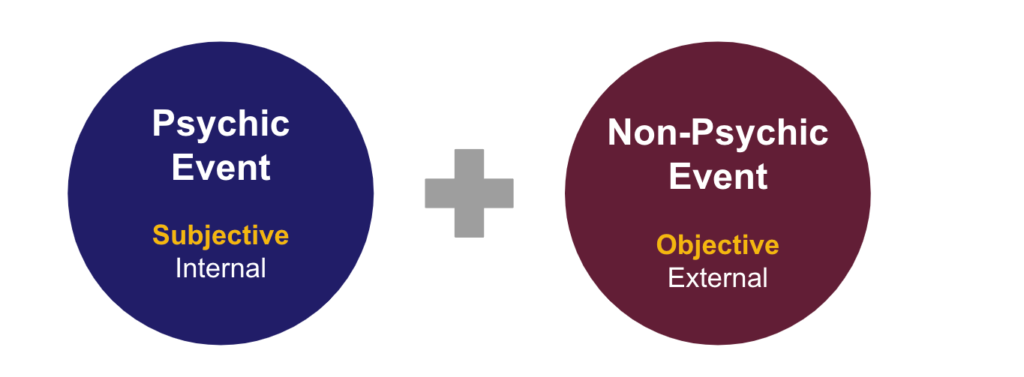
Synchronicity occurs when an event in the external world mirrors an internal issue.
Consequently, synchronicities require two events to happen simultaneously or in parallel:
Subjective event (internal/psychic)
Objective event (external/non-psychic)
For Jung, a “psychic” state refers to anything going on in your subjective experience, including your thoughts, feelings, attitudes, and impulses.
With synchronicities, an internal (psychic) event parallels an external (non-psychic) event even though there’s no causal connection between the two.
Coincidence versus Serendipity versus Synchronicity
These three terms are not interchangeable. Let’s clarify things:
A coincidence is when two events happen at the same time by chance.
Serendipity denotes a fortunate accident; it’s a pleasant event, but it’s not psychic.
A synchronicity is when those two events share meaning for the person experiencing them. There’s a meaningful parallel between the inner state and the outer event.
The difference isn’t statistical—it’s phenomenological. The meaning itself is the mechanism.
For example, seeing 11:11 on the clock isn’t synchronicity. It’s just a coincidence, or maybe even serendipitous
However, seeing 11:11 while thinking about a decision you’ve been wrestling with—that is serendipitous.
Close-up of a dandelion | Photo by Claud Richmond
Classic Synchronicity Examples
Before we explore the potential mechanisms at work behind these meaningful coincidences, let’s run through a few more examples of synchronicity.
You have a dream about an old friend you haven’t spoken to in years (subjective), and then the friend calls you the next day (objective).
You’re wrestling with a significant decision like starting a business (subjective), and you overhear someone on the train talking about how liberating it is to work for yourself (objective).
You’re going through a personal issue (subjective), and the character on your favorite television show has the same problem in the next episode (objective).
You’re trying to understand a complicated psychological problem your partner is dealing with, and you unexpectedly get into a dialogue with someone who breaks it down for you (without you even mentioning it).
You continually see specific signs that appear to be “nudging” you toward a particular change in habit, a new relationship, or a different career choice that you’ve been considering.
You’re thinking of taking qigong, and minutes later, you walk past someone practicing it in a park.
The adage, “When the student is ready, the teacher appears,” represents another example of synchronicity. The student’s openness, eagerness, and receptivity (subjective state) parallel the appearance of a physical teacher (objective state).
The Acausal Principle and the Nature of Reality (Time, Mind & Matter)
Jung called synchronicity an acausal principle. Let’s start by exploring what that means.
Western Causality and Linear Time
With causality, the assumption is that event A causes event B. You let go of the pen you’re holding [A], and the pen falls to the ground [B].
The first event causes the second event.
The underlying assumption of causality is that time is linear. A causes B because A happens in sequential order before B.
This causal relationship between two events is at the core of Newtonian (or classical) physics.
This view about causality and linear time is so deeply rooted in Western thinking that most people would never question it or consider that there’s a different or complementary way of perceiving phenomena.
Eastern Cyclical Time and Nonlinearity
But what happens when you remove the assumption of time as strictly linear? Sounds too far-fetched?
Well, from an Eastern viewpoint, especially for the Chinese, time isn’t perceived as linear but as cyclical.
Chinese philosophy has two primary aspects of time:
Timeless time (unchanging eternity)
Cyclical time
In this understanding, the time perceived in everyday life is cyclical. That is, life isn’t following a line from an arbitrary starting point to some unknown point in the future.
Instead, time flows through specific cycles or patterns, regardless of whether these patterns are observable to the individual’s consciousness.
Time as Nonlinear
Time, in this acausal context, is perceived as nonlinear. While nonlinear time isn’t workable from a Newtonian viewpoint, it is entirely conceivable from an understanding of quantum mechanics.
With an understanding of time as nonlinear, meaningful coincidences between the physical and psychic realms become plausible, if not obvious.
Sequence versus Coincidence: West versus East
Jung highlights the differences between causality and synchronicity:1Carl Jung, Collected Works Volume 11, pg. 593. (my emphasis)
Just as causality describes the sequence of events, so synchronicity to the Chinese mind, deals with the coincidence of events.
Jung later attempted to explain the East’s radically different orientation towards science and time:2C.G. Jung, Dream Analysis: Notes of the Seminar Given in 1928–1930, 1984, p. 44.
The East bases much of its science on this irregularity and considers coincidences as the reliable basis of the world rather than causality. Synchronism is the prejudice of the East; causality is the modern prejudice of the West.
In this way, Jung demonstrates that the principles of causality and synchronicity were notmutually exclusive.
The Principle of Correspondence
Essentially, Jung tried to illustrate how the West’s time-conditioned thinking blocks us from apperceiving this acausal principle and the existence of meaningful coincidences.
His solution was to replace this time-conditioned thinking with the correspondence principle.3C.G. Jung, Aion, Collected Works 9B, para 409.
The correspondence principle is an established Hermetic law in alchemy. Most are already familiar with the popular phrase from The Kybalion,
As above, so below: as below, so above.
Or, as Jung put it (paraphrasing), everything without (outside) is within us. Everything above us is below us.4Collected Works of C. G. Jung, Volume 15: Spirit in Man, Art, and Literature, para 12.
Jung’s Acausal Connecting Principle (Where East and West Meet)
After exploring both Western linear time and Eastern cyclical time, Jung proposed a bridge between them—the acausal connecting principle.
He recognized that not every connection in life fits the cause‑and‑effect chain prized by Western science. Some events unfold in a way that defies logic yet feels deeply ordered.
Drawing from Taoist philosophy and the I Ching, Jung saw how Eastern thinkers treated coincidence as part of an underlying pattern—a timeless flow where inner and outer events mirror each other.
To Jung, this was evidence that meaning itself could act as a kind of connective tissue between mind and matter.
Causality explains the sequence of events; acausality explains their significance.
When both perspectives come together, reality appears less mechanical and more alive—a multidimensional field where psyche and nature interact through symbolic correspondence rather than physical cause.
Photo by Nick Design | Unsplash
Archetypes and the Collective Unconscious
For Jung, archetypes are “the living system of reactions and aptitudes that determine the individual’s life in invisible ways.”5C.G. Jung, The Structure and Dynamics of the Psyche, Collected Works, Volume 8, 1970.
He perceived these primordial images as fundamental units of the human mind. These images shape virtually all human behavior, residing in what he referred to as the collective unconscious (a universal repository within the collective psyche).
As Marie-Louise von Franz explains:6von Franz, M.-L. (1997). Archetypal dimensions of the psyche. Shambhala Publications.
The archetypes are inherited dispositions, which cause us to react in a typical way to basic human problems, inner or outer.
From Jung’s perspective, all synchronistic events involve archetypes. He writes:7Carl Jung, Letters Vol. II, pp. 43-47.
Where an archetype prevails, we can expect synchronistic phenomena, i.e., acausal correspondences, which consist in a parallel arrangement of facts in time.
Both archetypes and synchronistic events represent psychic phenomena. They are “events” unfolding in the subjective, nonphysical landscape that can influence, inform, and coincide with the external, objective world.
One example Jung gives is what can happen when an individual’s life is threatened. Under a grave threat, “the archetypes are constellated, synchronistic situations can arise—events that are independent of him, existing in the outside world.”8Carl Jung, Conversations with C.G. Jung, pg. 51.
In this heightened state, if the individual is alert and receptive, the Universe is likely to illuminate a meaningful sign.
The Science of Synchronicity: Chaos, Cycles & Quantum Parallels
Modern science is beginning to glimpse what Jung intuited a century ago—that behind life’s seeming randomness may lie hidden patterns of order.
Economists and physicists observe hidden repeating cycles in weather, markets, and energy systems.
Quantum theory goes further, showing that particles can influence each other without direct contact, hinting that reality itself is interconnected and acausal.
These discoveries don’t prove Jung’s idea of synchronicity, but they illustrate how the universe can express both chance and design at once.
Seeing this, Jung’s “meaningful coincidences” no longer seem mystical—they may be glimpses of the same nonlinear web that science is just beginning to map.
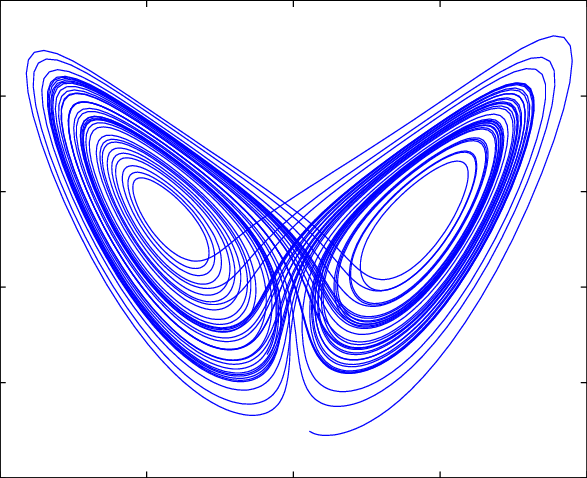
While studying weather data, American mathematician and meteorologist Edward Lorenz plotted various initial data points on a graph using nonlinear equations.
These seemingly random initial conditions (points of weather data) revealed a remarkable image, now known as the Lorenz butterfly or the Lorenz attractor (above).
(In fact, Lorenz coined the famous term the butterfly effect.)
This discovery is an essential insight from a field of study called chaos theory.
A key insight from chaos theory sheds additional light on the acausal principle: that within chaotic and complex systems, there are hidden patterns (referred to as attractors).
That is, although our brains may not be able to perceive it this way, there is a hidden order behind apparent randomness and chaos.
This understanding, in itself, helps contextualize the extraordinary reality of Jungian synchronicity.
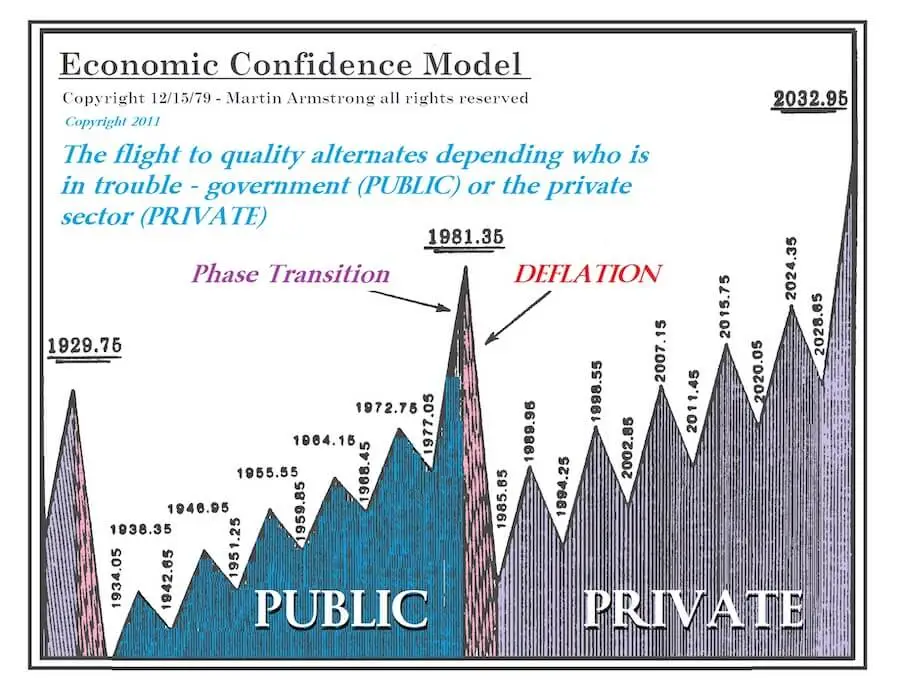
Martin Armstrong’s Economic Confidence Model (Cyclical Time) | source
Using Cyclical Time to Predict Market Movements
Martin Armstrong is the founder of Armstrong Economics and has been one of the world’s leading economists and financial advisors for over 50 years.
In the 1980s, he developed one of the first natural language algorithms (AI) using extensive historical data on world financial markets, geopolitical events, currencies, precious metals, weather, wars, and other relevant fields.
The result is what he calls Socrates, a predictive AI engine that can analyze markets in real-time. Since the 80s, Armstrong has been using Socrates to predict world events and market movements accurately for multi-billion-dollar institutions and world governments.9Armstrong was imprisoned for 11 years on false charges because he would not share Socrates with the government. See the revealing documentary titled The Forecaster.
He discovered that virtually everything in the objective world follows specific patterns. Armstrong’s Socrates discovered, for example, an 8.6-year business cycle.
Every industry has its cyclical waves, with ascending and descending trends. Behind the appearance of apparent randomness are hidden patterns or attractors.
Having followed Armstrong’s commentary and predictions for well over a decade, it is most impressive.
Of course, Mr. Armstrong wasn’t the first person to come to this understanding of repeating cycles …
Various oracles and divination practices operate based on this synchronistic connective principle, including:
I Ching
Tarot
Numerology
Astrology
Yijing (yarrow-stalk divination used in Confucianism)
Most of these ancient practices have existed for millennia.
The modern, “scientific mind” denigrates these oracles and divination practices as their operating mechanism exists outside their conventional scientific and psychological worldviews.
Jung discovered this understanding of the acausal principle behind synchronicity when he received a copy of the I Ching (translated by Richard Wilhelm).
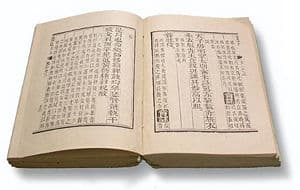
The I Ching, or The Book of Change, is all about cycles and the acausal nature of life. It was believed to have been published by a sage king named Fu Xi during the ninth century BC, based on divination practices that were at least a thousand years older.
The I Ching is considered both a scientific text and a spiritual manual. It was often used as a divination tool to help predict future events (based on this understanding of continual cycles like Armstrong’s AI engine).
How to Use the I Ching for Divination
The I Ching contains 64 hexagrams. Each hexagram has a unique six-line combination along with a specific passage and commentary.
To “cast your hexagram,” you first pose a question that’s relevant to you (either write it down or hold it in mind).
Then, to consult the I Ching, the two most common methods for casting use traditional yarrow stalks or three coins.
Using the coin method (simpler), you toss the three coins six times, recording whether each toss is yang or yin (heads or tails). Yang and yin each have a numeric value. Then, you calculate each toss to determine the hexagram line type.
After casting six times, you have your primary hexagram, and you’re ready to consult the I Ching for insights. (This article provides more specific details.)
Jung’s Observations Regarding the I Ching and Synchronicities
Jung observed that when his patients asked meaningful questions and consulted the I Ching, the resulting hexagram often provided relevant answers.
The insightful and meaningful results provided by the I Ching gave Jung further evidence of synchronicity and the acausal principle.
He wrote:10Carl Jung, Collected Works Volume 8, pg. 452.
The method like all divinatory or intuitive techniques is based on an acausal or synchronistic connective principle.
Jung observed similar encouraging results when his patients consulted Tarot cards.
Divination Ceremony and Dance, Brazil, by Zacharias Wagenaer (1630)
Experiments versus Oracles
In one of her lectures included in On Divination and Synchronicity, Marie-Louise von Franz contrasts the difference between the “modern, physical scientific experiment” and a “divination oracle” like the I Ching.
Physical experiments attempt to eliminate chance. And when an outlier exists, it’s ignored as a “small matter.”
With oracles, chance isn’t eliminated. Instead, it takes center stage. With divination, chance is the data.
So, in modern science, chance is a disturbance or a factor one eliminates. With divination, chance is the source of information.
Experiments
Oracles
Eliminate chance
Make chance the center
Based on repetition
Based on one unique act
Based on probability calculus
Use the unique individual number as the source of information
Said another way, modern experiments omit the outliers while divination practices exclusively focus on them.
Reviewing these critical differences, it is clear why modern science struggles with the reality of synchronicities.
And, it’s not surprising that many in the academic community would label the acausal principle a “pseudoscience.”
Ultimately, the oracle-synchronistic understanding is not at odds with the material science viewpoint. As we saw above, they represent complementary principles.11Carl Jung, Letters Volume II, pp. 425-426
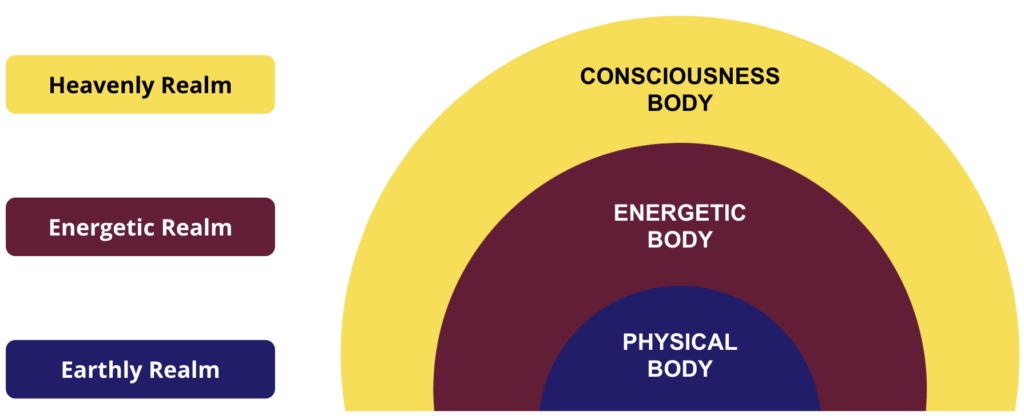
Three Realms of Existence (Taoism)
The Energetic Nature of Synchronistic Events
Let’s back up for a moment so we can better appreciate what’s happening when meaningful coincidences unfold.
To do so, we need to clarify a few concepts found in Taoism and compare them to Jungian explanations.
The Three Realms of Existence
In Taoist thought, they present three realms or levels of existence:
The Physical or Earthly Realm
The Energetic Realm
The Heavenly realm
These three realms coincide with the Three Treasures we’ve addressed in numerous previous guides:
Jing: vitality or life essence (associated with the physical body)
Qi: life force energy (associated with the energetic body)
Shen: spirit or consciousness (associated with the consciousness body)
The goal of Taoist practices is to transmute these Three Treasures within the body into higher consciousness and eventually realize emptiness, thereby bringing “earth and heaven” into balance within the individual.
Psychic Energy in the Acausal Principle
While causality is an observable phenomenon within the physical realm, synchronism (the acausal principle) involves the energetic and/or heavenly realm of consciousness itself.
Jung and the Jungians intuited the energetic nature behind this acausal principle.
In fact, to Jung, things like archetypes, dreams, oracles, fairytales, and myths all carry an energetic signature, which he and other Jungians refer to as psychic energy.12Harding, M. E. (1973). Psychic Energy: Its Source and Its Transformation. Princeton University Press.
As von Franz explains, “An archetypal tale, like a dream, represents a self-representation of the flow of psychic energy.”13On Divination and Synchronicity, 81.
This flow of psychic energy relates to the energetic realm, which operates on nonlinear and nonlocal principles (more consistent with quantum mechanics).
From a Jungian point of view, the entire process of depth psychology constitutes an interpretation of the flow of psychic energy.
We look at dreams, therefore, as an energic process, as a visualization of the flow of the energy of the unconscious, and the same is true for mythological dreams, for fairytales and myths—the archetypal forms of this manifestation. One can always look at them from an energic standpoint.
Inner Work: Synchronicity is a Bridge Between Realms
So, perhaps now it’s easier to appreciate better how inner work—the exploration of one’s psyche—relates to the principles behind synchronicity.
Jung states:15Carl Jung, Letters Vol. II, pp. 445-449.
In so far [as] synchronistic events include not only psychic but also physical forms of manifestation, the conclusion is justified that both modalities transcend the realm of the psychic and somehow also belong to the physical realm.
Here we see Jung acknowledging the interconnected nature of matter (earth and physical) and mind (both energetic and consciousness).
Note: Although I don’t get the sense that Jung (or the Jungians) had an accurate understanding of Taoist thought, he was undoubtedly aware that realms beyond the physical exist and interface with one another.
Experiencing Synchronicity Physically
For those with a certain level of energetic sensitivity who are more connected to their subtle energy body, there’s a visceral sensory experience in the presence of meaningful coincidences.
There’s often a tingling sensation, like an extra charge of qi energy coursing through you, especially up the spine and into the brain region.
An individual may also perceive a flash of light in the region associated with the third eye or at the crown of the head.
That is, “psychic energy” appears to have physical correlates within the human body.
The overall experience of authentic synchronicities has a decidedly magical feel to it.
Even if you were divorced from a sense of wonder before the experience, this essential quality will resurface after it.
Photo by Max Letek | Unsplash
The Spiritual Implications of Meaningful Coincidences
Now, the question many readers may ask: What’s the significance or true meaning of these synchronicities?
Since synchronistic events involve our personal psyche (subjective experience), we can’t derive an absolute or objective meaning from them.
That is, synchronicities require interpretations to extract any personal meaning or significance. For this reason, as we saw above, we can’t efficiently study synchronistic events using traditional experiments; you can only witness them.
How someone interprets the meaning of these events is up to the individual. One’s interpretation will be dependent on or influenced by their:
Prevailing beliefs and worldviews
Current internal tensions and life circumstances
Level of intuition, sensitivity, and self-awareness
Discernment and self-analysis are required to infer potential personal meaning from these events.
The Numinous Quality of Synchronicity
Jung described the “numinous” as a profound spiritual unfolding, a deeply felt experience of a higher, mysterious power that transcends the personal ego.
For Jung, the ultimate interpretation of synchronicities involved the numinous (spiritually elevated or sublime).
Jung writes:16Jung, Conversations with C.G. Jung, pg. 51
We should be particularly watchful when synchronous events occur for a numen is then in sight. In a certain mood one notices that the crows fly towards the left. When an archetypal event approaches the sphere of consciousness, it also manifests itself in the outer life.
This discernment is critical because the numinous separates genuine synchronicity from pattern-spotting (e.g., seeing 11:11 repeatedly). Without it, you’re just noticing coincidences.
The numinous is what the energetic realmfeels like when it breaks through. That tingling feeling, surge of energy up the back, the flash of light at the crown—these are the somatic signatures of meaning.
For example, an old friend calls whom you haven’t spoken to in a while; you feel the chills before you even answer the call.
Just remember, the numinous is a signal, not a drug. Chasing this feeling leads to manufactured synchronicities, which happen often with many individuals indoctrinated by New Age ideologies.
We need only pay attention inwardly, listen, and remain receptive to what unfolds next. And, at the same time, stay grounded.
The Hindu Interpretation of Synchronicity
From the Hindu perspective, everything is Brahman (or Brahma).
Brahman is God as the Creator, representing the totality of this manifest reality.
Inner work is a means of connecting your conscious mind with your unconscious. The goal of which is to bring unconscious material to the surface, build consciousness, and heal the splits within one’s psyche.
While the conscious mind operates mainly in the objective, earthly realm, the unconscious connects to the energetic and “heavenly” realm of consciousness itself.
Synchronicities can also illuminate shadow material—qualities you’ve disowned or repressed. When an outer event triggers disproportionate irritation, attraction, or fascination, it’s often reflecting something unconscious back at you. The synchronistic event becomes a mirror.
You may discover that as you acknowledge these synchronistic events, a stronger creative impulse comes alive within you (which further supports self-healing).
Pay Close Attention to Your Dreams
If you do nothing else but pay closer attention to your dreams by recording them each morning, you’re already beginning to constellate psychic energy from a Jungian perspective.
As Jung notes:17C.G. Jung, Dream Analysis: Notes of the Seminar Given in 1928–1930, 1984, p. 45.
The more we busy ourselves with dreams, the more we shall see such coincidences—chances.
And this is observably valid. The more you turn your attention toward your inner world, the more the Self begins to communicate with you through the three realms.
In this way, synchronicities can become essential markers for self-healing.
2 – Using Synchronicities for Spiritual Guidance and Intuition
When coincidences cluster around a question, they act as symbolic guidance, aligning outer events with inner knowing.
Synchronicities can also be a powerful aid when you’re on a spiritual journey.
Sometimes you get confused or uncertain and are looking for direction.
In these moments, you might, for example:
Pose a question to your subconscious in the evening before going to bed
Sit in meditation and pray for guidance
Consult an oracle like the I Ching
Pay attention to your dreams
Then, be patient and stay on the lookout for a meaningful sign. Spiritual guidance can manifest in unlikely ways.
The key is to put forth the question with both sincerity and faith.
Synchronicities and Spiritual Growth
As you continue along your path of spiritual growth, synchronistic events can begin happening rapidly and frequently.
Marie-Louise von Franz explains why this is so:18Franz, On Divination and Synchronicity, 21.
[The] larger our consciousness is, and the more it develops, the more we get hold of certain aspects of the spirit of the unconscious, draw it into our subjective sphere, and then call it our own psychic activity of our own spirit.
As we build consciousness and expand our awareness, the bridge between the three realms gets stronger.
3 – Applying Synchronicity to Real‑Life Decisions and Timing
Meaningful coincidences often surface at decision points; observing their timing helps calibrate when to act or wait.
Of course, the benefits of synchronicities aren’t exclusive to the psychic or spiritual dimension.
Meaningful coincidences can help inform many real-world decisions, including:
Career changes
Choosing a partner
Visiting a particular place
Reading a specific book
Visiting a website
Searching for a specific topic online
Using synchronicities to inform decision-making is done in a similar way to that described above.
Essentially, you put forth your question with sincerity and faith, and then pay attention.
One Last Example of Synchronicity
Here’s one more example that happened to me while writing this guide.
I had been thinking about acupuncture points lately, as I instinctively found myself focusing on specific regions of the body. So, I pulled a book on meridian theory from my shelf to reference when I had time.
On a work break, I was listening to a market report. While listening, I spontaneously picked up the meridian book, and just as I did, the analyst said the phrase “pressure points.”
This analyst was speaking about geopolitics and world events; he was using “pressure points” in a completely different context.
Yet, for me, this was a synchronistic event, a meaningful coincidence. It confirmed my instinctual decision, leading me to invest additional psychic energy in following it.
The Critical View: Why Western Science and Psychology Dismiss Synchronicity
Naturally, you won’t have difficulty finding criticism or skepticism of the concept of synchronicity.
In fact, mainstream psychology outright rejects the idea.19See, for example, https://www.psychologytoday.com/us/basics/synchronicity
In their collective mind, the concept of meaningful coincidences is nothing but the mind doing something it loves to do: recognizing patterns, including those that aren’t really there.
That is, to this cohort, “synchronicities” are just a random occurrence that our feeble minds are projecting meaning onto.
Is it just “confirmation bias” at work here?
They will tell you that synchronicity is nothing but confirmation bias.
Confirmation bias is the tendency to look for, interpret, and remember events in a way that confirms one’s existing beliefs, values, or worldviews.
In all fairness, confirmation bias is potentially a valid factor in some instances where individuals interpret synchronicity.
For example, if you see 11:11 on the clock two days in a row, your mind is going to look for and expect to see it on the third day. (The Reticular Activating System in the brain filters information based on what it perceives as relevant and important.20Kinomura, S., Larsson, J., Gulyás, B., & Roland, P. E. (1996). Activation by Attention of the Human Reticular Formation and Thalamic Intralaminar Nuclei. Science. https://doi.org/10.1126/science.271.5248.512)
But we can’t use pattern recognition and confirmation bias to explain away meaningful coincidences, as it would be irresponsible and sloppy thinking to do so.
Why is “modern psychology” so dismissive?
But why do so many individuals, especially within the academic community, have a challenging time understanding the nature of synchronicity?
To answer this question, we need to briefly look at the academic and scientific community’s dominant worldview and contrast it with a remarkable alternative.
Once we do so, we’ll better appreciate why there are synchronistic naysayers. Plus, we’ll also understand their confirmation bias.
Photo by Giulia May | Unsplash
Synchronicity FAQ
Now, let’s address some commonly asked questions:
Is synchronicity real or just confirmation bias?
Synchronicity isn’t either/or—it’s both a real phenomenon and something the skeptical mind can dismiss as pattern recognition.
Confirmation bias explains why you notice 11:11 after you’ve primed yourself to see it. It doesn’t explain the golden scarab beetle flying through Jung’s window at the exact moment his patient described dreaming about one.
The difference is the numinous charge—a felt sense of significance that pattern recognition alone can’t account for. Discernment means admitting that some coincidences are just coincidences, while others carry a weight that rational dismissal can’t dissolve.
What’s the difference between synchronicity and coincidence?
A coincidence is when two events happen at the same time by chance. A synchronicity is when those events share meaning for the person experiencing them, and that meaning arrives with a felt sense of significance.
The distinction isn’t statistical, but phenomenological.
If you see a stranger wearing the same obscure band t-shirt as you, that’s a coincidence. If you see it while wrestling with whether to quit your job and pursue music, and you feel a visceral charge when you notice it—that’s synchronicity. The meaning, not the probability, is what makes it synchronistic.
How do I know if I’m experiencing synchronicity or just seeing patterns?
Three criteria help distinguish genuine synchronicity from ordinary pattern-spotting.
First, there must be both an internal psychic state and an external event—just seeing repeating numbers with no corresponding inner question or tension isn’t synchronicity.
Second, the connection carries a numinous quality—a felt charge, a shiver, a sense that something meaningful just broke through.
Third, the event tends to address something active in your psyche—an unresolved question, a decision point, an emotional undercurrent.
If all three are present, you’re likely experiencing synchronicity. If you’re just noticing patterns with no inner resonance, you’re probably just noticing patterns.
Can you trigger synchronicities, or do they just happen?
You can’t force a synchronicity, but you can create the conditions where they’re more likely to occur.
Jung observed that the more attention you pay to the unconscious, the more the unconscious responds.
Synchronicities tend to cluster around periods of active inner work, emotional intensity, or major life transitions. You’re not manufacturing them; instead, you’re tuning the receiver.
What did Jung actually say about synchronicity and God?
Jung was careful—he never equated synchronicity with divine intervention in the traditional religious sense. But he didn’t shy away from the theological implications either.
He saw synchronistic events as manifestations of a deeper ordering principle in reality, one that transcends causality and hints at a unified field where psyche and matter are expressions of the same underlying reality.
When a synchronicity carried a numinous charge, Jung called it an encounter with the numen—a term borrowed from Rudolf Otto that points toward the divine without defining it. He believed these moments were glimpses of something transcendent, but he left the interpretation open.
Why do synchronicities seem to increase when I’m doing inner work?
Because inner work constellates psychic energy. When you record dreams, engage active imagination, or explore shadow material, you’re directing attention toward the unconscious—and the unconscious responds.
Marie-Louise von Franz explained it directly: the larger your consciousness grows, the more you draw the spirit of the unconscious into your subjective sphere. The boundary between inner and outer becomes more permeable.
Synchronicities aren’t increasing because the universe suddenly cares more about you—they’re increasing because you’re finally paying attention to the channel they’ve always been broadcast on.
Is there a dark side to synchronicity? Can it become an obsession?
Yes. The same numinous charge that makes synchronicity meaningful can become addictive.
Some people fall into what might be called sign-seeking—scanning every moment for hidden messages, interpreting every coincidence as cosmic guidance, losing the ability to make grounded decisions without external “confirmation.”
This is especially dangerous during periods of emotional vulnerability or spiritual emergency.
Jung himself warned against inflating the ego’s role in synchronistic events. The healthy relationship with synchronicity is one of receptive attention, not compulsive interpretation. If you’re chasing signs more than you’re living your life, step back.
How is synchronicity different from manifestation or the law of attraction?
Synchronicity and manifestation operate on fundamentally different principles.
Manifestation and the law of attraction claim that your thoughts cause external events—think positively about wealth and wealth appears. That’s a causal model, even if the mechanism is metaphysical.
Synchronicity is explicitly acausal—the inner state doesn’t cause the outer event; they arise together through a meaningful correspondence that transcends linear cause and effect.
Jung’s framework doesn’t promise you can manifest a parking spot by visualizing it. It suggests something stranger and more interesting: that psyche and world are expressions of the same underlying reality, and sometimes they align in ways that reveal that unity. No vision board required.
Sunflower Closeup | Photo by Rodolfo Mari
Unlocking the Power of Synchronicity
Above all else, synchronicity is an observable principle within the physical and psychic (energetic) realms.
Meaningful coincidences can be instructive and insightful indicators of our life decisions and overall direction.
Understanding the principles behind synchronicity, including acausality and nonlinearity, can transform our understanding of reality and lead to a more profound appreciation of the nature of existence and time.
Synchronicities are guideposts on the path of individuation—the lifelong process of becoming whole that Jung placed at the center of his psychology.
As von Franz observes:21Franz, On Divination and Synchronicity, 84.
For everything there is the right moment, the right constellation for action, and to act too early or too late destroys the whole possibility. We do not consider that enough. We think too much in abstract terms, either that a thing is good or bad, and we do not think enough from the feeling standard of the special time circumstances in which we act, for our ethical deeds do depend on time.
When you first begin experiencing synchronicities, they can feel extremely personal. After all, it’s an event unfolding in the external world that has meaningful significance to you.
However, over time, the experience of synchronicities becomes increasingly impersonal. These occurrences become less about you (from the ego’s viewpoint) and more an expression of the interconnectedness of all things, and on multiple levels.
Regardless, it’s as if, in that moment of meaningful chance, the Universe is speaking to you. The question is:
Are you ready to listen?
Books on Jungian Synchronicity
Jung’s book Synchronicity is a section of volume 8 of his Collected Works. Marie-Louise von Franz’s On Divination and Synchronicity is chock-full of insights as well.
(Disclaimer: affiliate links to Amazon below.)
Synchronicity: An Acausal Connecting Principle C. G. Jung
Jung, C. G. (1951–1961). Letters, Vol. II. Princeton University Press.
Jung, C. G. (1984). Conversations with C. G. Jung. Princeton University Press.
Jung, C. G. (1966). Collected Works of C. G. Jung, Vol. 15: Spirit in Man, Art, and Literature. Princeton University Press.
Jung, C. G. (1984). Dream Analysis: Notes of the Seminar Given in 1928–1930. Princeton University Press.
Jung, C. G. (1952). Collected Works Vol. 8: The Structure and Dynamics of the Psyche (includes “Synchronicity: An Acausal Connecting Principle”). Princeton University Press.
Jung, C. G. (1959). Aion, Collected Works Vol. 9 Part B. Princeton University Press.
Jung, C. G. (1952). Collected Works Vol. 11: Psychology and Religion: West and East. Princeton University Press.
Harding, M. E. (1973). Psychic Energy: Its Source and Its Transformation. Princeton University Press.
von Franz, M.‑L. (1980). On Divination and Synchronicity: The Psychology of Meaningful Chance. Spring Publications.
von Franz, M.-L. (1997). Archetypal dimensions of the psyche. Shambhala Publications.
Kinomura, S., Larsson, J., Gulyás, B., & Roland, P. E. (1996). Activation by Attention of the Human Reticular Formation and Thalamic Intralaminar Nuclei. Science. https://doi.org/10.1126/science.271.5248.512
About the Author
Scott Jeffrey is the founder of CEOsage, a self-leadership training platform. For 25 years, Scott was a business coach to high-performing entrepreneurs, CEOs, and best-selling authors. He publishes in-depth guides read by millions of growth-oriented individuals, focusing on self-actualization, shadow work, spiritual awakening, and integrated practices. He's the author of four books, including Creativity Revealed.