
Coaches stand on the sidelines, peering over their players as they move.
When they see a player doing something suboptimal, they pull their player aside to offer feedback.
The coach’s objective is to improve their players’ performance. Masterful coaches and leaders see things that players on the field cannot see.
Outperforming entrepreneurs, chief executives, and managers often have this coaching leadership style.
Offering effective feedback is a skill. Like all skills, this one can be learned and continuously improved.
Drawing on over 25 years of coaching psychology and leadership study, this guide unpacks the seven core characteristics of effective feedback and the psychological insights behind them—ensuring your dialogue builds trust, autonomy, and excellence.
Let’s dive in …
What Is Effective Feedback? (And What It’s Not)
Feedback is critical for any healthy learning environment.
Feedback is effective when the recipient can receive the information and adjust their behavior accordingly. That is, effective feedback leads to positive change.
Effective feedback derives from a spirit of individual and team improvement.
Effective feedback from a coach or manager helps individuals become the best versions of themselves in sports, work, education, and life.
Effective feedback is not criticism, condemnation, or judgment.
Effective feedback is not a command or an order. “Do it like this!” is a command, not feedback.
Ineffective feedback creates internal resistance within the recipient, leading them to shut down.
With ineffective feedback, there’s no positive change or momentum.
Seven Proven Benefits of Effective Feedback
Providing effective feedback can produce the following benefits:
- Increases employee and student effort
- Improves work performance
- Leads to better organization and team outcomes
- Improves the individual’s self-regulation skills—a key attribute of emotional intelligence
- Promotes more loyalty within an organization or team
- Supports continuous learning and a growth mindset
- Enhances interpersonal relationships
Effective feedback plays an essential role in any high-functioning organization, team, or learning environment.
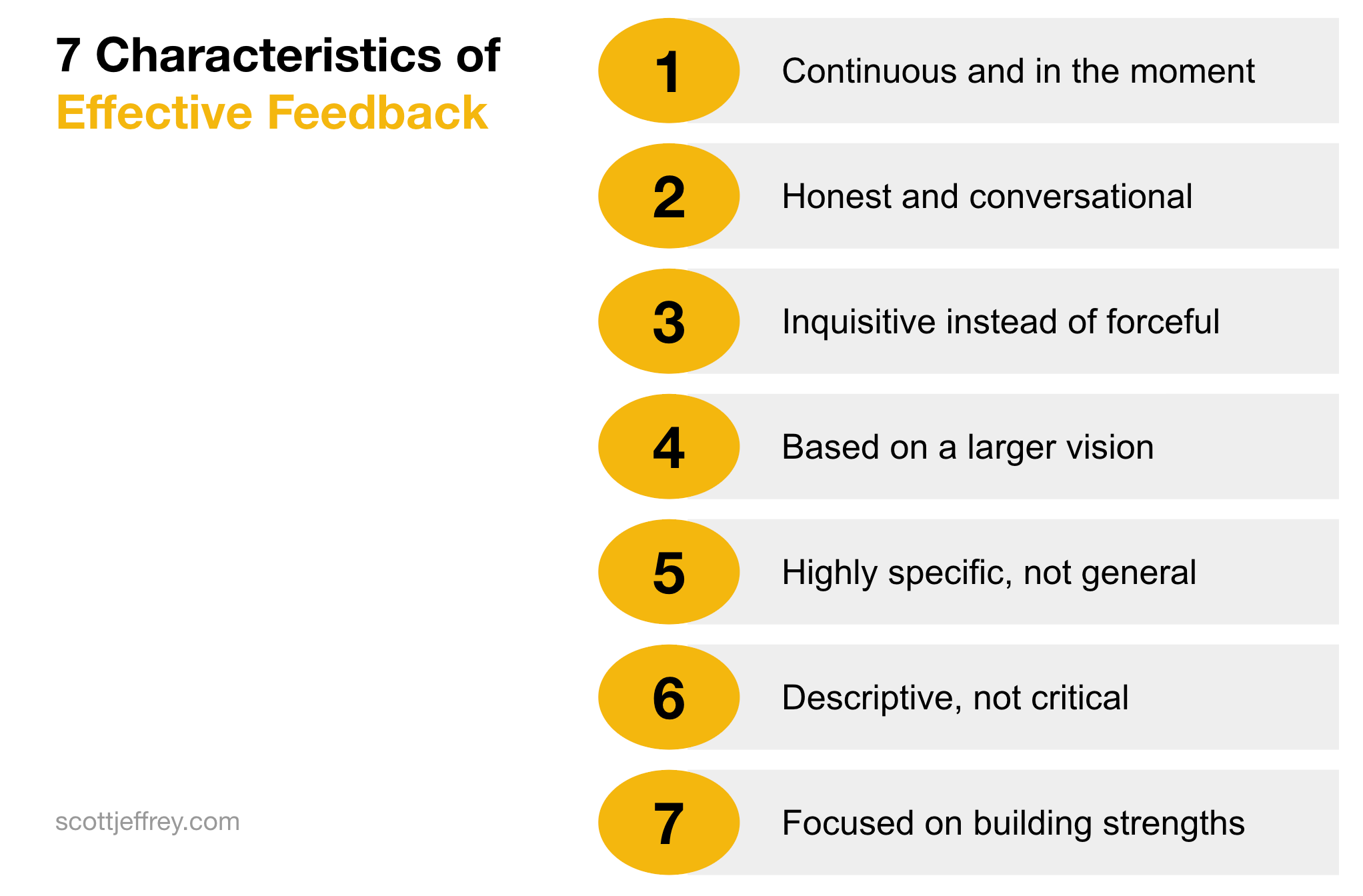
The 7 Characteristics of Effective Feedback
Here are seven principles and characteristics to keep in mind when offering feedback to your employees, team members, students, athletes, or children.
Effective feedback is:
- Continuous and in the moment
- Honest and conversational
- Inquisitive instead of forceful
- Anchored in a larger vision
- Highly specific, not general
- Descriptive, not critical
- Strength-focused
Now, let’s take a closer look at each characteristic with effective feedback examples:
1 – Continuous and in the Moment
The most effective feedback is given right at or near the time the issue requiring feedback is raised. This is the case in organizations, on the field, and even with dog training at home.
Most new dog owners, for example, struggle to train their puppies not to pee and poop in the house. Feedback needs to be in the moment.
So if your puppy poops on the rug during the day and you then come home and reprimand him for it, that is ineffective feedback. No learning or change takes place in this context.
If you don’t catch your pet making the mistake in the moment, you can’t provide effective feedback.
Similarly, if you observe him making a mistake and don’t provide immediate feedback, you’re sending mixed signals, which isn’t effective feedback.
The same principle applies to people. Effective feedback needs to be continuous, consistent, and as salient as possible.
2 – Honest and Conversational
A supportive leader doesn’t talk down, condemn, or berate others. Backhanded comments or passive-aggressive behavior undermine the feedback process.
Instead, effective leaders and communicators are honest with others. They acknowledge others as human beings. They communicate with emotional intelligence and a genuine concern for others’ well-being.
As psychologist Daniel Goleman’s research confirms, outperforming leaders have high levels of emotional intelligence.1Daniel Goleman. “What Makes a Leader?” Harvard Business Review, January 2004.
With emotional intelligence comes empathy. Empathy enables a leader to communicate feedback honestly and in a conversational way to their recipients. They understand the nature of internal resistance to feedback because they have experienced it within themselves (see examples below).
3 – Inquisitive Instead of Forceful
Forcefulness leads to internal resistance. Resistance blocks positive change.
Another characteristic of effective feedback is that it helps the individual arrive at the desired change on their own.
Effective feedback empowers others to make changes by using self-directed questions.
Great leaders guide individuals with questions instead of issuing demands. For example:
- This doesn’t seem to be working. Do you have any ideas on how we can tweak this?
- If there were a better way to move toward our desired outcome, what might it be?
- Your team doesn’t seem to be responding to this approach. Is there another way you can try communicating with them?
Encourage your team members to take ownership of their work. Try to help others come to the necessary conclusions on their own.
Whenever possible, allow them to make adjustments and improve their own performance—i.e., self-regulation and self-mastery.
(You’ll find more effective feedback examples with questions in a separate section below.)
4 – Anchored in a Larger Vision
A football or soccer coach provides feedback based on how the play is supposed to run.
A manager offers feedback based on the department’s or organization’s larger strategic goals and vision.
A music instructor provides feedback based on how the instrument is intended to sound when played expertly.
An ultimate vision or clear objective is what fuels effective feedback (not a drive for personal gain or power over others).
5 – Highly Specific, Not General
“Do better!” or “This doesn’t work” is not effective or helpful feedback.
Effective feedback is precise. For example:
- Notice the difference when you kick the ball with your head up versus your head down.
- When communicating with potential clients, maintain direct eye contact. Connect with them, human to human.
- You seemed nervous during that presentation. Next time, take a few deep, slow, steady breaths before you begin. And periodically take deep breaths while you’re presenting. It’s okay to pause occasionally to gather your thoughts.
With precise feedback, an individual can apply this instruction right away and then evaluate the results for themselves.
Highly specific feedback is essential for learning, as it creates a positive feedback loop that builds instructional momentum.
Provide specific feedback with clear action steps to achieve an objective or improve performance.
6 – Descriptive, Not Critical
Critical or judgmental comments undermine performance by reducing motivation to learn and improve.
Effective feedback is highly descriptive and points to specific ways for improvement.
Notice how all of the examples in the section above are descriptive.
“You did a good job” or “You did a bad job” may be evaluative, but it’s not effective feedback.
The role of the leadership coach is to provide others with specific details on how to learn, grow, and improve.
7 – Strength-Focused
If your feedback is always focused on the person’s weaknesses, it will eventually frustrate both of you.
As Daniel Coyle points out in The Talent Code, masterful coaches focus on building strengths rather than weaknesses.
If someone on the field performs ineffectively, a masterful coach is less likely to provide feedback. However, when someone demonstrates great skill or improvement, a masterful coach will highlight it for all to hear. Subconsciously, everyone on the field takes note.
When giving feedback, do your best to address specific weaknesses and capitalize on the employee’s or team member’s strengths that ultimately serve both them and the organization/team.
This form of effective feedback anchors in positive associations with making changes and performing at one’s best.

Why Do People Resist Feedback? The Psychology of Defensiveness
The challenging part about giving feedback is that most individuals have a negative association with receiving feedback.
In their minds, feedback equals criticism. Early childhood conditioning from parents and teachers is usually the primary source of this negative association.
What Is the Fixed Mindset and How Does It Block Feedback?
As psychologist Carol Dweck (2007) highlights in her extensive research spanning over 40 years, many individuals possess what she calls a fixed mindset.
Individuals with a fixed mindset are afraid of looking stupid and appearing incompetent. They don’t like hearing about their flaws.
In other words, the average person’s ego (especially nowadays) is fragile. It likes to think it’s perfect; it hates hearing that it’s not.
This early childhood conditioning, and in many cases, trauma, can create a massive barrier to giving feedback to others.
In contrast, individuals with a growth mindset thrive on feedback as a tool for learning and development.

What Are the Four Stages of Learning and Why Do They Matter for Feedback?
Another common reason individuals resist feedback is their unawareness of the fact that learning follows a specific multi-stage process.
The four stages of learning, or competence, are:
- Unconscious Incompetence (Ignorance)
- Conscious Incompetence (Awareness)
- Conscious Competence (Learning)
- Unconscious Competence (Mastery)
Individuals who resist genuine feedback most likely don’t understand or appreciate this process.
Again, with a fixed mindset, there’s limited growth because the individual is often mortally afraid of feeling or looking incompetent.
Yet, as you see above, unconscious incompetence (ignorance) is the first stage of learning anything. We simply don’t know what we don’t know.
The role of master coaches and those providing effective feedback is to find ways of guiding individuals around their resistance and through these learning stages, helping them build awareness and ultimately improve.
How to Overcome Resistance to Feedback
The seven characteristics of effective feedback listed above provide numerous ways to overcome people’s resistance to feedback and change.
How do you offer feedback in a way that others will be receptive to hearing it?
First, let’s highlight what we don’t want to do. The following ways of communicating increase resistance by raising people’s ego defenses:
- Talking down to others
- Being forceful, general, or critical
- Focusing on people’s weaknesses
In contrast, the following ways of giving feedback reduce resistance and make others more receptive to listening:
- Being honest and conversational in your communication style (characteristic #2)
- Being inquisitive and asking thought-provoking questions (characteristic #3)
- Staying focused on a larger vision (characteristic #4)
- Being highly specific and descriptive with your feedback (characteristics #5 and #6)
- Focusing mainly on building strengths that lead to positive momentum (characteristic #7)
The more you can apply these characteristics of effective feedback, the more receptive individuals will be to making positive changes.
What to Say When Someone Gets Defensive
It’s natural for people to get defensive to criticism, so never take it as a failure. The key is acknowledging the reaction without abandoning the feedback.
Here are three scripts you can experiment with:
When they justify: “I hear you. I’m not questioning your intent—I’m describing the impact. Those are two different things.”
When they shut down: “Take your time. I don’t need a response right now. Let’s sit with this and reconnect tomorrow.”
When they push back hard: “You may be right. Let me reflect on that. In the meantime, here’s the one piece I’d ask you to sit with.”
The main thing is to avoid escalating the situation without retreating either. Hold steady. Most defensive reactions dissolve within 48 hours—if you give them room to breathe.
Unleashing the Power of Questions
Let’s review additional effective feedback examples that utilize characteristic #3 (being inquisitive), as this is a compelling way to overcome resistance.
Masterful coaches and leaders employ the artful use of questions to induce positive change.
When you’re reviewing an employee’s proposal, for example, you might ask:
- What’s the primary objective of the proposal? (focusing them on the larger vision)
- Do you feel this proposal has achieved this objective? (self-assessment)
- Do you see any areas where the project could be improved?
- If there was a primary message that needed clarification, what might it be?
- What is the ideal response you’re looking for from this pitch?
- How else can you help ensure it receives that response?
This line of questioning enables the individual to identify areas for improvement and take ownership of the necessary changes.
Well-crafted questions circumvent the ego’s defense mechanisms.
The Permission Technique
Of course, your tone and intention when engaging with others are crucial factors.
If you come across as arrogant, all-knowing, and impatient, it doesn’t matter how well-crafted your questions are.
If, however, you genuinely want to see the person succeed, they will intuit your intention and push for higher performance.
To overcome the feedback barrier: Don’t command, criticize, or dictate. Instead, ask permission.
May I offer a few suggestions on this project?
Criticism raises people’s defense mechanisms; compassion reduces it. Ask questions to bring out the best in others’ performance and qualities. If you do, everyone wins.
Psychological Foundations from Self‑Determination Theory
Research shows that money is not our primary motivator. Managers who mainly use the old “carrot and stick” approach to motivation (do this and you’ll get a financial incentive) are rarely outperforming leaders.
Self-determination theory highlights three primary drivers to achieve psychological growth:2Ryan, R. M., & Deci, E. L. (2020). Intrinsic and extrinsic motivation from a self-determination theory perspective: Definitions, theory, practices, and future directions. Contemporary Educational Psychology, 61, 101860. https://doi.org/10.1016/j.cedpsych.2020.101860
- Purpose (Relatedness): connection to something meaningful
- Autonomy: a sense of choice and self‑direction
- Mastery (Competence): continual growth and skill refinement
Notice how all three of these drivers relate to the characteristics of effective feedback listed above.
When you communicate with others honestly and genuinely, you help them feel connected (so they can relate to you better).
When you are inquisitive with your feedback, you help others have autonomy.
And when you provide descriptive, specific feedback based on their strengths, you help others build competence and move toward mastery.
Frequently Asked Questions About Giving Effective Feedback
Now, let’s run through commonly asked questions about giving feedback.
1. What’s the difference between constructive feedback and criticism?
Feedback points to specific behavior and a path forward. Criticism attacks the person.
Feedback says, “When you present with your head down, the audience disconnects. Try lifting your chin next time.” Criticism says, “You’re a bad presenter.” One builds. The other breaks.
Effective feedback always describes the action, never judges the person.
2. How do you give negative feedback without demotivating someone?
Lead with inquiry, not force. Ask permission: “May I offer a few suggestions?” Then anchor the conversation in a shared vision—the team’s goal, the project’s success—not personal failure.
Stay descriptive and specific about the behavior. End by asking what they think. Autonomy preserves motivation. Commands kill it.
3. What are examples of effective and ineffective feedback?
Ineffective: “Do better next time.”
Effective: “When you paused to gather your thoughts before answering, the client leaned in. Do that more.”
Ineffective feedback is vague and critical. Effective feedback is specific, descriptive, and anchored in something the person can repeat or adjust immediately.
One creates resistance. The other creates momentum.
4. How do you give feedback to someone who gets defensive?
Stop talking. Let them react. Defensiveness is the ego protecting itself—it’s normal. Acknowledge what they said without agreeing or arguing. Then return to the specific behavior using “I noticed” language.
Give them space to process. Follow up the next day. Resistance fades when people feel heard before they feel corrected.
5. What is the SBI feedback model?
SBI stands for Situation-Behavior-Impact. You describe the situation, name the observable behavior, and explain the impact it had. It’s a useful starting framework.
But effective feedback goes further. It must also be continuous, inquisitive, strength-focused, and anchored in a larger vision. The 7 characteristics I outlined above build on SBI rather than replace it.
6. How often should managers give feedback?
Continuously and in the moment. Don’t save feedback for quarterly reviews. If you see something, address it as soon as it happens—that’s when learning sticks.
Weekly informal check-ins, plus immediate, specific feedback after key moments, create a rhythm. Waiting weeks makes the feedback feel disconnected from the behavior.
7. What are the common mistakes when giving feedback?
The biggest mistakes include waiting too long, being vague, making it personal, and commanding instead of asking.
Also, the “feedback sandwich”—praise, criticism, praise—confuses people.
Forceful “do it like this” orders trigger resistance. And feedback that only highlights weaknesses eventually frustrates everyone. Focus on building strengths. Be specific, timely, and inquisitive.
The Art of Giving Effective Feedback
Finally, an effective coach is always available and listens to his players. He owns his feedback.
Yes, you can ask for feedback on your feedback. If your team members trust you, they will feel comfortable providing you with honest feedback when you request it.
Players listen to great coaches not because they are authority figures, but because they respect their coaches and know the coaches have the players’ and the team’s best interests in mind.
Your employees will welcome your feedback when they feel you genuinely care and want to support them.
Effective communication originates from the heart. Business may be business, but people are still people.
When people know you genuinely care, they will listen more attentively.
Read Next
A Definitive Guide to Intrapersonal Intelligence
Visionary Leadership: Goleman’s Most Effective Leadership Style Explained
Brand Archetypes: Using Jungian Psychology to Build a Stronger Brand
Morning Routine List: Design a Daily Start That Fuels Clarity, Energy & Flow
References
- Goleman, D. (2004, January). What makes a leader? Harvard Business Review. https://hbr.org/2004/01/what-makes-a-leader
- Ryan, R. M., & Deci, E. L. (2020). Intrinsic and extrinsic motivation from a self-determination theory perspective: Definitions, theory, practices, and future directions. Contemporary Educational Psychology, 61, 101860. https://doi.org/10.1016/j.cedpsych.2020.101860