
OVERVIEW: A review of the best meditation tools to help you improve your meditation, find stillness, and train your mind.
______________
One of the things I explain in this meditation training guide is that meditation is a natural process.
Under ideal conditions, we would all remain in a present, mindful state.
However, we clearly don’t live under these ideal conditions.
As such, meditative practices can play a vital role in our ability to relax, observe, feel, and return to ourselves.
If you’re new to meditation or looking to deepen your practice, there are meditation tools on the market that can support your practice.
Let’s examine them now …
Is Meditation Beneficial?
Before investing in a meditation tool, consider whether meditation itself is worthwhile.
I assume you already know it is, but just in case …
Research shows that meditation can help:
- Develop self-awareness (study)
- Elevate your mood (study)
- Improve your immune function (study)
- Strengthen your willpower (study)
- Improve your sleep (study)
- Reduce stress (study)
- Enhance your focus and attention (study)
By all markers, meditation can support us in many ways.
Searching for the Best Meditation Tools
Perhaps you’ve tried meditation, or you may even already have a daily practice.
Regardless, most people I’ve talked with about meditation seem to struggle with it for various reasons.
I’ve been meditating daily for over 30 years using various practices and methods.
Years ago, I invested many thousands of dollars in various meditation tools, technologies, and courses in my exploration of mind training.
Truthfully, most of them were not worth the money.
If you’re looking for an edge to help you build momentum or deepen your practice, these meditation tools can help you.
Each meditation tool has a different function, which I’ll highlight below.
5 Best Meditation Tools
Here are the five meditation tools we’ll be reviewing:
- Profound Meditation 3.0 by iAwake Technologies
- Inner Balance Coherence Plus by Heartmath Institute
- Muse 2 Headband
- Kasina Mind Media System by Mind Space
- Noise-Canceling Headset by Bose
Select the meditation tools that most speak to you. (A few “bonus” meditation tools are also included below.)
Disclaimer: This post reviews various meditation tools and products that include affiliate links. If you choose to purchase these products through these links, I receive a nominal commission.
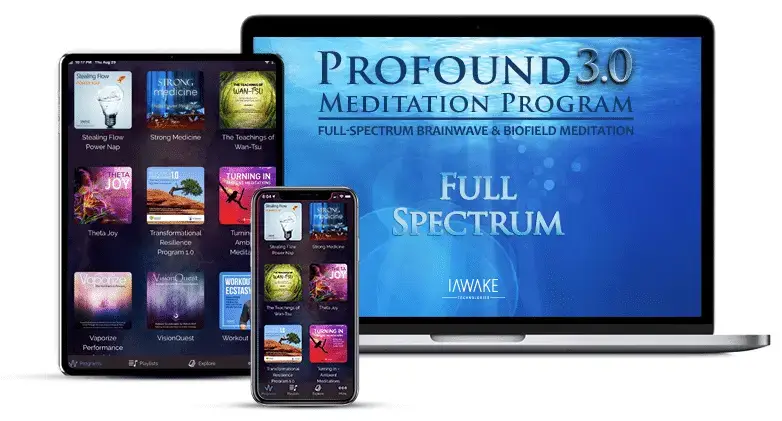
Meditation Tool #1: Profound Meditation 3.0 from iAwake Technologies
Are you familiar with binaural beats and isochronic tones? You take two different pure-tone frequencies that are close but not the same as each other, one in each ear. Combining these two frequencies creates a third tone called a binaural beat.
Binaural beats can be created to a wide range of frequencies, including those of brainwave patterns associated with various states of consciousness. The theory is that by listening to binaural beats and isochronic tones at specific brainwave patterns like alpha, theta, delta, gamma, and epsilon, you can safely induce various states of consciousness and support your meditation practice.
I’ve experimented with many of these programs on the market, but iAwake’s sound technology is unique. They go beyond traditional brainwave entrainment technology to include what they call biofield entrainment, harmonic layering, dual pulse binaural signaling, and more.
Additional Comments
These sound technologies are embedded in the background. You mainly hear various soundscapes (mostly rain/stream sounds). Profound Meditation 3.0 is a multi-disc set with a 3-tier system. You listen to the sounds in blocks of 20 minutes. With a high-quality headset, the sounds play in the background as you meditate.
This is a comprehensive meditation program that can produce psychoactive experiences. The accompanying manual explains everything you need to know to get started. The additional Releasing tracks are great for unwinding at the end of the day.
Efficacy
In my opinion, this is one of the best meditation tools you can use to start experiencing results. It can help you focus as well as deepen your meditation practice.
Best Used For
Dedicated seated meditation practice. In my opinion, this is the best option for serious meditators.
If you want to give this a test drive…
Access a free 20-minute track from this program here (along with other free tracks).
Use code CEOSAGE25 to receive a 25% discount on Profound Meditation 3.0.
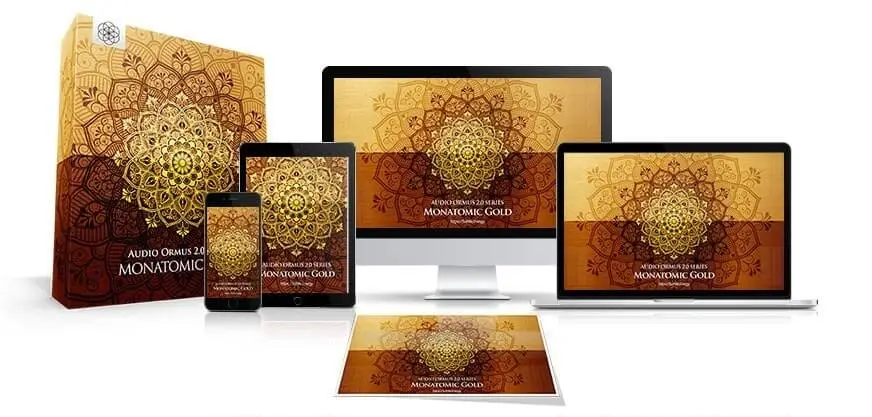
Meditation Tool #2: Monatomic Gold
Eric Thompson is the founder of Subtle Energy Sciences. (He was also the co-founder and Chief Technology Officer at iAwake Technologies and the creator of the Profound Meditation Program listed below.)
Using quantum resonance technology, Eric engineered a method of encoding digital images and sound files with specific energy signatures. The result is what he calls Digital Mandalas or Quantum Energy Apps, which combine beautiful digital art with layers of various energy-related signatures using quantum technology.
One of Subtle Energy Sciences’ most popular programs is called Monatomic Gold. The primary energetic signature in this digital mandala is derived from white powder gold, an unusual monatomic element (“ORMUS”) made famous by David Hudson.
Monatomic Gold is a comprehensive digital media program featuring ultra-amplified Quantum Energy Apps and accompanying audio files used during meditations.
Efficacy and Benefits
If you have “energetic sensitivity,” you’ll likely experience the effects fairly quickly.
If you don’t have energetic sensitivity, you may feel nothing at first. If that’s the case, Eric offers various ways to augment and optimize the effects.
The reported benefits of using Monatomic Gold include:
- Increase in focus and memory
- Improved physical and mental energy
- Enhanced healing and immune function
- Calms and balances the emotions
- Elevates your mood
- Helps provide deeper meditation
Long-term users even report experiencing mystical phenomena while using Monatomic Gold.
Best Used For
SES’s Monatomic Gold is a unique meditation technology worth experimenting with if you want to explore a different way to augment your existing sitting or standing practice.
It’s a solid overall meditation tool that you can use for sitting meditation, and you can also keep it on in the background while you work.
If you’re open to exploring new technologies, check out Monatomic Gold.
Use code CEOSAGE30 for a 30% discount on Monatomic Gold.

Meditation Tool #3: Muse Headband
Overview
The Muse Headband is perhaps the most popular meditation tool among biohackers. The Muse Headband helps train your brain for mindfulness by giving you sound cues of the electrical activity (EEG) of your brain while you meditate.
You wear the Muse around your forehead from ear to ear. Via Bluetooth, the Muse sends the signal to the Muse app on your smartphone. The app gives you real-time feedback (via various soundscapes) through your headphones. The more you quiet your mind, the calmer the soundscape becomes.
With this form of biofeedback, you’ll be able to track your progress with mindfulness training.
Additional Comments
While I’ve seen the Muse Headband in a live demo, I don’t own or use one. I try to avoid Bluetooth and wireless technology (including a cell phone) due to my sensitivity to electromagnetic frequencies. But many people use Muse, and if you’re not concerned about EMF, this product is probably worth trying out.
Efficacy
While I can’t speak to extensive direct experience with this, I’ve been told that it does produce positive results. By practicing with the Muse headband, you’re likely to notice greater awareness in a short time.
That is, you’ll become more conscious of when your mind begins to wander, enabling you to bring yourself back to the present moment.
Best Used For
If you like the idea of “gamifying” your meditation, and want to get real-time feedback as you meditate.
Use this link to get an automatic 20% discount on your Muse purchase.

Meditation Tool #4: Inner Balance Coherence Plus by The Heartmath Institute
Overview
Heartmath Institute studies the science of the human heart. They pioneered a means of measuring what’s called personal coherence, the synchronization of physical, mental, and emotional systems. Personal coherence is calculated by a combination of heart rate variability, pulse transit time, and respiratory patterns.
The Inner Balance Coherence Plus measures these variables with a sensor clipped onto your ear or with the thumb sensor on the device. You can use it as a portable tool, but you’ll get the most benefit by hooking it up to your computer and using it in conjunction with the accompanying software.
Additional Comments
Using HeartMath’s Quick Coherence Technique with the emWave2 attached sensor, the device measures your coherence as you attempt to steady your breath while holding a positive emotion directed at your heart.
Efficacy
As your ability to maintain coherence improves, you can increase the level of difficulty. Ten minutes a day is sufficient to increase your coherence score. It’s a worthwhile meditation tool for internal training.
Best Used For
The latest version of this meditation tool from Heartmath is called Inner Balance™ Coherence Plus. (It’s more “modernized” than the one I own, called emWave2.)
Either one of these meditation tools is helpful if you want to practice more heart-based meditations and get real-time feedback on your breathing and heart rate.
Check out Inner Balance™ Coherence Plus

Meditation Tool #5: Kasina by Mindplace
Overview
While studies on brainwave entrainment are intriguing, research indicates that light may influence the brain more than sound waves. At least about specific physical symptoms, research by Dave Siever suggests that light frequencies have a greater impact on the brain than soundwave technology.1https://mindalive.com/pages/research-articles-by-dave-siever
Regardless, there’s no reason to choose one over the other. The Kasina Mind Media System combines both modalities. You wear a headset and special glasses with embedded LED lights. This meditation tool comes with six categories that target different experiences: Accelerate, Meditate, Mind Art, Rejuvenate, Night Voyage, and Trance.
After you select the program category and your desired track (descriptions of each are included in the manual), you simply lie back (or sit up) and enjoy the show.
Additional Comments
Using Kasina is like having a personal laser light show. It’s perhaps the closest you can get to a psychedelic experience without taking a mind-altering substance.
Efficacy
Useful in triggering altered states of consciousness. It’s one of the best meditation tools that few people seem to know about. And if you’re a techie, the application is highly customizable, so you can build custom tracks.
Best Used For
If you want to explore the “mind-altering” side of meditation. Also, if you have a lot of resistance to meditation or have trouble quieting your mind, Kasina might be a good option for you.
3 Additional Meditation Tools
The following meditation tools can also help improve your overall meditation experience:

1 – QuietComfort Noise-Cancelling Headphones
Meditation is challenging for two reasons: external distractions and internal chatter. While Profound Meditation 3.0 and Kasina help reduce internal chatter, a noise-canceling headset helps reduce external distractions.
Wearing a Bose noise-canceling headset is like lowering the volume on the world around you. If you listen to any binaural beats, isochronic tones, or meditation music, this headset will definitely enhance your experience. I also use this headset whenever I really need to focus on a project. They’re great for air travel as they block out most of the plane engine’s rumble.
While you can find less expensive noise-canceling headsets on the market, in my experience, none of them are as effective as this one. It simply works. I keep one near my desk most of the time.
(Note: now, Bose is wireless, but it should still come with a cord if you want to deactivate Bluetooth.)
2 – Buckwheat Meditation Cushion
One reason I mentioned that many people struggle with meditation is due to poor physical alignment. I recommend sitting at the edge of a hard chair when you’re first getting started. But if you prefer to sit on the ground (which has numerous other benefits), then using a zafu can help.
To maintain proper structure alignment, you want only your coccyx region elevated. Any 2-inch or so basic meditation with a cotton cover serves this purpose. Something like this one.

3 – Insight Meditation Timer
This is a very well-designed meditation timer app for your phone. It’s highly customizable, allowing you to create various kinds of intervals and use different meditative gong sounds.
I used this app daily for years (when I used a phone). It’s very helpful when you’re doing various types of meditation where you want reminder tones every five minutes or so. I used it for Zhan Zhuang standing practices, too.
You can download it for free here. (I think a lot of the customizations are with the paid version.)
How to Use the Best Meditation Tools
All of the above meditation tools serve different functions.
For example, emWave2 and the Muse Headband give you real-time feedback.
Profound Meditation 3.0 and Kasina can help you reduce internal distractions and access deeper levels of meditation.
The Bose Noise-Cancelling Headset helps you reduce external distractions while amplifying the effects of meditation tools like Profound Meditation 3.0.
The buckwheat meditation cushion can help you maintain the correct meditative posture.
Enjoy!
Read Next
Best EMF Test Meters: A User-Friendly Review
Anti-Blue Light Glasses Benefits: Do They Really Work?
A Complete Guide to Red and Near Infrared (NIR) Light Therapy Devices
Do Grounding Mats Work? A Complete Review of the Best Earthing Mats