
OVERVIEW: This in-depth guide explores the biological dangers of artificial blue light, highlights blue light glasses benefits, and offers suggestions on how to use them.
______________
Artificial blue light is everywhere.
Our beloved devices are powered by blue-lit screens.
Most lighting in our homes, offices, and streets also emits this artificial blue light.
There are genuine and well-documented health risks associated with exposure to artificial blue light.
Do blue light glasses offer a solution?
What are the benefits of anti-blue light glasses?
Can they help us mitigate the harmful effects of artificial blue light?
Let’s dive in …
What is Blue Light?
Each wavelength of light in the electromagnetic spectrum affects our biology differently.
For example, blue wavelengths from natural light are beneficial during daylight hours.
Natural blue light from the sun:
- Improves attention
- Increases reaction time1https://www.sciencedaily.com/releases/2016/06/160610094747.htm
- Boosts energy
- Enhances mood
- Helps fight fatigue2Shadab A. Rahman, Erin E. Flynn-Evans, Daniel Aeschbach, George C. Brainard, Charles A. Czeisler, Steven W. Lockley. Diurnal Spectral Sensitivity of the Acute Alerting Effects of Light. SLEEP, 2014; DOI: 10.5665/sleep.3396
All of these things support proper functioning and performance. The blue wavelengths from the sun are crucial for our physical, mental, and emotional well-being.
But as we’ll see below, artificial blue light—especially in the evening—has many harmful effects.

Visible Spectrum
Artificial Blue Light
Therefore, blue light from the natural visible light spectrum is not the problem itself.
The problem is that human biology is only designed to receive exposure to blue and green light during the day.
After sundown, our exposure to blue light comes from artificial sources.
Primary sources of artificial blue light are:
- Smartphone screens
- Computer monitors
- Television screens
- LED, CFL, and fluorescent bulbs
Virtually every modern device with a display has a blue-lit screen. These screens, combined with artificial lighting, are the chief offenders of artificial blue light.
The problem is exacerbated because these devices and lighting are not full-spectrum. That is, they are powered primarily by harmful blue light to the exclusion of other wavelengths (for example, red and NIR light).
For this reason, incandescent and halogen light bulbs are far better for our health than LED or fluorescent bulbs.
The Real Dangers of Artificial Blue Light Exposure
A growing body of research links blue light exposure to various health risks.
How Artificial Blue Light Affects Sleep
Blue light causes the pineal gland to suppress melatonin production for up to four hours, impacting our sleep cycles.
One Harvard study compared the effects of 6 1/2 hours of blue light and green light exposure.3Blue light has a dark side, 2020. https://www.health.harvard.edu/staying-healthy/blue-light-has-a-dark-side
They found that blue light suppresses melatonin twice as long as green light, shifting circadian rhythms by twice as much (3 hours versus 1 1/2 hours).
In essence, artificial blue light disrupts the circadian rhythm (body clock), which then influences virtually every other system in the body.
Poor sleep, in general, is linked to:
- Heart disease4Cappuccio FP, Cooper D, D’Elia L, Strazzullo P, Miller MA. Sleep duration predicts cardiovascular outcomes: a systematic review and meta-analysis of prospective studies. Eur Heart J. 2011 Jun;32(12):1484-92. doi: 10.1093/eurheartj/ehr007.
- Depression5Zhai L, Zhang H, Zhang D. SLEEP DURATION AND DEPRESSION AMONG ADULTS: A META-ANALYSIS OF PROSPECTIVE STUDIES. Depression and Anxiety. 2015 Sep;32(9):664-70. doi: 10.1002/da.22386.
- Type-2 diabetes6Cappuccio FP, D’Elia L, Strazzullo P, Miller MA. Quantity and quality of sleep and incidence of type 2 diabetes: a systematic review and meta-analysis. Diabetes Care. 2010 Feb;33(2):414-20. doi: 10.2337/dc09-1124.
- Bipolar disorder in kids7BioMed Central. “Faulty body clock may make kids bipolar.” ScienceDaily, 13 November 2009. www.sciencedaily.com/releases/2009/11/091111200213.htm.
- Higher risks of breast cancer8Chunla He, Sonia Taj Anand, Mark H. Ebell, John E. Vena, Sara Wagner Robb. Circadian disrupting exposures and breast cancer risk: a meta-analysis. International Archives of Occupational and Environmental Health, 2014; DOI: 10.1007/s00420-014-0986-x
- Accelerated blindness9Kasun Ratnayake, John L. Payton, O. Harshana Lakmal, Ajith Karunarathne. Blue light excited retinal intercepts cellular signaling. Scientific Reports, 2018; 8 (1) DOI: 10.1038/s41598-018-28254-8
Without question, high-quality sleep is important.
Other Harmful Effects of Blue Light Exposure
Other documented consequences of prolonged blue light exposure include:
- General increased cancer risks (melatonin reduces the risk of cancer-related death)10Mills E, Wu P, Seely D, Guyatt G. Melatonin in the treatment of cancer: a systematic review of randomized controlled trials and meta-analysis. J Pineal Res. 2005 Nov;39(4):360-6. doi: 10.1111/j.1600-079X.2005.00258.x. PMID: 16207291.
- Diabetes risks (blue light messes with blood pressure)11Joshua Gooley et al. Exposure to room light prior to bedtime suppresses melatonin onset and shortens melatonin duration in humans. JCEM, March 2011
- Increased hunger/obesity (blue light disrupts our metabolism)12American Academy of Sleep Medicine. “Evening blue light exposure linked to increased hunger.” ScienceDaily, 2 June 2014. www.sciencedaily.com/releases/2014/06/140602115916.htm.
- Accelerated aging13Trevor R. Nash, Et Al. Daily blue-light exposure shortens lifespan and causes brain neurodegeneration in Drosophila. npj Aging and Mechanisms of Disease, 2019 DOI: 10.1038/s41514-019-0038-6
- Eye strain and fatigue
- Eye discomfort from dry eyes
- Retinal damage
- Blurred vision
- Headaches
- Fatigue
Ultimately, artificial blue light from digital devices reduces sleep quality.14Lisa A. Ostrin, Kaleb S. Abbott, Hope M. Queener. Attenuation of short wavelengths alters sleep and the ipRGC pupil response. Ophthalmic and Physiological Optics, 2017; 37 (4): 440 DOI: 10.1111/opo.12385
Because blue light suppresses melatonin and disrupts the circadian rhythm, it affects healthy bodily functioning, particularly sleep patterns.

What are Anti-Blue Light Glasses?
Blue light glasses are a misnomer.
Generally, when someone says “blue light glasses,” they mean blue light-blocking glasses or anti-blue light glasses.
Blue light glasses block or filter out blue light produced by electronic devices and artificial lighting.
Blue light-blocking glasses often have red or amber lenses and are, therefore, also called “amber glasses.” However, the lens can also be relatively clear or yellow, depending on how much of the visible spectrum the glasses filter.
Due to the growing awareness of the harmful effects of artificial blue light, numerous companies have emerged to offer solutions.
There is a wide range of blue light-blocking glasses, but not all of them are equal. Some glasses are more effective at filtering blue light than others.
Well-constructed anti-blue light glasses prevent blue and green light from entering your eyes. Evening eyewear should block at least 99% of all blue light.
6 Documented Anti-Blue Light Glasses Benefits
For over 15 years, blue light glasses have been a mainstay in the biohacking community—and for good reason!
As neurosurgeon Jack Kruse explains,
Blue blocking glasses are essential in modern society—nobody should be without [them], unless you’re living far away from civilization.
Here are some of the potential blue light glasses benefits documented thus far:
- Enables melatonin production
- Improves sleep and workday productivity
- Reduces ADHD and manic symptoms
- Provide insomnia relief
- Reduces eye fatigue
- Restores circadian rhythm
Let’s take a closer look at each of these blue light glasses’ benefits:
Enables Melatonin Production
Blue Light Glasses Benefit
As we saw above, exposure to artificial blue light inhibits melatonin production, negatively influencing our sleep.
Studies show that blue light glasses block the capacity of artificial light to suppress melatonin production.15Sasseville A, Paquet N, Sévigny J, Hébert M. Blue blocker glasses impede the capacity of bright light to suppress melatonin production. J Pineal Res. 2006 Aug;41(1):73-8.
Arguably, this alone is a valid reason to wear them.
Improves Sleep & Workday Productivity
Blue Light Glasses Benefit
Researchers at Indiana University Kelley School of Business found that blue light glasses improve employee sleep and workday productivity.16Cristiano L. Guarana, Christopher M. Barnes, Wei Jee Ong. The effects of blue-light filtration on sleep and work outcomes. Journal of Applied Psychology, 2020; DOI: 10.1037/apl0000806
They collected data from 63 company managers and 67 call center representatives randomly selected to wear blue light glasses or placebo glasses.
They found that anti-blue light glasses had the most significant effects on “night owls.”
In general, the effects of wearing blue-light-filtering glasses were stronger for ‘night owls’ than for ‘morning larks’. Owls tend to have sleep periods later in the day, whereas larks tend to have sleep periods early in the day. Although most of us can benefit from reducing our exposure to blue light, owl employees seem to benefit more because they encounter greater misalignments between their internal clock and the externally controlled work time.
These researchers received no compensation for this research. Swanwick donated the blue light glasses for this experiment.
Reduces ADHD and Manic Symptoms
Blue Light Glasses Benefit
Scientists at John Carroll University, working with Lighting Innovations Institute, developed blue-blocking glasses they claim can alter a person’s circadian rhythm, improve sleep disorders, and reduce ADHD symptoms.17https://www.jcu.edu/news-center/john-carroll-university-scientists-improve-adhd-symptoms-and-sleep-disorders-blue
The details of this particular study were scarce, and given that one of the researchers owns an anti-blue light company, the study may be biased. However, logically speaking, I do suspect that blue light glasses can reduce ADHD symptoms.
In fact, another study showed that amber-tinted glasses can reduce manic symptoms (from bipolar disorder) in just 3 days.18Henriksen, T. E., Et Al. (2016). Blue-blocking glasses as additive treatment for mania: A randomized placebo-controlled trial. Bipolar Disorders, 18(3), 221-232. https://doi.org/10.1111/bdi.12390
Provides Insomnia Relief
Blue Light Glasses Benefit
In a small study conducted at Columbia University Medical Center, researchers had participants wear amber-tinted glasses for seven consecutive nights for two hours before bedtime.19Ari Shechter, Elijah Wookhyun Kim, Marie-Pierre St-Onge, Andrew J. Westwood. Blocking nocturnal blue light for insomnia: A randomized controlled trial. Journal of Psychiatric Research, 2018; 96: 196 DOI: 10.1016/j.jpsychires.2017.10.015 A control group wore clear lenses (as a placebo).
They found that participants who wore amber-tinted glasses slept an extra 30 minutes compared to the control group. These participants reported greater quality, duration, and soundness of sleep.
Reduces Eye Fatigue
Blue Light Glasses Benefit
A small study involving 36 participants was conducted to determine whether wearing anti-blue light glasses during computer tasks reduces visual fatigue. 20Jonathan B. Lin, Blair W. Gerratt, Carl J. Bassi, Rajendra S. Apte; Short-Wavelength Light-Blocking Eyeglasses Attenuate Symptoms of Eye Fatigue. Invest. Ophthalmol. Vis. Sci. 2017;58(1):442-447. https://doi.org/10.1167/iovs.16-20663.
The subjects were randomized into high-blocking glasses and no-blocking placebo glasses. A masked grader measured critical flicker fusion frequency (CFF) to evaluate eye fatigue and eye strain while participants performed two hours of computer tasks.
They found that the blue light glasses group experienced far less eye fatigue. Participants in this group also reported significantly less eye-related pain and itchiness compared to the control group.
Restores Circadian Rhythm
Blue Light Glasses Benefit
The above studies suggest that anti-blue light glasses reduce exposure to artificial blue light. With reduced exposure, the pineal gland’s production of melatonin is less inhibited.
Essentially, blue light glasses help mitigate the harmful effects of artificial blue light from digital devices, televisions, and indoor lighting (especially LED, CFL, and fluorescent bulbs).
Consequently, the circadian rhythm (the body’s clock) can be restored, leading to improved sleep, better cognitive functioning, and many other demonstrable benefits.
Current Research Limitations on Blue Light Glasses
Like so many topics, if you want to find research for or against something, you can. Available studies have limitations. For example:
- What’s the intention of the researchers? What are their biases? Are they trying to approve or disprove the efficacy of anti-blue light glasses?
- What brand of anti-blue light glasses are they using on their test subjects? Not all blue light glasses are equal. How much blue and green light is filtered out in these studies?
- What are the specific conditions of the individuals in these studies? How many hours do they spend in front of screens and are exposed to artificial blue light daily?
These studies also have a relatively small sample size. I’m not aware of any large-scale studies that have determined the potential benefits of anti-blue light glasses.
As such, you can find a meta-analysis of available research, like this one, that suggests blue light glasses don’t improve visual performance, sleep, or eye health in adults.
Conversely, research, like all the studies listed above, suggests that it does help with sleep and eye health.
Ultimately, you’ll need to test it for yourself: wear a high-quality pair of anti-blue-light glasses for at least three weeks and see if you notice any differences. (I share my experiences at the end of this guide.)

How to Select Anti-Blue Light Glasses
When I purchased my first pair of blue light-blocking glasses, there weren’t many options on the market.
Significant changes have occurred in the last 15+ years.
As more people become aware of the damaging effects of artificial blue light exposure, the market for products grows to meet the demand.
The challenge is that not all anti-blue light glasses are the same. Also, many brands don’t quote precisely how much blue light their eyewear filters.
According to Charles Czeisler, M.D., chief of the Division of Sleep and Circadian Disorders at Brigham and Women’s Hospital in Boston, evening glasses should block almost all blue light to be effective.
Many inexpensive knock-off brands available on Amazon make false claims about their glasses, which are often rebuffed by customers who test them for themselves.
Additionally, many poorly made glasses reflect the light from monitors, which can affect vision. (In contrast, quality blue-light glasses have anti-reflective lenses.)
Understanding the Visible Electromagnetic Spectrum
Our eyes are sensitive to a small region of the visible spectrum.
- Visible light corresponds to a wavelength of 400 to 700 nanometers (nm).
- Visible blue light (merging into green) has a wavelength from about 400 to 510 nm.
- The most disruptive range of blue light is between 450 to 510 nm.
The 450 nm to 510 nm range signals its “daytime” to the circadian system. So for the glasses to be effective, they must completely block out this range.
Theoretically, the later in the evening, the further you are past sunset, the more blue light you want your glasses to filter.
Two Categories of Blue Light Blocking Glasses
As such, we can segment anti-blue light glasses into two categories:
- Daytime glasses that reduce artificial blue light exposure. These glasses are generally tinted yellow.
- Evening, twilight, or sunset glasses that ideally block ALL blue and most green light. These glasses tend to be reddish-amber.
Both glasses categories serve their purpose. I wear daytime glasses when I’m on the computer during the day and switch to sunset glasses in the evening.
Excellent Options for Anti-Blue Light Glasses
Over the last decade, I’ve purchased (and been given) numerous anti-blue light glasses to experiment with and use.
Let’s look at some excellent available options…
Disclaimer: The glasses recommended below have affiliate links. This does not affect what you pay at all. In most cases, you can use the discount codes provided below for additional savings.

The Original Night Shades by Spectra479
One of my favorites is the Spectra479 glasses. These amber-tinted glasses are tested to block 100% of light from the 280-490 nm range and 99.9% of light from the critical 450-510 nm range. They also say they block 80% of the green light.
Spectra479 is an excellent choice if you’re starting with blue light-blocking glasses.
These amber glasses are made with somewhat durable and lightweight TR90 thermoplastic frames. Plus, they wrap around your head, which means they block more blue light from the sides. At least in my case, they fit very comfortably.
They are not “high design,” but they are effective and cost significantly less than other options. (However, the frame and lens aren’t the same quality as the other options listed below.)
Spectra479 offers prescription and non-prescription options.
Use code CEOSAGE for a 15% discount on Spectra479 glasses.

Day-Time & Sunset Glasses by Ra Optics
Many blue light-blocking glasses on the market resemble computer or laboratory glasses, which may not be your preferred style.
In this case, Ra Optics designs a line of high-quality, stylish, attractive, and comfortable blue light blockers.
Ra Optics lenses are of exceptionally high quality and extremely lightweight. Their nighttime lenses reportedly block 100% of harmful artificial blue and green light, while their daytime lenses block 95% of blue light.
Ra Optics utilizes the highest-quality CR-39 polymer lenses. They are scratch-proof and shatter-resistant.
They also offer options for prescription reading glasses.
Ra Optics makes extremely comfortable glasses. I wear both their daytime and nighttime glasses. These have become my go-to glasses, which I wear often.
Jack Kruse also recommends Ra Optics.
Use this link to save 10% on all Ra Optics glasses.

Twilight Classic by TrueDark
TrueDark is one of Dave Asprey’s companies. Known as the “Bulletproof coffee” guy, Asprey is a popular biohacker and the author of Head Strong, highlighting the harmful effects of artificial blue light and “junk light.”
These patent-pending glasses claim to be the “only solution on the market that goes beyond a simple blue light filter to cover all of the ‘junk light’ spectrum that impacts sleep and performance, including greens and yellows.”
TrueDark Twilight Classic glasses reportedly block 99% of the wavelengths associated with blue, green, and violet light.
You only wear TrueDark Twilight for the last 30 minutes before sleeping. They reportedly block 100% of the light wavelengths from 380nm to 500nm.
Of all the anti-blue light glasses I’ve experimented with, these provide the most intense experience. You can feel the effects almost right away. If you travel and are prone to jet lag, these glasses may help alleviate your symptoms.
Use code CEOSAGE for a 10% discount on all TrueDark glasses (and get free shipping).

Classic Night Swannies by Swanwick
Swanwick has been in the blue light glasses business since 2015. They make quality glasses and have put them to the test.
Night Swannies have been independently and scientifically validated for their efficacy by several studies.
Swanwick’s Classic Night Swannies reportedly block 99 to 100% of blue light. Their glasses are made with prescription-grade (CR-39) lenses and BPA-free acetate frames.
Swanwick offers a wide range of daytime and evening anti-blue light glasses.
How to Test Your Anti-Blue Light Glasses Work
The best way to test anti-blue light glasses is to conduct a spectral transmission test. However, here’s a somewhat adequate test for personal home use.
This test from Siriya Mitsattha provides one way to determine if your glasses are filtering blue light.
For best results, be sure to turn up the brightness on your screen.
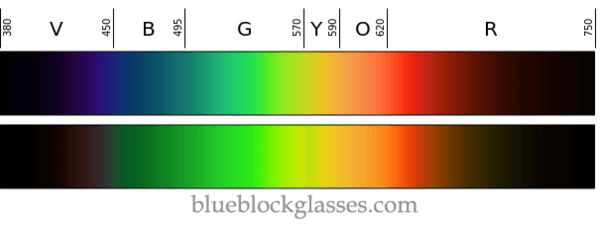
When you look at these two strips of the colored spectrum with the naked eye, you’ll notice they are different.
The top light wavelength spectrum is the common one.
The bottom light spectrum is different from about 520 nanometers down. There is no visible blue light.

However, when you look at these two spectrums with your blue light glasses, they should appear identical.
My Personal Experience Wearing Blue Light Glasses
The available research on the efficacy and benefits of wearing anti-blue light glasses is one thing; the experience of wearing them is another.
Many therapeutic devices and apparatuses on the market have persuasive marketing, but when you use them, you don’t necessarily experience any results or notice any differences, especially in the beginning.
This was not my experience with blue light glasses. I’ve been wearing various blue light-filtering glasses for over a decade.
As a writer and active researcher, I spend many hours gazing at a screen.
I always try to balance screen time with the outdoors. I consciously take many breaks, and I periodically gaze out the window to avoid eye strain.
I also keep my monitor at the lowest brightness setting possible and use an additional blue light filter app called Iris. (Highly recommend it.)
Even still, when I first put on a pair of anti-blue light glasses, I immediately felt the effects. It was as if my brain took a deep breath, and my entire body sighed in relief.
Almost immediately, I noticed a change in my sleeping patterns. I was no longer wired before sleeping. Instead, relaxation came more effortlessly, as did the natural transition from waking to sleeping.
I can’t say this will be your experience, as everyone is a “random sample of 1.”
However, I encourage everyone to try and experiment with a pair of anti-blue light glasses for themselves.
Read Next
How to Block Blue Light to Restore Your Circadian Rhythm and Improve Sleep
A Complete Guide to Red and Near Infrared (NIR) Light Therapy Devices